Saturday, 29 March 2014

Beakers were for Beer! part one: ale, mead & residues

Beakers were for beer. I was told this back in 1995, in my final year as an archaeology undergraduate. There was absolutely no doubt about this, or so it seemed at the time. I made a note to look further into the idea. This was when my interest in ancient brewing techniques began. I had never thought about it before, but, being married to a home brewer of fine ales, made from all grain, I was intrigued. He would carry a 25 kilogram sack of crushed malt from the Brewing Supplies shop into the house, and then after about a week, he would have made us some excellent beer. A 25 kilo sack of malt would make 4 brews of 8 or 9 gallons each. Yes, I'm mixing Imperial and Metric but I am not bothered about that. The point is that you can make plenty of beer from 25 kilos of malt.

How did those Bronze Age folk, living in Britain around 4000 years ago, make their beer? I asked several people in the Archaeology Department but nobody seemed to know. They all thought I was crazy, looking for the archaeological evidence of beer brewing. You won't find anything, they said.

A paper was cited by the lecturer: Burgess and Shennan: The Beaker Phenomenon: some suggestions. It had been presented at a conference "Settlement and economy in the third and second millennia BC" and the proceedings were published in 1976 as a British Archaeological Report (BAR 33). It is cited in dozens, if not hundreds of academic bibliographies about the Bronze Age of the British Isles. It has become a classic paper, but it is not easy to find unless you have access to a University Library. That is to say that I have not managed to find access to a copy online.

One of the arguments of the paper was that Beakers were made specially for the drinking of beer. They proposed that a warrior cult existed in Bronze Age Britain, with some people buried with grave goods that reflected their prestige, high status and lifestyle. Grave goods often included a drinking vessel - a finely made and decorated pottery 'beaker' from which they drank their beer. No archaeological evidence, such as residue analysis, was presented in the paper.

The Amesbury Archer, referred to by the media as the 'King' of Stonehenge was considered to have been an important person and someone of high status, since he was buried with lots of grave goods, including five fine beakers, gold jewellery, the equipment for making metal and a slate wrist guard that hints at his prowess with a bow and arrows.

http://www.britishmuseum.org/collectionimages/AN00160/AN00160012_001_l.jpg
beaker from Hemp Knoll, Avebury

If beakers were for beer, then what is the archaeological evidence? Did it taste like the beer that we drink today? Who made it? Were the brewers men or women? What's the story?

Strictly speaking, when referring to prehistoric brewing from cereals, it should be called ale, not beer. What's the difference? Ale and beer are both made from malted grain - barley, wheat, oats or rye. Ale is preserved and flavoured with a variety of herbs, such as bog myrtle, heather, yarrow, juniper or meadowsweet. Beer is flavoured with hops which were introduced to the brewing process only recently, in medieval times. Spices can also be used. Today, we tend to use the terms 'ale' and 'beer' fairly indiscriminately.

For anyone interested in ancient ale, the discovery of cereal based residues on old pots has to be one of the most exciting things. Research was very different in those days. In the late 1990s the internet was in its' infancy. Internet search engines were a rare and wonderful thing, to be accessed by a few lucky academics. Charles Mount has written about how University research has changed over the last 20 years here. He is writing about University College Dublin, but the story is the same throughout UK Universities.

So, for me, my first research involved going to the John Rylands Library, looking through the card index systems, finding archaeology journals and reading lots of excavation reports. I spent many hours doing this. I started with the Proceedings of the Society of Antiquaries of Scotland, fondly known as the PSAS (now available online). It is an excellent resource. I soon stumbled on excavation reports that had some intriguing descriptions of cereal based residues on pottery, together with a detailed pollen analysis. Just what I was looking for.

cereal based residues on pottery
A couple of years after the Burgess and Shennan paper was published, a discovery was made in Fife, Scotland, that supported their thesis that beakers were for beer drinking in the Bronze Age. 

In 1978, excavations by a team led by Gordon Barclay at the site of a timber circle, bank and ditch (c2330 ± 60BC) at North Mains, Strathallan, Scotland, revealed several cist burials  In one of these, a female cist burial, there was a fine, complete Food Vessel with a deposit of organic material still adhering to the inner surface of the pot, after thousands of years. It was described as a 'black greasy material on the internal surfaces'. Such discoveries are extremely  rare.

The cist was situated in the centre of the timber circle. Fortunately, it had remained partially sealed, hence the unusual survival of the organic material. Analysis of the residues revealed high percentages of cereal pollen and meadowsweet pollen. It was interpreted as being the probable remains of a cereal based fermented drink. The radiocarbon date was 1540 ± 65BC. The analysis (below) is on pages 178 to 180 of the excavation report in PSAS Volume 113. The details are important and of interest to any all grain brewer. The 'human interference' that has introduced charcoal to and that is referred to might be the drying of malted grain, rather than parching harvested grain.

There is a Table on page 179 which gives the details and percentages of the pollen finds. Of course, I recommend reading the whole report, which can be downloaded from the PSAS website. That is because I really like to read the original excavation reports rather than secondhand interpretations. It is almost like being there! The descriptions of the pottery finds (between pages 155 and 163) are also informative.

When I showed this pollen analysis to my husband he said 'I can make that. I just need to replace the hops with some meadowsweet flowers.' And so our research into recreating ancient ales began.

POLLEN ANALYSIS OF DEPOSITS IN A FOOD VESSEL FROM THE HENGE MONUMENT, NORTH MAINS                         S Bohncke
INTRODUCTION
Burial B was accompanied by a food vessel (SF17), discovered lying on its side by the skull. Within the pot a small deposit of black greasy material was found. As the analysis of material within vessels has proved valuable (Dickson 1978) samples of this deposit and scrapings from the pot wall were subjected to pollen analysis. 


MATERIAL AND METHODS

Part of the black greasy material was used for the preparation of two pollen samples and another sample was scraped from the inner fabric of the pot. All samples were treated with hydrogen fluoride to remove the silaceous component and were subsequently subjected to Erdtman's acetolysis. Microscope slides were then prepared using glycerol jel as an embedding medium.
 

RESULT AND DISCUSSION 
High percentages of Filipendula (meadowsweet) pollen (74-1 %, 77-8%, 84% (scraping)) and relatively high percentages of cerealia pollen were noted. There was also a large proportion of charcoal fragments. Within the Filipendula grains there was a wide range of variation in the states of preservation. The well preserved type is the tricolpate micro echinate pollen in which the pores are clearly pouting. The very corroded type lacks the characteristic pores but the wall structure is not affected. Immature pollen was also present. Relatively high proportions of Filipendula can be attributed in part to selective corrosion as Filipendula has a relatively thick wall but this could not explain the 74-1-84% found in these samples.

Cereals are self pollinating, the result being that little pollen is dispersed into the air. The anthers remain within the spikelets so that on the fully grown cereal pollen grains could still be present, though most would be lost during the winnowing process. Compared with the other species the cereals are over represented in both samples. This is probably the result of human interference. The charcoal in the samples might have originated in the processing of the grain (eg roasting to remove chaff), however the cereal pollen were not burnt and this therefore seems unlikely. The charcoal may also have found its way into the pot during the burial ritual or have been in the pot already, perhaps as the result of firing a new vessel for the burial. The remaining pollen almost certainly came accidentally into the food vessel and represented a part of the contemporary pollen rain. The presence of pollen of plants flowering at different times of the year (eg Corylus March-April, Polypodium August-September) might be explained by the addition of pollen-bearing water to whatever was contained in the vessel or its incorporation in the manufacture of the contents.


Dickson (1978) in his analysis of the Ashgrove beaker scrapings discovered very high proportions of Tilia and Filipendula and concluded that the vessel had contained lime honey or mead flavoured with meadowsweet. The North Mains food vessel contained neither lime pollen nor sufficient pollen from other honey-producing plants. The 2-4-3-7% of Compositae pollen were not sufficient for a honey based on Compositae alone. The high proportion of cereal pollen grains might suggest either a porridge of cereals (eg frumenty) or a fermented ale, flavoured with meadowsweet flowers or extract. The name 'meadow-sweet' originates from mead-sweet as it was used to flavour mead and other drinks. It is distinctly possible therefore that the North Mains food vessel contained a fermented drink.

the Ashgrove beaker
Mention is made of the Ashgrove Beaker. This was found in an excavation of a Bronze Age cist burial by Audrey Henshall and was published in Antiquity in 1963. As well as the skeleton and a beaker, there was also a fine dagger. It seemed that the pot had fallen over, spilling its' contents on the floor of the cist. James Dickson analysed the residues in the 1970s and he also published his results in Antiquity.

Pollen analysis revealed large amounts of immature lime pollen and meadowsweet pollen, which was interpreted as the remains of mead but sadly, it was not radiocarbon-dated. Nor did they look for cereal residues. Ian Hornsey discusses the implications of this discovery in his book, The History of Beer.

my first article

These discoveries, and others, led me to write my first article about the archaeology of ancient ale, towards the end of 1996. Descriptions of residues on Grooved Ware pottery from the neolithic site of Balfarg are very similar to those found on Beaker pottery. It was beginning to look as if making ale from the grain was a Neolithic, not a Bronze Age phenomenon.

I was very pleased and proud to be the cover girl for BA19 and I have Simon Denison, the then editor of British Archaeology, to thank for that. He was interested in my work and very supportive.

The picture shows the Strathallan or North Mains food vessel, with meadowsweet flowers surrounding it. These flowers would have been the flavouring and preservative for the ale, the base of which would have been a wort made from crushed malted cereal - barley and/or wheat.


http://www.archaeologyuk.org/ba/ba19/ba19b.gif
Finding Magic in Stone Age Ale - my first article - you can read it here.

That's all for this blog - more than enough for you to be getting on with. I find it odd that in 2014, particularly in the UK, there seems to be a taboo surrounding any discussion by archaeologists of malt and ale in prehistory.

The evidence is there, if you know and understand what the brewing process is and what you have to look for in the archaeological record.

 *******************************************
... my next blog will be about the Egtved Girl's Brew, the residues of which were found in a birch bark bucket in her oak log coffin in Denmark ... there are some details here.

Please get in touch with me if you have made a beer based upon these residues, if you know of someone who has or if you have been lucky enough to taste one of these brews.

I know about the 'Nordic Grog' made by Dogfish Head Brewery, under the guidance of Professor Pat McGovern. It was recently marketed as Kvasir, named after a Nordic Princess. 

I want to hear about any real home brewers who have had a go at recreating it.


Thankyou! 
 ********************************************

further reading
Burgess, C. & Shennan, S. 1976. The Beaker Phenomenon: some suggestions. In Burgess, C Miket, R. (eds.)  Settlement and economy in the third and second millennia BC : papers delivered at a conference organised by the Department of Adult Education, University of Newcastle upon Tyne, B.A.R 33, Oxford, 309-331.

Barclay, G. (1984a) 'Sites of the third millenium BC to the first millenium AD at North Mains, Strathallan, Perthshire', Proceedings of the Society of Antiquaries of Scotland. Vol.113


Dickson, J. 1978 'Bronze age mead', Antiquity, 52 (1978), 108-13.


Tuesday, 11 February 2014

crushed malt v malt extract

Making your own beer at home is becoming a popular hobby. On the internet there are thousands of videos, web pages and blogs about beer and how to make beer. They vary from the basic through to complex, jargon filled technical descriptions. There are some funny ones too. And quite a lot of strange stuff. If you are interested, just search for a few choice phrases around the basic question of 'how to make home brewed beer' and you will find plenty to choose from. I have put a couple of my favourite web sites and books at the end of this blog.

It can be confusing, with extract brewing, extract brewing (with grain) and all-grain brewing, not to mention the many different styles of beer and ale that can be made. Home brewers often tend to have their own, sometimes idiosyncratic ways of beer brewing. However, it is all based upon the same basic principle - that grain can be easily converted into ale by the processes of malting, mashing and fermentation. Maltsters and brewers have been doing this for thousands of years.

I aim to demystify the whole beer brewing process through this blog, and also to share some of our adventures with making ancient style ales.

Here is our Juniper Yule Ale, just as it is beginning to ferment. We had made 6 gallons of wort and the big plastic fermentation bucket was very full. When the ferment took off it was so vigorous that there was not enough headroom in the fermenter. So we siphoned a gallon of wort into this demijohn and put an airlock on when it settled down. No sugar was added to this wort - it all came from the crushed malt in the mash tun.

our ancient ale, bubbling away in the kitchen ... magic.

There are two main ways to make beer at home. Use a brewing kit with malt extract, or go for the all grain brew. We don't use malt extract, although it is possible to make really good beer with it. We just prefer the flavour of all grain ale, and think that it is well worth the extra effort of making your own wort, then fermenting it. Traditional ingredients and techniques provide authentic flavours for ancient ales.

Crushed malt is the traditional ingredient for ale and beer. Any grain can be malted - wheat, barley, oats, millet and rye. Today, a bewildering variety of malts are available to the brewer and for every brew there is a grain bill. Also known as the 'mash ingredients' or the 'mash bill' by some brewers, it is the particular and specific mixture of crushed malts in the mash tun that create the colour, flavour and body of the resulting ale. The grain bill depends what you are brewing - bitter, porter, pale ale or stout for example.

For our juniper ale, we mashed 15 pounds of pale crushed malt as the base malt, together with eight ounces of crystal malt and eight ounces of roasted barley for colour and flavour. From this, we got 6 gallons of wort that was boiled with a few hops and a couple of ounces of crushed juniper berries and then fermented into ale.


It is important to crush the malt before putting it into the mash tun because this mixes up the grain starch with the enzymes that were activated during the malting process. Those breweries who use malt tend to buy their malt as whole grains, because it stores better, then they crush it in a grain mill before mashing. Crushed malt is also known as 'grist' and the photo shows some of the pale crushed malt that we use. You can see the grain husks.

Malt extract is thick and sweet, like syrup. It is widely used in the food processing industry. You probably eat some most days, since it can be found in cereals, sweets, ice cream, cakes and many other processed foods.

sweet sticky malt extract


Today many home brewers and some of the big brewing companies use concentrated malt extract to make their ale and beer. There is no need for a mash tun. All you need are boilers and fermentation vessels. The mashing has been done for you, in the factory. Grain processing companies mash huge amounts of crushed malt, extract the wort and then concentrate it, by boiling it in a partial vacuum, to keep the temperature down.

It is a food processing technique that was patented in the 1860s and was first used to make condensed milk. It was not long before the vacuum extraction method was used to make wort concentrate and it is now a powerful industry, with factories all over the world. Over the past ten to fifteen years, the number of breweries using malt extract instead of malt has increased. Given that it is concentrated wort and that it has been made on an industrial scale using equipment, techniques and technologies that have only been available since the late 19th Century, it is debatable whether or not malt extract is a suitable ingredient if you want to re create an authentic ancient ale. In Brew Your Own magazine, May/June 2008, there is a detailed description of how to make malt extract. A shorter description can be found here

I was looking for a video that would show how extract brewing works. There are hundreds, if not thousands of them. I chose this one. In September 2012, the news story broke that President Obama wanted beer to be brewed in the White House. They chose the malt extract method. The recipe included a small amount of specialist malts for flavour, but the main ingredients were liquid malt extract and dried malt extract, with some special White House honey and pelleted hops. This seems to be the way that many people make beer at home. But not everyone.

There are a lot of home brewers who still use malted grain. There are even some who make the malt themselves and crush it before putting it into their mash tun. There are others who want to make ales using traditional gruit herbs instead of hops, which were introduced in medieval times ... but more of gruit ales and traditional floor malting later. That is another story. For now, I just wanted to write a little about the difference between extract brewing and all grain brewing. And I think I have done that.


*********************************************************************

If you are interested in reading more ...

... our favourite brewing book is The Big Book of Brewing by David Line.
First published in the 1970s, it is still in print. Excellent explanations of how to mash at home and it has very good, clear instructions and recipes. He wrote another book Brewing Beers Like Those You Buy. Also an excellent set of recipes for all grain brewing. I am not sure that all of the breweries that made those beers and ales still exist. The brewing industry has changed a lot since then.

... our favourite brewing history book is Beer: The Story of the Pint by Martyn Cornell.
This book covers the prehistory and the history of beer brewing. I think it is out of print but available secondhand, or from your local library. Another fascinating read by the same author is Amber Gold and Black, a history of beer styles. Available from here: zythophile

This is a very detailed site that explains everything you might want ever to know about making malt, ale and beer: http://www.howtobrew.com

Here is a site that discusses the 'extract or grain' debate:
http://www.maltproducts.com/news.malt.extract.html

Sunday, 2 February 2014

jargon: the malt, the mash & what is wort

This blog was started last year but, for several reasons, I didn't keep it up. One thing that I found tricky was learning to understand the Jargon of the Blog Page. Over recent months, I have managed to get to grips with image editing software. I did that so I could copyright my photos. Now I have to work out how to do lots of other new things, like making tabs and all that stuff. I am slowly navigating my way through the 'construction' things and 'gadgets'. See what I mean? I'm not even sure how to explain what it is that I don't know what to do! 

I am not asking for help. I know that if I persevere, I will learn how to do this. Eventually. Sometimes you need to do something for yourself before you can say that you understand it. So far I have mastered quite a few 'computer things' and this blog is just another. 

The point I want to make is this: that every skilled activity uses jargon to explain the specialised knowledge, skills and tricks of the trade. Once you learn the vocabulary, the jargon, the particular methods and techniques it is relatively easy to do. But if you don't understand these things, then you can be faced with a very difficult task. Every ancient and traditional craft has its' jargon. Those of the maltster and brewer are no exception. 
  
the jargon of malting and brewing - well some of it anyway 
Much of the jargon used by maltsters and brewers can be misunderstood by non brewers. It can lead to some very odd conversations between brewer and non brewer. I once spent a long time talking to someone about the possible archaeological evidence for malt and ale, only to discover later that he believed that I was talking about whiskey and ale. I thought it was a strange conversation at the time. Below is a picture of part of what I was talking about. 

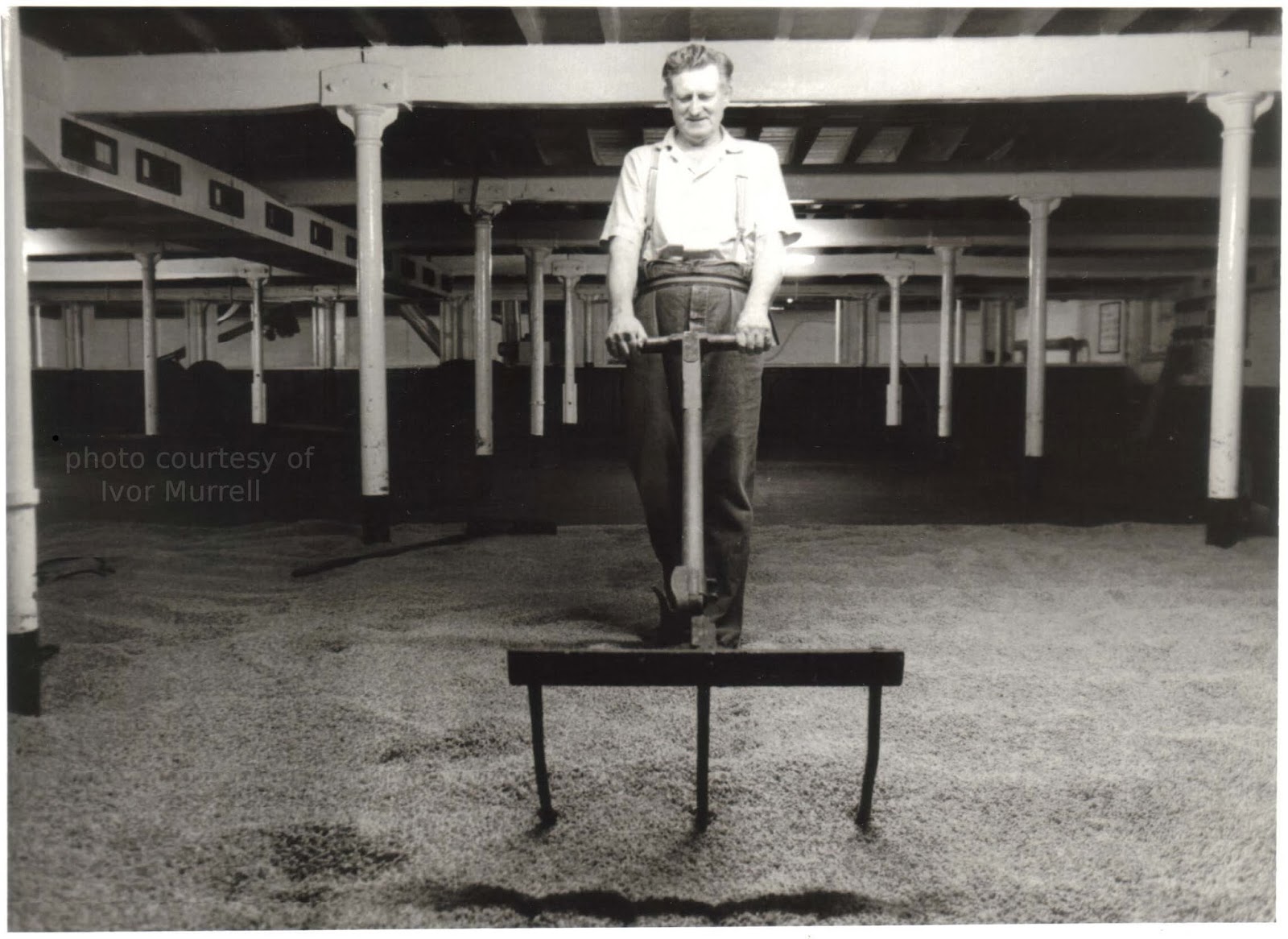
Traditional floor malting. Not one of my photos, this one was given to me by Ivor Murrell, who was Director General of the magb between 1993 and 2006. The malt is raked as it begins to germinate on the malting floor. 


I was talking about 'malt' as in malted barley, partially germinated grain, the prime ingredient for ale, beer, lager and also whiskey. Malt is grain that has been steeped in water, then it is spread out on a smooth floor in a dark, well ventilated building to begin to germinate. It must be raked and turned, to stop the rootlets from becoming matted together, before being carefully dried in a kiln. Malting is an ancient craft. A complex craft. One that probably dates back to the earliest grain processors of the Fertile Crescent, over ten thousand years ago.

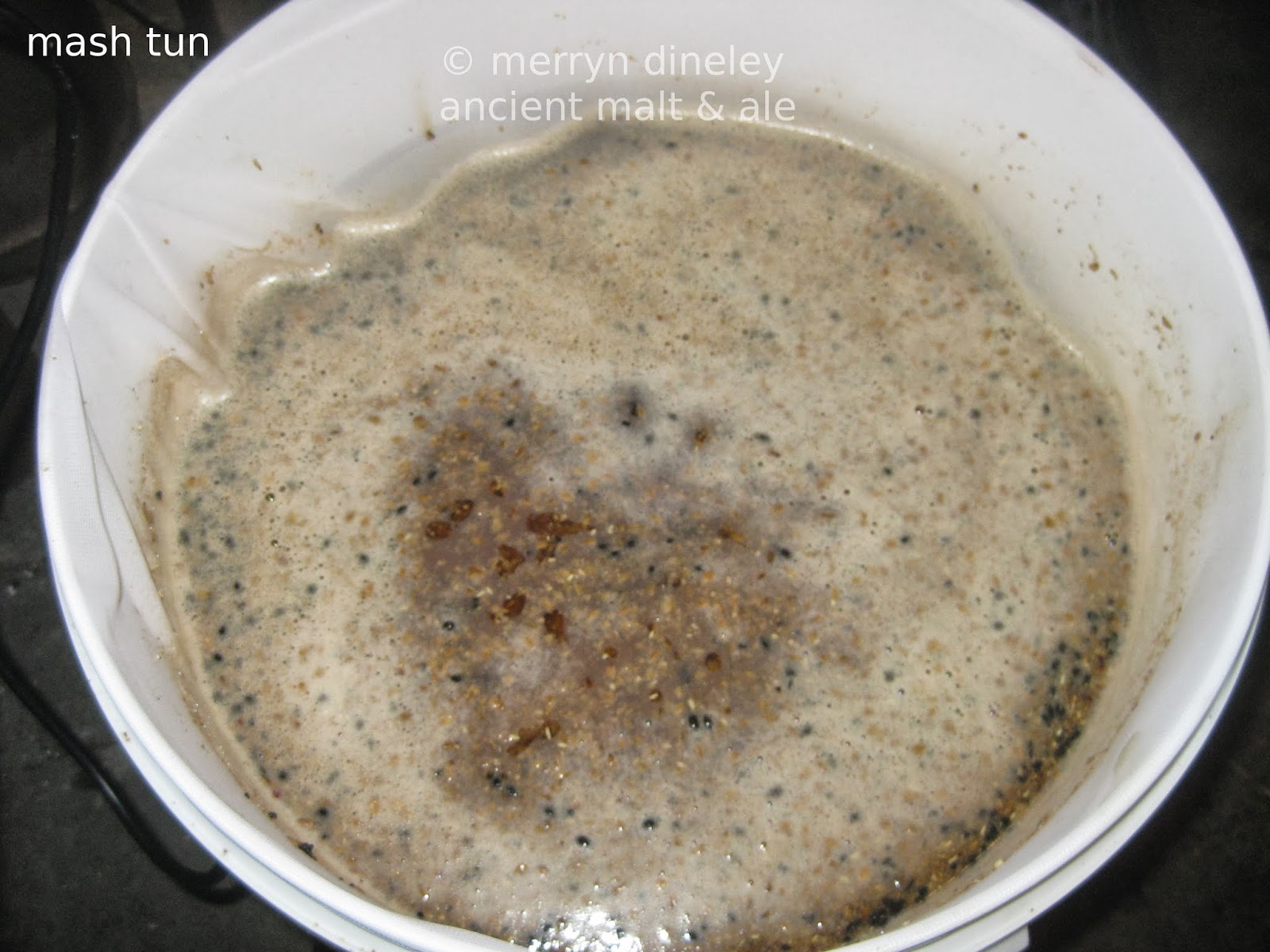
Another example of brewer's jargon is 'to mash' or as we call it in our garage brew house 'to run a mash'. We call it 'running a mash' because that's what it feels like. In modern breweries, the temperature of the water is regulated electronically. Or by computer. In our garage brew house, we have a simple mash tun that is heated by an electric element and you have to watch over it very carefully, turning it on and off as needs be. The mash tun is where the crushed malt is mixed with hot water (not too hot) and then left for about an hour. It is not like mashing potatoes. Nor is it like treading grapes ...

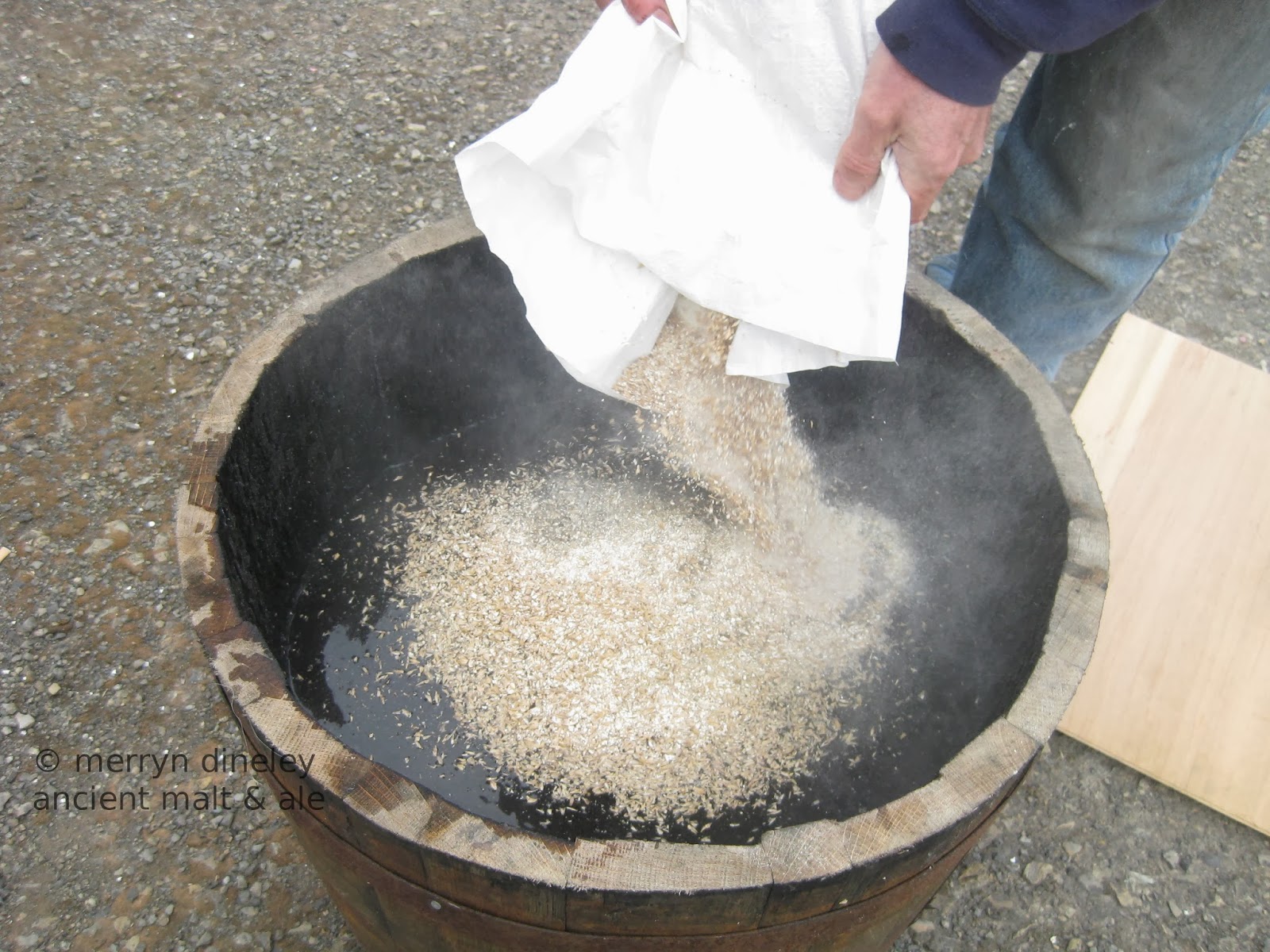
crushed malted barley is added to hot water in the mash tun

It is important to crush the malt before adding it to the hot water in the mash tun. We now know that, at temperatures between 65 and 67 degrees Centigrade, the enzymes (amylase) within the malt are reactivated in the hot water. They convert, transform or hydrolyse the grain starch into malt sugars. The technical term for this is the saccharification.This is what happens in every mash tun, whether it is a modern one heated by electricity or an old fashioned one, for example a cauldron heated by a fire or a wooden tub or trough heated by hot rocks. 


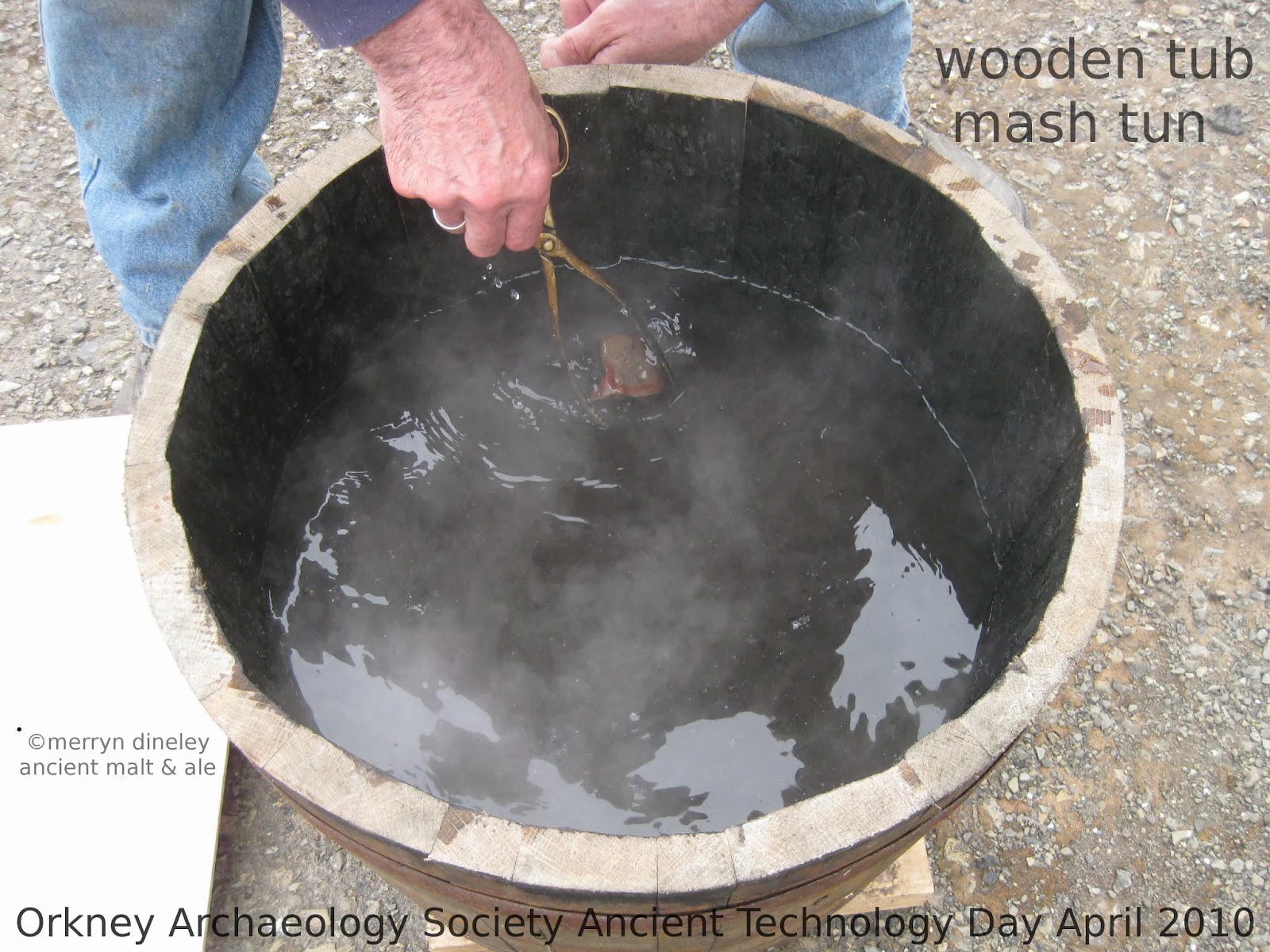
We ran a Viking style mash in a wooden tub and we got a good conversion of starch into sugars, using hot stones to heat the water and the mash. First of all, you have to heat the water to the correct temperature before you add the crushed malt. This is when you can see your face most clearly reflected in the hot water. Modern brewers use a thermometer. Before they were invented, brewers used this traditional technique, and it just so happens that, at 74 degrees Centigrade, the water becomes still enough to see a reflection. Hotter than that and it becomes too steamy to see anything. Cooler than that and the water surface is too 'bumpy'.


Add crushed malt to hot water, maintain the temperature for about an hour and then lauter and sparge to obtain a wort. This involves running off the sweet wort from the mash tun (lautering), collecting the wort in a clean jug. The cloudy wort is poured through the mash until it runs clear, and then you can sparge, by gently pouring hot water through the mash to obtain several gallons of wort (sparging). The grain itself acts as a filter. The wort is boiled with herbs or hops and then, when it is cool enough, yeast or barm is added which ferments the sugars into alcohol. Barm is the foam on the top of a fermenting beer and many craft breweries 'harvest' the barm and use it to start new fermentations.

We usually use about 13lb of pale crushed malt and we get 6 or 7 gallons of wort. Recently, we made a Juniper Ale for Yule, and we added a handful of berries, a couple of ounces or thereabouts, to the boil as well as the hops. There are some photos on my Facebook page here. We sent some bottles down to the Experimental Archaeology Conference, at Oxford University in January 2014 and there are some tasting notes here.

What is wort? Wort is the sweet, dark brown liquid from the mash tun. It is what the brewer ferments into ale or beer. It tastes very sweet and it is the primary fermentable sugar for either ale or beer. Oh, and whiskey as well. 


Well, that's all for now. There is so much to be said about malt, ale and beer in prehistory and in historical times that I am sure there will be more from me soon.

My published papers and my Master's Thesis, "Barley Malt and Ale in the Neolithic" which I did at Manchester University in 1998 are available as free downloads on my Academia.edu page. Here. It was published as a BAR (British Archaeological Report) in 2004.

Thursday, 9 May 2013

once upon a time ...

Once upon a time in the back garden, I started to do some archaeological grain processing experiments. It was the summer of 1995. I'd just finished an archaeology degree. Now I was enrolled on a master's degree course at Manchester University and I was beginning my investigations into how people may have made the ale in prehistory. 

In my final year as an undergraduate, I had chosen the British Neolithic and Bronze Age as my specialist subject. We were told that, in Bronze Age Britain- Beakers were for Beer! Warriors buried with wrist guards and bows and arrows and fine beaker pots for their ale! It got a laugh from the class, as any mention of beer and brewing seems to do. I'm still not sure why - but that was when I first began to wonder. "OK. So, how did they make it?" 

Being married to a craft brewer, I was used to living in a brew house. The sacks of crushed malt. The delicious aroma of the mash. The rituals. The water and wort spilled on the kitchen floor. Steam emanating from the out house door as he mashed the malt and boiled the wort. We lived in a big, old Victorian house and the dining room was where the beer was fermented. We had a cellar to keep it in. He would bring a sack of crushed malt in through the front door and transform it into beer. It was very good beer. It was a fairly simple process.

I spent months hunting around the John Rylands Library for any reference, anything at all, in the rows of archaeology books about prehistoric Britain for anything to do with
malt
ale
beer
brewing
maltster
barley
malting floor
etc etc etc ???

I found nothing about how ale was made. Anywhere. There's my research topic, I thought.
How did they make the ale in Bronze Age Britain? All the paper work was done, I was accepted as a Post Graduate student and I got a desk - nothing else, just a desk. In the late 1990s there were just a handful of computers in the Archaeology & Art History Department. None at all in the John Rylands University Library. But plenty of books, journals and excavation reports. So I applied myself to reading excavation reports and to understanding how ale is made. 

With three young children, it was always going to take a while. It would always be part time.

 Within a couple of months, reading about the organic residues described in excavation reports that had been identified on both Bronze Age Beakers and Neolithic Grooved Ware pottery, I realised that brewing might perhaps be a neolithic thing ... but more of that  particular excitement another time. 

To make ale from the grain, you must transform it into sugars. Sugar ferments into alcohol, we all know that. The transformation of cereal into alcohol is done by heating up crushed malt with water to make a wort. That is what craft brewers do. But I had to use equipment that would have been available to a Bronze Age or a Neolithic brewer.

So, all I needed was some crushed malt, an earthenware bowl and a fire. I took some of the household brewing ingredient - Maris Otter Pale Crushed Malt. I went to the local garden centre and bought an earthenware bowl. The bowl was heated, and sealed with beeswax. 

Making a small hearth and a fire, I put some crushed pale malt into the bowl and let it gently heat up on the warm ashes. At first the mixture was starchy and white. Here's a photo:

starting the first mash - crushed pale malt, water, warm ashes


After about half an hour, it began to turn golden brown and there was that familiar aroma of the mash. The liquid in the bowl began to taste sweet. I was making malt sugars. Then, I mixed up some crushed malt and water into a slightly thicker mixture and put it on the flat stone by the fire. The stone had become quite warm by now. If I sprinkled water on the "barley malt cakes" they began to change colour and become golden brown.Here is a photo:

my first mash in the bowl - my first "barley malt cakes" on a hot stone
This is known, officially, as the saccharification. My craft brewer husband had been telling me, for months, that I had to understand the saccharification before I could understand the brewing process. Now that I had done it for myself, I understood it - at least superficially. 
By doing something, experimentally, for myself, I had learned that:

Malted barley could be easily made into liquid malt sugars using simple equipment.

All that was needed was water, crushed malted grain, the application of gentle heat and a heat proof and watertight container for the mash. 

But it was also possible to make malt sugars on a hot stone by the fire. 

As with any archaeological experiment, it had thrown up many new questions for me to consider. And my investigations into ancient ale were underway. 

Could these be the so called "beer bread" of the Egyptians or the "bappir" of the Sumerians? How far back did this fundamental technology go? What is so special about the malted grain that you could make sugars from it? I had lots and lots to learn yet! 

Friday, 15 March 2013

getting organised

I shall start putting up posts and pictures soon.

I think the correct words to use are: Website Under Construction!

This blog will be about malt, beer and ale, maltsters and brewers, how to make an authentic prehistoric brew and how it was made in the past.

These are ancient crafts.

The archaeological evidence exists but it has been overlooked.