Showing posts with label first farmers. Show all posts

Wednesday, 4 February 2015

first farmers, first maltsters?

Could the first farmers in the fertile crescent have been the first people to make malt? Who were the first maltsters? After I had completed my M. Phil in 1999, I used to go round archaeology conferences and meetings (as an independent researcher, not affiliated to any University or College) and I gave papers and presentations that aimed to promote some discussion of these questions among archaeologists and anthropologists.

This is the first of a number of blogs based on these talks, presentations and papers from between 2000 and 2010.

I'm presenting here a few thoughts based upon a simple question - what were those first farmers doing with grain that they were so keen to grow? Of course, grain can be ground into flour to make bread, or perhaps, in the neolithic, some kind of gruel or porridge was made. But there is something else that can be done with grain, which not everyone is familiar with. It can also be malted.
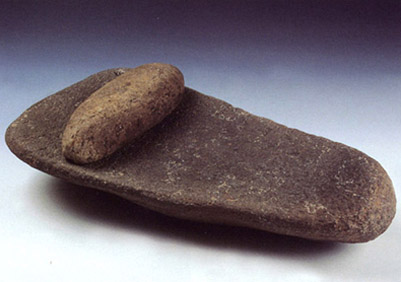
quern, suitable for crushing grain and malt here
Malting is the process of deliberate and careful partial germination transforms the properties of the grain. Within the grain, at the beginning of germination, enzymes are activated that can convert starches into sugars. Malted grain is friable, easier to crush and is very different to unmalted grain.

It seems probable that grain, because of its' special qualities when malted, was a status crop rather than a staple crop in the neolithic.  

Every all-grain beer brewer knows the importance of malt. It's the fundamental ingredient. When malt is crushed a little, mixed with water and heated in a mash tun to the correct temperature, it becomes sweet. The brewer then separates the liquid from the grain by lautering and sparging, and collects the liquid run off which is known today as wort. This is boiled with herbs or hops, then fermented into ale or beer.

the first farmers
The transition from fishing, hunting and gathering to a settled life of farming began around ten to twelve thousand years ago in the Near East and Levant. Wild grain grew abundantly, in natural fields, in the area now known as the Fertile Crescent (Harlan, 1967). Grain, lentils and chickpeas were gathered and processed by the nomadic population. As time went on, people began to plant and cultivate these crops deliberately. They processed them in different ways. Villages became established, such as Beidha, and plant domestication began as well as the domestication of goats. Hunter-gatherers became farmers. This was the neolithic revolution, or so it was named by Vere Gordon Childe in the 1930s.

The Spread of Agriculture in the Middle East
fertile crescent, image copyright:Oriental Institute of the University of Chicago

The new lifestyle spread rapidly across Europe, reaching the British Isles around five or six thousand years ago. This ‘wave of agriculture’ and the debate surrounding it have been discussed at great length in the literature (eg Maisels 1993, Harris 1996, Smith 1998, Zohary & Hopf 2001, Bellwood 2005). A great deal has been written and it is a complex issue. In 1952 Gordon Childe proposed that climate change was a major factor. Other explanations for the origins of agriculture include population pressure (Binford 1968, Flannery 1973), changes in socio-economic complexity, inequalities and drought. Theories abound, too many to discuss here. In 1990 Brian Hayden noted that

“few topics have engendered as much discussion and resulted in so few satisfying answers as the attempt to explain why hunter-gatherers began to cultivate plants and raise animals.” (Hayden 1990, 31) 

Archaeobotanical analysis of pollen, seeds, flora and fauna within the archaeological record seems to reveal that, ten to twelve thousand years ago, there were oak woods, pistachio trees and there was an abundance of wild life and game (Maisels 1993). Streams and rivers would have provided good fishing. It seems unlikely that the Natufian cultures of the epi-palaeolithic gathered wild grains to tide them over food shortages. They collected and processed them, and later domesticated them, because they wanted to make something. But what did they want to make?

the bread or beer debate
In 1953, Robert Braidwood from Oriental Institute of the University of Chicago initiated the ‘bread or beer’ debate, by organising a symposium "Did man once live by beer alone?". He was curious about the reason for the neolithic revolution, having been excavating at Jarmo, an early Neolithic village in the foothills of the Zagros Mountains of Iran, since the 1940s. He had organised a specialised multi disciplinary team with natural scientists, archaeobotanists, anthropologists and archaeologists (Braidwood et al, 1983). The excavation report Prehistoric Archaeology along the Zagros Flanks is a classic, if you like to read excavation reports, that is.

The symposium was published in the Journal of American Anthropology, number 55, in 1953 and it is now available to read online if you follow the next link. The specific question proposed by Professor Jonathan Sauer in Braidwood's Symposium was this:

… could the discovery that a mash of fermented grain yielded a palatable and nutritious beverage have acted as a greater stimulant toward the experimental selection and breeding of the cereals than the discovery of flour and bread making? One would assume that the utilisation of wild cereals (along with edible roots and berries) as a source of collected food would have been in existence for millennia before their domestication took place. Was the subsequent impetus to this domestication bread or beer?” (Braidwood 1953, 515)

Hans Helbaek considered that malting could perhaps have been the key to understanding early agriculture, even though he was aware that it was "a sore point in archaeological interpretation." It seems that it still is today. He discusses several aspects of malting on pages 517 & 518, for example, that a large vat may have been useful for part of the process. Germination may have been deliberate or accidental, he says, and context would be vital if germinated grain was to be found. Later on, he points out that germinated grain would have not survived in the ground. Carbonised grain might perhaps indicate a failed malting. It is clear from his argument that in the 1950s, there was some scientific understanding of the malting process. There were established techniques and processes that scientists had begun to understand.

Paul Manglesdorf pointed out that barley is “virtually useless” for bread making. He found it difficult to believe that “the foundations of Western Civilisation were laid by an ill fed people living in a perpetual state of partial intoxication” (page 520). He did not recognise germinated grain among the samples that he analysed from Jarmo, concluding that the earliest cereals were not used for brewing or baking but that they were used as ‘popped’ or ‘parched’ grains.

Linton noted the difficulty of making finely ground flour suitable for bread using a pestle and mortar or rubbing stones (page 524) and Oppenheim (page 525) suggested that gruel made from coarsely ground grits was the most likely product being made by the first farmers.

There was no consensus of opinion. After this auspicious start, the question of ‘bread or beer’ rested, debate appears to have died down and there was little further discussion. Presumably, it remained a controversial idea. The debate was resurrected in the late 1980s. In 1986, Solomon Katz and Mary Voigt published a paper in Expedition, volume 25/2 "Bread and Beer: the early use of cereals in the human diet" in which they presented a new paradigm: the biocultural development of cuisine. Their hypothesis included the idea that epi-palaeolithic hunter-gatherers had discovered that slightly sprouted grain tasted sweeter. I'd agree with their hypothesis. It would not be too difficult to discover this. The debate is not just about beer or bread, flour, porridge or gruel. It is also about making malt, malt sugars, the wort. I wrote my thesis, "Barley Malt and Ale in the Neolithic" about this, but I am not the first person to suggest the idea of maltsters in the epi-palaeolithic. Without malt there would be no wort and no ale or beer.

Grain processing was not necessarily a backbreaking, dreary chore of grinding the grain into a rough kind of flour to make unleavened bread.

The processes of malting and mashing magically transform inedible grain starch into delicious, sweet malt sugars. It could even be considered the first alchemy. The biblical phrase ‘land of milk and honey’ might refer to domesticated animals and the milk that they produced, as well as the production of liquid sugars from cereals, what brewers today call wort.

Malt and sweet barley mash are likely candidates for the things that the first farmers were interested in making. The accidental discovery of fermentation, whereby sugars are transformed into alcohol, followed closely behind. The spent grain that is left after sparging makes excellent animal fodder (Dineley, 2006). Spent grain is not alcoholic, it's just the slightly sweet barley husks and mash that is left after the malt sugars have been washed through.

Maltsters have known, for millennia, what they need to do with harvested grain in order to make sugars. Malting is an ancient skill, based upon techniques that, even today, have an element of magic, ritual and mystery. Making malt and malt sugars from the grain was one of the new technologies of the epi-palaeolithic. These grain processing techniques were discovered in the fertile crescent, these new skills crossed Europe, eventually arriving in the British Isles around five or six thousand years ago.  

neolithic farmers of the British Isles
What were the early neolithic farmers of the British Isles making with the grain that they grew? The transformation of grain into ale can be accurately described as both a ritual and a domestic activity and it seems to have been an important aspect of the neolithic cultural package. In the British Isles, harvested grain was being made into ale, an intoxicating beverage to be consumed, perhaps, at ceremonial sites. The making of the ale was as much of a ritual as its' consumption. 

further reading
My paper on the craft of the maltster was finally published, I put it on my Academia.edu page here

I wrote an article, based on the paper, for Brewer and Distiller International about the archaeological evidence for floor malting. It was published in the February issue, 2016: Who were the first maltsters? 

references

Bellwood P. 2005 First Farmers: The Origins of Agricultural Societies. Blackwell.

Binford L. 1968 Post Pleistocene Adaptations. In S. Binford and L. Binford (eds) New perspectives in Archaeology. Chicago.

Braidwood R. (1953) Did Man once live by bread alone? American Anthropologist 55, 515-526.

Braidwood R., Braidwood L., Howe B., Reed C. & Watson P. eds 1983 Prehistoric Archaeology across the Zagros Flanks. University of Chicago Oriental Institute Publications Vol 105, Chicago. here

Dineley M & Dineley G 2000 Neolithic ale: Barley as a source of malt sugars for fermentation. In Fairbairn A (ed) Plants in Neolithic Britain and beyond. Neolithic Studies Group Seminar Papers 5, 137-155, Oxbow Books. Paper presented at the Spring Meeting of the Neolithic Studies Group, Royal Academy, London, March, 1998.

Dineley M. 2006 The Use of Spent Grain as Cattle Feed in the Neolithic. In D. Serjeantson and D. Field (eds) Animals in the Neolithic of Britain and Europe, Neolithic Studies Group Seminar papers 7, Oxbow Books. Paper presented to the Spring Meeting of the Neolithic Studies Group, British Museum, 2004


Flannery K. 1974 The Origins of Agriculture. Annual Review of Anthropology, 2, 271-310.

Harlan J. R. 1967 A Wild Wheat Harvest in Turkey. Archaeology 20, 197-201.

Hayden B. 1990 Nimrods, Piscators, Pluckers and Planters: the emergence of food production. Journal of Anthropological Archaeology Vol 9, No 1, 31-69.

Harris D. R. 1996 The Origins and Spread of Agriculture and Pastoralism in Eurasia Routledge.

Katz S. & Voigt M. 1986 Bread and Beer: the early use of cereals in the human diet. Expedition Vol 25/2, 23-34 here

Maisels C. 1993 The Emergence of Civilisation. Routledge.


Smith B. 1998 The Emergence of Agriculture Scientific American Library, New York.

Zohary D. and Hopf M. 2001 Domestication of Plants in the Old World: the origin and spread of cultivated plants in West Asia, Europe and the Nile Valley. Clarendon Press, Oxford Science Publications.

Wednesday, 18 June 2014

The origins of the Viking bathhouse myth

We have spent some 10 years arguing that that the "first farmers", the Neolithic culture that brought cows, crops and ceramics to Britain 6000 years ago, possessed the material culture necessary for turning cereals into ale, and that there is sufficient archaeological evidence to merit investigation. Nobody in the archaeological community could be convinced. It is still considered to be a controversial theory. We have no idea why. Maybe it is a paradigm shift too far for some archaeologists to bridge, that cereals were initially cultivated for their potential sugars, a status crop, and not for their starches, a staple crop. So we considered investigating an era in which there should be no controversy.

We visited the island of Wyre in Orkney, and inspected "Cubbie Roo's" castle. This was built by Kolbein Hrugr, hrugr means "heap", he was a big man. It is mid 13th Century and one of the older mortar and stone built castles extant in Scotland. It is a fascinating site on one of the now remoter islands of Orkney. We were surprised, amazed and overwhelmed to find a stone built "mash oven" in an outbuilding round the back. Our excitement was because this could be the oldest mash oven in Europe. This building has a stone bench, perfect as an ale store, and drains. It would be very suitable for making ale, but so far archaeologists have interpreted this as just an ordinary oven.

Cubbie Roo's mash oven, Wyre, Orkney.


the medieval brewer, stirring the mash

We are lucky on Orkney to have well preserved Viking sites. A friend and neighbour suggested that we might like to look at the drains at the site on the Brough of Birsay.

Birsay is the late 10th Century base of Sigurd the Stout and his son Thorfinn.  In the Orkneyinga Saga they are renowned for their hospitality. We can imagine the great feasts they had there. This might even be the site of Sigurd's Yule Feast, where Kari slew Gunnar Lambi's son in front of King Sigtrygg of Dublin ( pp xxvii-xxviii, Orkneyinga Saga, edited by Joseph Anderson.)

Drains are significant for brewing installations. The mashing process makes sugars from the malt and these are very sticky and messy. Any spillage or accidents have to be washed away, and the brewing equipment has to be kept clean. A brewery cannot function without effective drains.

one of the massive stone lined drains at Birsay

There is a massive drain running down the middle of what I think is the head of the Viking causeway, most of which has been eroded by the sea. To the right of this causeway, looking back to the mainland, is the so called "Viking Sauna" (see photo below) with stone slabs on edge, supposedly to support wooden benching. I heard an expert on TV saying that "they poured hot water down the drain under these benches, to keep their bums warm". I think it's far more likely to be the brew house and ale store.

not the sauna - this is the brew house and ale store
On the left of the causeway, looking towards the mainland, is a building interpreted as a "Bathhouse or Sauna", in the photo below. It looks more to me like a mash house. It has a bench and a large hearth and drains along the wall. One end has been lost to the sea, and it is thought that there was a large hall or langskaill further out to sea.

the mash house, with large stone shelf & several drains

I was puzzled. These installations are little different to the Orkney Brewery, which is just down the road at Quoyloo. Rob Hill's Swannay Brewery, also on Orkney, uses the same installations - a mash tun and fermenting vessels. How on earth could anyone think that these buildings were a Bathhouse and a Sauna? Maybe they knew absolutely nothing about how beer is made.

When I get puzzled by archaeology, I like to read the original excavation reports. This tells me what came out of the ground and there are usually nuggets of really useful information that are lost or not mentioned in summaries.

The earliest reference to 'Viking Bathhouses or Saunas' that I could find came from Dr Alexander Curle's excavations at Jarlshoff, Shetland, published in 1935, in the Proceedings of the Society of Antiquaries of Scotland (PSAS 69). He wrote that "...the presence of such a drain, and the condition of the ash deposited within it, suggest the possibility of the remains of a bath-house existing nearby." (page 284).

Curle explains that this is the first Viking settlement excavation in Britain, and that his interpretations are based upon the work of Thorsteinn Erlingsson, who wrote about Icelandic settlements. In his book  Ruins of the Saga Time, published in 1895. Erlingsson describes the components of the traditional farmstead house, including the bath-stofa or bathroom. He describes it as being part of the main structure and it is not a separate building.

Jarlshof, Shetland - is this the bath house, hof, a religious building or a brewhouse?

The structure in question at Jarlshof (see photo above) was beneath a mausoleum and it was not excavated until the 1950s by JRC Hamilton. Alexander Curle did not actually excavate it. In the foreground is a large longhearth and a substantial drain. To the rear of the building there is what looks to me like the bowl or footings of a grain drier.

So how on earth could Dr. Curle know that it was a bath-house, other than making the assumption that it was, because of the drains and and a means of heating water?

This remained a mystery to me until I stumbled across Dr. Alexander Curle's excavation report for another Viking age site, at Freswick, Caithness, Scotland, published in the Proceedings of the Society of Antiquaries in 1939, see PSAS 73 . In this, he describes a feature that, at first sight looks very much like a small Roman style bath-tub, with a large hearth and drains.

I was devastated, despite the complete absence of any mention of bath-houses in the Sagas, here was an archetypal bath-house. The Sagas describe the practice of bathing in streams, lakes and rivers. There were even open-air hot baths in Iceland, thanks to the natural hot springs there. Otherwise the Vikings habitually bathed in tubs of hot water in the andyri or porch. Even the King of Norway took his bath in a tub. 

reconstruction of Snorri Sturlussun's 'bath house' makes use of a hot spring, 
it is in the open air and is nothing like the buildings at the Brough of
Birsay & Jarlshof.

Then one day I re-read "The Vikings in Scotland" by James Graham-Campbell and Colleen E Batey. On page 198, the Viking settlement at Freswick is discussed:

"... as part of the re-examination of this building through  the surviving records, several problems became clear, the most significant being the complete stratigraphical separation between the secondary structure and the underlying drain. These could never have been associated and thus the secondary building is unlikely to have been a bath-house."

It was now obvious to me. Dr Alexander Curle was already aware of Freswick when he excavated Jarlshof, and this had influenced his interpretation. It has also influenced the interpretations of Viking sites for many other excavators and archaeologists since then. Whenever they find drains and a means of heating water, they interpret it as a "bath-house", even though the original archetype has been found to be wrong.

Interestingly the Brough of Birsay was excavated under the direction of Dr Curle's daughter-in-law, Cecil Curle, so she would have followed the family tradition and their interpretations. 

In short, most archaeologists do not know how to make beer from the grain. They certainly drink it, and they may even have made beer from kits, but they do not understand the processes, and so they do not recognise the installations in any era up until the late Mediaeval when monasteries brewed.

What a sad loss.
----------------------------------------------------------------------------------

further reading
We presented a poster at the 7th Experimental Archaeology Conference, Cardiff University. It can be downloaded here:

Where were the Viking Brew Houses? 


more reading (added June 25th 2014) 
We wrote a paper for the EXARC Journal, it has been peer reviewed and it is currently on the member's only section of the Journal. It will be released for everyone to access, download and read in the near future, probably later this year.

In the meantime, here is a shorter version of that paper, published in the Orkney Archaeological Society Newsletter. We called it 'Where did the Vikings make their ale?'.

Update

Lars Marius Garshol has been studying Norwegian Farmhouse brewing for a long time and is an expert in this field. The methods and equipment that he describes seem to us to have changed very little, if at all, from those of the 10C.
For anyone who wishes to understand or recreate Viking style brewing his work is an invaluable resource. Here is his Blog.

Lars' Blog


Tuesday, 13 May 2014

controversy in a grooved ware bucket

 The Larger Vertical Stone
Balfarg: an ancient site on a housing estate
The focus of my research changed suddenly, from the British Bronze Age to the Neolithic, one day in the summer of 1997. I was reading an excavation report about the prehistoric ceremonial site in Scotland, known as Balfarg. It was a large and complex place. As well as a neolithic henge and stone circle, which was preceded by a timber circle, there were the remains of mysterious rectangular timber built structures. There was also a ring cairn and a ring ditch. Lots of prehistoric pottery was found, ranging from neolithic bowls and large grooved ware bucket shaped pots to bronze age beakers, tripartite food vessels and bucket urns.

Pits contained what the excavators interpreted as "ritually charged" material. These so called "ritual pits" contained large quantities of broken and burnt pottery, mixed up with charcoal and burnt bone. Apparently, these things were deposited deliberately. In other pits there was no pottery, just charcoal, and the pit had been carefully sealed with closely packed stones.

Residues were noticed on a few sherds of neolithic grooved ware that had been buried in one of these pits. Analysis of these cereal based residues with meadowsweet pollen are similar to those found on Bronze Age pots, specifically, the Strathallan Food Vessel and the Ashgrove Beaker, which have both been interpreted as possibly being the remains of ale.

Were they making malt and ale in neolithic Britain? It seemed so to me. The Neolithic Revolution began in the British Isles around 4000 BC. Did it take people almost 2000 years, until the Bronze Age, before they realised or discovered that it was possible to make malt and ale with the barley and wheat that they were so keen to grow? Was the Neolithic really a time of growing grain to make flour, bread, porridge and gruel? Or were they making sandwiches for the feasts, as Professor Mike Parker Pearson seems to be suggesting. Or maybe he is just making a joke?

a few words about brewing residues
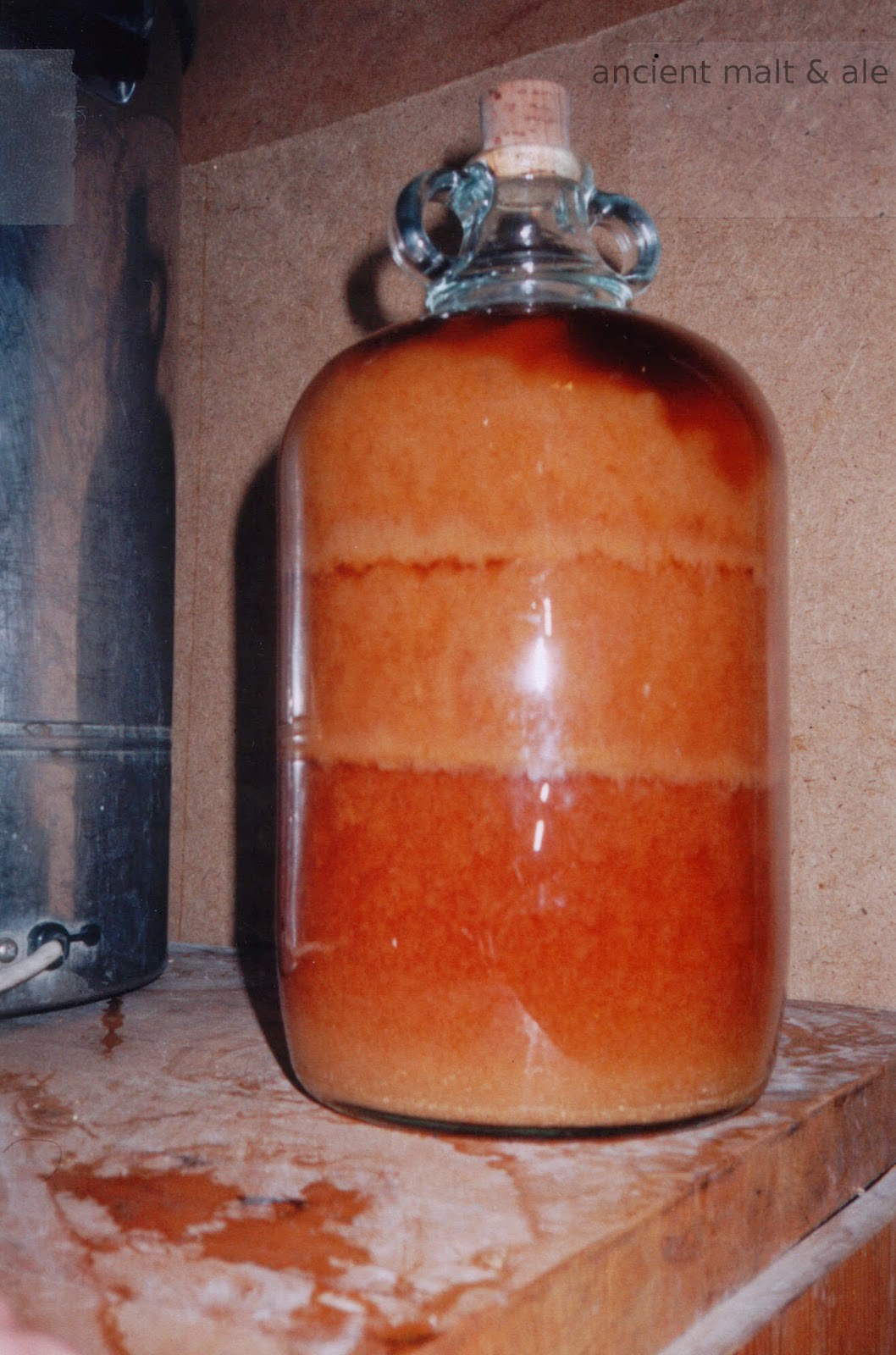
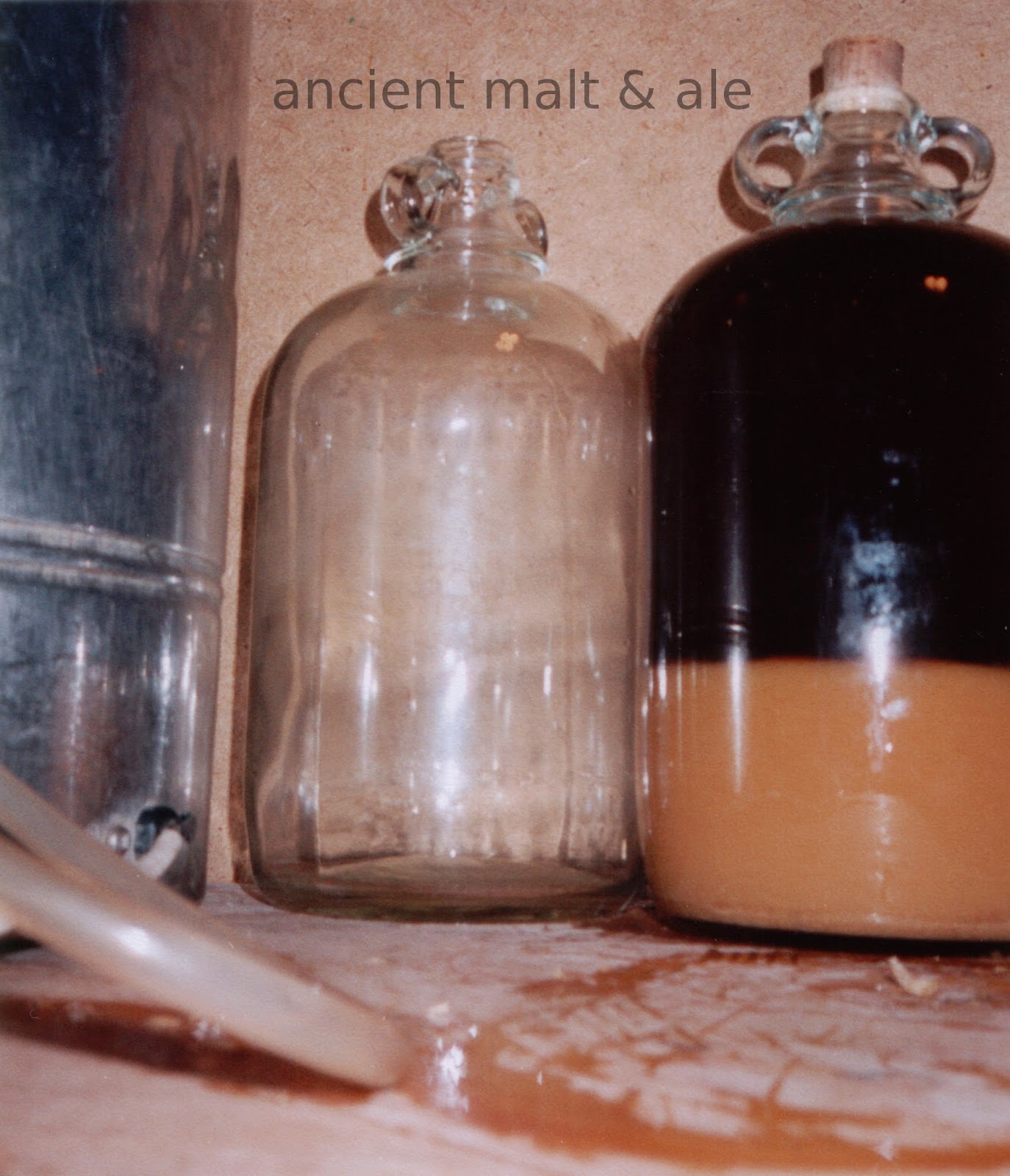
When making ale from crushed malted grain, two types of sludgy cereal based residues are generated during the brewing process. The first is a sludge, rich in barley chaff from the sparging process. Freshly sparged wort is cloudy at first. 

freshly sparged wort - settling out
the same wort, settled out with sludgy cereal residues accumulated
Once you have a clear wort, it is racked or syphoned off into a fresh clean vessel. Some chaff will inevitably get through. Boil the wort with selected herbs, flowers or hops and then ferment it. You can use the barm from previous brews to start a fermentation, it is ideal. A simple process, once you know how to do it.

The second type of brewing residue is cereal based, but with traces of yeast and herbs, hops, flower heads, leaves, twigs or pollen that settle out during the fermentation of the wort in the fermenting vessel. If you are lucky enough to drink a bottle of traditionally made real ale, the kind that must be poured in one go so as not to disturb the sediment, then you will know roughly what I mean. 

cereal based residues on grooved ware buckets
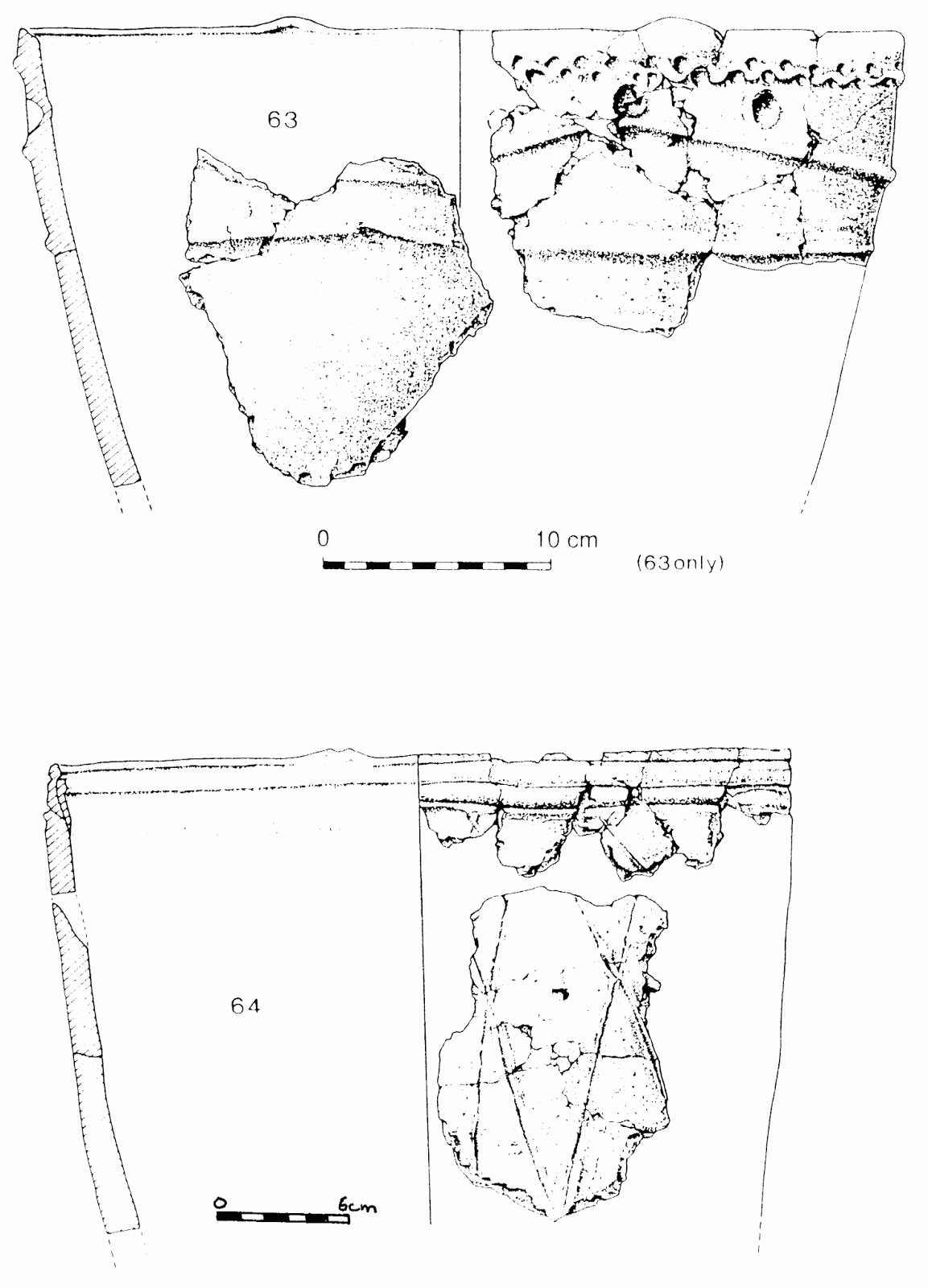
Let's go back to the Balfarg excavation report. The pots in question were numbers 63 and 64. Sherds from these two large grooved ware bucket shaped pots were found in a pit, close by one of the rectangular timber structures. Brian Moffat's descriptions of the cereal based residues make interesting reading for any all-grain brewer or archaeologist. I recognised immediately what these residues represented when I read them, way back on that summer's day in 1997. Not a sort of porridge with added herbs. Not a kind of gruel. These cereal based residues were probably the remains of brewing sediments from the fermentation bucket.

I was so excited by this! Ale in the Neolithic! I ran round to my best friend's house, just round the corner from where I lived, and told her all about it. She is a biochemist and was just as excited as I was. I told my supervisor the next day. He did not seem impressed at the prospect of malt and ale in neolithic Scotland. The previous year I had a short article published in British Archaeology, so I contacted the editor. He asked me to send him some details so that he could include it in the News section, September 1997. The Getafix and magic potions reference was not my idea! I do like it, though.

the original descriptions of the residues on pots 63 & 64

pots 63 & 64 from Balfarg (PSAS Vol 123)
Three broad, yet distinct types of burned cereal based residues were identified on the inside surface of sherds:
1. amorphous & burned
2. amorphous, granular & burned 
these two types were abundant in all samples.

3. burned cereal mash
both barley & oats, part grains, there was no entire carbonized grain since the grain had been thoroughly ground down, making taxonomic identification difficult.

"... a cereal based preparation ... with meadowsweet, indicated by both pollen & macroplant remains, clumps in one sample indicate a flowerhead was added ... fat hen ... cabbage/mustard? ... the single record of nightshade is puzzling ... pollen from hemlock ... the mix is coarse and crude ... like course porridge with potherbs and flavourings"

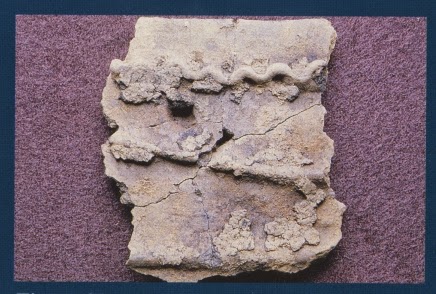
Another burned deposit was encrusted on the outer surface of one sherd of Pot P63. Both pollen and seeds of black henbane were identified.  
"... the seeds are robust and resilient and the breaks show mechanical rendering ... pollen and seed fragments were fairly well intermixed suggesting an incomplete process of homogenization ... the small cache of seeds is of black henbane alone."

Two separate organic residue deposits. One inside the pots, this one was cereal based with several different herbs added. The other residue was a burnt encrustation on the outside surface which, when first analysed, contained henbane pollen and several henbane seeds.
burnt encrustation on the outside of Pot 63 that contained henbane pollen and seeds

The above photo is from the booklet "Balfarg. The Prehistoric Ceremonial Complex" published by Fife Council, Glenrothes Development Corporation and Historic Scotland, 1993. I think it was intended as a guidebook for the site and is now out of print. There may be secondhand copies available. The original archaeobotanical report of the Balfarg residues is on pages 108-110 in Proceedings of the Society of Antiquaries of Scotland, Vol 123.

Henbane (hyoscyamus niger)
According to Culpepper, henbane should never be taken internally. More modern herbal reference books warn that it is a deadly poisonous plant. Do not use. This is very good advice. However, henbane does have its' place as a herbal remedy that was sometimes used in historical times, for example, to alleviate earache if applied externally, as a tincture. If consumed in small quantities, henbane induces intoxication, hallucinations, blurred vision, rapid heartbeat, euphoria and dizziness.

It is an effective painkiller, according to the herbal literature. All parts of the plant can be used and the seeds are about ten times more potent than the leaves or flowers. I am sure that, in the Neolithic, people knew about the medicinal and other properties of the henbane plant. It grows well in coastal regions and henbane seeds were identified at Skara Brae, a neolithic village in Orkney, Scotland. An intriguing aspect of the plant is that the active ingredients, the alkaloids, are more soluble in alcohol than in water.

henbane (hyoscyamus niger)

so what's the controversy?
This appeared to be not about the cereal based residues, but rather about the unusual identification of henbane seeds in the burnt encrustation on the outside surface of a neolithic pot sherd. It seems that, at first, there was not a problem. The excavation report, with its' rather interesting archaeobotanical report, sat quietly in the library journal section for a few years. It did not make any trouble. As more things were written about it, and as more archaeologists made reference to the possible "ritually charged" aspects of this rare residue discovery, it seemed that a re-analysis was required. This was commissioned by Historic Scotland. Two academic papers were rapidly produced.

The first was published in January 1999 in the Journal of Archaeological Science. This is a pay to view paper, with access available through University Libraries. Although the existence of henbane seeds within the residue was not confirmed, the residue was described as "a uniform and well processed substance, possibly something like a thick carbohydrate or protein based gruel". This description is consistent with the sludgy residues that accumulate at the bottom of an ale fermentation vessel - a well processed homogeneous mixture of cereal chaff, pollen, plant fragments and seeds.

The second paper was published in March, 2000 in Antiquity. This one, happily, is accessible online and is essentially a summary of the first paper. The focus is on disproving the "henbane ale" theory. The abstract makes this clear: "Were drugs in use in prehistory? Recent claims for the use of hallucinogenic substances have been made, and caused a stir. However, new work on a Scottish Neolithic ceremonial site suggests archaeologists (and the media) may have been jumping to the wrong conclusions!"

Whether or not henbane was added to the ale is clearly debatable. If such plants were being added to the brew, then it infers an understanding of their properties and some interesting ritual practices in prehistory. It might infer shamanistic practices, witchcraft, medicinal use of plants and more. A paper has been published recently in the Journal of Archaeological Method and Theory by Elisa Guerra-Doce of the Universidad de Valladolid in Spain. She argues that "far from being consumed for hedonistic purposes, drug plants and alcoholic drinks had a sacred role among prehistoric societies. It is not surprising that most of the evidence derives from both elite burials and restricted ceremonial sites, suggesting the possibility that the consumption of mind-altering products was socially controlled in prehistoric Europe."

My interest is in the cereal based residues on these ancient grooved ware pots and what they tell us about cereal processing techniques in the Neolithic. Flour, bread, porridge, gruel or was it malt and ale? What were they drinking at feasts? Was it sacred river water, or was it sacred ale? When searching for an image of grooved ware pottery online I found this comment on that well known online Encyclopedia - Wikipedia:

"Grooved ware comes in many sizes, some vessels are extremely large, about 30 gallons, and would be suitable for fermentation. The majority are smaller, ranging from jug to cup size, and could be used for serving and drinking. The theory that the first British farmers (c4000 BC) had the knowledge and ability to make ale from their crops with their pottery appears to be controversial and not yet widely discussed by the archaeological community."

There have been some amazing recent archaeological excavations and discoveries of ancient ceremonial and feasting sites, for example the Ness of Brodgar on Orkney and Durrington Walls, near Stonehenge in England, which was investigated by the Stonehenge Riverside Project. There is also evidence for beer brewing and feasting at Gobekli Tepe in Turkey, at the dawn of agriculture, some twelve thousand years ago.

It is surely time for the academic community to start talking seriously about how grain was being processed in prehistory. What were they were using it for? The options seem to be flour, bread, porridge, gruel or malt and ale, with added herbs.

----------------------------------------------------------------------------------------------------------------------

Balfarg Excavations
Balfarg was excavated before the construction of a housing estate. As a result, plans were altered to preserve the stones and build the houses around them. The excavation reports are online, thanks to the Archaeology Data Service, York University, so you can read it for yourself from the comfort of your own desk or armchair: Barclay, G J & Russell-White, C J (eds) 1993 'Excavations in the ceremonial complex at Balfarg/Balbirnie, Glenrothes, Fife' Proceedings of the Society of Antiquaries of Scotland Vol 123, 43-210.

Balfarg had been excavated earlier, in the 1970s. During those excavations a cist burial was found, containing the bones of an adult together with a dagger and a fine beaker with a handle - a rare find indeed. This excavation, by Roger Mercer, was published in 1981: The excavation of a late neolithic henge-type enclosure at Balfarg, Markinch, Fife, Scotland 1977-1978. Proceedings of the Society of the Antiquaries of Scotland Vol 111, 63-171.