Showing posts with label floor malting. Show all posts

Friday, 16 September 2016

a morning with maltsters, part two

Making malt involves a huge amount of knowledge, skill and experience. This is the second part of my write up of an Orkney Science Festival event that I was fortunate to attend. Making Malt took place on the morning of 7th September at the Highland Park Distillery, Kirkwall. If you haven't read part one, see here.

There were twelve tickets available. Malt, malting and the history of the craft is something that I'm particularly interested in, so I bought two tickets on the first day that they were available. Well worth it. The second presentation of the morning, by Distillery Manager Marie Stanton, was about the practice and techniques of floor malting. She gave us a fascinating insight into the craft.

To make good malt, she said, you need good quality barley as well as common sense, experience, commitment and an unnatural obsession with the weather. The first four things seem obvious but, the weather? What's that got to do with making malt? Malt is a living thing, it requires careful handling and processing. The maltster needs to be very much aware of the weather, looking after the barley on the floor as it begins to germinate and adjusting things accordingly. In cold weather, the barley is couched, or heaped up deeper on the floor. In warm weather, such as the day the seminar was held, they had been raking it out thinner, to cool it. The grain generates heat as it germinates on the floor.

This is the ancient craft of floor malting, a craft that has been around for thousands of years. Decisions about length of steep, depth of bed and readiness for the kiln are based upon years of experience, knowledge and skill.

The steep is about more than just getting the barley wet before it goes onto the germination floor. Water temperature is important, as well as several air rests. Grain left in water will drown and be no good for germination. The idea is to rehydrate the harvested and stored grain up to about 45% moisture.

When sufficiently steeped, the grain is couched, spread, turned and raked regularly according to temperature and conditions. It begins to germinate. This might sound straightforward, but there's more to it than you might think. I'll write about this in the next blog, the tour of the Maltings. When we were visiting, malt was drying in the kiln but there was none on the floors.

steeped grain on the malting floors at the Highland Park Distillery, Kirkwall, Orkney
source: undiscovered Scotland where there is more about floor maltings

The presentation on Making Malt continued. Bowls of barley were passed round.

One contained freshly steeped barley. It had the aroma of wet grain, as you might expect. Another contained barley that had been on the floor and had begun to germinate. This had a pleasant, fresh, almost floral aroma which is hard to describe. The two bowls had very different aromas, although they were just a couple of days' processing apart. This was something I did not expect, these aromas of germinating barley.

There is some complex chemistry going on inside the grain as it begins to germinate. If you want to know more about the biochemistry and physiology of grain germination, there's a reading list at the end of the blog.

The purpose of germination is to allow the embryo to grow, just a little. Enzymes develop and begin to degrade the beta glutens, proteins and cell walls. This is known as modification. When the grain (green malt) is sufficiently modified, it's ready for the kiln.

The malt is dried slowly and gently, to preserve the enzymes. They will be needed in the mash tun. Although there is a fierce fire, the malt is not put directly above it. Hot air and smoke from the fire needs to pass along the flue and through the bed of malted grain, drying it gently over several days. The malt steams as it dries. Both peat and coke are used as fuel. The wet malt takes on flavour from the peat smoke. It's turned regularly in the kiln, to ensure an even drying process. The maltster does not want the malt to be too dry, does not want roots, but they do want plenty of enzymes. It's important to know your kiln, we were told. Each one is different and the drying of the green malt from the floor is a matter of great skill, experience and knowledge.

After kilning, the malt needs to rest for a few weeks before it is used. There was some discussion in the room about why this should be and why it affects the flavour. It seems that the complex chemical processes of this resting period are still not understood. There was general agreement that rested and unrested malt should not be mixed together. 

At the end of the presentation, a bowl of the finished malt was passed round. We were told that we could have a taste.

It was delicious, each malted grain imbued with a peaty, smoky aroma, very good indeed.

Next, the tour of the maltings. We saw bubbling steep tanks, malt chariots and shiels. We saw the malt, steaming in the kilns. As we went in I realised I'd forgotten my camera. I made notes, not just about what we saw on the tour, but also some thoughts on origins of this ancient craft and the potential archaeological evidence for it.

------------------------------------------------------------------------

After completing my Master's in 1999, I tried to get funding for a PhD looking into the history and prehistory of malting and the archaeological evidence for malt. I didn't get any funding, but I did get to spend several years preparing funding applications. I worked with brewing scientists and therefore I had access to their library at UMIST, Manchester, where I read up on malting and brewing science, grain germination physiology. I can't say that I understand it all but I learned a lot. 

Here are a few books that cover the subject in detail:


Bewley and Black 1994 Seeds: Physiology and Development
This is about all seeds, see the chapters on barley, barley germination, malting

Malts-and-Malting-Book-cover
Dennis Briggs 1998 Malts and Malting
This is what maltsters call “the bible”.


D E Briggs, R S Stevens, Tom Young, J S Hough 1981 Malting and Brewing Science: Malt and Sweet Wort, Vol 1, Springer US
There is a second volume on hopped wort and beer.



Wednesday, 4 February 2015

first farmers, first maltsters?

Could the first farmers in the fertile crescent have been the first people to make malt? Who were the first maltsters? After I had completed my M. Phil in 1999, I used to go round archaeology conferences and meetings (as an independent researcher, not affiliated to any University or College) and I gave papers and presentations that aimed to promote some discussion of these questions among archaeologists and anthropologists.

This is the first of a number of blogs based on these talks, presentations and papers from between 2000 and 2010.

I'm presenting here a few thoughts based upon a simple question - what were those first farmers doing with grain that they were so keen to grow? Of course, grain can be ground into flour to make bread, or perhaps, in the neolithic, some kind of gruel or porridge was made. But there is something else that can be done with grain, which not everyone is familiar with. It can also be malted.

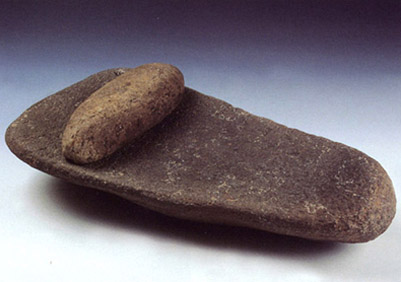
quern, suitable for crushing grain and malt here
Malting is the process of deliberate and careful partial germination transforms the properties of the grain. Within the grain, at the beginning of germination, enzymes are activated that can convert starches into sugars. Malted grain is friable, easier to crush and is very different to unmalted grain.

It seems probable that grain, because of its' special qualities when malted, was a status crop rather than a staple crop in the neolithic.  

Every all-grain beer brewer knows the importance of malt. It's the fundamental ingredient. When malt is crushed a little, mixed with water and heated in a mash tun to the correct temperature, it becomes sweet. The brewer then separates the liquid from the grain by lautering and sparging, and collects the liquid run off which is known today as wort. This is boiled with herbs or hops, then fermented into ale or beer.

the first farmers
The transition from fishing, hunting and gathering to a settled life of farming began around ten to twelve thousand years ago in the Near East and Levant. Wild grain grew abundantly, in natural fields, in the area now known as the Fertile Crescent (Harlan, 1967). Grain, lentils and chickpeas were gathered and processed by the nomadic population. As time went on, people began to plant and cultivate these crops deliberately. They processed them in different ways. Villages became established, such as Beidha, and plant domestication began as well as the domestication of goats. Hunter-gatherers became farmers. This was the neolithic revolution, or so it was named by Vere Gordon Childe in the 1930s.

The Spread of Agriculture in the Middle East
fertile crescent, image copyright:Oriental Institute of the University of Chicago

The new lifestyle spread rapidly across Europe, reaching the British Isles around five or six thousand years ago. This ‘wave of agriculture’ and the debate surrounding it have been discussed at great length in the literature (eg Maisels 1993, Harris 1996, Smith 1998, Zohary & Hopf 2001, Bellwood 2005). A great deal has been written and it is a complex issue. In 1952 Gordon Childe proposed that climate change was a major factor. Other explanations for the origins of agriculture include population pressure (Binford 1968, Flannery 1973), changes in socio-economic complexity, inequalities and drought. Theories abound, too many to discuss here. In 1990 Brian Hayden noted that

“few topics have engendered as much discussion and resulted in so few satisfying answers as the attempt to explain why hunter-gatherers began to cultivate plants and raise animals.” (Hayden 1990, 31) 

Archaeobotanical analysis of pollen, seeds, flora and fauna within the archaeological record seems to reveal that, ten to twelve thousand years ago, there were oak woods, pistachio trees and there was an abundance of wild life and game (Maisels 1993). Streams and rivers would have provided good fishing. It seems unlikely that the Natufian cultures of the epi-palaeolithic gathered wild grains to tide them over food shortages. They collected and processed them, and later domesticated them, because they wanted to make something. But what did they want to make?

the bread or beer debate
In 1953, Robert Braidwood from Oriental Institute of the University of Chicago initiated the ‘bread or beer’ debate, by organising a symposium "Did man once live by beer alone?". He was curious about the reason for the neolithic revolution, having been excavating at Jarmo, an early Neolithic village in the foothills of the Zagros Mountains of Iran, since the 1940s. He had organised a specialised multi disciplinary team with natural scientists, archaeobotanists, anthropologists and archaeologists (Braidwood et al, 1983). The excavation report Prehistoric Archaeology along the Zagros Flanks is a classic, if you like to read excavation reports, that is.

The symposium was published in the Journal of American Anthropology, number 55, in 1953 and it is now available to read online if you follow the next link. The specific question proposed by Professor Jonathan Sauer in Braidwood's Symposium was this:

… could the discovery that a mash of fermented grain yielded a palatable and nutritious beverage have acted as a greater stimulant toward the experimental selection and breeding of the cereals than the discovery of flour and bread making? One would assume that the utilisation of wild cereals (along with edible roots and berries) as a source of collected food would have been in existence for millennia before their domestication took place. Was the subsequent impetus to this domestication bread or beer?” (Braidwood 1953, 515)

Hans Helbaek considered that malting could perhaps have been the key to understanding early agriculture, even though he was aware that it was "a sore point in archaeological interpretation." It seems that it still is today. He discusses several aspects of malting on pages 517 & 518, for example, that a large vat may have been useful for part of the process. Germination may have been deliberate or accidental, he says, and context would be vital if germinated grain was to be found. Later on, he points out that germinated grain would have not survived in the ground. Carbonised grain might perhaps indicate a failed malting. It is clear from his argument that in the 1950s, there was some scientific understanding of the malting process. There were established techniques and processes that scientists had begun to understand.

Paul Manglesdorf pointed out that barley is “virtually useless” for bread making. He found it difficult to believe that “the foundations of Western Civilisation were laid by an ill fed people living in a perpetual state of partial intoxication” (page 520). He did not recognise germinated grain among the samples that he analysed from Jarmo, concluding that the earliest cereals were not used for brewing or baking but that they were used as ‘popped’ or ‘parched’ grains.

Linton noted the difficulty of making finely ground flour suitable for bread using a pestle and mortar or rubbing stones (page 524) and Oppenheim (page 525) suggested that gruel made from coarsely ground grits was the most likely product being made by the first farmers.

There was no consensus of opinion. After this auspicious start, the question of ‘bread or beer’ rested, debate appears to have died down and there was little further discussion. Presumably, it remained a controversial idea. The debate was resurrected in the late 1980s. In 1986, Solomon Katz and Mary Voigt published a paper in Expedition, volume 25/2 "Bread and Beer: the early use of cereals in the human diet" in which they presented a new paradigm: the biocultural development of cuisine. Their hypothesis included the idea that epi-palaeolithic hunter-gatherers had discovered that slightly sprouted grain tasted sweeter. I'd agree with their hypothesis. It would not be too difficult to discover this. The debate is not just about beer or bread, flour, porridge or gruel. It is also about making malt, malt sugars, the wort. I wrote my thesis, "Barley Malt and Ale in the Neolithic" about this, but I am not the first person to suggest the idea of maltsters in the epi-palaeolithic. Without malt there would be no wort and no ale or beer.

Grain processing was not necessarily a backbreaking, dreary chore of grinding the grain into a rough kind of flour to make unleavened bread.

The processes of malting and mashing magically transform inedible grain starch into delicious, sweet malt sugars. It could even be considered the first alchemy. The biblical phrase ‘land of milk and honey’ might refer to domesticated animals and the milk that they produced, as well as the production of liquid sugars from cereals, what brewers today call wort.

Malt and sweet barley mash are likely candidates for the things that the first farmers were interested in making. The accidental discovery of fermentation, whereby sugars are transformed into alcohol, followed closely behind. The spent grain that is left after sparging makes excellent animal fodder (Dineley, 2006). Spent grain is not alcoholic, it's just the slightly sweet barley husks and mash that is left after the malt sugars have been washed through.

Maltsters have known, for millennia, what they need to do with harvested grain in order to make sugars. Malting is an ancient skill, based upon techniques that, even today, have an element of magic, ritual and mystery. Making malt and malt sugars from the grain was one of the new technologies of the epi-palaeolithic. These grain processing techniques were discovered in the fertile crescent, these new skills crossed Europe, eventually arriving in the British Isles around five or six thousand years ago.  

neolithic farmers of the British Isles
What were the early neolithic farmers of the British Isles making with the grain that they grew? The transformation of grain into ale can be accurately described as both a ritual and a domestic activity and it seems to have been an important aspect of the neolithic cultural package. In the British Isles, harvested grain was being made into ale, an intoxicating beverage to be consumed, perhaps, at ceremonial sites. The making of the ale was as much of a ritual as its' consumption. 

further reading
My paper on the craft of the maltster was finally published, I put it on my Academia.edu page here

I wrote an article, based on the paper, for Brewer and Distiller International about the archaeological evidence for floor malting. It was published in the February issue, 2016: Who were the first maltsters? 

references

Bellwood P. 2005 First Farmers: The Origins of Agricultural Societies. Blackwell.

Binford L. 1968 Post Pleistocene Adaptations. In S. Binford and L. Binford (eds) New perspectives in Archaeology. Chicago.

Braidwood R. (1953) Did Man once live by bread alone? American Anthropologist 55, 515-526.

Braidwood R., Braidwood L., Howe B., Reed C. & Watson P. eds 1983 Prehistoric Archaeology across the Zagros Flanks. University of Chicago Oriental Institute Publications Vol 105, Chicago. here

Dineley M & Dineley G 2000 Neolithic ale: Barley as a source of malt sugars for fermentation. In Fairbairn A (ed) Plants in Neolithic Britain and beyond. Neolithic Studies Group Seminar Papers 5, 137-155, Oxbow Books. Paper presented at the Spring Meeting of the Neolithic Studies Group, Royal Academy, London, March, 1998.

Dineley M. 2006 The Use of Spent Grain as Cattle Feed in the Neolithic. In D. Serjeantson and D. Field (eds) Animals in the Neolithic of Britain and Europe, Neolithic Studies Group Seminar papers 7, Oxbow Books. Paper presented to the Spring Meeting of the Neolithic Studies Group, British Museum, 2004


Flannery K. 1974 The Origins of Agriculture. Annual Review of Anthropology, 2, 271-310.

Harlan J. R. 1967 A Wild Wheat Harvest in Turkey. Archaeology 20, 197-201.

Hayden B. 1990 Nimrods, Piscators, Pluckers and Planters: the emergence of food production. Journal of Anthropological Archaeology Vol 9, No 1, 31-69.

Harris D. R. 1996 The Origins and Spread of Agriculture and Pastoralism in Eurasia Routledge.

Katz S. & Voigt M. 1986 Bread and Beer: the early use of cereals in the human diet. Expedition Vol 25/2, 23-34 here

Maisels C. 1993 The Emergence of Civilisation. Routledge.


Smith B. 1998 The Emergence of Agriculture Scientific American Library, New York.

Zohary D. and Hopf M. 2001 Domestication of Plants in the Old World: the origin and spread of cultivated plants in West Asia, Europe and the Nile Valley. Clarendon Press, Oxford Science Publications.

Tuesday, 20 January 2015

thousands of grain impressions in a burnt plaster floor

Sometimes, a single sentence in an excavation report can be the beginning of research that sparks your curiosity and makes you ask questions. For me, it was a few words and a brief, enigmatic description that I read in an excavation report several years ago, in the late 1990s, when I began my research into ancient grain processing techniques and the neolithic revolution.

The site was Beidha, a small neolithic village in the Jordan Valley. Here, in the 7th Millennium BC, people began to settle down, grow grain and keep domestic animals - cows, pigs, sheep and goats. Although they were still hunting and gathering, they were beginning to process the crops they grew, which included cereals and lentils. The earliest agriculturalists. Today, when you search for the neolithic village of Beidha on the internet you will find lots of information about it. This is, to some extent, thanks to a project established in 2010, to protect and promote the site. Beidha is an ancient place, now open to the public. It is not far from Petra, in Jordan, and is part of the World Heritage Site. Definitely on my list of places to go.

The village appeared to have burned down, nobody knows how or why. Diana Kirkbride excavated the site in the 1950s and 1960s as part of a larger project to investigate the early agriculturalists of the Ancient Near East, organised by Robert Braidwood of the Oriental Institute of Chicago. In her report, she described the remains and the contents of one of the rectangular mud brick buildings in the village of Beidha. As well as a lime plaster floor, facilities and equipment suitable for grain agriculture and processing were found, specifically, hoes, sickles and quern stones. There were also large stone bowls and the remains of baskets that appear to have been waterproofed. The baskets had been lined with either bitumen or lime plaster.

She thought that the building may have burnt down, somehow leaving behind the evidence of the presence of grain on the floor, which she described as

 “... tens of thousands of grain impressions in the burnt plaster floor ...
Kirkbride, D. 1968 ‘Beidha: early neolithic village life south of the Dead Sea’ Antiquity XLII, 263

This is an intriguing description.

At the time that I was studying the Beidha excavation report, Graham and I had recently returned from Orkney where, at the Corrigall Farm Museum, we had our first lesson in the techniques and traditions of floor malting. The curator, Mr Harry Flett, had explained to us how the grain must be steeped in water, then turned out onto a smooth floor in a barn to begin germination. Malt is partially germinated grain. When growth is obvious, that is, when the root and shoot begin to show, the malt is carefully dried. Then it can be used for making wort and brewing ale.

I had been reading excavation reports from neolithic sites in the British Isles and northern Europe, where floor surfaces of buildings are rarely preserved. The floors of the long houses and other buildings of the Linearbandkeramik Culture were destroyed by modern deep ploughing. In the British Isles, I had only come across one description of a deliberately made beaten earth floor in a neolithic building. This was in one of the rectangular timber buildings at Lough Gur, in Ireland, a site excavated in the early 1950s by Sean O'Riordain and published in the Proceedings of the Royal Irish Academy.

It was great news to me that some floor surfaces of buildings from early neolithic cultures in the ancient Near East had been so well preserved. I began to read more excavation reports, to see what else had been discovered. Although I have yet to find another description of grain impressions in association with an early neolithic lime plaster floor from that part of the world, I did find plenty of detailed descriptions of floors made of beaten earth, stamped clay and lime plaster. Some of them were painted, and there was very little discussion of their function or purpose.

The function of floors is a subject not often discussed in excavation reports. Floors are important. They are a crucial facility for making malt. And, as many people know, it's the malting that interests me most. When was it discovered? How? Who were the first maltsters? How has malting technology changed and developed over the millennia? What is the archaeological evidence for malt? What role did malting play in the development of grain agriculture and the neolithic revolution? 

the neolithic revolution in the Fertile Crescent

The practice of grain cultivation, agriculture and grain processing as well as animal husbandry and the domestication of cattle, sheep, goats and pigs are defining features of the neolithic way of life.

Archaeologists agree on this definition, although there is much disagreement among the academics about why people "became farmers". It is one of the biggest questions in academic archaeology - why did people begin to cultivate and process wild grains in the Ancient Near East and Levant? What were they making with the grain? These were some of the questions that Braidwood's team of archaeologists, anthropologists and archaeobotanists and had set out to answer in the 1950s. Was it bread or beer?

The debate was reawakened in the 1980s by Solomon Katz and Mary Voigt, when they published their paper "Bread or Beer: the early use of cereals in the human diet". They suggested that making malt was an important part of the story. Hunting and gathering were, of course, still important ways of food acquisition. Wheat and barley grew as wild plants in this region. People began to gather and process them long before they started to cultivate them deliberately and settle down in villages to tend their crops and look after their sheep, goats, pigs and cattle.

Grain cultivation and processing began in the Near East and Levant around ten to twelve thousand years ago. This new way of life spread across Europe and reached the British Isles around six thousand years ago.

mud, clay & lime plaster floors in the neolithic of the Fertile Crescent

A common feature of many early neolithic sites in the Fertile Crescent are the deliberately made, smooth, level floors made of mud, clay or lime plaster. Mud or clay floors may have been relatively easy to make. The lime plaster floors, some of them apparently polished, would have involved a particularly complex technology in their manufacture, as well as considerable human effort and co-operation in their construction. The Natufians, these first agriculturalists of the Fertile Crescent, were using lime plaster for a wide range of uses - to make walls, floors, statues, as well as so called 'white ware' vessels, the precursor to pottery made from clay. The use of lime plaster in the early neolithic of the Fertile Crescent is a huge area for research and investigation.

To make lime plaster, large quantities of chalk had to be collected, then burnt at 850 degrees Centigrade to make the quicklime. Water would have been added to make the slaked lime which can then be used to make the floor. They must be laid and levelled very quickly and would have been similar in appearance to a modern concrete floor.

Polished lime plaster floors were found in a rectangular building at Gobekli Tepe, in the layers of this enigmatic settlement or temple dated to the seventh and eighth millennia BC, the era of the pre pottery neolithic. Gobekli Tepe was excavated by Professor Klaus Schmidt of the German Archaeological Institute over many seasons. The earliest levels have been dated to the epi-palaeolithic, around the tenth millennium BC. The team excavating this site interpreted it as having been a place of feasting and cult activity.

Another interesting and large rectangular building of the seventh millennium BC was excavated at the early neolithic village of Yiftahel, lower Galilee. Inside one of the buildings there was a lime plaster floor measuring 110 square metres and 3-6 cm thick. It would have required some seven tons of lime plaster. At the time of excavation, it was the largest rectangular mud brick building of the period in the Levant. Details of the lime plaster, what it was and how it was made can be found here in a paper published in the Journal Palaeorient in 1991.

File:Yiftahel structure with plastered floor1.jpg
remains of a lime plaster floor at Yiftahel: the production of lime plaster was on an industrial scale. see here


bins, pestles, mortars & earth floors at Ain Mallaha see here
At Ain Mallaha there are the remains of an early neolithic settlement. It is situated by Lake Huleh in the upper Jordan valley and was inhabited between 10,000 and 8200 BC. The floors within the buildings apparently gave the impression of having been deliberately made by accumulation and they appear to have been cleaned and repaired on a regular basis.

Stamped mud floors, some  surfaced with a smooth layer of clean clay, together with domed ovens and brick-lined roasting pits were features discovered during excavations at Ali Kosh, a neolithic settlement dated to c7200 BC and located on the southern plains of Khuzistan.

At Tell Ramad, a neolithic village in Syria, c7000–6000 BC, the remains of lime kilns were excavated and some of the floors were made of lime plaster. Again, lime plaster was being made on an almost industrial scale. During excavations, it was noted that some of the floors had upturned edges. What purpose was this innovation for? We may never know, but perhaps this refinement had the function of containing the malt. It would work to keep the germinating grain on the specially made lime plaster floor surface.

Floors of compacted clay were found in the buildings of the earliest and lowest occupation levels at Mureybit a settlement dated to between c8500 and c6900 BC and located beside the Euphrates river in northern Syria. Excavations also revealed a variety of grain agriculture and processing equipment including sickles, pestles, mortars, quern stones, fire pits and hearths.

A floor at the site of Ain Ghazal, an early neolithic settlement near Amman in Jordan, showed evidence of at least five different layers. It had been repeatedly repaired and well maintained. Re plastering and regular maintenance of these lime plaster floors was undertaken at a number of these early neolithic sites.

This is a feature of more recent malting floors. It is desirable to have a smooth and level surface for the efficient raking and turning of the grain as it germinates. Access to a reliable water source is another necessity for the malting and mashing of grain and at all of these sites that I have mentioned, there were nearby springs, streams or rivers.

Robert Braidwood of the Oriental Institute of Chicago initiated the "Bread or Beer" debate in 1953. Anthropologists and archaeologists discussed the roles of bread and beer in the Origin of Grain Agriculture debate. Only Hans Helbaek considered the role of malt, without which there would be no fermentable sugars and no beer.

The archaeological evidence, some of which is outlined above, indicates that it was neither bread nor beer, rather it seems that those first agriculturalists may have been making malt.

-------------------------------------------------------------

further reading:

I have a peer reviewed paper "The Craft of the Maltster" which is hopefully, due to be published soon. It was presented to the Food in Archaeology Conference in April 2010 at Exeter University. The book of the conference is, I am assured, on its' way into print. I have been given permission by the publishers to put the paper on my academia page. It can be downloaded here.


Sunday, 13 July 2014

where have all the malting floors gone?

There are only a handful of malting companies in the British Isles who still use the ancient and traditional technique of floor malting. One of these is Tucker's Maltings, in Newton Abbott, near Exeter, Devon. They are the only Maltings in the UK who offer regular guided tours. Another is the Warminster Malt Company, established in 1855. Guinness owned and operated this Maltings between 1950 and 1994. It provided the malt for the famous brew. When they moved out, the new company provided quality floor malt for several small independent craft breweries.

The Crisp Malting Group is a large company, with malting plants operating in Scotland and England. They own Maltings in Alloa and Portgordon, Scotland, and also in Ditchingham, Great Ryburgh and Mistley in Suffolk, Norfolk and Essex, respectively. The site at Great Ryburgh is the largest and, as they say on their web page, it provides an insight into the technical developments and innovations that have taken place in the malting industry over the last 150 years. The Ryburgh Maltings was set up in the 1850s. It eventually became the largest floor malting plant in Europe. They still have and use some of the traditional floor malting facilities. Today, however, because of demand, most of the malt is produced using modern equipment. These are the Saladin Maltings, installed in the early 1960s. Circular germinating vats, also known as drum maltings, were added in 1973. In the early 1990s, modern computerised systems were introduced.

These modern systems can deal with large amounts of grain but the fundamental processes of steeping, malting and kilning remain unchanged. If you want to see just how huge the modern computerised GKV systems can be, here is a time lapse video of one being built between August 2011 and February 2012 for the Great Western Malting Company. It will replace the drum maltings. In the 21st century, making the equipment for malting has become a big industry in itself. 

raking the malt on the germination floor
There is also Thomas Fawcett & Sons Ltd, based in Castleford, West Yorkshire, where the original malting floors are still in use, alongside the Saladin Maltings and a state of the art germinating kilning vessel. The family has been making malt since the 1760s. Established in 1809, the family business and company has seven generations of experience of making malt.

We contacted them not long after visiting the Corrigall Farm Museum on Orkney where we had seen the traditional 18th century grain barn, complete with threshing and malting floor. Fawcett's were kind enough to take us on a guided tour round the Maltings and explain what they did. That was in 1997, just before I completed my thesis. It gave us an insight into the complexities of malting on an industrial scale. A more recent description of a tour around Fawcett's is here. It seems that not a lot has changed there over the last 17 years.

So, where have all the malting floors gone?
Replaced by modern technology, almost every one ...

It's crucial to turn the malt regularly. This aerates it and prevents the rootlets from becoming entangled and matted on the malting floor. This important job has traditionally been done by people, who pulled a specially designed malt rake through the germinating grain. It is a time consuming process. As the malting floors became larger and larger to cope with the demand for beer and whiskey in the Victorian era, so the task of turning the malt became increasingly labour intensive and expensive.

In the 1890s, a new mechanised system was invented by Charles Saladin, a French engineer (1878-1942). Named after him, the Saladin box was a large concrete or metal box in which revolving metal forks moved slowly from end to end, turning and aerating the grain as it germinated. The picture below is from a Belgian malting company's web pages, Dingemans, who began to use the new mechanical system in the early 20th century. The malt needs to be aerated and, as time went by, the basic design has been improved with perforated floors, and air being blown through the germinating grain to maintain an even temperature. Drum maltings are essentially the same system, but with circular grain beds, not rectangular boxes.

In the British Isles, the malting floors began to be replaced by Saladin box maltings slightly later than in Europe, with the first being installed in Edinburgh's North British Grain Distillery in 1948. They became increasingly popular during the 1950s and 1960s. Saladin boxes and pneumatic maltings, where the germinating grain is aerated, have been improved upon by larger capacity drum maltings and more recently by enormous computer controlled state of the art Germinating Kilning Vessels.

Malting equipment in the modern food processing industry has become huge and complex, yet it is still based upon the fundamental processes of steeping, germination and kilning. There is a very good analysis of modern malting techniques and equipment here, Chapter 3 of ' Engineering Aspects of Cereal and Cereal Based Products' edited by Raquel de Pinho Ferreira Guine, Paula Maria dos Reis Correia.

malthouses
Apart from the Nottingham cave maltings, dated to the 13th and 14th centuries, there are very few recorded malthouses or facilities for making the malt in the medieval era. Mostly, malt was made in the grain barn. The cave maltings are unique. Because of the ambient temperature being the same all year round, they could make malt all the time. In a traditional grain barn or malthouse, it was only made in the cooler months of the year, those months with an 'r' in, that is, any month except May, June, July and August when it was too hot to make malt. Over the centuries, as the breweries gradually became larger and more centralised in towns, so the malthouses and malting floors had to become much larger to supply them.

Great Dunmow Maltings
Great Dunmow Maltings, now a museum
The details of the commercialisation, industrialisation and mechanisation of the malting process in England is very well told by Amber Patrick in her report for English Heritage. She explains that the basic 16th century malthouse had two floors, the top being for grain storage and the ground floor was the growing floor. The kiln for drying the malt would be at one end. A good example is the Boyes Croft, Great Dunmow, Essex, a Grade II listed building.

By the end of the 17th century, commercial malting was on such a scale that it warranted taxation. The Malt Tax was introduced in 1697 and was not repealed until 1880. The malting industry became highly regulated and the buildings became larger, sometimes with two malting floors, one above the other. Amber Patrick explains that the trend for the last three or four hundred years has been for the malthouses to become bigger and bigger.

The Industrial Revolution and the construction of the canals, then the railways, greatly accelerated this trend. It became easier to transport large quantities of malt to the breweries quickly and efficiently. More multi storey Maltings were constructed in the 18th and 19th centuries, usually right by the canal or the railway.


The Bass Maltings, above, were built between 1903 and 1906. There was an engine house, to provide the power for shifting around the huge amounts of malt that was made there. It was originally planned to build eight more malting buildings, mirroring the eight that did get constructed. It was a state of the art, hugely mechanised turn of the century floor Maltings, one of the last to be built in Britain. It closed down in the 1960s, with the introduction of box and pneumatic maltings, which could produce more malt at a cheaper cost.

While browsing about on the internet, I found some fascinating images of the inside of the Maltings, on a blog about decaying industrial buildings, www.adarkertrantor.co.uk. They were taken in 2012 and they show how this important industrial site was abandoned with much of the equipment still there.


Malthouses were huge, multi storeyed and functional, yet they could still be attractive buildings. As I was writing this blog, I looked on the internet for a suitable image of a disused Maltings that I could use. The difficulty in finding an image online of an industrial malthouse is that most of them have been closed down or demolished in the last few decades. Many have been converted into flats and housing developments. Some have become offices and others are Listed Buildings. I came across this recent story from the Newark Advertiser, about a Grecian style Maltings that is up for sale and future development. It is a good story, well worth reading, since it tells you who owned it and how it came to be built. The Maltings was built in 1864 and it was last used to make malt in 1966. It could be the story of any industrial maltings.

Making malt in the the ancient and traditional way is being revived in the USA. That's great news - I know about a few people who are doing this. If you are making malt on a small scale, using traditional techniques and I have missed you out, please let me know.

 Valley Malt, Hadley, Massachusetts

 Riverbend Malthouse, North Carolina

Rebel Malting Company - they use a Saladin system

Colorado Malting Company

further reading

Amber Patrick Maltings in England a report for English Heritage, 2004

Christine Clarke, The British Malting Industry since 1830 published in 1998
Summary: "Malt is the main ingredient in the national beverage, beer. For centuries the malting industry has provided a principal bridge between agriculture and the brewing industry, yet its history has been little studied. The British Malting Industry since 1830 is the first overall account of malting, dealing with the processes, products and sales, owners and employees, and with the evolution of what in 1830 were almost all small, local businesses. Christine Clark traces the influence of the growing demand for beer in Victorian England, and of the increasing power of the large breweries, on the malt industry ..."

Roger PutmanBeers and Breweries of Britain (pages 9-12),published 2004