Showing posts with label burnt mound. Show all posts

Thursday, 7 July 2016

trough, mash and wort

How do you collect the wort when you have mashed in a trough in the ground?

The main problem, obviously, is that you can't lauter and sparge in the same way that you would if you had used a wooden tub as a mash tun with a spigot, or if you had a bespoke lautering and sparging vessel. When the trough is in the ground, it's a different story.

There are thousands of sites throughout the British Isles that archaeologists know as Burnt Mounds. All that remains is a large pile of fire cracked stones and the remains of a trough lined with either stone or wood. If you have never heard of burnt mounds before, I suggest you have a look at an earlier blog which explains what they are and some of the interpretations. Archaeologists agree that they were used to make water hot. This was achieved by heating rocks in a fire then putting them into the trough of water. What you do with that hot water is up to you. There are many possibilities. Some interpretations include bathing, others suggest cooking meat and some archaeologists think that they were used as a sauna. Another function is as a mash tun. With the discovery of chaff and grain in an oak trough excavated in Wales in 2008, a mash tun is a strong possibility.

Trough mashing at Bressay, Shetland

Replica trough at Bressay, Shetland, surrounded by fire cracked stones.


A few years ago, we mashed in a full sized replica stone trough, based on the one from the Bronze Age burnt mound site on the island of Bressay, Shetland.

The original trough and buildings were moved stone by stone, since it was in danger from coastal erosion.

A replica trough and hearth was built beside the Bressay Heritage Centre, for experimental archaeological work. It's been used to dye wool, it has been used as a bath and also as a mash tun by archaeologist Dr Lauren Doughton in her experimental work.

We were there in the summer of 2011 to mash some malt with her when she was working on her PhD about burnt mounds and troughs. 

The weather was rough, even though it was mid July. Buffeted by the wind and rain, we managed to run a mash and collect some of the wort. Our time was strictly limited because we had to catch the last ferry off the island and get back to our tent. A full set of pictures of the day's mashing, collection of wort and the final brew can be seen here on my Facebook page.

Brewers usually want to obtain as much wort as they can from the mash. There is potential for lots of waste from a trough mash unless you can find a way of maximising the wort extraction. The most obvious technique might be to let the grain settle to the bottom of the trough, then scoop the wort out using a jug or a bucket or something like that. It's tricky, as we discovered. Nevertheless, it works. Inevitably there will be bits of husk in the wort. This is not a problem. They will sink to the bottom again and it is easily possible to obtain a clear wort for fermentation from a trough mash.

Locally sourced clay was used to seal the corners of the replica trough before we began the mash.

Water was put into the trough. It became slightly murky, a grey colour from the clay luting that we had used to seal the trough. We were a bit worried, however, we did not need to be concerned because the resulting ale from this experiment was delicious, sparklingly clear and bright, perhaps the result of our accidental addition of clay to the water.

The hot rock rolling team, from the fire into the water.

The technique of rolling hot stones from the fire into the trough of water had been perfected by Lauren and her team in previous runs. Using garden forks and spades, the hot rocks were expertly rolled down the slope and into the water.

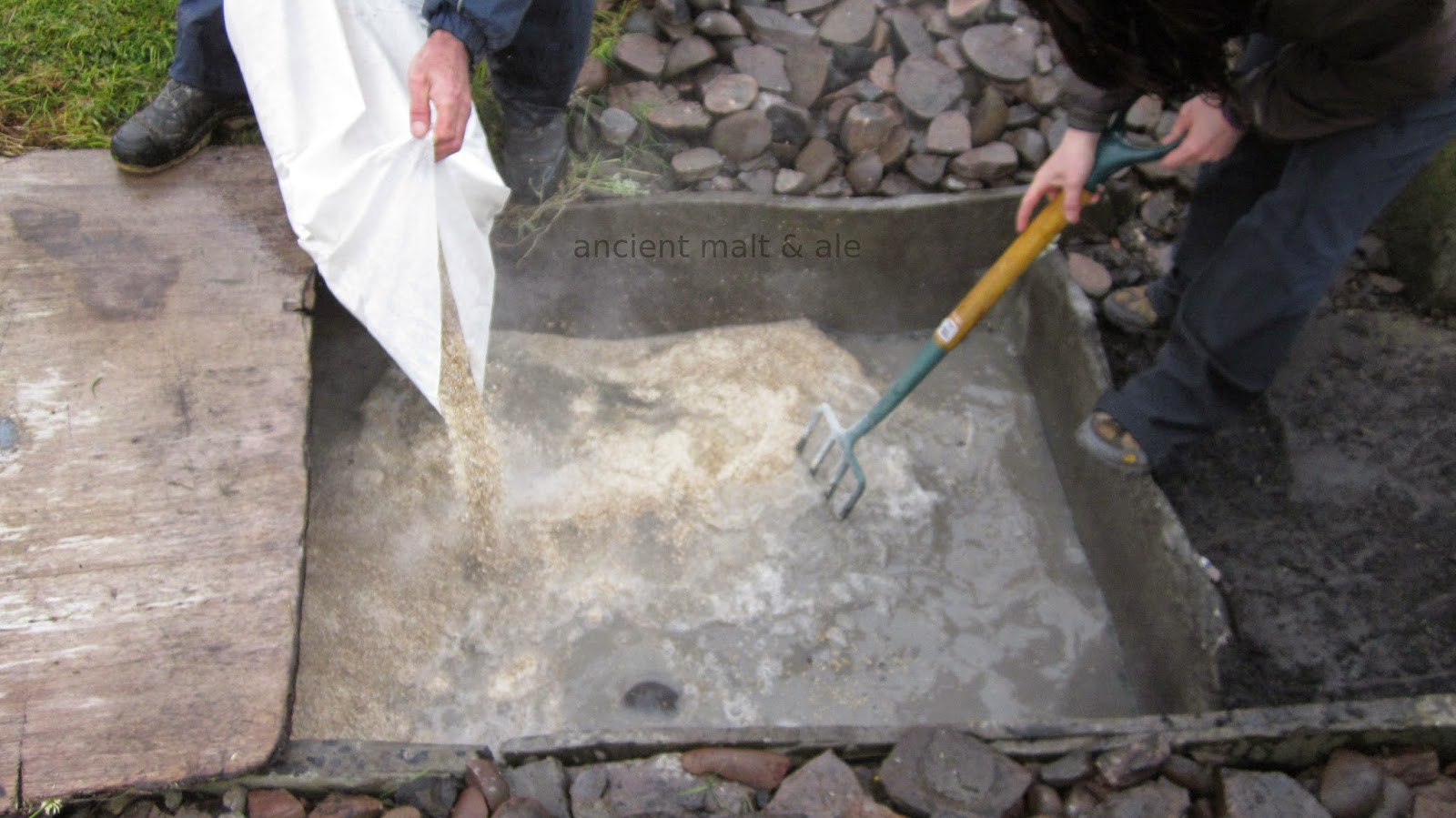
When the water reached strike temperature, 50 kilos of crushed pale malt was added to the 200 litres of water and stirred with a garden fork. You know when the water is the correct temperature for the strike, around 74 degrees Centigrade or thereabouts, because this is when you can clearly see your reflection in the water, no ripples, no steam. We double checked with a thermometer.

The strike:adding the crushed malt to hot water.

The saccharification takes about an hour and it's crucial to keep the mash temperature right for that time, adding hot rocks and stirring as necessary. We put a wooden board over the trough, to help keep the steam and the heat in. It was a good conversion of starches into sugars, a successful mash. The finished mash, when settled, was a deep dark brown and it tasted very sweet.

The finished and settled mash - the next job is to collect the wort and ferment it.
For non brewers, I should emphasise that wort is not alcoholic. Sugar ferments into alcohol, starch does not. The saccharification that happens during the mash is a crucial part of the beer brewing process. Fresh wort is very sweet and prone to all kinds of bacterial and fungal infections. On the three occasions when we have been too tired to process the mash after a demonstration, the next morning the mash was fizzy and sour. Wild yeasts and lactic bacteria infections had ruined it. It was useless. Wort must be collected as soon as it is cool enough to take the yeast. The yeast ferments sugars into alcohol. Herbs or hops preserve and flavour the ale or beer.

We were short of time and collected as much wort as was possible. The brewer used jugs, buckets and plastic containers to scoop from the trough. We had, of course, taken the stones out first, when they were cool enough to handle. The process of collecting the wort was hard work and we only managed to get about 6 gallons out of the trough before we had to pack up, load the van and catch the last ferry back to the Shetland mainland.

The brewer collects wort from the trough. The stones have been removed and are on the heap.

The wort was put into a fermentation vessel, yeast was added and the fermentation vessel was kept warm using sleeping bags as insulation. After about four or five days it had fermented into a fine, clear and strong ale. We used a handful of dried meadowsweet flowers as a preservative.

This is how we should have collected the wort
On the ferry back to mainland Shetland we realised that we had made a mistake. We should have piled the stones up in the trough to make a sort of dam, then we could have put the mash to one side and the wort would have been so much easier to collect. This is how the Moore Group archaeologists collected the wort at their trough mash demonstration at the Sixth World Archaeology Conference in Dublin, 2008.

They made a wooden trough and painted the bottom part with bitumen to ensure that it did not leak. They correctly assumed that the University authorities would not allow them to dig a big hole and set their trough in the ground.

Moore Group archaeologists filling the trough with water at WAC 6, Dublin
They heated the stones on a fire, dropped them into the water and added the crushed malt when the strike temperature was right. It was this hot rock mashing demonstration that inspired us to stop mashing in pottery vessels and start using troughs, wooden tubs and hot stones.

Here are some of my photos of the Moore Group's event:

1 heating the rocks
2 heating the water
3 saccharification: the mash


4 the stone dam, mash and wort separated

5 settled wort and mash

6 collecting the wort, it's cloudy because it has been stirred up.


Hot rock mashing is a spectacular process, the stones sizzle as they hit the water, the mash saccharification happens right before your eyes and the aroma from the mash smells delicious. This is a mysterious, magical transformation from grain starchiness into fermentable sweetness. Surely this would have been an event that would have amazed and impressed people in prehistory, just as much as it does in modern times.

Collecting the wort like this, by creating a dam of stones, is an extremely efficient way of doing it, perhaps even allowing for sparging. Once the first runnings have been collected from the trough, more hot water can be poured gently through the mash, thus releasing more wort for the brewer. There would be very little waste and a good quantity of wort could be collected.


Is there any archaeological evidence for the collection of wort like this?

It is rare that prehistoric troughs are excavated with the stones still within them. If you have excavated one like this, I would love to hear about it. Excavations in 2013 by Wessex Archaeology at Kingsmead Quarry, Horton, in Berkshire, England revealed the remains of four neolithic buildings. They were interpreted as having been 'houses', which is often the case with these discoveries. I do wonder how many of these neolithic 'houses' might have been used as barns or as buildings where the grain was stored and processed. But that's a story for another blog.

One of these four neolithic rectangular timber buildings at Horton caught our attention when we were looking at the pictures online. There appear to be some fire reddened rocks close by one of the buildings, in a heap. The buildings are, as always, interpreted as "houses". But were they dwellings? Or some other kind of building, like a barn or grain processing building? See Wessex Archaeology's page about them here


The red rocks look rather like modern bricks. There seems to be no mention or discussion of them on the web page. Maybe I missed it. However the stratigraphy indicates that they are contemporary with the building. So, are these stones an indication of hot rock water heating technology at neolithic Horton? Were they piled up in a wooden trough that has long rotted away? What were the people doing in and around this rectangular wooden building, over 5000 years ago?

I cannot answer these questions. I am nevertheless intrigued by this discovery. And so I finish this blog with a close up (thanks to Graham) of those mysterious fire reddened stones and welcome interpretations, comments and discussion.
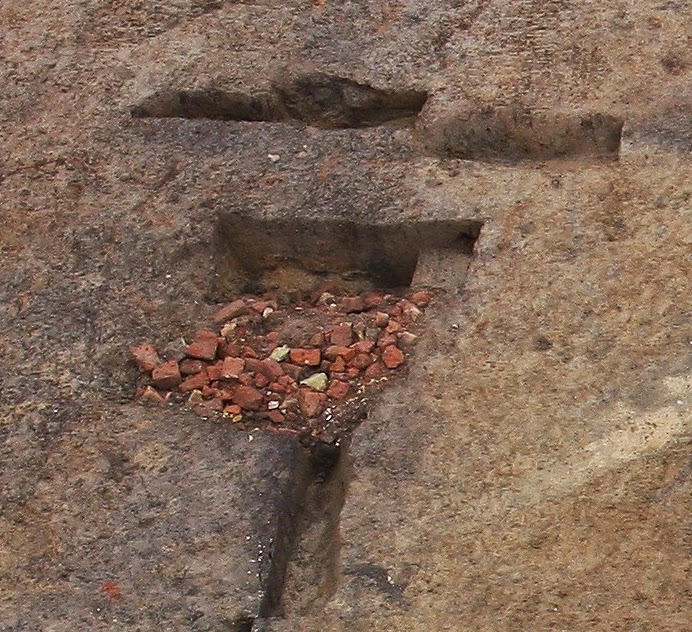
a close up of those mysterious fire reddened stones beside the neolithic building at Horton

 ------------------------------------------------------------------------------------

If you want to know what our Bronze Age Trough Ale, with meadowsweet, tasted like, we sent some to David Connolly of BAJR (British Archaeological Jobs & Resources). Although he struggled to open the parcel, he gave his opinion on the ale's flavour and strength.

It is sometimes said that prehistoric ale was weak, cloudy and sour and that it tasted disgusting. We disagree.

Here is the link: https://www.youtube.com/watch?v=wpvPi25TTOI

Quinn, B., & Moore, D. 2009 ‘Fulacht fiadh’ and the beer experiment’ in Stanley et al (eds) Dining & Dwelling. NRA Monograph Series No. 6, 43-53, NRA, Dublin.

Friday, 23 May 2014

trough mashing, tridents, fire cracked stones and ale

introduction and update
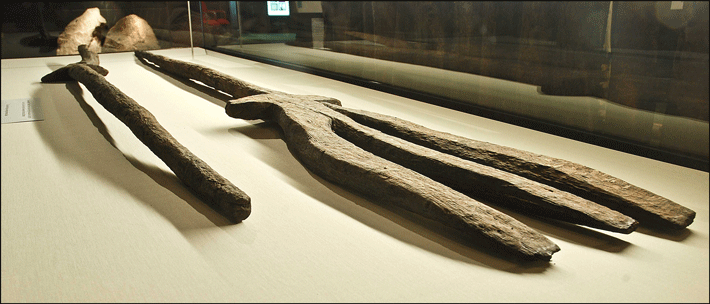
This blog discusses some of the practical and technical details of mashing in, Neolithic and Bronze Age style. It's about troughs and tridents, hot rocks and prehistoric burnt mounds. It was first published in the summer of 2014. I've edited it, added a few more details and brought it a bit more up to date. Why did I do this? Because it's now 17th February 2022 and the World of Stonehenge Exhibition has just opened at the British Museum in London. Among the 400 wonderful exhibits are two large wooden tridents, carved from solid oak and each measuring over two metres long. They were discovered near Stainton, Carslisle, in 2013. What were these mysterious objects used for? Archaeologists were puzzled. Suggestions at the time included eel spears or hay forks, neither being particularly convincing.

There was quite a lot of discussion on social media about the various possible and probable uses for these enigmatic objects made from solid oak. I'll try and find a link to it. It was a lively and, at times, argumentative discussion.

One suggestion that Graham and I made at the time was that these wooden tridents were ideal as mash forks, a traditional tool used for stirring the crushed malt into hot water in the 'mashing in' part of the ale and beer brewing process. Initially the idea was met with some negativity and suspicion. However, it now seems to be one of the accepted interpretations and, I am pleased to report, is included in the newly published book of the 'The World of Stonehenge' Exhibition:

"The tridents may have been used for fishing or eel trapping, or in agricultural activities as hay forks, and even as mashing forks in the process of beer brewing. It is likely that farmers were using some of their cereal harvests to make alcohol for social and religious gatherings rather than consuming only sober porridge and savoury foods." 

(Garrow, D. & Wilkin, N. The World of Stonehenge, published by The British Museum, 2022 page 50)

Neolithic-wooden-trident
(© Tullie House Museum and Art Gallery Trust)
This image is from a news item in Archaeology, Friday December 6th 2013. see:https://www.archaeology.org/news/1610-england-neolithic-wooden-tridents

At the World Archaeology Conference (WAC 6) in Dublin, 2008, archaeologists from the Moore Group demonstrated how to mash in a wooden trough using fire heated stones. They used a garden fork to transfer the stones into the trough.  Inspired by their brewing experiments Graham and I mashed in a replica stone trough at Bressay, Shetland, the site of a Bronze Age burnt mound, in the summer of 2011. We used a garden fork to stir the mash and, at the time, we wished that the handle of the fork could have been longer. Something like these tridents would have been perfect for the job. See our blog trough, mash and wort for more details of these experiments and demonstrations.

These two wooden tridents were carved from single pieces of oak and would certainly have been sturdy enough for the task of stirring the mash in a trough in the ground. They would also have been suitable to remove hot stones from a fire, transferring them into the trough of water in order to heat it and maintain a good mash temperature. The tridents have been dated to c3650 BC and were found in a palaeochannel at Stainton, a site associated with burnt mounds and much more. See here for more details of the excavations. 

And now, after this updated introduction, let's go back to the blog that we wrote in the summer of 2014:

what is a burnt mound?  

In Ireland, over 5000 burnt mound sites are known. In Scotland, about 1900 have been excavated so far. They also found in England and Wales. The burnt mound itself is a pile of fire reddened and cracked stones, often in a semi-circular shape as they have been thrown onto the heap. The stones were put into a fire to be heated up, then dropped into a trough of water in order to heat it. There are many things that hot water can be used for.

Archaeologists agree that burnt mound sites are something to do with hot rock technology - using hot stones to heat lots of water - but to what purpose? That's what archaeologists can't agree on. There have been several suggestions:

- they were used to cook meat. The idea is that you wrap a big piece of meat in straw and leave it in the heated water trough for several hours. You probably have to keep putting more hot stones in, as the water cools. There are easier and more efficient ways of cooking meat.

- they were a sauna or sweat lodge. I don't understand this. In my experience, a sauna has a few hot stones upon which water is splashed to make steam. You don't need a large trough of water and lots of hot stones.

- you can wash sheep fleece or wool in them. This seems to be a practical idea. Fleece must be washed before it is spun into wool for clothing.

None of these suggestions are controversial. Most people reckon that the troughs would have been multi functional - a bit like the kitchen sink only much bigger. When it was suggested that these sites could have been used for making beer, some archaeologists became ever so slightly annoyed. Although the idea was first put forward in 2007, backed by successful experimental work and sound brewing theory, it is still considered by some to be controversial. I don't know why. 

Hot rocks are ideal for heating large amounts of water to the perfect temperature for mashing, which is between 65 and 67 degrees Centigrade. Getting the water much hotter than this is very difficult. We found it impossible to get the water to boil. 

troughs as mash tuns
The possibility that they were used in the making of ale or beer was first suggested by Declan Moore and Billy Quinn of Moore Archaeological and Environmental Services Ltd. I first met them at a Conference about beer and brewing in prehistory and antiquity, held in Barcelona, October 2004. I gave a paper about the importance of malt in the brewing process. Billy and Declan asked me whether it was possible to make beer in a hole in the ground. We agreed they should have a go.

The following year, they came to Orkney to meet Graham and to learn a bit more about how to make ale and beer from the grain. They tasted the wort and were surprised how sweet it is. They tried Graham's beer and liked it. Then they went back to Ireland to do their own research into hot rock mashing in a trough. It went extremely well, and led to their now famous video on You Tube. They wrote an article for Archaeology Ireland and there have been several more articles online since then. The details of their subsequent work are on their web page.

They gave a demonstration of the technique at the Sixth World Archaeology Conference in Dublin, 2008. I was lucky enough to be there and it was spectacular. The smoke, the steam, the hot stones and the aroma of the mash! All of these things added to the magic and drama of the demonstration. If an archaeologist is looking for an impressive show of ritual, power and transformation in prehistory, then a hot rock mash ticks all the boxes. 

One day in the summer of 2009, I got a phone call from Billy. He told me that a trough with grain in it had just been found in Wales. The well preserved trough, with wood lined water channels, was excavated by Dave Chapman of Ancient Arts who went on to do some mashing and brewing experiments of his own. He was successful, as reported in British Archaeology news.

We had to try this for ourselves. So far, we had been mashing small amounts of crushed malt in earthenware bowls. It was clear that the 'hot rocks in a trough' technique worked much better. Graham made a small wooden trough, about one third the size of the real ones, and we had some fun mashing with hot stones. It is best to use stones from the land. Rocks collected from the beach explode when being heated in the fire. This is very dangerous.

We had an opportunity to mash in the replica trough at Bressay, Shetland in the summer of 2011. The same trough that was used to experimentally wash fleeces. We cleaned it well and luted the corners with local clay, to prevent water leakage. This explains the grey colour of the water in the photo below. There was initially some concern that there might be a problem. It turned out to be the clearest, sparkliest ale we have ever made. Bentonite powder, a derivative of clay, is used today to clear wine and beer.

the strike: 50 kg of crushed malt is added to about 250 litres of hot water in the replica Cruester trough, Bressay, Shetland.
We used a garden fork to stir it about.
 
A successful mash. Adding a few hot stones kept the mash at an ideal temperature for the conversion of starch into sugar, which took about an hour. We put a piece of wood over the trough for heat retention. 

crushed malt & water transformed into 250 litres of wort in the trough, enough to make plenty of ale for a feast.
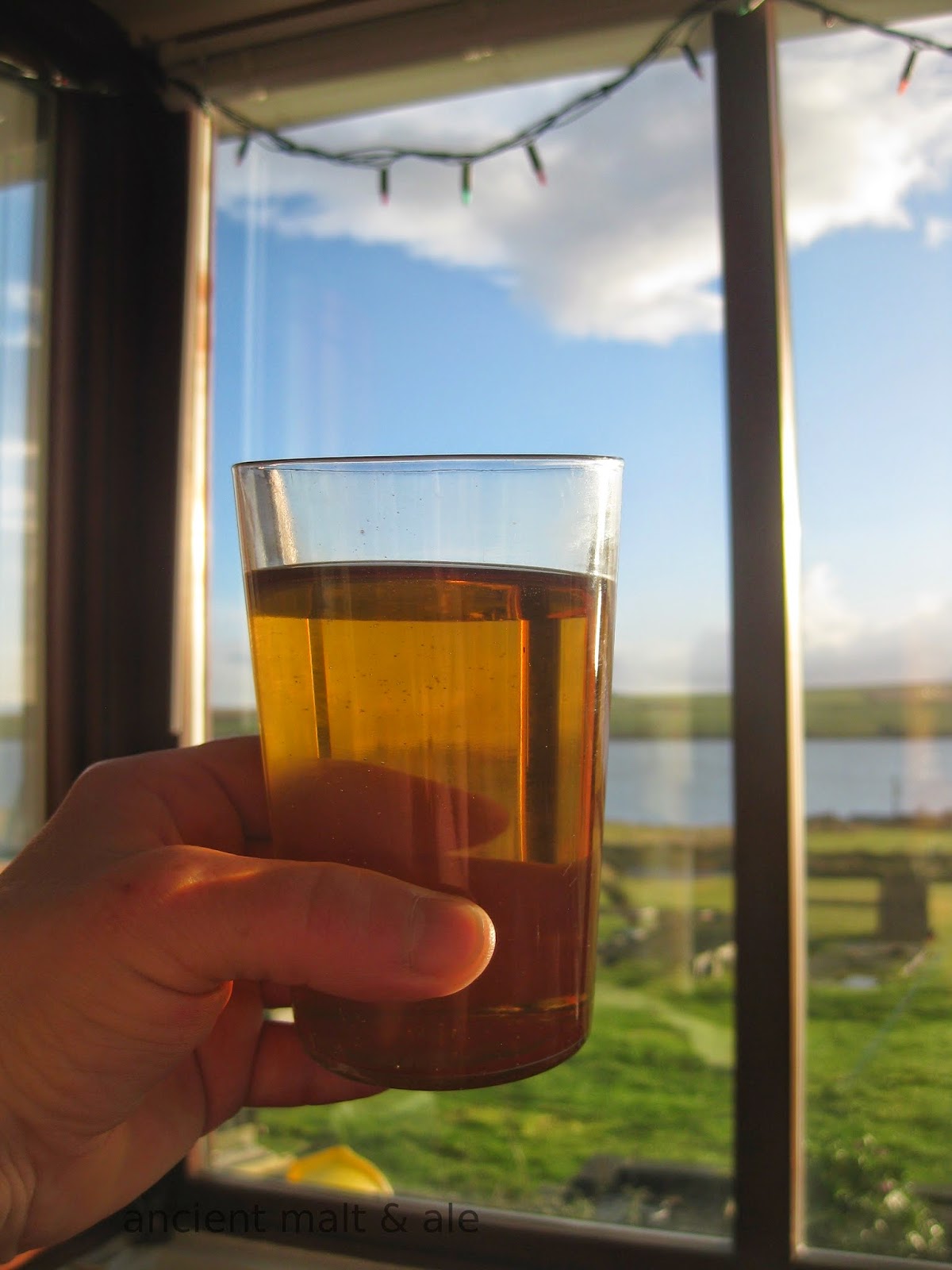
cheers! our clear and bright Bressay Ale.

After taking some of the wort from the trough using jugs, we added brewer's yeast and fermented it for several days. We only had one fermentation vessel, so we could not make use of more than 6 gallons of wort.

Next morning, when we went to empty and clean the trough, all the wort had drained away. Only the spent grain was left. Although we had clay luted it, the reconstructed trough is above the local water table. Meadowsweet flowers, about an ounce and a half, were added to the 6 gallons of wort when it had finished fermenting. Also, we had a ferry to catch and so our time was limited.

The result was a strong, clear ale. You can see all the pictures of our Bressay mashing and brewing adventure on my Facebook page. The ale kept really well.

We bottled it and sent some to the Past Horizons people to taste. It did take a while to open the parcel, but I think it was probably worth it.


neolithic burnt mounds, wooden tridents and fire cracked stones
There are excavations taking place in Northumberland, not far from Bamburgh Castle, organised by the Bamburgh Research Project. Several burnt mounds have been excavated and archaeomagnetromic dates that have so far been obtained indicate that these burnt mounds were in use during the Neolithic. Pottery finds support this interpretation. The dates obtained so far are 6,230 +/- 50 years BP at 95% confidence. There is a good summary of the excavations here.

St.Arnoldus.jpg
Bishop Arnold of Soissons
In December last year, there was much discussion and argument on social media about some neolithic wooden tridents that had been found at a multi period site in Cumbria, which included several burnt mounds. What were these long handled wooden 'forks' used for? Fish prongs? Or maybe they were used for catching eels? Interpretations varied amongst archaeologists.

We think they would be a useful implement for stirring the crushed malt into the hot water - the strike. The crushed malt, also known as grist, clumps together when it is being added to the hot water. It is important to stir it about. It is also necessary to stir the mash when you add more heated stones. You don't want to have hot spots, you want to maintain an even temperature throughout the mash. The fork can also be used to move the hot stones about in the trough, if necessary.

In the Bressay trough, we used a garden fork. The handle was far too short and a long handled wooden trident would have been ideal.

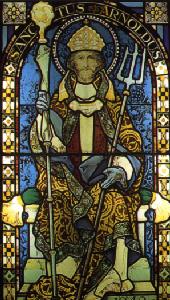
Bishop Arnold of Soissons (who lived from 1040 to 1087) was the patron saint of brewers in Belgium. He is depicted with Bishop's mitre and a mash rake, which looks very much like those neolithic wooden rakes excavated in Cumbria.

Several neolithic buildings have been excavated at Kingsmead Quarry, Berkshire, England, by Wessex Archaeology. They have been interpreted as houses. This site is another very complex, multi period discovery, with finds ranging from the mesolithic, neolithic and Bronze Age through to post medieval structures.

One of the four neolithic rectangular timber buildings, or 'houses' at Horton caught our attention when we were looking at the images online. There seem to be some fire reddened rocks close by the trenches that reveal the outline of the building in the photo below. What are they? They look rather like modern bricks, but the stratigraphy indicates that they are contemporary with the building. Are these stones an indication of hot rock technology at neolithic Horton? If so, exactly what were they doing in and around this wooden building, over 5000 years ago?

the footprint of a neolithic rectangular timber building at Horton, Kingsmead Quarry, with a big pile of fire cracked stones.
Details of the excavation here.


We looked through the reports online but could not find a reference to them. Quite a mystery! Graham managed to enlarge the section of the image with the rocks in and here it is. In close up they look even more mysterious. We look forward to reading the full excavation report to see what the interpretation of these rocks might be.

a close up of those mysterious fire reddened stones.

We would love to hear your ideas about burnt mounds, troughs, mash tuns and the possibilities of hot stone technology. This technique, of heating water and the mash with hot stones, is so successful that it has been done from the Neolithic to Viking times. Some burnt mounds provide dates that indicate this.