Showing posts with label grooved ware. Show all posts

Sunday, 17 July 2016

big pots: fermentation and storage

Brewing ale in Neolithic Britain - it seems to be a controversial topic among some academic archaeologists. I'm not sure what the problem is with malting and brewing ale in the neolithic era. It could be that few people understand the processes involved in the transformation of grain into malt, wort and ale.

If you have come to this page via the BBC Earth website, or from the Stone Pages, please be aware that the comments attributed to me there are wrong. I have no idea where they came from, other than as a misunderstanding. I hope for a correction in the near future but so far I am not having much success.

Roasted malts, also known as specialty malts, are a feature of modern industrial malting. I'm working on a blog about that at the moment and will post a link to it when I have completed it, hopefully before the Yule celebrations of 2016!

The last few posts have been about explaining the saccharification in the mash tun, where the crushed malt, when mixed with water and gently heated, is converted by enzymes into malt sugars. I've also written a little about lautering, sparging and how to collect the wort.

We've been asked 'why not ferment in the trough. Why go to all the trouble of trying to collect a wort without bits in it?'

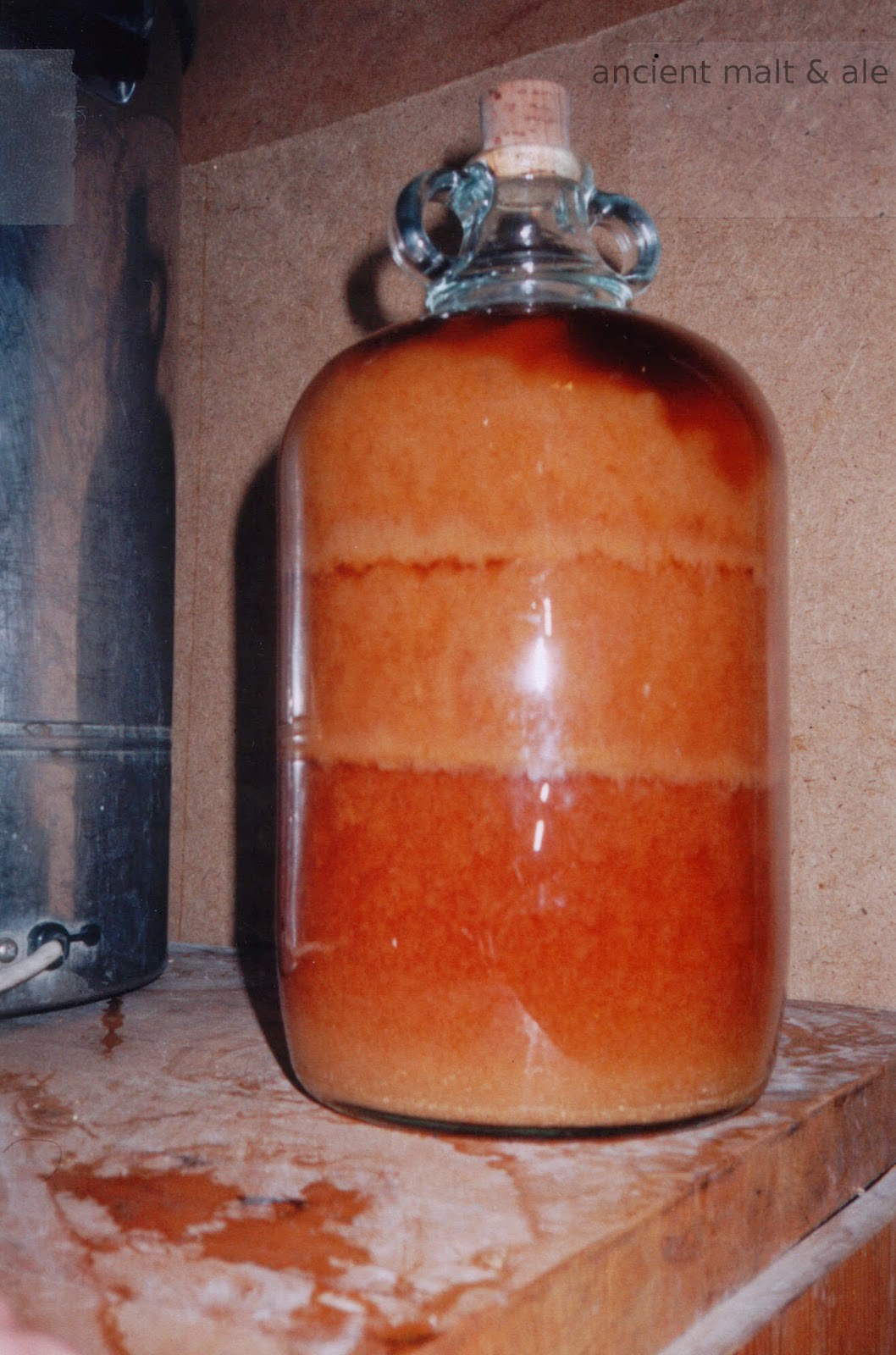
Firstly, alcoholic fermentation requires anaerobic conditions. A large vat (1000s of litres) within a building has a blanket of carbon dioxide over the fermenting beer, as in lambic brewing. A small trough (100s of litres) situated outside would have this blanket blown away. Secondly, during fermentation, the little bubbles of carbon dioxide produced by the yeast, stick to the smaller particles and lift them into the froth of the barm. You can see the towering barm in the picture below. It can turn into a really messy monster when it has a lot of little bits in it. After fermentation you would still have the problem of straining or filtering what brew has not been lost to the froth-over. That is a lot harder with little bubbles in it. A bed of husks will not form properly and filtering just doesn't work. 

Inoculating the wort: starting a fermentation
Once the brewer has obtained a quantity of wort by mashing, lautering and sparging, the next stage of the brewing process is the fermentation. Whether you mash in a large pot, a wooden tub with a spigot hole, in a trough in the ground or in a modern mash tun, the wort that you make must be dealt with promptly to prevent infection setting in. Wort does not keep well. Either you boil it, as is necessary with hops, and then cool and inoculate with yeast at the right temperature. Or you can inoculate a fresh wort when it has cooled, and then add the herbs. We found that meadowsweet flowers inhibited the yeast and are better added after the fermentation. To find out more about raw ale which, basically, is beer made from an unboiled wort, I suggest a look at this blog. Raw ale is a huge topic in itself.

fermentation in close up, this is the barm (foam) on a fermenting beer

There are a number of ways of adding the yeast to the wort to start the fermentation. Today, the brewer can add yeast directly, in dried form or as a yeast starter, when the wort temperature is just right. Many modern breweries keep their yeast starter in a fridge. They scoop some of the barm (foam) from the top of the fermenting beer and then store it in a cool place until required. The yeast culture can be kept and used for several months. 

Brewers in history and prehistory could also have used this simple and basic technique, keeping their barm/yeast culture in a cool place. In the 1980s, archaeologists found a medium sized grooved ware pot which had been sunk into the ground in the remains of one of the buildings at Barnhouse, Orkney. The pot, about a litre in volume, had been buried up to its' rim. Analysis revealed that it had contained some kind of 'cereal based mixture', but they were unsure about the pot's function. I think it may have been a barm pot. It was located in a large building, numbered eight by the excavation team and interpreted as a 'temple' or some other kind of ritual building. There were drains as well as many sherds of broken or smashed Grooved Ware pottery, representing pots of about one litre in volume. There was also evidence of feasting and what archaeologists refer to as 'ritual activity', although what that was is not made clear in the excavation report.

I would say that if an archaeologist is looking for a prehistoric ritual activity then the mysterious and magical transformation of grain into malt, wort and ale is well worth considering.

In Norway, Lithuania, Latvia and other places, the tradition of making farmhouse ale survives, with brewers passing on their skills, techniques and knowledge to their descendants. Old traditions of inoculating the wort are still practised in several areas of northern Europe. The picture below shows a wooden yeast ring or kveikering being used to inoculate a yeast starter.

wooden yeast ring or kveikering (photo from the beer blog of Lars Garshol)

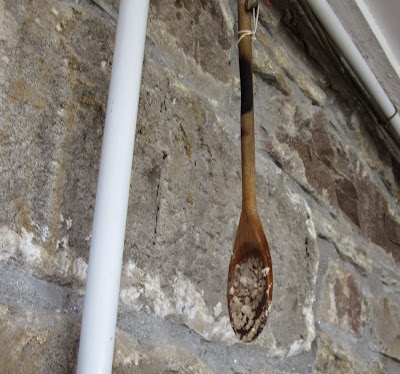
Some sources say that the tradition of the kveikering dates back to the 18th century, although I wonder whether the concept might date even further back. It's difficult to be sure because, of course, a wooden object used to gather yeast and start a fermentation would not survive in the archaeological record. In the Viking era, apparently, a stick was used to stir the fermenting wort. This would put yeast onto the stick. Then, if it was kept dry, it could be used to start the next fermentation by stirring a fresh wort. In the Western Isles of Scotland there is a tradition of stirring the fermenting beer with a hazel stick (or wand) which is then hung up to dry and used to stir the next batch of wort, to begin the fermentation.

We did some experiments using a wooden spoon and found that this technique works perfectly.
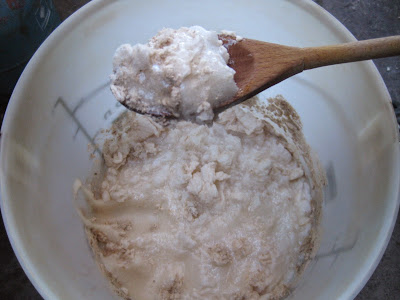
harvesting barm from the fermentation vessel
barm/yeast drying on the wooden spoon (more photos here)

Big pots as fermentation and storage vessels.
The neolithic era was the time of the 'first farmers'. The earliest grain agriculturalists of the British Isles (c4000BC onwards) were also the megalith builders. They created magnificent stone circles and henges as gathering places for the community. They built stone tombs for their dead and they began to settle down. Associated with the 'first farmers' is the integrated 'cultural package' of grain cultivation, the management of domesticated animals (cows, sheep, goats and pigs) and the manufacture of ceramics. This was the 'neolithic revolution', a different lifestyle to the mesolithic hunter gatherers who had roamed the land for thousands of years previously. At this time in prehistory, the technology for making large stave built wooden vessels (vats, tubs, barrels) did not exist.

How did these neolithic 'first farmers' process their grain? Were they grinding it into flour, to make bread? Were they boiling it, making some kind of gruel or porridge? Or were they making ale from it, by malting, mashing, sparging and fermentation? For some reason, the possibility that such a thing as ale in the neolithic is considered to be a controversial idea by many archaeologists. I'm not sure why. 

Some of the large neolithic Grooved Ware pots might have been used as fermentation vessels. They are perfect in both shape and size. One particularly large Grooved Ware pot found at the neolithic village of Skara Brae, Orkney, was around 30 gallons in volume. Most of the large Grooved Ware pots were around eight to ten gallons. They are found at many ritual and feasting sites of the neolithic, in domestic contexts, for example at Skara Brae, Orkney, and at stone circles and henge monuments throughout the British Isles.

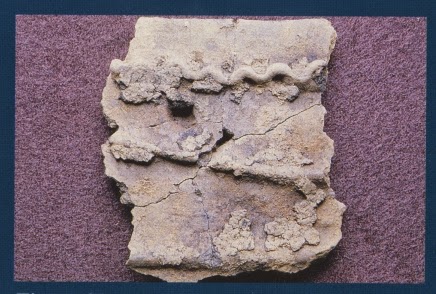
What is Grooved Ware? It is neolithic pottery that archaeologists have defined by its' decorative pattern of grooves and shapes on the exterior. Not all grooved ware has grooves; some of it has fancy applied decoration, with blobs of clay and raised patterns. Most Grooved Ware pots are bucket shaped, with a flat bottom. They are found throughout the British Isles, from Clacton to Orkney and Shetland and also in Ireland. Indeed, this style of pottery was first called 'Rinyo-Clacton Ware'. Rinyo being the name of a site on one of the Orkney islands, Rousay. It was a neolithic village larger than Skara Brae. Grooved Ware was also found on the south coast, at Lion Point near Clacton.

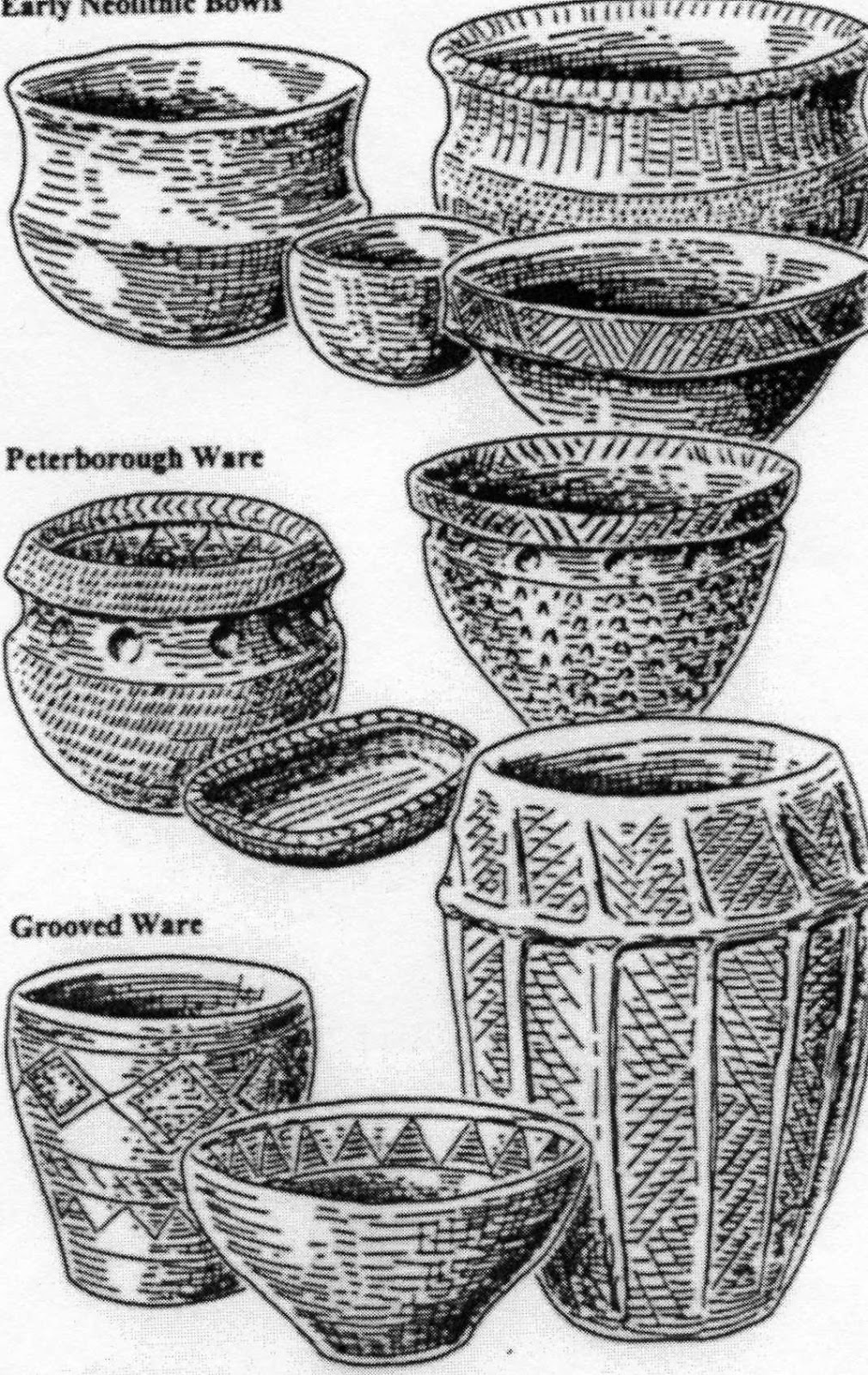
Here's one of Stuart Piggott's beautiful and classic drawings of British Neolithic pottery, showing what some of the Grooved Ware pots from the south coast probably looked like, based upon sherds found during excavations on the Essex coast, at Lion Point.


Pottery is frequently found during archaeological excavations. Archaeologists regard it as diagnostic. The discovery and identification of a sherd of pottery gives them a good clue about the date of the site. Neolithic and Bronze Age pottery was not glazed. It could have been waterproofed in several ways, by burnishing or by being sealed with fats, beeswax or milk.

a sherd of grooved ware
Pottery typologies are complex. It's an enormous area of archaeological study and I could not possibly go into every style and type of British Neolithic pottery in this blog. We would be here forever. There's Windmill Hill, Grimston-Lyles Hill Ware, Ronaldsway, Grooved Ware, Unstan Ware, Peterborough Ware, Ebbsfleet and so the list goes on. Most are round bottomed pots, with the exception of Grooved Ware. It took me many months to get to grips with these stylistic categorisations that have been imposed upon pottery of 5000 years ago.

Many bowl shaped pots are interpreted as 'cooking pots'. That seems fairly reasonable. What puzzles me is that whenever archaeologists find a very large pot, or the sherds of a large flat bottomed bucket shaped pot, it is almost always interpreted as a 'storage pot'. I have not yet come across a large pot from the British Neolithic that has been interpreted as a potential fermentation vessel, although some of them have a volume of several gallons and such large pots are often found at feasting sites, for example, at Durrington Walls, near Stonehenge.

If an earthenware pot is to be used to contain any liquid it must be waterproofed. We discovered, in our mashing and fermenting experiments, that beeswax worked very well as a sealant, as did butter and lard.

As a control experiment we tried fermenting mead in an untreated earthenware pot. The fermentation worked well, the room filled with the smell of mead, and the outside surface of the pot was covered in little beads of sticky sweetness. But the final product was disappointingly low in alcohol. It turns out that the alcohol diffuses through the porous pot much faster than the honey solution. This makes an untreated pot pretty useless for creating an alcoholic drink.

Here is a sample of some of the British Neolithic pottery types, as recorded by Stuart Piggott. You can see that there is a wide range of styles. Some have holes in the rim, to secure a covering or lid of, perhaps, leather. Some are deep, others are wide and shallow. I prefer to look at these pots with function in mind, rather than consider only their decoration and style.


Is there any archaeological evidence for the use of large pots for the fermentation or storage of barley wort? 
One of the very best indicators that a pot was used to ferment wort into ale, or for storing the ale, is the identification of beerstone on the internal surface. Beerstone precipitates out of a fermenting barley wort, it looks rather like eggshell. We have a lot of it accumulating on our plastic fermentation buckets and storage vessels.

It takes many hundreds of uses to accumulate a visible deposit of beerstone, but it is a certain proof of fermented wort. Brewers using plastic pipes in breweries often have to clean them of an accumulation of beerstone. It clogs the pipes.

Here is some beerstone from one of our fermentation vessels:


Beerstone has been identified on pots from a Bronze Age site in the Zagros mountains of modern day Iran. At excavations at Godin Tepe a great many pots and jars were discovered, they were stored in the University of Pennsylvania Museum. Subsequent analysis of a yellowish deposit on the internal surface of jars identified beerstone and it is generally accepted as unequivocal evidence for beer brewing. This pioneering paper by Badler, Michel and McGovern, published in 1993, tells the whole story and contains sufficient detail to be able to repeat the tests for beerstone on prehistoric pottery.

I wonder whether any archaeologists in the UK or Europe would consider looking for beerstone on big prehistoric pots? Maybe it is already being investigated. It would be great if this could happen, since this might end the apparent controversy about whether or not a big old pot was used for the fermentation of beer made from a barley wort.

-----------------------------------------------------

If you would like to make your own kveikering, here is some more information  and details of how to make one. Brewer Martin Warren of the Poppyland Brewery was so impressed by the idea that he made his own.

My conference paper from 1996 "Neolithic Ale: Barley as a source of sugars for fermentation" can be downloaded from my Academia page, here. 


Tuesday, 13 May 2014

controversy in a grooved ware bucket

 The Larger Vertical Stone
Balfarg: an ancient site on a housing estate
The focus of my research changed suddenly, from the British Bronze Age to the Neolithic, one day in the summer of 1997. I was reading an excavation report about the prehistoric ceremonial site in Scotland, known as Balfarg. It was a large and complex place. As well as a neolithic henge and stone circle, which was preceded by a timber circle, there were the remains of mysterious rectangular timber built structures. There was also a ring cairn and a ring ditch. Lots of prehistoric pottery was found, ranging from neolithic bowls and large grooved ware bucket shaped pots to bronze age beakers, tripartite food vessels and bucket urns.

Pits contained what the excavators interpreted as "ritually charged" material. These so called "ritual pits" contained large quantities of broken and burnt pottery, mixed up with charcoal and burnt bone. Apparently, these things were deposited deliberately. In other pits there was no pottery, just charcoal, and the pit had been carefully sealed with closely packed stones.

Residues were noticed on a few sherds of neolithic grooved ware that had been buried in one of these pits. Analysis of these cereal based residues with meadowsweet pollen are similar to those found on Bronze Age pots, specifically, the Strathallan Food Vessel and the Ashgrove Beaker, which have both been interpreted as possibly being the remains of ale.

Were they making malt and ale in neolithic Britain? It seemed so to me. The Neolithic Revolution began in the British Isles around 4000 BC. Did it take people almost 2000 years, until the Bronze Age, before they realised or discovered that it was possible to make malt and ale with the barley and wheat that they were so keen to grow? Was the Neolithic really a time of growing grain to make flour, bread, porridge and gruel? Or were they making sandwiches for the feasts, as Professor Mike Parker Pearson seems to be suggesting. Or maybe he is just making a joke?

a few words about brewing residues
When making ale from crushed malted grain, two types of sludgy cereal based residues are generated during the brewing process. The first is a sludge, rich in barley chaff from the sparging process. Freshly sparged wort is cloudy at first. 

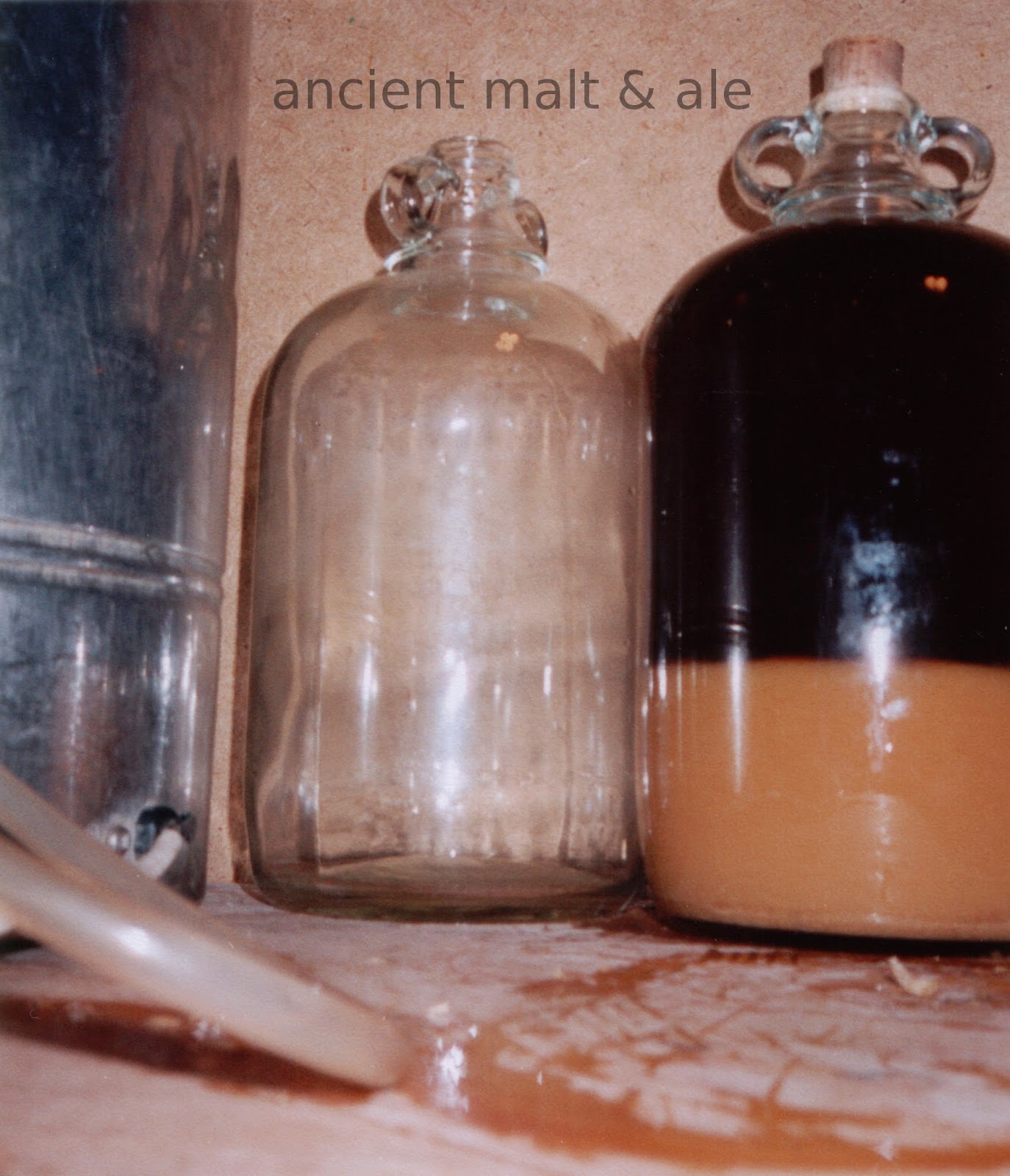
freshly sparged wort - settling out
the same wort, settled out with sludgy cereal residues accumulated
Once you have a clear wort, it is racked or syphoned off into a fresh clean vessel. Some chaff will inevitably get through. Boil the wort with selected herbs, flowers or hops and then ferment it. You can use the barm from previous brews to start a fermentation, it is ideal. A simple process, once you know how to do it.

The second type of brewing residue is cereal based, but with traces of yeast and herbs, hops, flower heads, leaves, twigs or pollen that settle out during the fermentation of the wort in the fermenting vessel. If you are lucky enough to drink a bottle of traditionally made real ale, the kind that must be poured in one go so as not to disturb the sediment, then you will know roughly what I mean. 

cereal based residues on grooved ware buckets
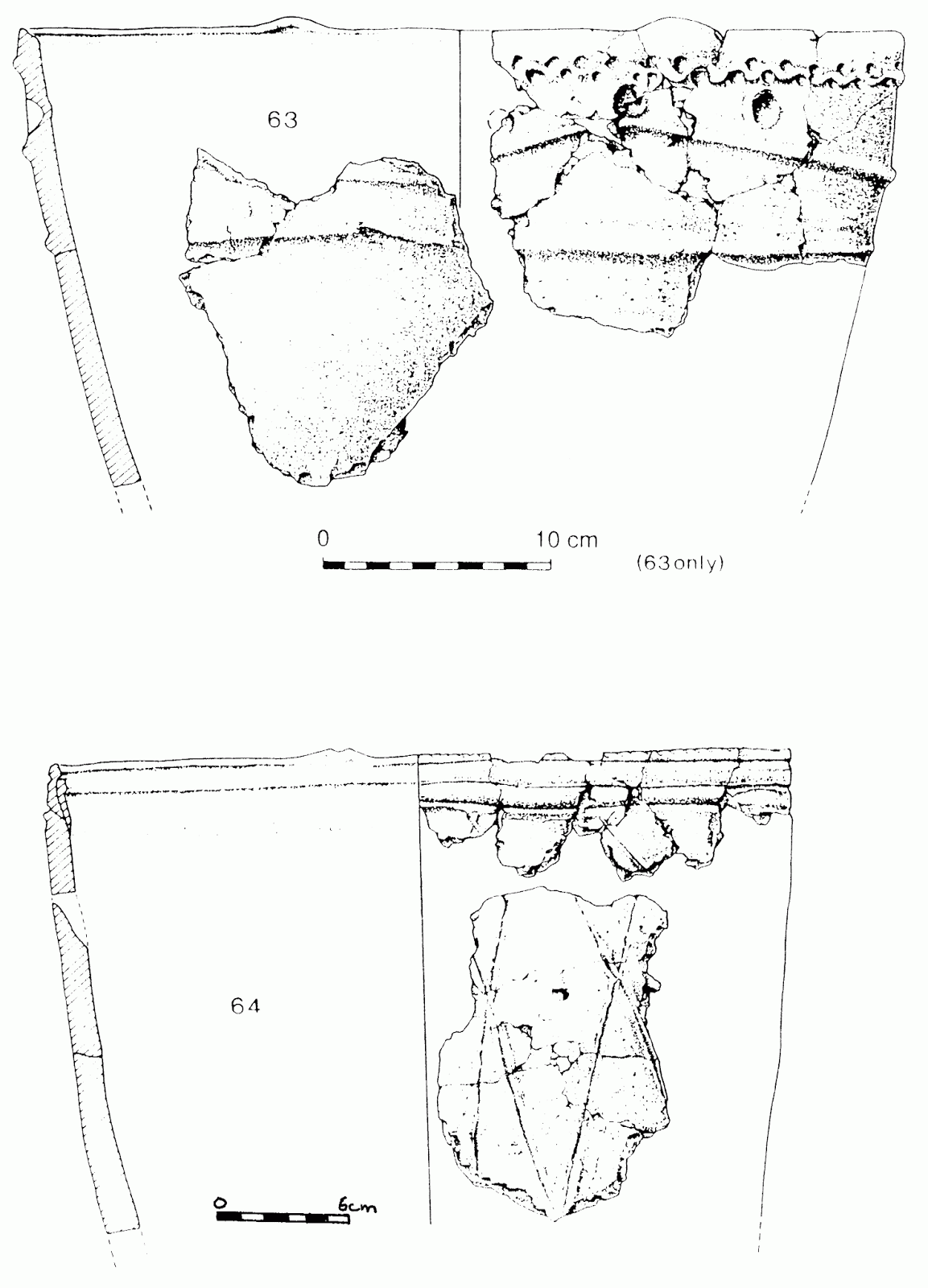
Let's go back to the Balfarg excavation report. The pots in question were numbers 63 and 64. Sherds from these two large grooved ware bucket shaped pots were found in a pit, close by one of the rectangular timber structures. Brian Moffat's descriptions of the cereal based residues make interesting reading for any all-grain brewer or archaeologist. I recognised immediately what these residues represented when I read them, way back on that summer's day in 1997. Not a sort of porridge with added herbs. Not a kind of gruel. These cereal based residues were probably the remains of brewing sediments from the fermentation bucket.

I was so excited by this! Ale in the Neolithic! I ran round to my best friend's house, just round the corner from where I lived, and told her all about it. She is a biochemist and was just as excited as I was. I told my supervisor the next day. He did not seem impressed at the prospect of malt and ale in neolithic Scotland. The previous year I had a short article published in British Archaeology, so I contacted the editor. He asked me to send him some details so that he could include it in the News section, September 1997. The Getafix and magic potions reference was not my idea! I do like it, though.

the original descriptions of the residues on pots 63 & 64

pots 63 & 64 from Balfarg (PSAS Vol 123)
Three broad, yet distinct types of burned cereal based residues were identified on the inside surface of sherds:
1. amorphous & burned
2. amorphous, granular & burned 
these two types were abundant in all samples.

3. burned cereal mash
both barley & oats, part grains, there was no entire carbonized grain since the grain had been thoroughly ground down, making taxonomic identification difficult.

"... a cereal based preparation ... with meadowsweet, indicated by both pollen & macroplant remains, clumps in one sample indicate a flowerhead was added ... fat hen ... cabbage/mustard? ... the single record of nightshade is puzzling ... pollen from hemlock ... the mix is coarse and crude ... like course porridge with potherbs and flavourings"

Another burned deposit was encrusted on the outer surface of one sherd of Pot P63. Both pollen and seeds of black henbane were identified.  
"... the seeds are robust and resilient and the breaks show mechanical rendering ... pollen and seed fragments were fairly well intermixed suggesting an incomplete process of homogenization ... the small cache of seeds is of black henbane alone."

Two separate organic residue deposits. One inside the pots, this one was cereal based with several different herbs added. The other residue was a burnt encrustation on the outside surface which, when first analysed, contained henbane pollen and several henbane seeds.
burnt encrustation on the outside of Pot 63 that contained henbane pollen and seeds

The above photo is from the booklet "Balfarg. The Prehistoric Ceremonial Complex" published by Fife Council, Glenrothes Development Corporation and Historic Scotland, 1993. I think it was intended as a guidebook for the site and is now out of print. There may be secondhand copies available. The original archaeobotanical report of the Balfarg residues is on pages 108-110 in Proceedings of the Society of Antiquaries of Scotland, Vol 123.

Henbane (hyoscyamus niger)
According to Culpepper, henbane should never be taken internally. More modern herbal reference books warn that it is a deadly poisonous plant. Do not use. This is very good advice. However, henbane does have its' place as a herbal remedy that was sometimes used in historical times, for example, to alleviate earache if applied externally, as a tincture. If consumed in small quantities, henbane induces intoxication, hallucinations, blurred vision, rapid heartbeat, euphoria and dizziness.

It is an effective painkiller, according to the herbal literature. All parts of the plant can be used and the seeds are about ten times more potent than the leaves or flowers. I am sure that, in the Neolithic, people knew about the medicinal and other properties of the henbane plant. It grows well in coastal regions and henbane seeds were identified at Skara Brae, a neolithic village in Orkney, Scotland. An intriguing aspect of the plant is that the active ingredients, the alkaloids, are more soluble in alcohol than in water.

henbane (hyoscyamus niger)

so what's the controversy?
This appeared to be not about the cereal based residues, but rather about the unusual identification of henbane seeds in the burnt encrustation on the outside surface of a neolithic pot sherd. It seems that, at first, there was not a problem. The excavation report, with its' rather interesting archaeobotanical report, sat quietly in the library journal section for a few years. It did not make any trouble. As more things were written about it, and as more archaeologists made reference to the possible "ritually charged" aspects of this rare residue discovery, it seemed that a re-analysis was required. This was commissioned by Historic Scotland. Two academic papers were rapidly produced.

The first was published in January 1999 in the Journal of Archaeological Science. This is a pay to view paper, with access available through University Libraries. Although the existence of henbane seeds within the residue was not confirmed, the residue was described as "a uniform and well processed substance, possibly something like a thick carbohydrate or protein based gruel". This description is consistent with the sludgy residues that accumulate at the bottom of an ale fermentation vessel - a well processed homogeneous mixture of cereal chaff, pollen, plant fragments and seeds.

The second paper was published in March, 2000 in Antiquity. This one, happily, is accessible online and is essentially a summary of the first paper. The focus is on disproving the "henbane ale" theory. The abstract makes this clear: "Were drugs in use in prehistory? Recent claims for the use of hallucinogenic substances have been made, and caused a stir. However, new work on a Scottish Neolithic ceremonial site suggests archaeologists (and the media) may have been jumping to the wrong conclusions!"

Whether or not henbane was added to the ale is clearly debatable. If such plants were being added to the brew, then it infers an understanding of their properties and some interesting ritual practices in prehistory. It might infer shamanistic practices, witchcraft, medicinal use of plants and more. A paper has been published recently in the Journal of Archaeological Method and Theory by Elisa Guerra-Doce of the Universidad de Valladolid in Spain. She argues that "far from being consumed for hedonistic purposes, drug plants and alcoholic drinks had a sacred role among prehistoric societies. It is not surprising that most of the evidence derives from both elite burials and restricted ceremonial sites, suggesting the possibility that the consumption of mind-altering products was socially controlled in prehistoric Europe."

My interest is in the cereal based residues on these ancient grooved ware pots and what they tell us about cereal processing techniques in the Neolithic. Flour, bread, porridge, gruel or was it malt and ale? What were they drinking at feasts? Was it sacred river water, or was it sacred ale? When searching for an image of grooved ware pottery online I found this comment on that well known online Encyclopedia - Wikipedia:

"Grooved ware comes in many sizes, some vessels are extremely large, about 30 gallons, and would be suitable for fermentation. The majority are smaller, ranging from jug to cup size, and could be used for serving and drinking. The theory that the first British farmers (c4000 BC) had the knowledge and ability to make ale from their crops with their pottery appears to be controversial and not yet widely discussed by the archaeological community."

There have been some amazing recent archaeological excavations and discoveries of ancient ceremonial and feasting sites, for example the Ness of Brodgar on Orkney and Durrington Walls, near Stonehenge in England, which was investigated by the Stonehenge Riverside Project. There is also evidence for beer brewing and feasting at Gobekli Tepe in Turkey, at the dawn of agriculture, some twelve thousand years ago.

It is surely time for the academic community to start talking seriously about how grain was being processed in prehistory. What were they were using it for? The options seem to be flour, bread, porridge, gruel or malt and ale, with added herbs.

----------------------------------------------------------------------------------------------------------------------

Balfarg Excavations
Balfarg was excavated before the construction of a housing estate. As a result, plans were altered to preserve the stones and build the houses around them. The excavation reports are online, thanks to the Archaeology Data Service, York University, so you can read it for yourself from the comfort of your own desk or armchair: Barclay, G J & Russell-White, C J (eds) 1993 'Excavations in the ceremonial complex at Balfarg/Balbirnie, Glenrothes, Fife' Proceedings of the Society of Antiquaries of Scotland Vol 123, 43-210.

Balfarg had been excavated earlier, in the 1970s. During those excavations a cist burial was found, containing the bones of an adult together with a dagger and a fine beaker with a handle - a rare find indeed. This excavation, by Roger Mercer, was published in 1981: The excavation of a late neolithic henge-type enclosure at Balfarg, Markinch, Fife, Scotland 1977-1978. Proceedings of the Society of the Antiquaries of Scotland Vol 111, 63-171.