Showing posts with label saccharification. Show all posts

Sunday, 17 July 2016

big pots: fermentation and storage

Brewing ale in Neolithic Britain - it seems to be a controversial topic among some academic archaeologists. I'm not sure what the problem is with malting and brewing ale in the neolithic era. It could be that few people understand the processes involved in the transformation of grain into malt, wort and ale.

If you have come to this page via the BBC Earth website, or from the Stone Pages, please be aware that the comments attributed to me there are wrong. I have no idea where they came from, other than as a misunderstanding. I hope for a correction in the near future but so far I am not having much success.

Roasted malts, also known as specialty malts, are a feature of modern industrial malting. I'm working on a blog about that at the moment and will post a link to it when I have completed it, hopefully before the Yule celebrations of 2016!

The last few posts have been about explaining the saccharification in the mash tun, where the crushed malt, when mixed with water and gently heated, is converted by enzymes into malt sugars. I've also written a little about lautering, sparging and how to collect the wort.

We've been asked 'why not ferment in the trough. Why go to all the trouble of trying to collect a wort without bits in it?'

Firstly, alcoholic fermentation requires anaerobic conditions. A large vat (1000s of litres) within a building has a blanket of carbon dioxide over the fermenting beer, as in lambic brewing. A small trough (100s of litres) situated outside would have this blanket blown away. Secondly, during fermentation, the little bubbles of carbon dioxide produced by the yeast, stick to the smaller particles and lift them into the froth of the barm. You can see the towering barm in the picture below. It can turn into a really messy monster when it has a lot of little bits in it. After fermentation you would still have the problem of straining or filtering what brew has not been lost to the froth-over. That is a lot harder with little bubbles in it. A bed of husks will not form properly and filtering just doesn't work. 

Inoculating the wort: starting a fermentation
Once the brewer has obtained a quantity of wort by mashing, lautering and sparging, the next stage of the brewing process is the fermentation. Whether you mash in a large pot, a wooden tub with a spigot hole, in a trough in the ground or in a modern mash tun, the wort that you make must be dealt with promptly to prevent infection setting in. Wort does not keep well. Either you boil it, as is necessary with hops, and then cool and inoculate with yeast at the right temperature. Or you can inoculate a fresh wort when it has cooled, and then add the herbs. We found that meadowsweet flowers inhibited the yeast and are better added after the fermentation. To find out more about raw ale which, basically, is beer made from an unboiled wort, I suggest a look at this blog. Raw ale is a huge topic in itself.

fermentation in close up, this is the barm (foam) on a fermenting beer

There are a number of ways of adding the yeast to the wort to start the fermentation. Today, the brewer can add yeast directly, in dried form or as a yeast starter, when the wort temperature is just right. Many modern breweries keep their yeast starter in a fridge. They scoop some of the barm (foam) from the top of the fermenting beer and then store it in a cool place until required. The yeast culture can be kept and used for several months. 

Brewers in history and prehistory could also have used this simple and basic technique, keeping their barm/yeast culture in a cool place. In the 1980s, archaeologists found a medium sized grooved ware pot which had been sunk into the ground in the remains of one of the buildings at Barnhouse, Orkney. The pot, about a litre in volume, had been buried up to its' rim. Analysis revealed that it had contained some kind of 'cereal based mixture', but they were unsure about the pot's function. I think it may have been a barm pot. It was located in a large building, numbered eight by the excavation team and interpreted as a 'temple' or some other kind of ritual building. There were drains as well as many sherds of broken or smashed Grooved Ware pottery, representing pots of about one litre in volume. There was also evidence of feasting and what archaeologists refer to as 'ritual activity', although what that was is not made clear in the excavation report.

I would say that if an archaeologist is looking for a prehistoric ritual activity then the mysterious and magical transformation of grain into malt, wort and ale is well worth considering.

In Norway, Lithuania, Latvia and other places, the tradition of making farmhouse ale survives, with brewers passing on their skills, techniques and knowledge to their descendants. Old traditions of inoculating the wort are still practised in several areas of northern Europe. The picture below shows a wooden yeast ring or kveikering being used to inoculate a yeast starter.

wooden yeast ring or kveikering (photo from the beer blog of Lars Garshol)

Some sources say that the tradition of the kveikering dates back to the 18th century, although I wonder whether the concept might date even further back. It's difficult to be sure because, of course, a wooden object used to gather yeast and start a fermentation would not survive in the archaeological record. In the Viking era, apparently, a stick was used to stir the fermenting wort. This would put yeast onto the stick. Then, if it was kept dry, it could be used to start the next fermentation by stirring a fresh wort. In the Western Isles of Scotland there is a tradition of stirring the fermenting beer with a hazel stick (or wand) which is then hung up to dry and used to stir the next batch of wort, to begin the fermentation.

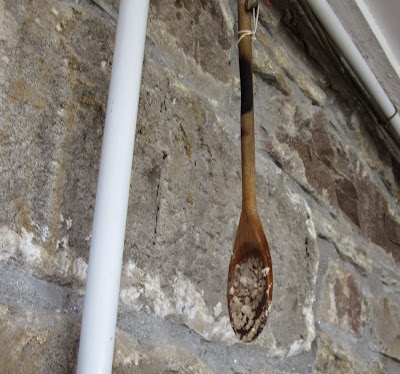
We did some experiments using a wooden spoon and found that this technique works perfectly.
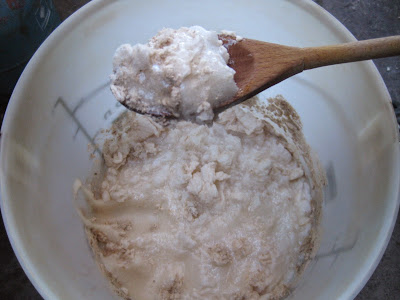
harvesting barm from the fermentation vessel
barm/yeast drying on the wooden spoon (more photos here)

Big pots as fermentation and storage vessels.
The neolithic era was the time of the 'first farmers'. The earliest grain agriculturalists of the British Isles (c4000BC onwards) were also the megalith builders. They created magnificent stone circles and henges as gathering places for the community. They built stone tombs for their dead and they began to settle down. Associated with the 'first farmers' is the integrated 'cultural package' of grain cultivation, the management of domesticated animals (cows, sheep, goats and pigs) and the manufacture of ceramics. This was the 'neolithic revolution', a different lifestyle to the mesolithic hunter gatherers who had roamed the land for thousands of years previously. At this time in prehistory, the technology for making large stave built wooden vessels (vats, tubs, barrels) did not exist.

How did these neolithic 'first farmers' process their grain? Were they grinding it into flour, to make bread? Were they boiling it, making some kind of gruel or porridge? Or were they making ale from it, by malting, mashing, sparging and fermentation? For some reason, the possibility that such a thing as ale in the neolithic is considered to be a controversial idea by many archaeologists. I'm not sure why. 

Some of the large neolithic Grooved Ware pots might have been used as fermentation vessels. They are perfect in both shape and size. One particularly large Grooved Ware pot found at the neolithic village of Skara Brae, Orkney, was around 30 gallons in volume. Most of the large Grooved Ware pots were around eight to ten gallons. They are found at many ritual and feasting sites of the neolithic, in domestic contexts, for example at Skara Brae, Orkney, and at stone circles and henge monuments throughout the British Isles.

What is Grooved Ware? It is neolithic pottery that archaeologists have defined by its' decorative pattern of grooves and shapes on the exterior. Not all grooved ware has grooves; some of it has fancy applied decoration, with blobs of clay and raised patterns. Most Grooved Ware pots are bucket shaped, with a flat bottom. They are found throughout the British Isles, from Clacton to Orkney and Shetland and also in Ireland. Indeed, this style of pottery was first called 'Rinyo-Clacton Ware'. Rinyo being the name of a site on one of the Orkney islands, Rousay. It was a neolithic village larger than Skara Brae. Grooved Ware was also found on the south coast, at Lion Point near Clacton.

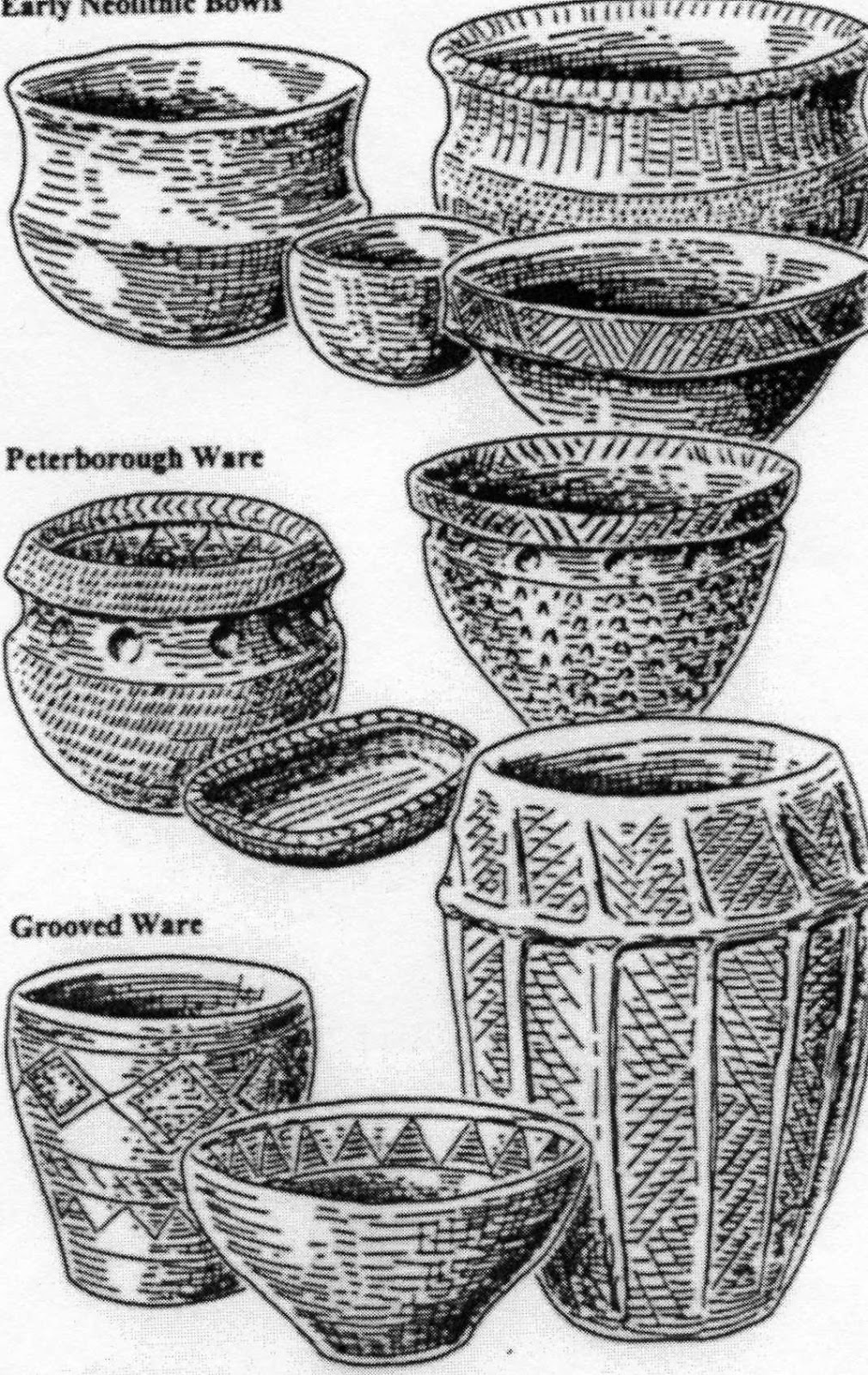
Here's one of Stuart Piggott's beautiful and classic drawings of British Neolithic pottery, showing what some of the Grooved Ware pots from the south coast probably looked like, based upon sherds found during excavations on the Essex coast, at Lion Point.


Pottery is frequently found during archaeological excavations. Archaeologists regard it as diagnostic. The discovery and identification of a sherd of pottery gives them a good clue about the date of the site. Neolithic and Bronze Age pottery was not glazed. It could have been waterproofed in several ways, by burnishing or by being sealed with fats, beeswax or milk.

a sherd of grooved ware
Pottery typologies are complex. It's an enormous area of archaeological study and I could not possibly go into every style and type of British Neolithic pottery in this blog. We would be here forever. There's Windmill Hill, Grimston-Lyles Hill Ware, Ronaldsway, Grooved Ware, Unstan Ware, Peterborough Ware, Ebbsfleet and so the list goes on. Most are round bottomed pots, with the exception of Grooved Ware. It took me many months to get to grips with these stylistic categorisations that have been imposed upon pottery of 5000 years ago.

Many bowl shaped pots are interpreted as 'cooking pots'. That seems fairly reasonable. What puzzles me is that whenever archaeologists find a very large pot, or the sherds of a large flat bottomed bucket shaped pot, it is almost always interpreted as a 'storage pot'. I have not yet come across a large pot from the British Neolithic that has been interpreted as a potential fermentation vessel, although some of them have a volume of several gallons and such large pots are often found at feasting sites, for example, at Durrington Walls, near Stonehenge.

If an earthenware pot is to be used to contain any liquid it must be waterproofed. We discovered, in our mashing and fermenting experiments, that beeswax worked very well as a sealant, as did butter and lard.

As a control experiment we tried fermenting mead in an untreated earthenware pot. The fermentation worked well, the room filled with the smell of mead, and the outside surface of the pot was covered in little beads of sticky sweetness. But the final product was disappointingly low in alcohol. It turns out that the alcohol diffuses through the porous pot much faster than the honey solution. This makes an untreated pot pretty useless for creating an alcoholic drink.

Here is a sample of some of the British Neolithic pottery types, as recorded by Stuart Piggott. You can see that there is a wide range of styles. Some have holes in the rim, to secure a covering or lid of, perhaps, leather. Some are deep, others are wide and shallow. I prefer to look at these pots with function in mind, rather than consider only their decoration and style.


Is there any archaeological evidence for the use of large pots for the fermentation or storage of barley wort? 
One of the very best indicators that a pot was used to ferment wort into ale, or for storing the ale, is the identification of beerstone on the internal surface. Beerstone precipitates out of a fermenting barley wort, it looks rather like eggshell. We have a lot of it accumulating on our plastic fermentation buckets and storage vessels.

It takes many hundreds of uses to accumulate a visible deposit of beerstone, but it is a certain proof of fermented wort. Brewers using plastic pipes in breweries often have to clean them of an accumulation of beerstone. It clogs the pipes.

Here is some beerstone from one of our fermentation vessels:


Beerstone has been identified on pots from a Bronze Age site in the Zagros mountains of modern day Iran. At excavations at Godin Tepe a great many pots and jars were discovered, they were stored in the University of Pennsylvania Museum. Subsequent analysis of a yellowish deposit on the internal surface of jars identified beerstone and it is generally accepted as unequivocal evidence for beer brewing. This pioneering paper by Badler, Michel and McGovern, published in 1993, tells the whole story and contains sufficient detail to be able to repeat the tests for beerstone on prehistoric pottery.

I wonder whether any archaeologists in the UK or Europe would consider looking for beerstone on big prehistoric pots? Maybe it is already being investigated. It would be great if this could happen, since this might end the apparent controversy about whether or not a big old pot was used for the fermentation of beer made from a barley wort.

-----------------------------------------------------

If you would like to make your own kveikering, here is some more information  and details of how to make one. Brewer Martin Warren of the Poppyland Brewery was so impressed by the idea that he made his own.

My conference paper from 1996 "Neolithic Ale: Barley as a source of sugars for fermentation" can be downloaded from my Academia page, here. 


Thursday, 7 July 2016

trough, mash and wort

How do you collect the wort when you have mashed in a trough in the ground?

The main problem, obviously, is that you can't lauter and sparge in the same way that you would if you had used a wooden tub as a mash tun with a spigot, or if you had a bespoke lautering and sparging vessel. When the trough is in the ground, it's a different story.

There are thousands of sites throughout the British Isles that archaeologists know as Burnt Mounds. All that remains is a large pile of fire cracked stones and the remains of a trough lined with either stone or wood. If you have never heard of burnt mounds before, I suggest you have a look at an earlier blog which explains what they are and some of the interpretations. Archaeologists agree that they were used to make water hot. This was achieved by heating rocks in a fire then putting them into the trough of water. What you do with that hot water is up to you. There are many possibilities. Some interpretations include bathing, others suggest cooking meat and some archaeologists think that they were used as a sauna. Another function is as a mash tun. With the discovery of chaff and grain in an oak trough excavated in Wales in 2008, a mash tun is a strong possibility.

Trough mashing at Bressay, Shetland

Replica trough at Bressay, Shetland, surrounded by fire cracked stones.


A few years ago, we mashed in a full sized replica stone trough, based on the one from the Bronze Age burnt mound site on the island of Bressay, Shetland.

The original trough and buildings were moved stone by stone, since it was in danger from coastal erosion.

A replica trough and hearth was built beside the Bressay Heritage Centre, for experimental archaeological work. It's been used to dye wool, it has been used as a bath and also as a mash tun by archaeologist Dr Lauren Doughton in her experimental work.

We were there in the summer of 2011 to mash some malt with her when she was working on her PhD about burnt mounds and troughs. 

The weather was rough, even though it was mid July. Buffeted by the wind and rain, we managed to run a mash and collect some of the wort. Our time was strictly limited because we had to catch the last ferry off the island and get back to our tent. A full set of pictures of the day's mashing, collection of wort and the final brew can be seen here on my Facebook page.

Brewers usually want to obtain as much wort as they can from the mash. There is potential for lots of waste from a trough mash unless you can find a way of maximising the wort extraction. The most obvious technique might be to let the grain settle to the bottom of the trough, then scoop the wort out using a jug or a bucket or something like that. It's tricky, as we discovered. Nevertheless, it works. Inevitably there will be bits of husk in the wort. This is not a problem. They will sink to the bottom again and it is easily possible to obtain a clear wort for fermentation from a trough mash.

Locally sourced clay was used to seal the corners of the replica trough before we began the mash.

Water was put into the trough. It became slightly murky, a grey colour from the clay luting that we had used to seal the trough. We were a bit worried, however, we did not need to be concerned because the resulting ale from this experiment was delicious, sparklingly clear and bright, perhaps the result of our accidental addition of clay to the water.

The hot rock rolling team, from the fire into the water.

The technique of rolling hot stones from the fire into the trough of water had been perfected by Lauren and her team in previous runs. Using garden forks and spades, the hot rocks were expertly rolled down the slope and into the water.

When the water reached strike temperature, 50 kilos of crushed pale malt was added to the 200 litres of water and stirred with a garden fork. You know when the water is the correct temperature for the strike, around 74 degrees Centigrade or thereabouts, because this is when you can clearly see your reflection in the water, no ripples, no steam. We double checked with a thermometer.

The strike:adding the crushed malt to hot water.

The saccharification takes about an hour and it's crucial to keep the mash temperature right for that time, adding hot rocks and stirring as necessary. We put a wooden board over the trough, to help keep the steam and the heat in. It was a good conversion of starches into sugars, a successful mash. The finished mash, when settled, was a deep dark brown and it tasted very sweet.

The finished and settled mash - the next job is to collect the wort and ferment it.
For non brewers, I should emphasise that wort is not alcoholic. Sugar ferments into alcohol, starch does not. The saccharification that happens during the mash is a crucial part of the beer brewing process. Fresh wort is very sweet and prone to all kinds of bacterial and fungal infections. On the three occasions when we have been too tired to process the mash after a demonstration, the next morning the mash was fizzy and sour. Wild yeasts and lactic bacteria infections had ruined it. It was useless. Wort must be collected as soon as it is cool enough to take the yeast. The yeast ferments sugars into alcohol. Herbs or hops preserve and flavour the ale or beer.

We were short of time and collected as much wort as was possible. The brewer used jugs, buckets and plastic containers to scoop from the trough. We had, of course, taken the stones out first, when they were cool enough to handle. The process of collecting the wort was hard work and we only managed to get about 6 gallons out of the trough before we had to pack up, load the van and catch the last ferry back to the Shetland mainland.

The brewer collects wort from the trough. The stones have been removed and are on the heap.

The wort was put into a fermentation vessel, yeast was added and the fermentation vessel was kept warm using sleeping bags as insulation. After about four or five days it had fermented into a fine, clear and strong ale. We used a handful of dried meadowsweet flowers as a preservative.

This is how we should have collected the wort
On the ferry back to mainland Shetland we realised that we had made a mistake. We should have piled the stones up in the trough to make a sort of dam, then we could have put the mash to one side and the wort would have been so much easier to collect. This is how the Moore Group archaeologists collected the wort at their trough mash demonstration at the Sixth World Archaeology Conference in Dublin, 2008.

They made a wooden trough and painted the bottom part with bitumen to ensure that it did not leak. They correctly assumed that the University authorities would not allow them to dig a big hole and set their trough in the ground.

Moore Group archaeologists filling the trough with water at WAC 6, Dublin
They heated the stones on a fire, dropped them into the water and added the crushed malt when the strike temperature was right. It was this hot rock mashing demonstration that inspired us to stop mashing in pottery vessels and start using troughs, wooden tubs and hot stones.

Here are some of my photos of the Moore Group's event:

1 heating the rocks
2 heating the water
3 saccharification: the mash


4 the stone dam, mash and wort separated

5 settled wort and mash

6 collecting the wort, it's cloudy because it has been stirred up.


Hot rock mashing is a spectacular process, the stones sizzle as they hit the water, the mash saccharification happens right before your eyes and the aroma from the mash smells delicious. This is a mysterious, magical transformation from grain starchiness into fermentable sweetness. Surely this would have been an event that would have amazed and impressed people in prehistory, just as much as it does in modern times.

Collecting the wort like this, by creating a dam of stones, is an extremely efficient way of doing it, perhaps even allowing for sparging. Once the first runnings have been collected from the trough, more hot water can be poured gently through the mash, thus releasing more wort for the brewer. There would be very little waste and a good quantity of wort could be collected.


Is there any archaeological evidence for the collection of wort like this?

It is rare that prehistoric troughs are excavated with the stones still within them. If you have excavated one like this, I would love to hear about it. Excavations in 2013 by Wessex Archaeology at Kingsmead Quarry, Horton, in Berkshire, England revealed the remains of four neolithic buildings. They were interpreted as having been 'houses', which is often the case with these discoveries. I do wonder how many of these neolithic 'houses' might have been used as barns or as buildings where the grain was stored and processed. But that's a story for another blog.

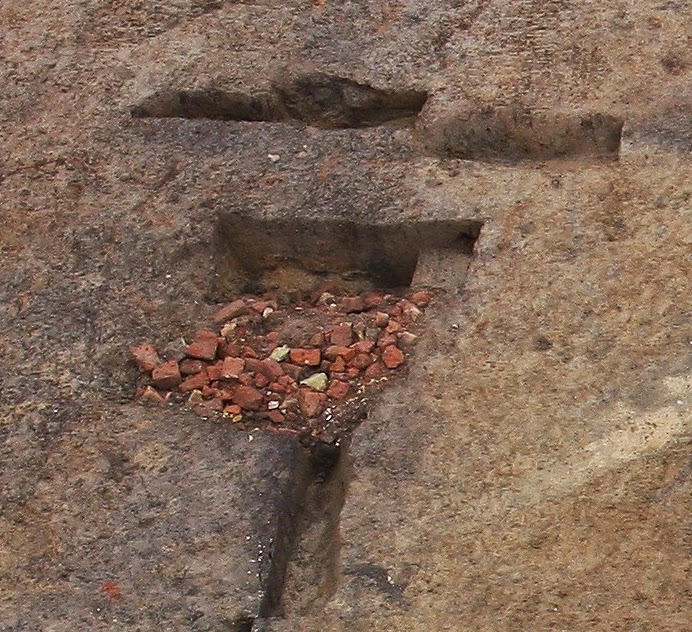
One of these four neolithic rectangular timber buildings at Horton caught our attention when we were looking at the pictures online. There appear to be some fire reddened rocks close by one of the buildings, in a heap. The buildings are, as always, interpreted as "houses". But were they dwellings? Or some other kind of building, like a barn or grain processing building? See Wessex Archaeology's page about them here


The red rocks look rather like modern bricks. There seems to be no mention or discussion of them on the web page. Maybe I missed it. However the stratigraphy indicates that they are contemporary with the building. So, are these stones an indication of hot rock water heating technology at neolithic Horton? Were they piled up in a wooden trough that has long rotted away? What were the people doing in and around this rectangular wooden building, over 5000 years ago?

I cannot answer these questions. I am nevertheless intrigued by this discovery. And so I finish this blog with a close up (thanks to Graham) of those mysterious fire reddened stones and welcome interpretations, comments and discussion.

a close up of those mysterious fire reddened stones beside the neolithic building at Horton

 ------------------------------------------------------------------------------------

If you want to know what our Bronze Age Trough Ale, with meadowsweet, tasted like, we sent some to David Connolly of BAJR (British Archaeological Jobs & Resources). Although he struggled to open the parcel, he gave his opinion on the ale's flavour and strength.

It is sometimes said that prehistoric ale was weak, cloudy and sour and that it tasted disgusting. We disagree.

Here is the link: https://www.youtube.com/watch?v=wpvPi25TTOI

Quinn, B., & Moore, D. 2009 ‘Fulacht fiadh’ and the beer experiment’ in Stanley et al (eds) Dining & Dwelling. NRA Monograph Series No. 6, 43-53, NRA, Dublin.

Saturday, 21 May 2016

saccharification or what happens in the mash tun

I'm picking up the blog again, after taking quite a long time off. To my surprise, folk have been reading our past posts, so thank you very much indeed for that.

One of the reasons that I started this blog was to try and deal with some peculiar misunderstandings about how beer and ale are made. In the archaeological and anthropological literature you can read all sorts of odd things about brewing beer in prehistory and how it was invented. Malt is rarely mentioned.

I have read that "... beer was invented when some barley got wet in a bucket and then it fermented" or, and I read this very recently, that "... beer is one of the most important of human inventions, as it is likely to be one of the key reasons that farming was started, in order to grow hops for brewing ..."

You need malt, not hops, to provide the fermentable sugars to make beer and ale. This blog is about what happens to the malt in the mash tun - the transformation from grain starch into sugars.

Most people don't have the opportunity to see or to experience this magical process. We are fortunate, we have our own mash tun in the garage and we regularly make some very tasty ale and beer, using crushed malt that we buy directly from the maltster. We can go online and buy the malt. It's delivered to the door. We buy 25 kg at a time and it's always very fresh and good malt.

Our mash tun can take about sixteen or seventeen pounds of malt and we usually make about ten or eleven gallons of beer. That lasts us a while, so we don't have to make it too often.

We can choose how strong or weak we want the beer to be. We do this by deciding how much malt to use and how much water to sparge with. We can add hops or herbs, whatever we decide to do. In the past we've made some very good ancient ales in our mash tun - meadowsweet is the usual herb of choice because we live on Orkney and it grows profusely here. So we can go and pick it in July/August, dry it, store it and use it whenever we want to. We'd like to try other herbs. I'm just starting to grow a brewers herb garden, so far I have yarrow, heather, meadowsweet and angelica. Mostly we use hops.

What happens in the mash tun? Saccharification. The creation of sweetness that can be fermented. Grain starch is converted into malt sugar in the mash tun by enzymes in the malt.

Where do the enzymes come from? Basically, when any grain begins to germinate, starch converting enzymes are activated in the aleurone layer of cells, just beneath the grain husk. These enzymes convert the starch of the endosperm into sugars, the food source for the growing plant. The maltster's job is to begin germination, then stop it and dry it, very gently, at just the right moment. The craft of the maltster goes back to the dawn of grain agriculture. The first alchemy. 

Saccharification is an essential part of the brewing process. The brewer takes the lightly crushed malted grain and adds it to hot, but not boiling, water in the mash tun. Enzymes in the partially germinated grain re-activate in the mash tun and convert the grain starch into malt sugar. The process takes about an hour.

Here's our mash tun:
The strike: the moment when crushed malt is added to hot water
The aroma of a mash is distinctive - it's a strong, sweet, delicious smell. Recently we went to a meeting about recreating old beer styles at Fuller's Brewery in Chiswick, London. As we approached the brewery, even though we could not see it, we knew we were going in the right direction because we could smell the first mash of the day. Exactly the same smell that we get from our little mash tun in the garage.

The process is the same, no matter what the size or the shape of the mash tun.

A few years ago, I went to the Eindhoven Open Air Archaeology Museum and used an earthenware bowl to demonstrate the saccharification - how to gently heat crushed malt and water over the hot ashes of a fire and make sugars. In the photograph below, you can see the white crushed malt in the bowls by the hearth. For me, that's a little over crushed, but it still worked just fine for the saccharification. In little over one hour, the starchy crushed malt had become a mash of delicious malt sugars, as you can see in the large earthenware bowl in the hearth.

Saccharification in a hearth at Eindhoven Open Air Museum.
The beautiful bowl was made by Flor Buchuk Gill, she was the potter at the Open Air Museum at the time.
The equipment is very simple. The technique is not complicated. There is no need to understand the complex biochemistry that goes on in the mash tun. All you have to do is get the details right and you will get a result. Heat some crushed malt with abundant water at temperatures not exceeding 67 degrees Centigrade and the enzymes will re-activate. If the temperature is too high, then the enzymes are destroyed. 

The next stage is to separate the sweet liquid (the wort) from the mash. This is done by sparging, washing hot water through the mash and collecting the wort. I shall save that for the next blog.

Some people think that the beer brewer's mash tun is something like the wine maker's tub. They are not at all the same thing. They are completely different processes. Perhaps the word 'mash' is confusing.

Making wine, as most people know, involves treading or mashing grapes into a pulp, then syphoning off the juice and fermenting it. When making ale or beer, you have to make the sugars first, and this happens in the mash tun.

Some people make 'country wines'. Among the most popular are dandelion, parsnip, nettle and elderflower. Each wine making event involves gathering the ingredients and then buying a few kilos of sugar. Dandelion flowers, for example, are mixed with hot water and a kilo or two of sugar. Here's a typical country wine recipe. There are loads of recipes for these so called country wines. They are all pretty much the same. They all involve several bags of sugar.

As has been explained in an earlier blog, flowers, nettles or parsnips do not provide any fermentable sugars, just flavour.

I can understand why some people might be confused if they have never seen inside a mash tun or if they have not made an ale or a beer using malted grain. For most people today, seeing what happens inside a mash tun is not part of their everyday life and experience.

However, a few hundred years ago, making the malt and brewing ale and beer at home was a common activity. It happened on farms and in large households. It was a household task. In the past, when making the malt and the ale was a regular event, it would have been something that people were familiar with.

Today it seems to be a mystery to many.

Sunday, 28 December 2014

What is Wort - a brewer's perspective

Hope you had a grand Yule and that you enjoyed the midwinter celebrations. We wish you all the best and A Happy New Year for 2015. There has been a bit of a lull on ancient ale blogging in the last couple of months, however we aim to correct this in the New Year and get back to writing again.

This one is about the Wort. Graham wrote it several months ago. It would make a good response to a short article "Beverage with heritage" that we read over the holidays. It was published in the Christmas and New Year Edition of New Scientist magazine, the 'one minute interview' with Patrick McGovern, director of the Biomolecular Archaeology Project for Cuisine, Fermented Beverages and Health at the University of Pennsylvania Museum. The question is asked: how does ancient booze compare with the modern stuff? The answer includes that "they wanted to be sure they had enough sugar to get the fermentation going, so they took whatever they had that contained sugar and mixed them together."
.
This idea of 'mushing loads of random sweet stuff together to make alcohol in prehistory' seems to be a commonly held view amongst non brewers. Merryn wrote a blog about desperately seeking sugars a few months ago, which tried to address the issue and dispel this myth.

Here is Graham's perspective, a beer brewer's explanation of what wort is:


Wort (pronounced wirt, not wart ) is the Juice of the Barley, well not quite, but almost very nearly so. It is a thin, runny, very sweet but very sticky liquid, straw coloured through to brown. It is effectively a thin synthetic honey substitute. Ale made from wort without preservatives or flavouring actually tastes a lot like mead made from honey.

Wort is the liquid sugars extracted from malt, that is to say, partially germinated cereal grains - barley, wheat of all varieties, oats and even millet, but not rice or maize. It is the primary source of fermentable sugars in making ale or beer and always has been. It is relatively easy to make a sugar solution of at least 10% from malt, and then to wash further sugars from the grain down to a realistic level of 1-2%,  "small beer" level and, of course, anywhere in-between. This compares very favourably with other natural sources of sugar like birch sap, which is between 0.5 and 2% sugar, which would only make a small beer. So adding birch sap to a brew would only dilute it, not strengthen it as some scholars claim.

Wort is made by "hijacking" some of the natural processes of the grain's life cycle.

As part of the growing process the germinating grain must convert it's energy store, starch, into sugars so that these can then be built into cellulose, the structural skeleton of the roots and shoots. This requires the liberation of the two amylitic enzymes, alpha and beta, which are little like ptyalase, the enzyme in saliva that converts starches into sugars.

If this growing (germination) process is halted when the most enzymes are present and little of the growing structure has started, it will be good malt.

So, to make wort you lightly crush the malt and mix it with hot water at about 65 degrees Centigrade. Keep it at this temperature for anywhere between half hour to about 2 hours, depending on your style. This is called mashing. Then you drain the clear liquid sugars from this mash by lautering, which is yet another story. This gives you a strong wort. Then you can wash further sugars from this mash, sparging, to get a weaker wort.

Brewers measure the potential sugar and therefore alcohol of a wort using "specific gravity". Water is 1000. David Line in his book "The Big Book of Brewing" explains this in great detail in chapter 18.

This was my "Bible" when when I first began brewing beer 32 years ago. David Line was a pioneer in his time, explaining what the processes were, how they were done and why. He also explains different methods of mashing using simple equipment and this has been very valuable to me in re-creating the ancient and traditional crafts of brewing ale.

So to recap: wort is a golden brown, very sweet, very sticky, runny liquid that contains most of the potential sugars from the malt. It can be made to a variety of strengths e.g. Arctic Ale.

To illustrate this I will give you the results of one of my recent brews.

The recipe is loosely based on David Line's "Brewing Beers Like Those You Buy" page 88, Gales HSB. One of my favourite beers, sadly no longer made. I found his book to be an excellent collection of recipes for good Ales and Beers that could be bought in the late 1970s and 80s. Large brewery's methods have changed since then and sadly many of the modern renditions taste nothing like they used to.

15lb 8oz of crushed pale malt, Munton's Perl Blend, were mashed with 5 gallons of water, inside a grain bag, in a Peco Electrim mash-tun. The strike temperature was 70 degrees Centigrade and as the grain was added slowly, the temperature fell to about 60 degrees Centigrade, and was then raised back to 65 degrees Centigrade.

The mash tun was unplugged and covered with a sleeping bag to maintain the mash temperature. It was left like this for 2 hours.

From this I lautered 3.5 gals of wort which was nearly 1080OG.

wort: the first running
measuring the first running


This was followed by sparging. The first gallon of wort was 1062OG, the second 1048OG, and these, together with the 3.5 gallons, were boiled in an Buffalo 40 litre boiler with 1lb of dark soft brown sugar, and 4oz of molasses (these are the in the recipe and I think the molasses adds a certain something to the flavour) for one and a half hours. This produced 5 gallons of 1084OG. This was fermented in two fermenters.


A further 5 gallons of wort were sparged of 1036OG, 1020OG, 1012OG, 1006OG (this was very pale and weak) and finally 1014OG left to drain overnight. This was again boiled on the old hops, because there is an awful lot of sugars left on the hops. This gave 5 gallons of 1024OG, which was added to the two fermenters. At the end of primary fermentation this gave 10 gallons of 1008 final gravity.

The average of 1084 and 1024 gives an OG of 1054 for the 10 gallons. According to David Line's graph (on page 147 Big Book of Brewing) gives a strength of 7.5-1.1= 6.4% alcohol.

This was quite a surprise to me, for I haven't been measuring the gravities for some time, and I never expected to get this much beer from 15.5lbs of malt.

A recent comparison with a commercial beer, Scapa Special 4.6%, suggests that my beer was no stronger, so maybe there is something wrong with my figures.

But it did make me think that I may be over-sparging my wort and that this could be contributing to the haze, and tannin like bitterness. So I have increased the malt to 17lb 8oz, and now I am getting a much nicer beer.

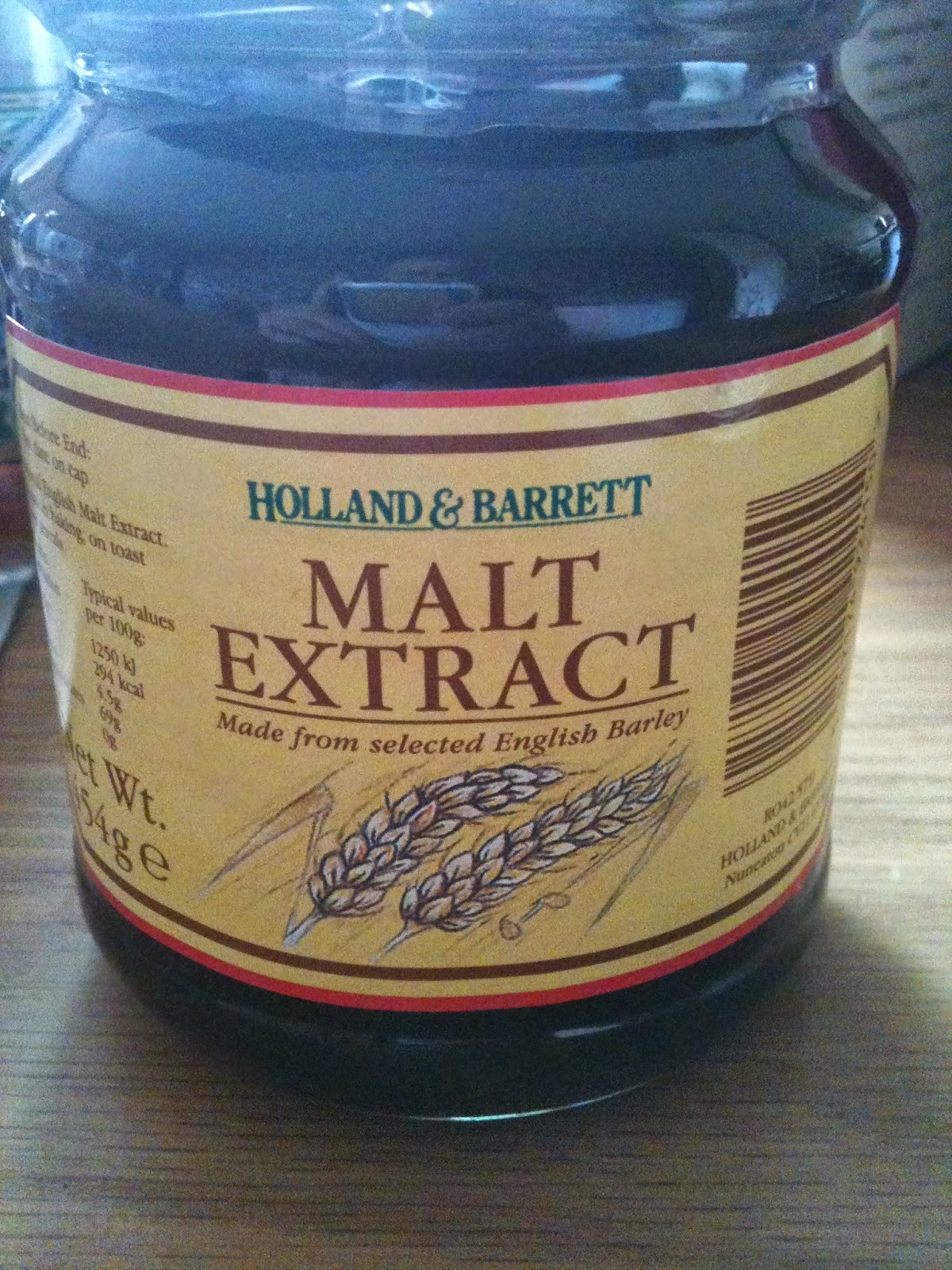
For those of you who will never meet malt, or a mash tun there is an alternative. Go to a whole food shop and buy one of these.


As best as I can estimate, this jar contains 11 fl oz of malt extract weighing 16oz, so this makes a density, specific gravity, or OG of 1450 or so. Dilute this with 4 imperial pints of water and you will have a re-hydrated wort of about OG1054.

Wort is a brown, runny, very sweet liquid that is extremely sticky when it dries. It could be described as a kind of dilute synthetic honey, that is very ancient in origin and is possibly the first process that was ever made with cereals. It could be that cereals were first cultivated, not for their staple qualities e.g. flour, gruel or bread, but instead for their status potential, sugars.

Many of the early settlements in the Fertile Crescent had special buildings with smooth floors, made of beaten earth, clay or lime plaster which are ideal as malting floors. All that is then required are containers within which to heat the crushed malt and water (the mash) to make a sweet wort. Merryn's M. Phil, entitled Barley Malt & Ale in the Neolithic (1999), looks at this, and the archaeological evidence for it, in some detail. One particular site, Beidha, was excavated in the late 1950s by Diana Kirkbride, a member of Robert Braidwood's team. She describes a smooth plaster floor with 'thousands of grain impressions'. This is probably a malting floor. The site is dated to the 8th millennium BC.

There is a Biblical expression: "The land flowing with milk and honey". Some Biblical scholars have made tortuous explanations to explain this phrase - they write about how wild bees' nests in cracks in the rocks would ooze honey in the hot sun. More informed scholars explain that this phrase refers not to bee honey, but rather to some kind of artificial sweetness, perhaps made from figs or dates, or maybe even made from grapes.

This must be because these scholars do not recognise nor do they understand that cereals can be a source of sweetness, if processed correctly.

I think that this phrase 'land of milk and honey' refers to milk and wort. It is a metaphor, or a description of a land that is good for both cows and for growing grain.

It seems that Biblical scholars have overlooked the fact that wort (liquid sugars made from the grain) was once commonplace in Egypt and Sumeria, otherwise they would not have been able to make beer. This was probably common throughout the whole Fertile Crescent and the Biblical Israel.

With the rise of Islam in this area, alcohol has been proscribed. There is no further use for malt or wort, so the practices and knowledge of malting and mashing have died out completely there. Archaeobotanists and archaeologists who have done field work on cereals in Turkey and the Ancient Near East seem to be unaware of the malting, the mashing and the wort. It is outside their experience and so it is understandable that wort has been overlooked in archaeological interpretation.

Today Bouza is made, it can be described as a type of beer, however it is a wheat based beverage made by lactic fermention. It is no longer alcoholic.

So, why do I bother to go to all the trouble of mashing, lautering, sparging, boiling and all that washing of brewing equipment? After all, it takes a whole day, a huge amount of effort. The answer is that all of the Beer Kits that I have ever used produce a beer with a kind of metallic flavour. The Kit contains a large can of Malt Extract. No amount of boiling with extra hops, or anything else will make it taste any better.

I make my beer with the simple, basic ingredients. I use traditional techniques to make the wort because I think it makes a better tasting beer. At least, when everything goes to plan, it tastes good. Even when it's bad it is often not much worse than some of the bad commercial beer available in supermarkets.

Beer is changing, with the way it is made. Some commercial beers, in cans, bottles and on draught have this unpleasant metallic flavour. They have been made from malt extract.

I was disturbed recently by looking carefully at the contents lists of commercial beers. Some like Scapa Special say that they are made from "maris otter pale ale malt", or others "a blend of pale and roasted malts". I know these are made "from the grain" and not with malt extract.

Some lagers and stouts are labeled as containing barley, wheat and oats, with no mention at all of the malt.  I can't help but wonder if they have been made from syrups, much like the high fructose corn syrup so popular in the processed food industry. This could explain the uniform blandness of some of these cheaper beers.


Monday, 19 May 2014

desperately seeking sugars

A few years ago, we were standing beside the trench of an excavation on Orkney. Lots of serious digging was going on. One of the diggers looked up, recognised us and said something like...

oh hello! Are you those brewing people?

Yes, that's us. 

Can you tell me how to make Heather Ale?

Of course, we replied. No problem.

Because we've got loads of heather growing around our house and we want to make some beer with it! 

But you can't make beer from flowers, we replied. Flowers provide the flavouring, the preservative ... you have to add sugar. That's what ferments into alcohol. 

beer made from flowers?
We began to think that, maybe, when some archaeologists had come across our work on prehistoric brewing and heard about our ancient style meadowsweet ale, they thought that we had made it from meadowsweet flowers. We had not considered that before. Later that month, our suspicions were confirmed when we did a prehistoric brewing demonstration at a neolithic feast, organised by the Orkney Archaeology Society. I think it was in 2008. Over an open fire, with just the hot ashes, we heated some water in an earthenware bowl. It was our mini mash tun.

When the water was clear enough for us to see our reflection, we knew it was the right temperature.We added the crushed malt. This is known as 'the strike'. The local hens came running when we got the malt sack out of the van. Soon, there was the sweet aroma of the saccharification, this is when the enzymes re-activate in the mash tun and turn grain starch into malt sugar. It smells delicious. Folk began to wander over to find out what was going on. Some of them tasted the mash.

We were asked how much sugar we had added. None, said Graham. All the sugars come from the malted barley in the mash tun. No, go on, there must be some added sugar in there! No, we assured them, there was no added sugar. Later a couple of ladies asked how many flowers we had used to make our ancient brew. The answer was about an ounce and a half for five gallons of ale. They walked away, shaking their heads in disbelief. I am quite sure that they had confused what we were doing with making a flower wine.

Check out the recipes for "country wines" online - they all have a couple of pounds of sugar per gallon in the list of ingredients.

Quite simply, it is not possible to make ale or beer from flowers.

beer made from birch sap? 
Birch sap contains very few sugars, less than one per cent. It is more like a sweet water. You could collect a lot of it, then boil it to make a syrup but it is hardly a practical way of obtaining sugars for fermentation. John Wright, writing in the Guardian, explains how to make birch sap wine. The ingredients include 1.8 kilos of sugar and grape juice concentrate.

beer made from bread?
Some archaeological and anthropological sources suggest that beer and ale were made from bread in ancient times. There is a common myth that beer was discovered when a loaf of bread fell into a bucket of water and fermented overnight.

If it was really possible to make beer from bread in ancient times, then why aren't we doing it now? Surely people would be queuing up to buy loaves of bread so that they could throw them into a bucket of water to ferment for a few days. Home brewed Egyptian beer. It might taste horrible. It might be a bit weak and sour. But that's what it was like in the past. Wasn't it?

Sorry to disappoint you, but it is not possible to make beer from bread. The biochemistry does not allow it. There are no sugars in bread to ferment into alcohol. However, a quick search on the internet shows how the idea that bread can be somehow transformed into beer still prevails. There are lots of different methods suggested. Here is just one example:

" Barley was used to make beer. The barley was combined with yeast and made into a dough which was part-baked in a stone oven. It was then crumbled into a large vat, mixed with water and allowed to ferment before being flavoured with dates or honey. Recent evidence suggests that barley malt may also have been used in the process.www.historyonthenet.com

If you crush the barley into flour, then make a bread you have destroyed the fabric of the grain. There is no possibility of germination, no possibility of starches being turned into sugars. No beer or ale. Baking in a hot oven alone would be enough to destroy any enzymes. It would also destroy the yeast. This method would not work.

The recent evidence, referred to above, is that of Delwen Samuel. Analysis of residues on 3000 year old ancient Egyptian pottery showed erosion pits from the enzymatic action in the the individual starch granules. This proved that the grain had begun germination - it was malt.

Delwen Samuel's papers are available online. In 1997 she published 'Fermentation Technology 3000 years ago. The Archaeology of Ancient Egyptian beer'. The scanning electron microscope images of pitted starch granules can be seen there.

beer is made from malt
To make ale or beer, you need malt. This is grain - barley, wheat, oats or rye - that has begun to germinate. Germination stimulates the production of the starch converting enzymes. Making malt is a specialised craft in itself. There is far more to it than soaking grain in a bucket, then letting it sprout. The two crafts of maltster and brewer are separate today. The maltster supplies the brewer with malted grain.

mashing 
The brewer heats the crushed malt with hot water in the mash tun to make malt sugars. Sugars ferment into alcohol. It's a simple but very obvious thing. Over the years, we have given demonstrations of what happens in the mash tun, of how the crushed malted grain is heated up gently, to make malt sugars. This is known as the mash, or saccharification - the enzymes in the malt are active at about 65 to 67 degrees Centigrade, so this is the temperature to aim at in your mash tun. 

The mash tun can be an earthenware bowl, heated in the ashes of a fire. We have done this many times, the image below is from a demonstration at Eindhoven Museum. I went there in 2009, as part of a brewing forum organised by EXARC.

a mashing demonstration at Eindhoven,

Or the mash tun can be a wooden trough in the ground, heated by hot rocks. We have done this several times. The pioneers of the technique are the Moore Group archaeologists. The video of their hot rock mash in a wooden trough, first done in 2007, is now legendary.

Given that thermometers are a recent invention, brewers in the past learned how to judge this temperature by skill and experience. John Tyndall, giving a lecture on Fermentation at the Glasgow Science Lectures Association, October 19th, 1876 said

"Our prehistoric fathers may have been savages, but they were clever and observant ones ... the art and practice of the brewer are founded on empirical observation ... the brewer learnt from long experience the conditions not the reasons for success" 

In the scholarly literature and in many of the archaeological and anthropological academic papers about making beer in ancient times, a wide range of beer making ingredients have been suggested - barley, wheat, dates, figs, fruit, berries, birch sap or birch syrup, honey or flowers and leaves.

All that any brewer needs to make ale or beer is water, malt, herbs and/or hops and yeast.

Wort is the sweet liquid that comes from the mash tun after sparging. The exotic ingredients of the scholarly papers can enhance the ale in several ways, by preserving, flavouring or by providing medicinal or other properties. But they do not provide the primary fermentable sugars. This comes from the grain, which has been malted, mashed, lautered and sparged. Barley is a reliable source of sugars for fermentation. You just need to know how to make it.

There is no need to go desperately seeking sugars.

Just understand the malt, the mash and the saccharification that occurs in the mash tun.


further reading
The Big Book of Brewing by David Line
In our opinion, this is the best book to read on the processes of malting, mashing, lautering, sparging and fermentation.

------------------------------------------------------------

two years later 
I went to a talk recently, it was about the neolithic, grooved ware and the use of pottery. My impression, after talking to several archaeologists, is that it still seems to be a widely held belief among archaeologists that 'alcohol production' in prehistory was no more than guesswork. It involved mixing up random stuff to make 'something alcoholic that did not taste very nice'. No skill involved.