Showing posts with label neolithic. Show all posts

Sunday, 17 July 2016

big pots: fermentation and storage

Brewing ale in Neolithic Britain - it seems to be a controversial topic among some academic archaeologists. I'm not sure what the problem is with malting and brewing ale in the neolithic era. It could be that few people understand the processes involved in the transformation of grain into malt, wort and ale.

If you have come to this page via the BBC Earth website, or from the Stone Pages, please be aware that the comments attributed to me there are wrong. I have no idea where they came from, other than as a misunderstanding. I hope for a correction in the near future but so far I am not having much success.

Roasted malts, also known as specialty malts, are a feature of modern industrial malting. I'm working on a blog about that at the moment and will post a link to it when I have completed it, hopefully before the Yule celebrations of 2016!

The last few posts have been about explaining the saccharification in the mash tun, where the crushed malt, when mixed with water and gently heated, is converted by enzymes into malt sugars. I've also written a little about lautering, sparging and how to collect the wort.

We've been asked 'why not ferment in the trough. Why go to all the trouble of trying to collect a wort without bits in it?'

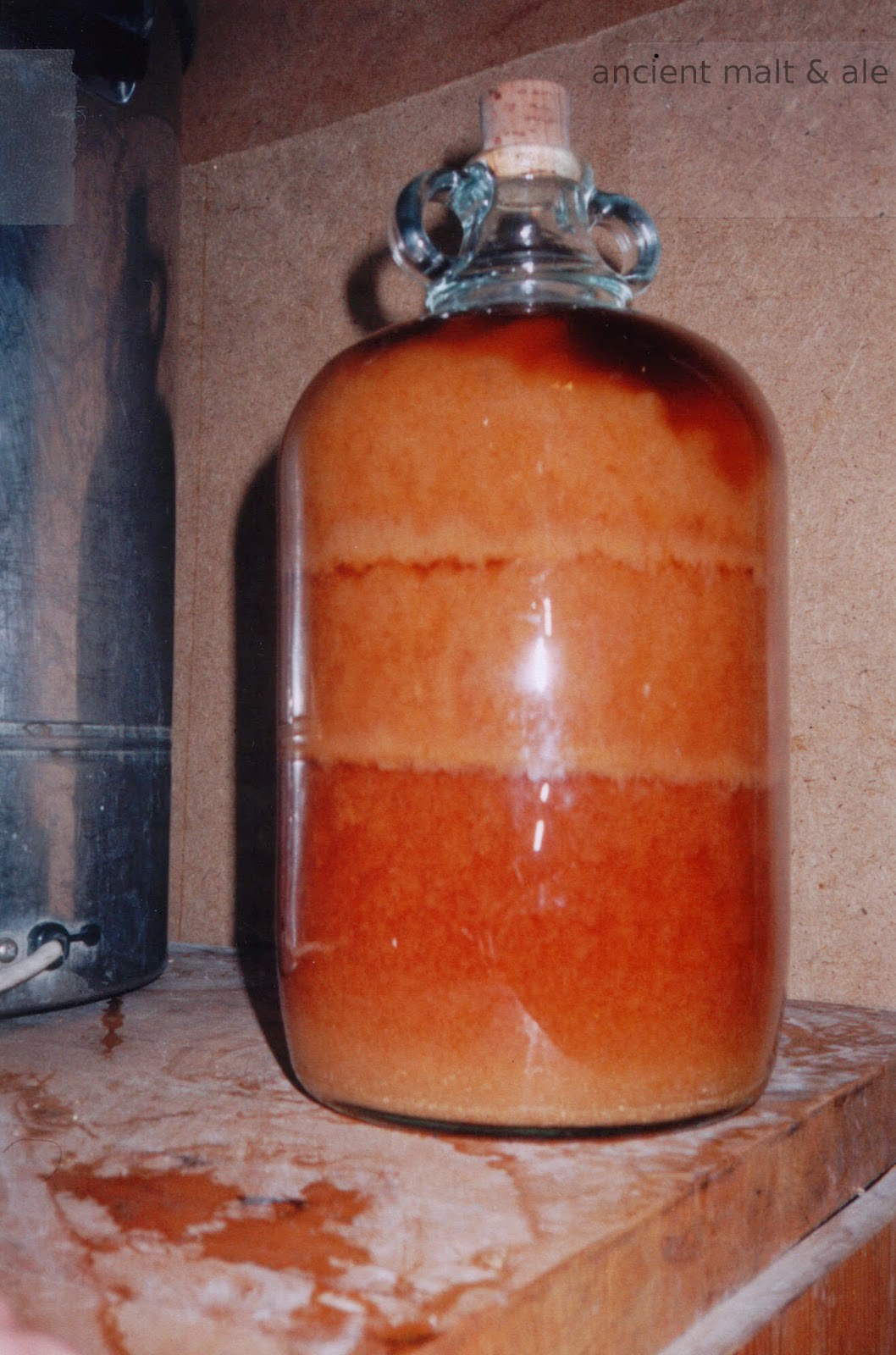
Firstly, alcoholic fermentation requires anaerobic conditions. A large vat (1000s of litres) within a building has a blanket of carbon dioxide over the fermenting beer, as in lambic brewing. A small trough (100s of litres) situated outside would have this blanket blown away. Secondly, during fermentation, the little bubbles of carbon dioxide produced by the yeast, stick to the smaller particles and lift them into the froth of the barm. You can see the towering barm in the picture below. It can turn into a really messy monster when it has a lot of little bits in it. After fermentation you would still have the problem of straining or filtering what brew has not been lost to the froth-over. That is a lot harder with little bubbles in it. A bed of husks will not form properly and filtering just doesn't work. 

Inoculating the wort: starting a fermentation
Once the brewer has obtained a quantity of wort by mashing, lautering and sparging, the next stage of the brewing process is the fermentation. Whether you mash in a large pot, a wooden tub with a spigot hole, in a trough in the ground or in a modern mash tun, the wort that you make must be dealt with promptly to prevent infection setting in. Wort does not keep well. Either you boil it, as is necessary with hops, and then cool and inoculate with yeast at the right temperature. Or you can inoculate a fresh wort when it has cooled, and then add the herbs. We found that meadowsweet flowers inhibited the yeast and are better added after the fermentation. To find out more about raw ale which, basically, is beer made from an unboiled wort, I suggest a look at this blog. Raw ale is a huge topic in itself.

fermentation in close up, this is the barm (foam) on a fermenting beer

There are a number of ways of adding the yeast to the wort to start the fermentation. Today, the brewer can add yeast directly, in dried form or as a yeast starter, when the wort temperature is just right. Many modern breweries keep their yeast starter in a fridge. They scoop some of the barm (foam) from the top of the fermenting beer and then store it in a cool place until required. The yeast culture can be kept and used for several months. 

Brewers in history and prehistory could also have used this simple and basic technique, keeping their barm/yeast culture in a cool place. In the 1980s, archaeologists found a medium sized grooved ware pot which had been sunk into the ground in the remains of one of the buildings at Barnhouse, Orkney. The pot, about a litre in volume, had been buried up to its' rim. Analysis revealed that it had contained some kind of 'cereal based mixture', but they were unsure about the pot's function. I think it may have been a barm pot. It was located in a large building, numbered eight by the excavation team and interpreted as a 'temple' or some other kind of ritual building. There were drains as well as many sherds of broken or smashed Grooved Ware pottery, representing pots of about one litre in volume. There was also evidence of feasting and what archaeologists refer to as 'ritual activity', although what that was is not made clear in the excavation report.

I would say that if an archaeologist is looking for a prehistoric ritual activity then the mysterious and magical transformation of grain into malt, wort and ale is well worth considering.

In Norway, Lithuania, Latvia and other places, the tradition of making farmhouse ale survives, with brewers passing on their skills, techniques and knowledge to their descendants. Old traditions of inoculating the wort are still practised in several areas of northern Europe. The picture below shows a wooden yeast ring or kveikering being used to inoculate a yeast starter.

wooden yeast ring or kveikering (photo from the beer blog of Lars Garshol)

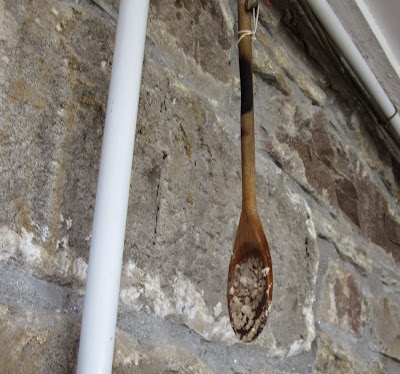
Some sources say that the tradition of the kveikering dates back to the 18th century, although I wonder whether the concept might date even further back. It's difficult to be sure because, of course, a wooden object used to gather yeast and start a fermentation would not survive in the archaeological record. In the Viking era, apparently, a stick was used to stir the fermenting wort. This would put yeast onto the stick. Then, if it was kept dry, it could be used to start the next fermentation by stirring a fresh wort. In the Western Isles of Scotland there is a tradition of stirring the fermenting beer with a hazel stick (or wand) which is then hung up to dry and used to stir the next batch of wort, to begin the fermentation.

We did some experiments using a wooden spoon and found that this technique works perfectly.
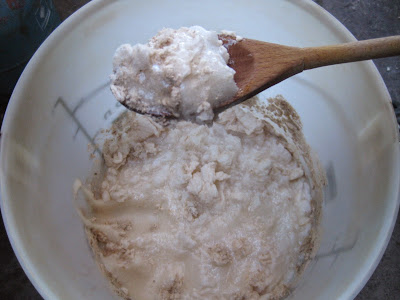
harvesting barm from the fermentation vessel
barm/yeast drying on the wooden spoon (more photos here)

Big pots as fermentation and storage vessels.
The neolithic era was the time of the 'first farmers'. The earliest grain agriculturalists of the British Isles (c4000BC onwards) were also the megalith builders. They created magnificent stone circles and henges as gathering places for the community. They built stone tombs for their dead and they began to settle down. Associated with the 'first farmers' is the integrated 'cultural package' of grain cultivation, the management of domesticated animals (cows, sheep, goats and pigs) and the manufacture of ceramics. This was the 'neolithic revolution', a different lifestyle to the mesolithic hunter gatherers who had roamed the land for thousands of years previously. At this time in prehistory, the technology for making large stave built wooden vessels (vats, tubs, barrels) did not exist.

How did these neolithic 'first farmers' process their grain? Were they grinding it into flour, to make bread? Were they boiling it, making some kind of gruel or porridge? Or were they making ale from it, by malting, mashing, sparging and fermentation? For some reason, the possibility that such a thing as ale in the neolithic is considered to be a controversial idea by many archaeologists. I'm not sure why. 

Some of the large neolithic Grooved Ware pots might have been used as fermentation vessels. They are perfect in both shape and size. One particularly large Grooved Ware pot found at the neolithic village of Skara Brae, Orkney, was around 30 gallons in volume. Most of the large Grooved Ware pots were around eight to ten gallons. They are found at many ritual and feasting sites of the neolithic, in domestic contexts, for example at Skara Brae, Orkney, and at stone circles and henge monuments throughout the British Isles.

What is Grooved Ware? It is neolithic pottery that archaeologists have defined by its' decorative pattern of grooves and shapes on the exterior. Not all grooved ware has grooves; some of it has fancy applied decoration, with blobs of clay and raised patterns. Most Grooved Ware pots are bucket shaped, with a flat bottom. They are found throughout the British Isles, from Clacton to Orkney and Shetland and also in Ireland. Indeed, this style of pottery was first called 'Rinyo-Clacton Ware'. Rinyo being the name of a site on one of the Orkney islands, Rousay. It was a neolithic village larger than Skara Brae. Grooved Ware was also found on the south coast, at Lion Point near Clacton.

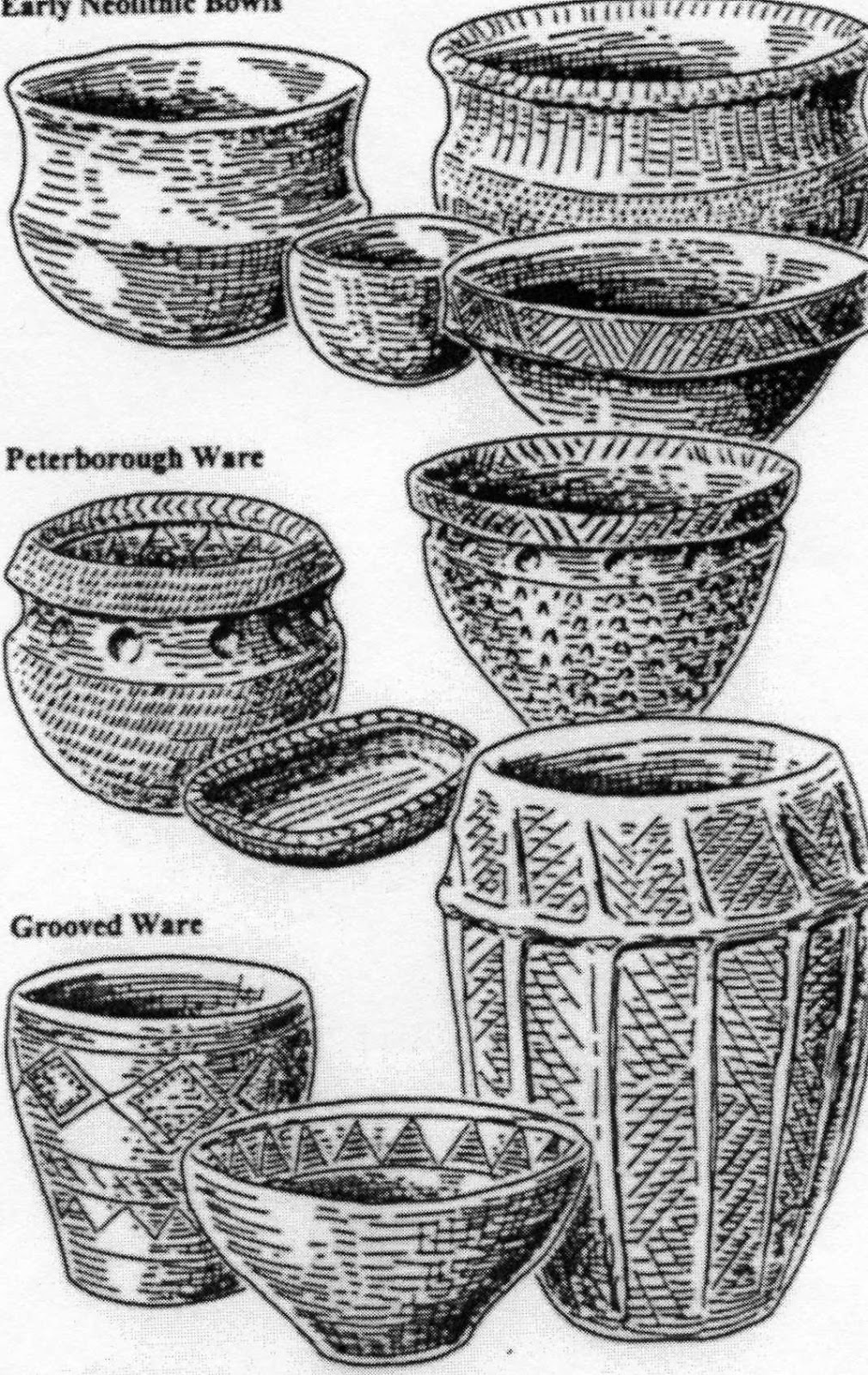
Here's one of Stuart Piggott's beautiful and classic drawings of British Neolithic pottery, showing what some of the Grooved Ware pots from the south coast probably looked like, based upon sherds found during excavations on the Essex coast, at Lion Point.


Pottery is frequently found during archaeological excavations. Archaeologists regard it as diagnostic. The discovery and identification of a sherd of pottery gives them a good clue about the date of the site. Neolithic and Bronze Age pottery was not glazed. It could have been waterproofed in several ways, by burnishing or by being sealed with fats, beeswax or milk.

a sherd of grooved ware
Pottery typologies are complex. It's an enormous area of archaeological study and I could not possibly go into every style and type of British Neolithic pottery in this blog. We would be here forever. There's Windmill Hill, Grimston-Lyles Hill Ware, Ronaldsway, Grooved Ware, Unstan Ware, Peterborough Ware, Ebbsfleet and so the list goes on. Most are round bottomed pots, with the exception of Grooved Ware. It took me many months to get to grips with these stylistic categorisations that have been imposed upon pottery of 5000 years ago.

Many bowl shaped pots are interpreted as 'cooking pots'. That seems fairly reasonable. What puzzles me is that whenever archaeologists find a very large pot, or the sherds of a large flat bottomed bucket shaped pot, it is almost always interpreted as a 'storage pot'. I have not yet come across a large pot from the British Neolithic that has been interpreted as a potential fermentation vessel, although some of them have a volume of several gallons and such large pots are often found at feasting sites, for example, at Durrington Walls, near Stonehenge.

If an earthenware pot is to be used to contain any liquid it must be waterproofed. We discovered, in our mashing and fermenting experiments, that beeswax worked very well as a sealant, as did butter and lard.

As a control experiment we tried fermenting mead in an untreated earthenware pot. The fermentation worked well, the room filled with the smell of mead, and the outside surface of the pot was covered in little beads of sticky sweetness. But the final product was disappointingly low in alcohol. It turns out that the alcohol diffuses through the porous pot much faster than the honey solution. This makes an untreated pot pretty useless for creating an alcoholic drink.

Here is a sample of some of the British Neolithic pottery types, as recorded by Stuart Piggott. You can see that there is a wide range of styles. Some have holes in the rim, to secure a covering or lid of, perhaps, leather. Some are deep, others are wide and shallow. I prefer to look at these pots with function in mind, rather than consider only their decoration and style.


Is there any archaeological evidence for the use of large pots for the fermentation or storage of barley wort? 
One of the very best indicators that a pot was used to ferment wort into ale, or for storing the ale, is the identification of beerstone on the internal surface. Beerstone precipitates out of a fermenting barley wort, it looks rather like eggshell. We have a lot of it accumulating on our plastic fermentation buckets and storage vessels.

It takes many hundreds of uses to accumulate a visible deposit of beerstone, but it is a certain proof of fermented wort. Brewers using plastic pipes in breweries often have to clean them of an accumulation of beerstone. It clogs the pipes.

Here is some beerstone from one of our fermentation vessels:


Beerstone has been identified on pots from a Bronze Age site in the Zagros mountains of modern day Iran. At excavations at Godin Tepe a great many pots and jars were discovered, they were stored in the University of Pennsylvania Museum. Subsequent analysis of a yellowish deposit on the internal surface of jars identified beerstone and it is generally accepted as unequivocal evidence for beer brewing. This pioneering paper by Badler, Michel and McGovern, published in 1993, tells the whole story and contains sufficient detail to be able to repeat the tests for beerstone on prehistoric pottery.

I wonder whether any archaeologists in the UK or Europe would consider looking for beerstone on big prehistoric pots? Maybe it is already being investigated. It would be great if this could happen, since this might end the apparent controversy about whether or not a big old pot was used for the fermentation of beer made from a barley wort.

-----------------------------------------------------

If you would like to make your own kveikering, here is some more information  and details of how to make one. Brewer Martin Warren of the Poppyland Brewery was so impressed by the idea that he made his own.

My conference paper from 1996 "Neolithic Ale: Barley as a source of sugars for fermentation" can be downloaded from my Academia page, here. 


Tuesday, 20 January 2015

thousands of grain impressions in a burnt plaster floor

Sometimes, a single sentence in an excavation report can be the beginning of research that sparks your curiosity and makes you ask questions. For me, it was a few words and a brief, enigmatic description that I read in an excavation report several years ago, in the late 1990s, when I began my research into ancient grain processing techniques and the neolithic revolution.

The site was Beidha, a small neolithic village in the Jordan Valley. Here, in the 7th Millennium BC, people began to settle down, grow grain and keep domestic animals - cows, pigs, sheep and goats. Although they were still hunting and gathering, they were beginning to process the crops they grew, which included cereals and lentils. The earliest agriculturalists. Today, when you search for the neolithic village of Beidha on the internet you will find lots of information about it. This is, to some extent, thanks to a project established in 2010, to protect and promote the site. Beidha is an ancient place, now open to the public. It is not far from Petra, in Jordan, and is part of the World Heritage Site. Definitely on my list of places to go.

The village appeared to have burned down, nobody knows how or why. Diana Kirkbride excavated the site in the 1950s and 1960s as part of a larger project to investigate the early agriculturalists of the Ancient Near East, organised by Robert Braidwood of the Oriental Institute of Chicago. In her report, she described the remains and the contents of one of the rectangular mud brick buildings in the village of Beidha. As well as a lime plaster floor, facilities and equipment suitable for grain agriculture and processing were found, specifically, hoes, sickles and quern stones. There were also large stone bowls and the remains of baskets that appear to have been waterproofed. The baskets had been lined with either bitumen or lime plaster.

She thought that the building may have burnt down, somehow leaving behind the evidence of the presence of grain on the floor, which she described as

 “... tens of thousands of grain impressions in the burnt plaster floor ...
Kirkbride, D. 1968 ‘Beidha: early neolithic village life south of the Dead Sea’ Antiquity XLII, 263

This is an intriguing description.

At the time that I was studying the Beidha excavation report, Graham and I had recently returned from Orkney where, at the Corrigall Farm Museum, we had our first lesson in the techniques and traditions of floor malting. The curator, Mr Harry Flett, had explained to us how the grain must be steeped in water, then turned out onto a smooth floor in a barn to begin germination. Malt is partially germinated grain. When growth is obvious, that is, when the root and shoot begin to show, the malt is carefully dried. Then it can be used for making wort and brewing ale.

I had been reading excavation reports from neolithic sites in the British Isles and northern Europe, where floor surfaces of buildings are rarely preserved. The floors of the long houses and other buildings of the Linearbandkeramik Culture were destroyed by modern deep ploughing. In the British Isles, I had only come across one description of a deliberately made beaten earth floor in a neolithic building. This was in one of the rectangular timber buildings at Lough Gur, in Ireland, a site excavated in the early 1950s by Sean O'Riordain and published in the Proceedings of the Royal Irish Academy.

It was great news to me that some floor surfaces of buildings from early neolithic cultures in the ancient Near East had been so well preserved. I began to read more excavation reports, to see what else had been discovered. Although I have yet to find another description of grain impressions in association with an early neolithic lime plaster floor from that part of the world, I did find plenty of detailed descriptions of floors made of beaten earth, stamped clay and lime plaster. Some of them were painted, and there was very little discussion of their function or purpose.

The function of floors is a subject not often discussed in excavation reports. Floors are important. They are a crucial facility for making malt. And, as many people know, it's the malting that interests me most. When was it discovered? How? Who were the first maltsters? How has malting technology changed and developed over the millennia? What is the archaeological evidence for malt? What role did malting play in the development of grain agriculture and the neolithic revolution? 

the neolithic revolution in the Fertile Crescent

The practice of grain cultivation, agriculture and grain processing as well as animal husbandry and the domestication of cattle, sheep, goats and pigs are defining features of the neolithic way of life.

Archaeologists agree on this definition, although there is much disagreement among the academics about why people "became farmers". It is one of the biggest questions in academic archaeology - why did people begin to cultivate and process wild grains in the Ancient Near East and Levant? What were they making with the grain? These were some of the questions that Braidwood's team of archaeologists, anthropologists and archaeobotanists and had set out to answer in the 1950s. Was it bread or beer?

The debate was reawakened in the 1980s by Solomon Katz and Mary Voigt, when they published their paper "Bread or Beer: the early use of cereals in the human diet". They suggested that making malt was an important part of the story. Hunting and gathering were, of course, still important ways of food acquisition. Wheat and barley grew as wild plants in this region. People began to gather and process them long before they started to cultivate them deliberately and settle down in villages to tend their crops and look after their sheep, goats, pigs and cattle.

Grain cultivation and processing began in the Near East and Levant around ten to twelve thousand years ago. This new way of life spread across Europe and reached the British Isles around six thousand years ago.

mud, clay & lime plaster floors in the neolithic of the Fertile Crescent

A common feature of many early neolithic sites in the Fertile Crescent are the deliberately made, smooth, level floors made of mud, clay or lime plaster. Mud or clay floors may have been relatively easy to make. The lime plaster floors, some of them apparently polished, would have involved a particularly complex technology in their manufacture, as well as considerable human effort and co-operation in their construction. The Natufians, these first agriculturalists of the Fertile Crescent, were using lime plaster for a wide range of uses - to make walls, floors, statues, as well as so called 'white ware' vessels, the precursor to pottery made from clay. The use of lime plaster in the early neolithic of the Fertile Crescent is a huge area for research and investigation.

To make lime plaster, large quantities of chalk had to be collected, then burnt at 850 degrees Centigrade to make the quicklime. Water would have been added to make the slaked lime which can then be used to make the floor. They must be laid and levelled very quickly and would have been similar in appearance to a modern concrete floor.

Polished lime plaster floors were found in a rectangular building at Gobekli Tepe, in the layers of this enigmatic settlement or temple dated to the seventh and eighth millennia BC, the era of the pre pottery neolithic. Gobekli Tepe was excavated by Professor Klaus Schmidt of the German Archaeological Institute over many seasons. The earliest levels have been dated to the epi-palaeolithic, around the tenth millennium BC. The team excavating this site interpreted it as having been a place of feasting and cult activity.

Another interesting and large rectangular building of the seventh millennium BC was excavated at the early neolithic village of Yiftahel, lower Galilee. Inside one of the buildings there was a lime plaster floor measuring 110 square metres and 3-6 cm thick. It would have required some seven tons of lime plaster. At the time of excavation, it was the largest rectangular mud brick building of the period in the Levant. Details of the lime plaster, what it was and how it was made can be found here in a paper published in the Journal Palaeorient in 1991.

File:Yiftahel structure with plastered floor1.jpg
remains of a lime plaster floor at Yiftahel: the production of lime plaster was on an industrial scale. see here


bins, pestles, mortars & earth floors at Ain Mallaha see here
At Ain Mallaha there are the remains of an early neolithic settlement. It is situated by Lake Huleh in the upper Jordan valley and was inhabited between 10,000 and 8200 BC. The floors within the buildings apparently gave the impression of having been deliberately made by accumulation and they appear to have been cleaned and repaired on a regular basis.

Stamped mud floors, some  surfaced with a smooth layer of clean clay, together with domed ovens and brick-lined roasting pits were features discovered during excavations at Ali Kosh, a neolithic settlement dated to c7200 BC and located on the southern plains of Khuzistan.

At Tell Ramad, a neolithic village in Syria, c7000–6000 BC, the remains of lime kilns were excavated and some of the floors were made of lime plaster. Again, lime plaster was being made on an almost industrial scale. During excavations, it was noted that some of the floors had upturned edges. What purpose was this innovation for? We may never know, but perhaps this refinement had the function of containing the malt. It would work to keep the germinating grain on the specially made lime plaster floor surface.

Floors of compacted clay were found in the buildings of the earliest and lowest occupation levels at Mureybit a settlement dated to between c8500 and c6900 BC and located beside the Euphrates river in northern Syria. Excavations also revealed a variety of grain agriculture and processing equipment including sickles, pestles, mortars, quern stones, fire pits and hearths.

A floor at the site of Ain Ghazal, an early neolithic settlement near Amman in Jordan, showed evidence of at least five different layers. It had been repeatedly repaired and well maintained. Re plastering and regular maintenance of these lime plaster floors was undertaken at a number of these early neolithic sites.

This is a feature of more recent malting floors. It is desirable to have a smooth and level surface for the efficient raking and turning of the grain as it germinates. Access to a reliable water source is another necessity for the malting and mashing of grain and at all of these sites that I have mentioned, there were nearby springs, streams or rivers.

Robert Braidwood of the Oriental Institute of Chicago initiated the "Bread or Beer" debate in 1953. Anthropologists and archaeologists discussed the roles of bread and beer in the Origin of Grain Agriculture debate. Only Hans Helbaek considered the role of malt, without which there would be no fermentable sugars and no beer.

The archaeological evidence, some of which is outlined above, indicates that it was neither bread nor beer, rather it seems that those first agriculturalists may have been making malt.

-------------------------------------------------------------

further reading:

I have a peer reviewed paper "The Craft of the Maltster" which is hopefully, due to be published soon. It was presented to the Food in Archaeology Conference in April 2010 at Exeter University. The book of the conference is, I am assured, on its' way into print. I have been given permission by the publishers to put the paper on my academia page. It can be downloaded here.


Monday, 18 August 2014

what's the archaeological evidence for malt?

This is something that I became more and more interested in, once I had completed and submitted my thesis. How does an archaeologist or an archaeobotanist recognise whether or not a grain is malted? What happens inside the grain on the malting floor? I had access to the University Library for a few years after my degree - by teaching archaeology classes in the Continuing Education Department. I explored sections of the Library that, perhaps, no archaeologist had visited before. I studied grain germination physiology, biochemistry and discovered that Bewley and Black's classic study of seed germination was the best.

Malting is an important craft and technology. The main reason for making malt is to brew with it, or more specifically, to make an ale or beer from the wort. Malt is also the main ingredient for whiskey, of course, but I am most interested in malt and ale in prehistory and its' role in the origin of grain agriculture. Apart from grain barns and malting floors, it seems that the best archaeological evidence for malt lies within the grain itself. There are clear physiological indications, depending upon whether the grain is desiccated (dried) or carbonised (charred).

Carbonised or charred grains are frequently found in archaeological excavations from the neolithic, when people first began to cultivate and process grain, right through to the medieval era and beyond. Carbonised grains are found all over northern Europe.

What do they signify?

Is it evidence of a grain store or granary that has been destroyed by fire? This was suggested in interpretations of excavations of an huge rectangular timber building at Balbridie, Fife, Scotland where thousands of carbonised grains were found?

Perhaps the grain dryer in a barn caught fire, while they were drying the harvested grain or oats. Or was it a kilning of the malt, which has gone disastrously wrong?

Lots of grain barns have burned down over the years, as well as traditional malthouses. It's not an unusual event. Even in recent times, as late as the 1960s, malthouses have been known to catch fire.

Carbonised grains were found at Eberdingen-Hochdorf, where there were the remains of Iron Age malting and brewing. This Iron Age site was excavated by Professor Hans Peter Stika between 1989 and 1993. According to the excavation report, it was a high status site, probably the rural residence of a prince. The carbonised grains, a huge number of them, were found in a sort of U shaped ditch, together with bits of charred wood. The interpretation was that as the malt was being dried, the fire had got out of control and set fire to both the wooden platform upon which the malt had been laid, as well as carbonising all the malt. The charred grains were mostly barley. Many of them had missing embryos and the grain was in poor condition.

They were identified as having been deliberately malted using these criteria:
... groove like channels on the dorsal sides
... the dorsal side becomes concave
... the coleoptile and coleorhizae become more prominent
... germination roots develop
... separated or fragmented embryos
... germination was even, meaning that it was deliberate and intentional

A recent excavation at another Iron Age site has also identified the activities of making malt and brewing by examining the charred grain. Another accidental fire had preserved the malt as it was being dried in the 5th Century BC at Roquepertuse in south eastern France. The sample of grain was taken from the floor of a building, close to a hearth and an oven. The excavators describe it like this:

"In spite of favourable conditions for the preservation of seeds in the sediment, which was rich in ash, charcoal and generally carbonised plant material, the grains are corroded and highly fragmented. This fairly poor preservation seems rather specific to the barley grains from this sample. Conditions are therefore not suitable for a satisfactory observation of all the morphological features of most of the grains. However, the best preserved specimens allow the assessment that slightly more than 90% of the grains were sprouted when carbonised. This is easily visible from the groove like channel on the dorsal side of the grains. As far as we can see, the sprout length is not perfectly uniform, but it generally reaches about two thirds the length of the grain. 

The poor preservation of barley grains is probably caused by germination, which tended to render them brittle. Fragmentation occurred mostly after carbonisation and is therefore not due to Iron Age human practices." Bouby et al, 2011, Never mind the bottle. Archaeobotanical evidence for beer brewing in Mediterranean France and the consumption of alcoholic beverages during the 5th Century BC

It's beginning to get a little bit technical here and, perhaps, a good time to explain some of the grain germination jargon. There is a lot of it, so I shall stick to the basics. The fundamental biochemical processes and the physiological changes of grain germination occurred in ancient grains just as they do today, in modern grains. It doesn't matter whether you make malt 10,000 years ago or 5000 years ago or 10 minutes ago, the biochemistry of grain germination remains the same.

Grains are a lot plumper than they used to be, because of selection and development by farmers over the millennia. The aleurone layer, a special layer of cells just beneath the husk, is three or four cells in depth in modern grains, rather than the one or two cells in ancient grains. The structure of ancient cereal grains was studied by Professor Geoffrey Palmer, who looked at 3000 year old grain from Amarna, Egypt. Using a scanning electron microscope to investigate ancient desiccated grains, he found that the internal structure remained intact. Individual starch granules within the endosperm could be seen with little holes or pits, where the enzymes had begun to convert grain starch into sugars. There are lots of wonderful scanning electron microscope images in his paper.

Carbonised, or charred grain is found on many archaeological sites in Northern Europe and the British Isles. The matrix of charred or carbonised grain has been destroyed by heat of the fire, so it is not possible to look at individual starch granules. Although carbonised grain is often used just to provide a radiocarbon date for the site, there might be other clues for the archaeologist and archaeobotanist that reveal what kind of grain processing techniques were taking place. Such as separated embryos, fragmentation and friability.

what happens on the malting floor?
Barley, wheat, oats, sorghum and rye can all be malted. I hope these diagrams of grain and malt will help to explain how the grain germinates. This is how it works at a basic level.

When the grain has been sufficiently steeped and aerated in water, growth hormones (gibberellin) are activated in the scutellum and embryo. These growth hormones stimulate the production of enzymes in the aleurone layer, which is a thin layer of special cells, just beneath the husk.


The maltster knows, through skill and experience, when the grain is sufficiently steeped. The wet grain is transferred to the malting floor, where it is piled up, then gradually raked out into a bed, a few inches deep. Here it begins to germinate. When rootlet and shoot are about one third the length of the grain, it is called green malt, and the next stage is to carefully dry it. 

Biochemical changes occur within the grain as it germinates on the floor. The enzymes that were activated within the aleurone layer begin to convert grain starch into sugars, the initial food source for the growing grain. These are the same enzymes that re activate in the mash tun and make a sweet mash. Other enzymes break down the husk, making the grain friable and, therefore, easier to crush than unmalted grain.

Malt, therefore, is made up of mostly starch, with a few sugars and, most importantly, those dormant starch converting enzymes that re activate in the mash tun at the right temperature.

Grain germination has a complex biochemistry. Scientists still don't fully understand how the aleurone layer works. If you want to know more detail, have a look here. If you want to read even more detail, have a look here, at chapter 14 of 'Barley: production, improvement and uses' by Steven Ullrich. Or get hold of a copy of Bewley and Black.

The products of brewing are ephemeral. Malt goes into the mash tun. Wort is fermented into ale which people drink and spent grain is fed to animals and waste liquid is washed down the drains. For the maltster and the brewer, it is a tragedy if the grain barn is destroyed by fire while the malt is being dried. For the archaeologist and archaeobotanist, it is a wonderful thing because the grain is carbonised and it is therefore preserved for analysis.

drying the green malt
Straight off the malting floor, it is called green malt. The maltster stops the growing process by gently drying the malt in a kiln. Gentle heat does not destroy the enzymes. Warm air passes through the malt, usually over several days. Traditional grain drying kilns do not have a solid floor. The malt is put upon a permeable floor to dry, so that warm air passes through the grain bed. Making good malt is a skilful task.

Today, maltsters produce a variety of types of malt by kilning at different temperatures. Base malts are kilned at lower temperatures. The enzymes are not destroyed and will remain active in the mash tun. Specialty malts are kilned at higher temperatures, destroying the enzymes. These provide only colour and flavour to the beer, making up no more than 10% of the grain bill in the mash tun. Specialty malts have been developed over the last two hundred years, making a wide range of beers possible from pale ale to dark stout.

SEMs of carbonised grain from Balbridie 'timber hall', Fife, Scotland
I spent a few years making funding applications, hoping to continue my research into the archaeological evidence for malt. That never happened but, working with the Satake Centre for Grain Process Engineering at UMIST, Manchester, I was able to get some scanning electron images of ancient carbonised grain from a neolithic site in Scotland.

The SEM images below were taken to accompany our funding applications and they were not originally intended for publication, but I think enough time has passed for me to now put them up on my blog and share them. The SEM work was done by a brewing research student. I am sorry to say I don't know her name and I did not get to meet her.

I was given six tiny carbonised grains from the thousands that had littered the floor of a 6000 year old, early neolithic rectangular timber building in Scotland. The building was destroyed by fire. Professor Ian Ralston, one of the original excavators, was kind enough to send me them. Three of the grains had missing embryos, visible with the naked aye and very clear under a normal microscope. One of the grains was examined using a scanning electron microscope and it shows the missing embryo, on the right, indicating that it has begun to germinate.

More of the grains from the site would need to be examined, to identify how many had begun to germinate. If it turns out to be a high percentage, and if the grains are friable and poorly preserved, then this is a deliberate malting for the production of ale in neolithic Scotland. Several SEM images of the same grain were made. The image below shows that the endosperm of the grain has been badly damaged by the fire. But it is possible to just about see the aleurone layer, beneath the husk.

Moving in closer to see the detail of the husk, we were very surprised indeed to see that the aleurone layer, that special layer of cells that kick starts the germination process, is visible, intact and well preserved. The husk has begun to be broken down by other enzymes, as can be seen in the bottom left of the image, and the grain was friable and fragile. All these are good indications of being malted.

This final image of that little carbonised grain show how well the individual cells of the aleurone layer have been preserved. They look rather like sponges, and some appear to have been activated. The more you look at this image, the more detail you can see. It is possible to make out erosion pits, beneath the individual aleurone layer cells, that indicate that the enzymes have begun to hydrolyse starch into sugars.
This is my favourite SEM image of an ancient grain. I think it would be a very good research project for someone to look at ancient carbonised grain from as many sites as possible. Changes in the aleurone layer cells and degradation of the husk might prove to be important criteria for the identification of malt. 


********************************************


Friday, 23 May 2014

trough mashing, tridents, fire cracked stones and ale

introduction and update
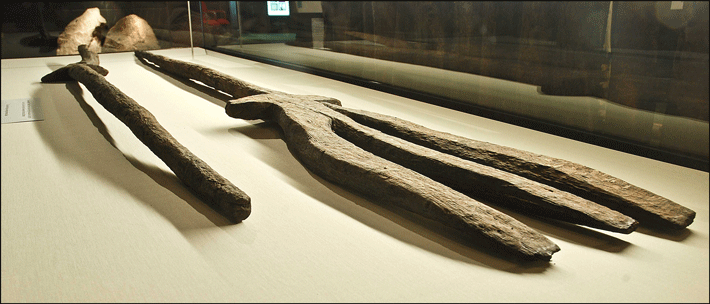
This blog discusses some of the practical and technical details of mashing in, Neolithic and Bronze Age style. It's about troughs and tridents, hot rocks and prehistoric burnt mounds. It was first published in the summer of 2014. I've edited it, added a few more details and brought it a bit more up to date. Why did I do this? Because it's now 17th February 2022 and the World of Stonehenge Exhibition has just opened at the British Museum in London. Among the 400 wonderful exhibits are two large wooden tridents, carved from solid oak and each measuring over two metres long. They were discovered near Stainton, Carslisle, in 2013. What were these mysterious objects used for? Archaeologists were puzzled. Suggestions at the time included eel spears or hay forks, neither being particularly convincing.

There was quite a lot of discussion on social media about the various possible and probable uses for these enigmatic objects made from solid oak. I'll try and find a link to it. It was a lively and, at times, argumentative discussion.

One suggestion that Graham and I made at the time was that these wooden tridents were ideal as mash forks, a traditional tool used for stirring the crushed malt into hot water in the 'mashing in' part of the ale and beer brewing process. Initially the idea was met with some negativity and suspicion. However, it now seems to be one of the accepted interpretations and, I am pleased to report, is included in the newly published book of the 'The World of Stonehenge' Exhibition:

"The tridents may have been used for fishing or eel trapping, or in agricultural activities as hay forks, and even as mashing forks in the process of beer brewing. It is likely that farmers were using some of their cereal harvests to make alcohol for social and religious gatherings rather than consuming only sober porridge and savoury foods." 

(Garrow, D. & Wilkin, N. The World of Stonehenge, published by The British Museum, 2022 page 50)

Neolithic-wooden-trident
(© Tullie House Museum and Art Gallery Trust)
This image is from a news item in Archaeology, Friday December 6th 2013. see:https://www.archaeology.org/news/1610-england-neolithic-wooden-tridents

At the World Archaeology Conference (WAC 6) in Dublin, 2008, archaeologists from the Moore Group demonstrated how to mash in a wooden trough using fire heated stones. They used a garden fork to transfer the stones into the trough.  Inspired by their brewing experiments Graham and I mashed in a replica stone trough at Bressay, Shetland, the site of a Bronze Age burnt mound, in the summer of 2011. We used a garden fork to stir the mash and, at the time, we wished that the handle of the fork could have been longer. Something like these tridents would have been perfect for the job. See our blog trough, mash and wort for more details of these experiments and demonstrations.

These two wooden tridents were carved from single pieces of oak and would certainly have been sturdy enough for the task of stirring the mash in a trough in the ground. They would also have been suitable to remove hot stones from a fire, transferring them into the trough of water in order to heat it and maintain a good mash temperature. The tridents have been dated to c3650 BC and were found in a palaeochannel at Stainton, a site associated with burnt mounds and much more. See here for more details of the excavations. 

And now, after this updated introduction, let's go back to the blog that we wrote in the summer of 2014:

what is a burnt mound?  

In Ireland, over 5000 burnt mound sites are known. In Scotland, about 1900 have been excavated so far. They also found in England and Wales. The burnt mound itself is a pile of fire reddened and cracked stones, often in a semi-circular shape as they have been thrown onto the heap. The stones were put into a fire to be heated up, then dropped into a trough of water in order to heat it. There are many things that hot water can be used for.

Archaeologists agree that burnt mound sites are something to do with hot rock technology - using hot stones to heat lots of water - but to what purpose? That's what archaeologists can't agree on. There have been several suggestions:

- they were used to cook meat. The idea is that you wrap a big piece of meat in straw and leave it in the heated water trough for several hours. You probably have to keep putting more hot stones in, as the water cools. There are easier and more efficient ways of cooking meat.

- they were a sauna or sweat lodge. I don't understand this. In my experience, a sauna has a few hot stones upon which water is splashed to make steam. You don't need a large trough of water and lots of hot stones.

- you can wash sheep fleece or wool in them. This seems to be a practical idea. Fleece must be washed before it is spun into wool for clothing.

None of these suggestions are controversial. Most people reckon that the troughs would have been multi functional - a bit like the kitchen sink only much bigger. When it was suggested that these sites could have been used for making beer, some archaeologists became ever so slightly annoyed. Although the idea was first put forward in 2007, backed by successful experimental work and sound brewing theory, it is still considered by some to be controversial. I don't know why. 

Hot rocks are ideal for heating large amounts of water to the perfect temperature for mashing, which is between 65 and 67 degrees Centigrade. Getting the water much hotter than this is very difficult. We found it impossible to get the water to boil. 

troughs as mash tuns
The possibility that they were used in the making of ale or beer was first suggested by Declan Moore and Billy Quinn of Moore Archaeological and Environmental Services Ltd. I first met them at a Conference about beer and brewing in prehistory and antiquity, held in Barcelona, October 2004. I gave a paper about the importance of malt in the brewing process. Billy and Declan asked me whether it was possible to make beer in a hole in the ground. We agreed they should have a go.

The following year, they came to Orkney to meet Graham and to learn a bit more about how to make ale and beer from the grain. They tasted the wort and were surprised how sweet it is. They tried Graham's beer and liked it. Then they went back to Ireland to do their own research into hot rock mashing in a trough. It went extremely well, and led to their now famous video on You Tube. They wrote an article for Archaeology Ireland and there have been several more articles online since then. The details of their subsequent work are on their web page.

They gave a demonstration of the technique at the Sixth World Archaeology Conference in Dublin, 2008. I was lucky enough to be there and it was spectacular. The smoke, the steam, the hot stones and the aroma of the mash! All of these things added to the magic and drama of the demonstration. If an archaeologist is looking for an impressive show of ritual, power and transformation in prehistory, then a hot rock mash ticks all the boxes. 

One day in the summer of 2009, I got a phone call from Billy. He told me that a trough with grain in it had just been found in Wales. The well preserved trough, with wood lined water channels, was excavated by Dave Chapman of Ancient Arts who went on to do some mashing and brewing experiments of his own. He was successful, as reported in British Archaeology news.

We had to try this for ourselves. So far, we had been mashing small amounts of crushed malt in earthenware bowls. It was clear that the 'hot rocks in a trough' technique worked much better. Graham made a small wooden trough, about one third the size of the real ones, and we had some fun mashing with hot stones. It is best to use stones from the land. Rocks collected from the beach explode when being heated in the fire. This is very dangerous.

We had an opportunity to mash in the replica trough at Bressay, Shetland in the summer of 2011. The same trough that was used to experimentally wash fleeces. We cleaned it well and luted the corners with local clay, to prevent water leakage. This explains the grey colour of the water in the photo below. There was initially some concern that there might be a problem. It turned out to be the clearest, sparkliest ale we have ever made. Bentonite powder, a derivative of clay, is used today to clear wine and beer.

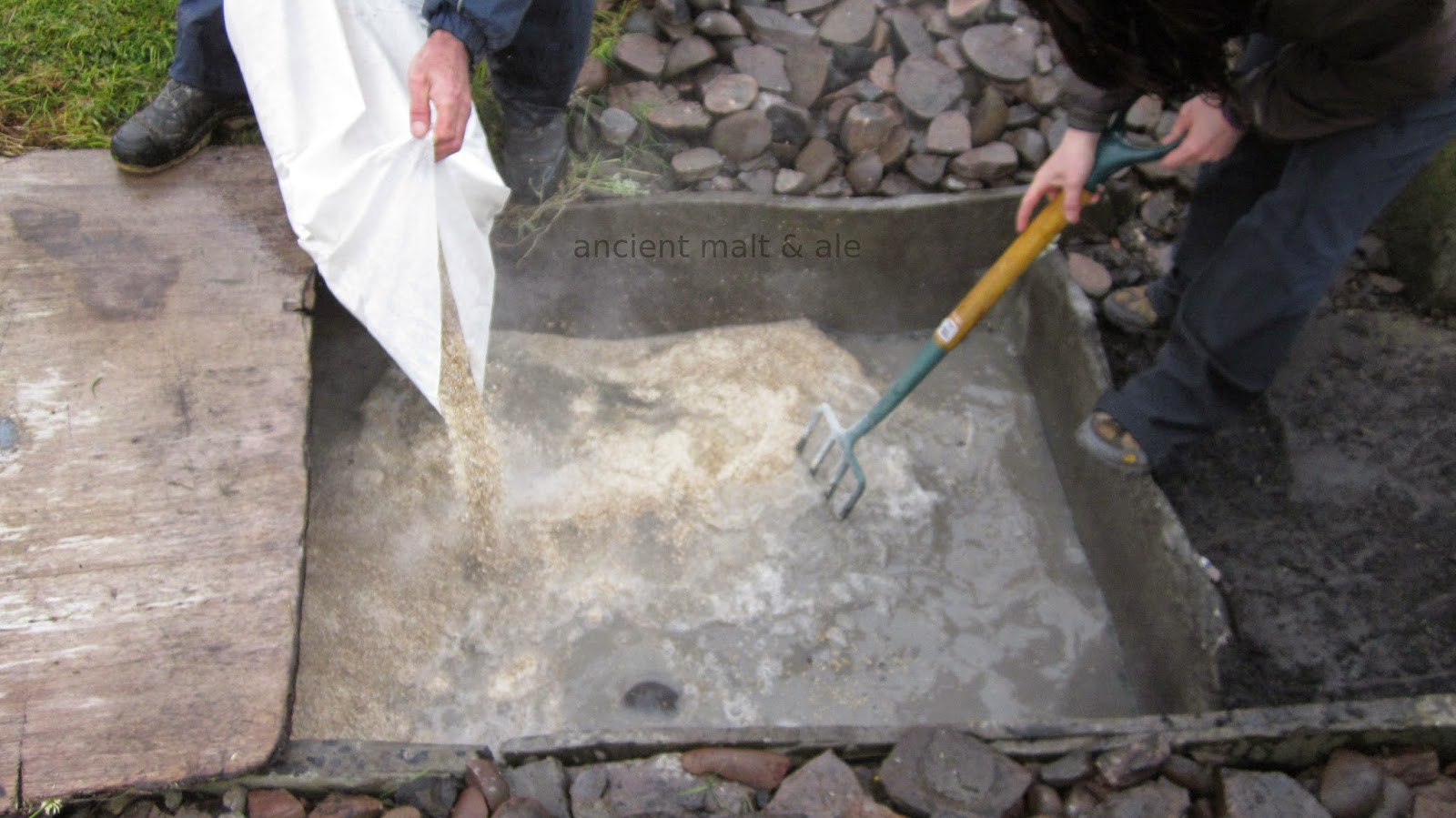
the strike: 50 kg of crushed malt is added to about 250 litres of hot water in the replica Cruester trough, Bressay, Shetland.
We used a garden fork to stir it about.
 
A successful mash. Adding a few hot stones kept the mash at an ideal temperature for the conversion of starch into sugar, which took about an hour. We put a piece of wood over the trough for heat retention. 

crushed malt & water transformed into 250 litres of wort in the trough, enough to make plenty of ale for a feast.
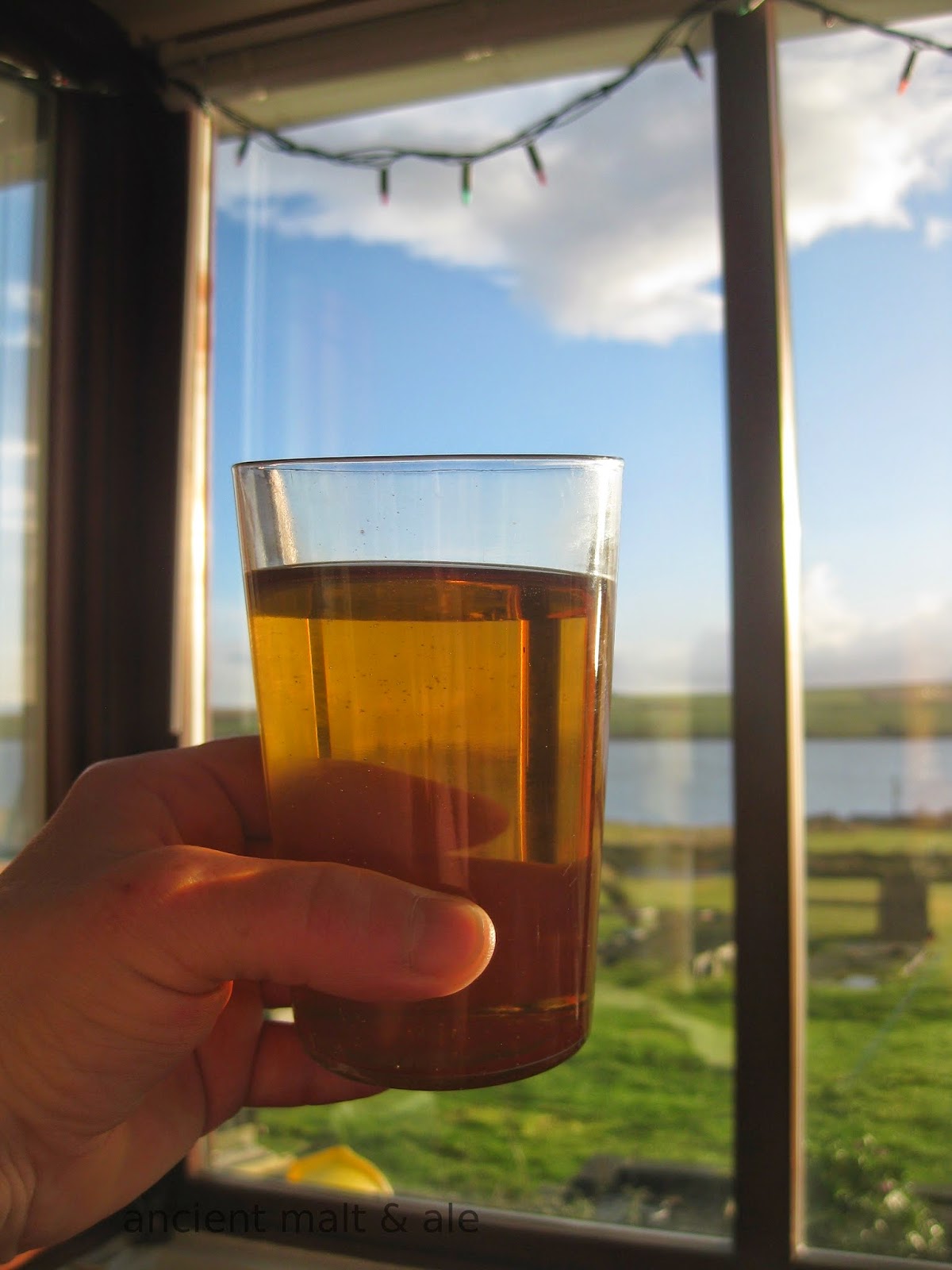
cheers! our clear and bright Bressay Ale.

After taking some of the wort from the trough using jugs, we added brewer's yeast and fermented it for several days. We only had one fermentation vessel, so we could not make use of more than 6 gallons of wort.

Next morning, when we went to empty and clean the trough, all the wort had drained away. Only the spent grain was left. Although we had clay luted it, the reconstructed trough is above the local water table. Meadowsweet flowers, about an ounce and a half, were added to the 6 gallons of wort when it had finished fermenting. Also, we had a ferry to catch and so our time was limited.

The result was a strong, clear ale. You can see all the pictures of our Bressay mashing and brewing adventure on my Facebook page. The ale kept really well.

We bottled it and sent some to the Past Horizons people to taste. It did take a while to open the parcel, but I think it was probably worth it.


neolithic burnt mounds, wooden tridents and fire cracked stones
There are excavations taking place in Northumberland, not far from Bamburgh Castle, organised by the Bamburgh Research Project. Several burnt mounds have been excavated and archaeomagnetromic dates that have so far been obtained indicate that these burnt mounds were in use during the Neolithic. Pottery finds support this interpretation. The dates obtained so far are 6,230 +/- 50 years BP at 95% confidence. There is a good summary of the excavations here.

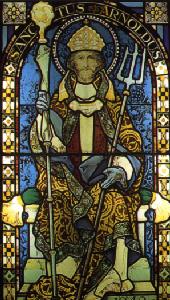
St.Arnoldus.jpg
Bishop Arnold of Soissons
In December last year, there was much discussion and argument on social media about some neolithic wooden tridents that had been found at a multi period site in Cumbria, which included several burnt mounds. What were these long handled wooden 'forks' used for? Fish prongs? Or maybe they were used for catching eels? Interpretations varied amongst archaeologists.

We think they would be a useful implement for stirring the crushed malt into the hot water - the strike. The crushed malt, also known as grist, clumps together when it is being added to the hot water. It is important to stir it about. It is also necessary to stir the mash when you add more heated stones. You don't want to have hot spots, you want to maintain an even temperature throughout the mash. The fork can also be used to move the hot stones about in the trough, if necessary.

In the Bressay trough, we used a garden fork. The handle was far too short and a long handled wooden trident would have been ideal.

Bishop Arnold of Soissons (who lived from 1040 to 1087) was the patron saint of brewers in Belgium. He is depicted with Bishop's mitre and a mash rake, which looks very much like those neolithic wooden rakes excavated in Cumbria.

Several neolithic buildings have been excavated at Kingsmead Quarry, Berkshire, England, by Wessex Archaeology. They have been interpreted as houses. This site is another very complex, multi period discovery, with finds ranging from the mesolithic, neolithic and Bronze Age through to post medieval structures.

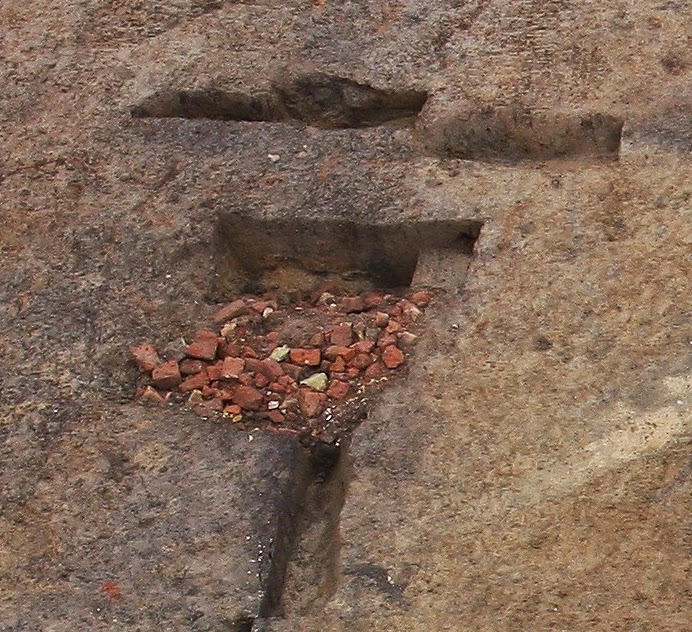
One of the four neolithic rectangular timber buildings, or 'houses' at Horton caught our attention when we were looking at the images online. There seem to be some fire reddened rocks close by the trenches that reveal the outline of the building in the photo below. What are they? They look rather like modern bricks, but the stratigraphy indicates that they are contemporary with the building. Are these stones an indication of hot rock technology at neolithic Horton? If so, exactly what were they doing in and around this wooden building, over 5000 years ago?

the footprint of a neolithic rectangular timber building at Horton, Kingsmead Quarry, with a big pile of fire cracked stones.
Details of the excavation here.


We looked through the reports online but could not find a reference to them. Quite a mystery! Graham managed to enlarge the section of the image with the rocks in and here it is. In close up they look even more mysterious. We look forward to reading the full excavation report to see what the interpretation of these rocks might be.

a close up of those mysterious fire reddened stones.

We would love to hear your ideas about burnt mounds, troughs, mash tuns and the possibilities of hot stone technology. This technique, of heating water and the mash with hot stones, is so successful that it has been done from the Neolithic to Viking times. Some burnt mounds provide dates that indicate this.

Tuesday, 13 May 2014

controversy in a grooved ware bucket

 The Larger Vertical Stone
Balfarg: an ancient site on a housing estate
The focus of my research changed suddenly, from the British Bronze Age to the Neolithic, one day in the summer of 1997. I was reading an excavation report about the prehistoric ceremonial site in Scotland, known as Balfarg. It was a large and complex place. As well as a neolithic henge and stone circle, which was preceded by a timber circle, there were the remains of mysterious rectangular timber built structures. There was also a ring cairn and a ring ditch. Lots of prehistoric pottery was found, ranging from neolithic bowls and large grooved ware bucket shaped pots to bronze age beakers, tripartite food vessels and bucket urns.

Pits contained what the excavators interpreted as "ritually charged" material. These so called "ritual pits" contained large quantities of broken and burnt pottery, mixed up with charcoal and burnt bone. Apparently, these things were deposited deliberately. In other pits there was no pottery, just charcoal, and the pit had been carefully sealed with closely packed stones.

Residues were noticed on a few sherds of neolithic grooved ware that had been buried in one of these pits. Analysis of these cereal based residues with meadowsweet pollen are similar to those found on Bronze Age pots, specifically, the Strathallan Food Vessel and the Ashgrove Beaker, which have both been interpreted as possibly being the remains of ale.

Were they making malt and ale in neolithic Britain? It seemed so to me. The Neolithic Revolution began in the British Isles around 4000 BC. Did it take people almost 2000 years, until the Bronze Age, before they realised or discovered that it was possible to make malt and ale with the barley and wheat that they were so keen to grow? Was the Neolithic really a time of growing grain to make flour, bread, porridge and gruel? Or were they making sandwiches for the feasts, as Professor Mike Parker Pearson seems to be suggesting. Or maybe he is just making a joke?

a few words about brewing residues
When making ale from crushed malted grain, two types of sludgy cereal based residues are generated during the brewing process. The first is a sludge, rich in barley chaff from the sparging process. Freshly sparged wort is cloudy at first. 

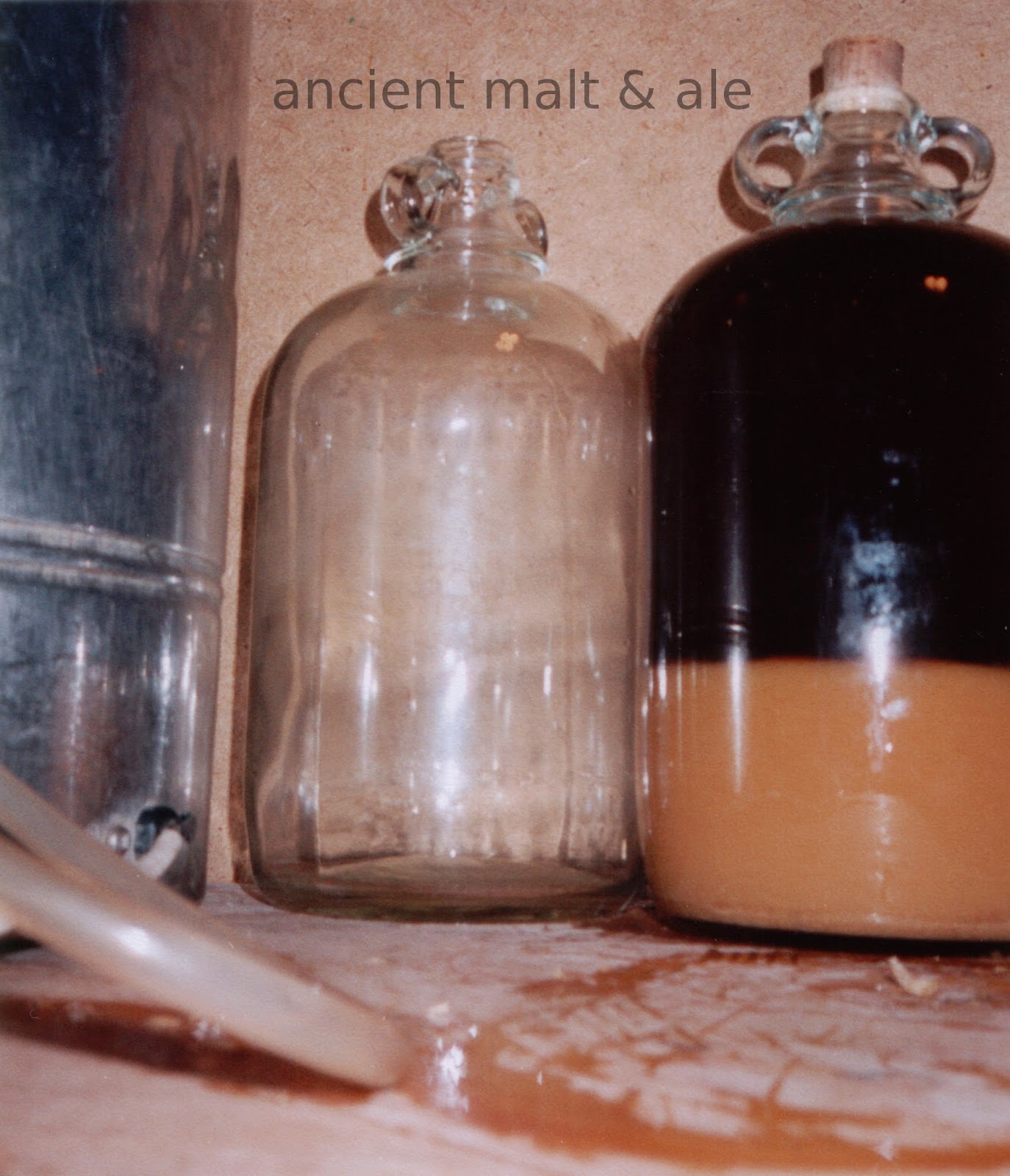
freshly sparged wort - settling out
the same wort, settled out with sludgy cereal residues accumulated
Once you have a clear wort, it is racked or syphoned off into a fresh clean vessel. Some chaff will inevitably get through. Boil the wort with selected herbs, flowers or hops and then ferment it. You can use the barm from previous brews to start a fermentation, it is ideal. A simple process, once you know how to do it.

The second type of brewing residue is cereal based, but with traces of yeast and herbs, hops, flower heads, leaves, twigs or pollen that settle out during the fermentation of the wort in the fermenting vessel. If you are lucky enough to drink a bottle of traditionally made real ale, the kind that must be poured in one go so as not to disturb the sediment, then you will know roughly what I mean. 

cereal based residues on grooved ware buckets
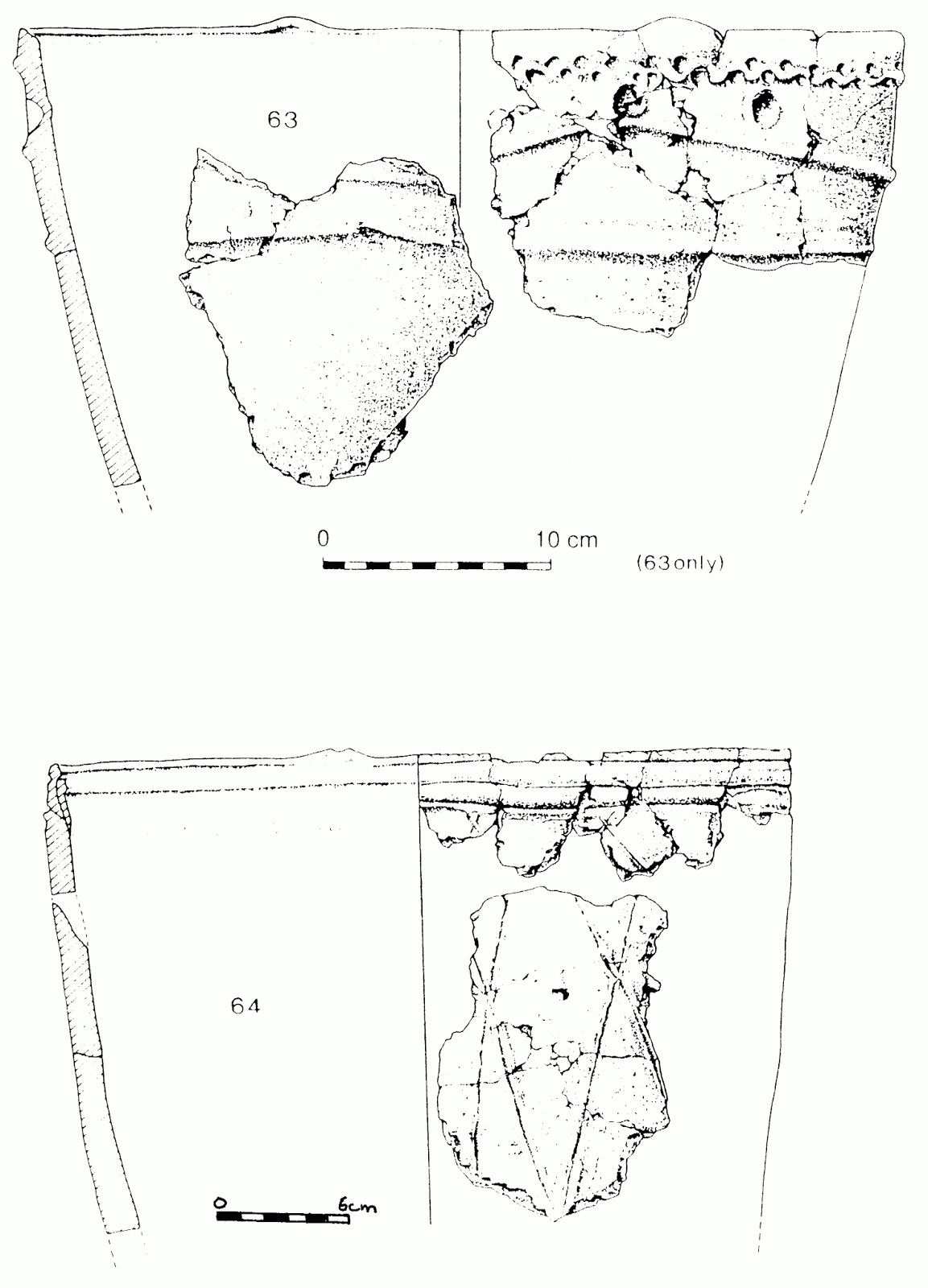
Let's go back to the Balfarg excavation report. The pots in question were numbers 63 and 64. Sherds from these two large grooved ware bucket shaped pots were found in a pit, close by one of the rectangular timber structures. Brian Moffat's descriptions of the cereal based residues make interesting reading for any all-grain brewer or archaeologist. I recognised immediately what these residues represented when I read them, way back on that summer's day in 1997. Not a sort of porridge with added herbs. Not a kind of gruel. These cereal based residues were probably the remains of brewing sediments from the fermentation bucket.

I was so excited by this! Ale in the Neolithic! I ran round to my best friend's house, just round the corner from where I lived, and told her all about it. She is a biochemist and was just as excited as I was. I told my supervisor the next day. He did not seem impressed at the prospect of malt and ale in neolithic Scotland. The previous year I had a short article published in British Archaeology, so I contacted the editor. He asked me to send him some details so that he could include it in the News section, September 1997. The Getafix and magic potions reference was not my idea! I do like it, though.

the original descriptions of the residues on pots 63 & 64

pots 63 & 64 from Balfarg (PSAS Vol 123)
Three broad, yet distinct types of burned cereal based residues were identified on the inside surface of sherds:
1. amorphous & burned
2. amorphous, granular & burned 
these two types were abundant in all samples.

3. burned cereal mash
both barley & oats, part grains, there was no entire carbonized grain since the grain had been thoroughly ground down, making taxonomic identification difficult.

"... a cereal based preparation ... with meadowsweet, indicated by both pollen & macroplant remains, clumps in one sample indicate a flowerhead was added ... fat hen ... cabbage/mustard? ... the single record of nightshade is puzzling ... pollen from hemlock ... the mix is coarse and crude ... like course porridge with potherbs and flavourings"

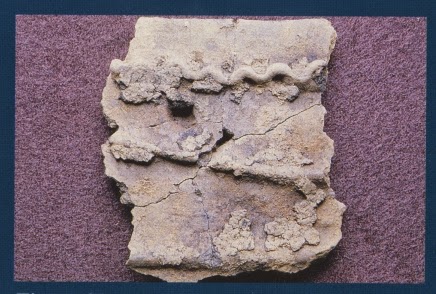
Another burned deposit was encrusted on the outer surface of one sherd of Pot P63. Both pollen and seeds of black henbane were identified.  
"... the seeds are robust and resilient and the breaks show mechanical rendering ... pollen and seed fragments were fairly well intermixed suggesting an incomplete process of homogenization ... the small cache of seeds is of black henbane alone."

Two separate organic residue deposits. One inside the pots, this one was cereal based with several different herbs added. The other residue was a burnt encrustation on the outside surface which, when first analysed, contained henbane pollen and several henbane seeds.
burnt encrustation on the outside of Pot 63 that contained henbane pollen and seeds

The above photo is from the booklet "Balfarg. The Prehistoric Ceremonial Complex" published by Fife Council, Glenrothes Development Corporation and Historic Scotland, 1993. I think it was intended as a guidebook for the site and is now out of print. There may be secondhand copies available. The original archaeobotanical report of the Balfarg residues is on pages 108-110 in Proceedings of the Society of Antiquaries of Scotland, Vol 123.

Henbane (hyoscyamus niger)
According to Culpepper, henbane should never be taken internally. More modern herbal reference books warn that it is a deadly poisonous plant. Do not use. This is very good advice. However, henbane does have its' place as a herbal remedy that was sometimes used in historical times, for example, to alleviate earache if applied externally, as a tincture. If consumed in small quantities, henbane induces intoxication, hallucinations, blurred vision, rapid heartbeat, euphoria and dizziness.

It is an effective painkiller, according to the herbal literature. All parts of the plant can be used and the seeds are about ten times more potent than the leaves or flowers. I am sure that, in the Neolithic, people knew about the medicinal and other properties of the henbane plant. It grows well in coastal regions and henbane seeds were identified at Skara Brae, a neolithic village in Orkney, Scotland. An intriguing aspect of the plant is that the active ingredients, the alkaloids, are more soluble in alcohol than in water.

henbane (hyoscyamus niger)

so what's the controversy?
This appeared to be not about the cereal based residues, but rather about the unusual identification of henbane seeds in the burnt encrustation on the outside surface of a neolithic pot sherd. It seems that, at first, there was not a problem. The excavation report, with its' rather interesting archaeobotanical report, sat quietly in the library journal section for a few years. It did not make any trouble. As more things were written about it, and as more archaeologists made reference to the possible "ritually charged" aspects of this rare residue discovery, it seemed that a re-analysis was required. This was commissioned by Historic Scotland. Two academic papers were rapidly produced.

The first was published in January 1999 in the Journal of Archaeological Science. This is a pay to view paper, with access available through University Libraries. Although the existence of henbane seeds within the residue was not confirmed, the residue was described as "a uniform and well processed substance, possibly something like a thick carbohydrate or protein based gruel". This description is consistent with the sludgy residues that accumulate at the bottom of an ale fermentation vessel - a well processed homogeneous mixture of cereal chaff, pollen, plant fragments and seeds.

The second paper was published in March, 2000 in Antiquity. This one, happily, is accessible online and is essentially a summary of the first paper. The focus is on disproving the "henbane ale" theory. The abstract makes this clear: "Were drugs in use in prehistory? Recent claims for the use of hallucinogenic substances have been made, and caused a stir. However, new work on a Scottish Neolithic ceremonial site suggests archaeologists (and the media) may have been jumping to the wrong conclusions!"

Whether or not henbane was added to the ale is clearly debatable. If such plants were being added to the brew, then it infers an understanding of their properties and some interesting ritual practices in prehistory. It might infer shamanistic practices, witchcraft, medicinal use of plants and more. A paper has been published recently in the Journal of Archaeological Method and Theory by Elisa Guerra-Doce of the Universidad de Valladolid in Spain. She argues that "far from being consumed for hedonistic purposes, drug plants and alcoholic drinks had a sacred role among prehistoric societies. It is not surprising that most of the evidence derives from both elite burials and restricted ceremonial sites, suggesting the possibility that the consumption of mind-altering products was socially controlled in prehistoric Europe."

My interest is in the cereal based residues on these ancient grooved ware pots and what they tell us about cereal processing techniques in the Neolithic. Flour, bread, porridge, gruel or was it malt and ale? What were they drinking at feasts? Was it sacred river water, or was it sacred ale? When searching for an image of grooved ware pottery online I found this comment on that well known online Encyclopedia - Wikipedia:

"Grooved ware comes in many sizes, some vessels are extremely large, about 30 gallons, and would be suitable for fermentation. The majority are smaller, ranging from jug to cup size, and could be used for serving and drinking. The theory that the first British farmers (c4000 BC) had the knowledge and ability to make ale from their crops with their pottery appears to be controversial and not yet widely discussed by the archaeological community."

There have been some amazing recent archaeological excavations and discoveries of ancient ceremonial and feasting sites, for example the Ness of Brodgar on Orkney and Durrington Walls, near Stonehenge in England, which was investigated by the Stonehenge Riverside Project. There is also evidence for beer brewing and feasting at Gobekli Tepe in Turkey, at the dawn of agriculture, some twelve thousand years ago.

It is surely time for the academic community to start talking seriously about how grain was being processed in prehistory. What were they were using it for? The options seem to be flour, bread, porridge, gruel or malt and ale, with added herbs.

----------------------------------------------------------------------------------------------------------------------

Balfarg Excavations
Balfarg was excavated before the construction of a housing estate. As a result, plans were altered to preserve the stones and build the houses around them. The excavation reports are online, thanks to the Archaeology Data Service, York University, so you can read it for yourself from the comfort of your own desk or armchair: Barclay, G J & Russell-White, C J (eds) 1993 'Excavations in the ceremonial complex at Balfarg/Balbirnie, Glenrothes, Fife' Proceedings of the Society of Antiquaries of Scotland Vol 123, 43-210.

Balfarg had been excavated earlier, in the 1970s. During those excavations a cist burial was found, containing the bones of an adult together with a dagger and a fine beaker with a handle - a rare find indeed. This excavation, by Roger Mercer, was published in 1981: The excavation of a late neolithic henge-type enclosure at Balfarg, Markinch, Fife, Scotland 1977-1978. Proceedings of the Society of the Antiquaries of Scotland Vol 111, 63-171.