Showing posts with label embryo. Show all posts

Saturday, 24 September 2016

a morning with maltsters, part three: on the tour, some archaeological thoughts

We left the meeting room of the Highland Park Distillery and started our tour of the maltings. I'd forgotten my camera, however it gave me the opportunity to make notes and think a bit about the archaeological evidence for making malt.

This was not my first tour of a malting facility. Years ago, when I started my post graduate research into the archaeology of malt, ale and beer I contacted Thomas Fawcett and Sons, Maltsters, in Castleford, West Yorkshire and asked if they could show us round. They were very helpful and friendly. Soon we had been given a personally guided tour of the maltings by James Fawcett himself. Fawcett's make malt for the brewing industry using traditional floor malting techniques as well as having modern Germinating Kilning Vessels. There's a short film on their website where the ancient craft of floor malting can be seen. We'd wanted to see how an industrial maltings worked, having already visited an 18th Century grain barn at the Corrigall Farm Museum, Orkney, with a threshing floor, malting floor and grain drying kiln. Making malt is the same process, whether you are in a grain barn on a farm or at an industrial floor malting. The only difference is the scale of the task.

The tour of the Highland Park Maltings began with the steep tanks. Barley is steeped in water with regular air rests. Air is bubbled through. Steep tanks vary in size, obviously, but the basic principle is to get the barley wet enough and aerated sufficiently to trigger the germination process.
the steep tank, barley in bubbling water, with regular air rests
source MAGB

Steep tanks emulate a traditional and probably ancient technique. Maltsters in history and prehistory would have put their harvested grain into a porous bag and then left it in a shallow bubbling stream for a few days. This practice would, of course, leave absolutely no archaeological evidence. I was first told about it by an Orcadian farmer, maltster, brewer and crofter, Harry Flett, who was the custodian of the Corrigall Farm Museum.

a babbling brook, plenty of water and oxygen here
source wikipedia images
In Britain, people began to grow barley and wheat around six thousand years ago. This was the neolithic era, when hunter gatherers settled down and grew crops. What were they doing with the grain? How were they processing it? The consensus of opinion in academic archaeological literature and belief is that, since the earliest neolithic, they were grinding it into flour to make bread. Perhaps they were boiling it up to make porridge or gruel. The possibility of making malt has not been taken seriously. Many archaeologists, including professors, have shouted at me when I've made this suggestion at conferences. They don't like the idea of making malt in the neolithic.

I've written about some aspects of my research into neolithic grain processing, grain barns and the "first farmers" in an earlier blog. Many of the neolithic rectangular timber buildings in Britain and Ireland were situated beside or close to streams and rivers. Carbonised barley grains with missing embryos have been discovered at a number of these ancient sites. I think that they are good candidates for grain barns and malt houses five thousand years ago.

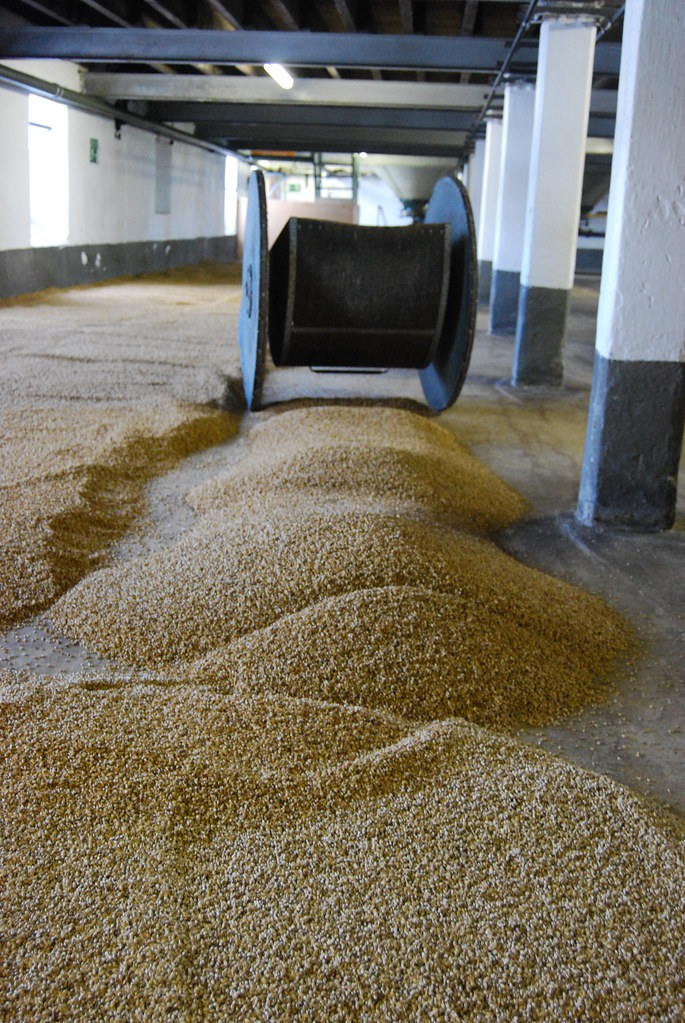
The steeped grain is transferred to the malting, or germination, floor. This is where it begins to grow visibly. Conditions have to be right. It's too hot in the summer months for floor malting, however, with the modern GKV systems it's now possible to make malt every day of the year. At an industrial floor maltings there are large amounts of grain to be carefully transferred from one place to another. We were introduced to the malt chariot.

steeped grain goes into the chariot
source here
from steep tank to malting floor
source here

According to Distillery Manager Marie Stanton, a malt chariot is a tricky thing to learn how to drive. The maltsters are experts at it, of course. An industrial floor maltings has to deal with large amounts of malt which is couched, then spread out on the floor. The chariot at Highland Park was in use regularly for this purpose. Ambient temperature and weather conditions dictate the depth of the grain bed.

There were several wooden malt shovels, or shiels, leaning up against the wall. They are used to turn the malt. It's a long job and in an industrial maltings like this, team work is crucial. It takes hard work and skill to turn tons of malt on the floor using one of these. On the tour we were told that some maltsters at the Highland Park were ambidextrous, able to turn malt to the right and to the left with ease. Others preferred to just work one way, which seems to be how the owner of this well worn malt shovel worked.
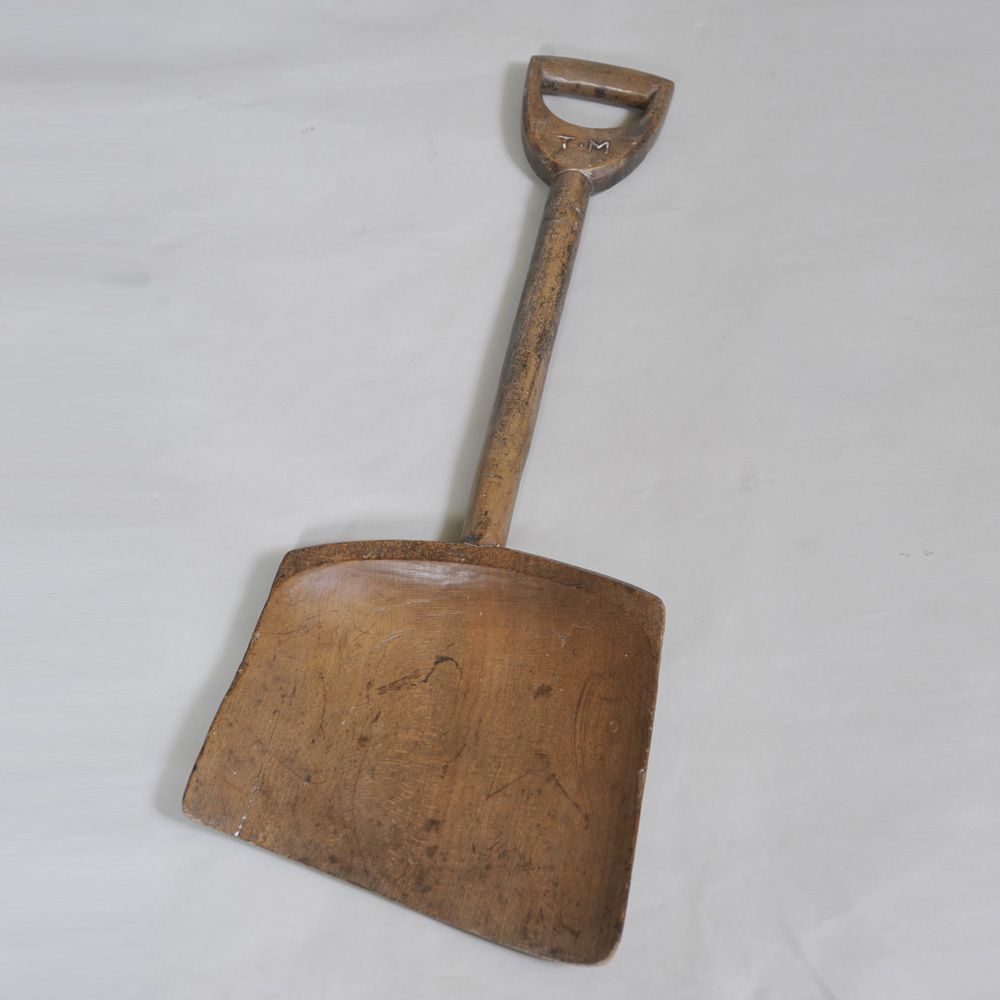
A 19th Century malt shovel, well worn from use
source here

As well as wooden malt shovels, fish tail rakes are used. These make the job so much easier, follow the link below the photo to find out why. Raking the malt is not just a skill, it's an art.

A medieval style custom made malt rake, with fish tails, used by Riverbend Malt House
How did neolithic and bronze age maltsters turn their malt? What did they use? They had no metal rakes. Wooden tools rarely survive in the archaeological record. I've sometimes thought that an animal's shoulder blade might have been a suitable tool. A scapula is a sturdy thing, it has the shape of a shovel and could be used for many tasks that the "first farmers" needed to do. It would do the job of turning the malt nicely. Has anything been found that might support this idea? There's only one discovery that I know of. During road works in 1987 at Achavanich in Scotland, a female cist burial dated to the Bronze Age was discovered. It had contained the crouched burial of a young woman, however only the skull and a few bones remained.

The grave goods that accompanied this young woman were these: a beaker or food vessel, a thumb nail scraper, two flint flakes and, unusually, the shoulder blade of an ox. The beaker or food vessel had organic residues within it. This is another rare find. According to the official site records (HER)

"The contents of the beaker were analysed by Dr Brian Moffat of SHARP who, from a preliminary examination, suggested that it contained: prepared cereal grain, honey, added flowers and fruit (including meadowsweet, bramble & wood sage), and the sap of birch and alder trees."
 
Similar residues have been found in other bronze age pots and have been identified as the remains of ale. These two things combined, the pot with cereal based residues and an ox shoulder blade, suggest to me that the woman may have been a maker of malt and ale. She had been buried with the necessary equipment. I mentioned this to a couple of people on the tour and they agreed it could be a possibility. The young woman who was buried 3700 years ago is now the subject of a new investigation by archaeologist Dr Maya Hoole. The details are here if you are interested.

ox shoulder blade from the Achavanich burial, was it used to turn the malt?
source here (this is a screen grab from the Facebook page)
The next part of the tour took us to a small room, the laboratory, where the viability of grain for germination was assessed. Why does it need to be tested before it is steeped and turned out on the malting floor? Because barley has a latent dormancy after harvest. It must be stored, in a dry place, for a few weeks or months before it will germinate. The reasons for this and the biochemistry behind it are not yet fully understood. The length of dormancy can vary between crops and barley variety. Traditionally, grain has always been left for a while after harvest. People have known about latent dormancy for a long time.

Grain that will not germinate is useless to a maltster. Upon delivery, samples are taken from every batch of grain. Individual grains are selected at random and tested for viability. This can be done by steeping them in a solution of hydrogen peroxide at 0.75% at 18-21 degrees Centigrade. Germinated corns (seeds) are counted after three days. For a working maltings, this takes too long.

A quicker method of checking viability is to cut a grain longitudinally and use tetrazolium chloride which stains the embryo pink. The maltster can get a result in half an hour. There was a very nice little grain cutting machine in the laboratory at Highland Park, used to cut grains in half for testing from every batch of barley. Shame I forgot my camera, but here's a picture of a stained living barley grain from the MAGB website. Pink toed barley, that's what the maltsters call it, if the barley has a pink toe then it's good for making malt.
white endosperm, pink embryo, it's alive!
source here


The final part of the tour was to climb the old narrow wooden staircase, it was more like a boxed in ladder, to look at the kilning floors in the loft. We were treading in the footsteps of maltsters past, it was a strange feeling. The steps were worn, malt has been dried here, in the same way, for two hundred years. We looked through the window to see the green malt, steaming as it began to dry. It looked very much like the photo below. Drying malt on this scale takes three or four days. The maltsters turn it at regular intervals so that it dries evenly. Hot air and peat smoke from the fire downstairs passes along the flue and through the bed of wet malt, imparting flavour, drying it gently so that the malt is not killed.

green malt at Highland Park, steaming on the kiln floor as it slowly dries
source: a blog by the whiskyspeller's here
We left the kilning floors by a small door which led us onto a metal walkway on the roof, right beside the distinctive pagodas. Whenever the malt is being dried there is steam coming from the pagodas. We had great view over Kirkwall and a new perspective of the Distillery, a place that we often drive past. 

the twin pagodas of the Highland Park Distillery
source here
Finally, we went down the metal staircase on the outside of the building to see the kiln fire downstairs. The maltsters start the fire with coke to warm the kiln, after this, peat from Hobbister is used. The peaty smoke flavours the wet malt. Coke is used at the end to thoroughly dry the malt. Each fire needs to be run slightly differently, depending upon the batch of malt. It's just another of those maltster's skills that can only be learned by experience and practice.

the kiln fire, it's a long way from the malt and there's a metal flue
This kiln has a fierce fire but is situated a long way from the malt. In a pot kiln, you need great heat to fire the pots. The principle with a grain or malt drying kiln is completely different. Hot air and smoke pass along the flue and through the bed of green malt. There are sturdy metal linings to contain the sparks and make it safe. I don't want to go into any more whisky making details. My interest is in making malt for brewing ale and beer. 

Today there are many different kinds of malt being made by maltsters for brewers. It can be confusing for a non brewer. The most crucial is the base malt, the one that is made and dried like this, carefully and slowly to keep the starch converting enzymes alive. These enzymes are needed in the mash tun. Base malt provides all the necessary sugars for fermentation. Other malts, such as crystal malt or chocolate malt have only been made since the mid 18th Century. Just to confuse the issue even further, there is also roasted barley, which is not malted at all and which gives dark beers like Guinness and porter their distinctive black colour and flavour. Hops add bitterness and other flavours, they are also antimicrobial. Unroasted barley alone cannot be used to make beer, it is added to the base malt. Unroasted barley has no enzymes.

Specialist malts provide colour and flavour to the finished ale or beer. They are a modern thing; making roasted malt is not a prehistoric technology. Specialist malts are roasted at high temperatures that kill all the enzymes, therefore it is not possible to make beer using only this kind of malt. I shall have to write something later about this, it's a huge subject. 

Malt is a mysterious thing to most people. In the world of archaeological and anthropological literature I find few references to malt. There is very little meaningful discussion of it.  Assumptions have been made that malt is "toasted roasted barley sprouts". Another belief is that the archaeologist has to actually find "sprouted barley" with roots and shoot still intact for there to have been malting and brewing at their site. I have been told this many times by archaeobotanists. The reality is that the malt loses its' roots and shoots in the kiln. An archaeologist will not find them. There are many other indications that grain has been malted.

When you read the academic archaeological and anthropological literature about "alcohol production in prehistory", there is a belief, an assumption, that all you have to do is mush up a few sweet things, like berries, honey, some sort of sweet plant, maybe a bit of barley and some birch sap. Leave it in a bucket or a pot and, magically, you will have "some sort of alcohol". Making ale and beer is not like that at all. Malt is the essential ingredient. It provides both flavour and, more importantly, the necessary fermentable sugars without which there will be no ale. No beer. 

That's more than enough for now. I shall continue working on my post about alcohol production and some of the myths that surround it in the archaeological and anthropological literature. I look forward to comments and discussion with about malt in the future. Malt matters.

~~~~~~~~~~~~~~~~~~~~~~~~~~~~~~~~

Here's a bit more that I've written about malt, malting, the history and the archaeology. I shall get around to tagging the blogs soon so they are easier to navigate.

Brewer & Distiller International February 2016
The craft of the maltster  
Food & Drink in Archaeology 4 eds Howard, Bedigan, Jervis & Sykes
grain dryers, malt kilns and malting ovens


Monday, 18 August 2014

what's the archaeological evidence for malt?

This is something that I became more and more interested in, once I had completed and submitted my thesis. How does an archaeologist or an archaeobotanist recognise whether or not a grain is malted? What happens inside the grain on the malting floor? I had access to the University Library for a few years after my degree - by teaching archaeology classes in the Continuing Education Department. I explored sections of the Library that, perhaps, no archaeologist had visited before. I studied grain germination physiology, biochemistry and discovered that Bewley and Black's classic study of seed germination was the best.

Malting is an important craft and technology. The main reason for making malt is to brew with it, or more specifically, to make an ale or beer from the wort. Malt is also the main ingredient for whiskey, of course, but I am most interested in malt and ale in prehistory and its' role in the origin of grain agriculture. Apart from grain barns and malting floors, it seems that the best archaeological evidence for malt lies within the grain itself. There are clear physiological indications, depending upon whether the grain is desiccated (dried) or carbonised (charred).

Carbonised or charred grains are frequently found in archaeological excavations from the neolithic, when people first began to cultivate and process grain, right through to the medieval era and beyond. Carbonised grains are found all over northern Europe.

What do they signify?

Is it evidence of a grain store or granary that has been destroyed by fire? This was suggested in interpretations of excavations of an huge rectangular timber building at Balbridie, Fife, Scotland where thousands of carbonised grains were found?

Perhaps the grain dryer in a barn caught fire, while they were drying the harvested grain or oats. Or was it a kilning of the malt, which has gone disastrously wrong?

Lots of grain barns have burned down over the years, as well as traditional malthouses. It's not an unusual event. Even in recent times, as late as the 1960s, malthouses have been known to catch fire.

Carbonised grains were found at Eberdingen-Hochdorf, where there were the remains of Iron Age malting and brewing. This Iron Age site was excavated by Professor Hans Peter Stika between 1989 and 1993. According to the excavation report, it was a high status site, probably the rural residence of a prince. The carbonised grains, a huge number of them, were found in a sort of U shaped ditch, together with bits of charred wood. The interpretation was that as the malt was being dried, the fire had got out of control and set fire to both the wooden platform upon which the malt had been laid, as well as carbonising all the malt. The charred grains were mostly barley. Many of them had missing embryos and the grain was in poor condition.

They were identified as having been deliberately malted using these criteria:
... groove like channels on the dorsal sides
... the dorsal side becomes concave
... the coleoptile and coleorhizae become more prominent
... germination roots develop
... separated or fragmented embryos
... germination was even, meaning that it was deliberate and intentional

A recent excavation at another Iron Age site has also identified the activities of making malt and brewing by examining the charred grain. Another accidental fire had preserved the malt as it was being dried in the 5th Century BC at Roquepertuse in south eastern France. The sample of grain was taken from the floor of a building, close to a hearth and an oven. The excavators describe it like this:

"In spite of favourable conditions for the preservation of seeds in the sediment, which was rich in ash, charcoal and generally carbonised plant material, the grains are corroded and highly fragmented. This fairly poor preservation seems rather specific to the barley grains from this sample. Conditions are therefore not suitable for a satisfactory observation of all the morphological features of most of the grains. However, the best preserved specimens allow the assessment that slightly more than 90% of the grains were sprouted when carbonised. This is easily visible from the groove like channel on the dorsal side of the grains. As far as we can see, the sprout length is not perfectly uniform, but it generally reaches about two thirds the length of the grain. 

The poor preservation of barley grains is probably caused by germination, which tended to render them brittle. Fragmentation occurred mostly after carbonisation and is therefore not due to Iron Age human practices." Bouby et al, 2011, Never mind the bottle. Archaeobotanical evidence for beer brewing in Mediterranean France and the consumption of alcoholic beverages during the 5th Century BC

It's beginning to get a little bit technical here and, perhaps, a good time to explain some of the grain germination jargon. There is a lot of it, so I shall stick to the basics. The fundamental biochemical processes and the physiological changes of grain germination occurred in ancient grains just as they do today, in modern grains. It doesn't matter whether you make malt 10,000 years ago or 5000 years ago or 10 minutes ago, the biochemistry of grain germination remains the same.

Grains are a lot plumper than they used to be, because of selection and development by farmers over the millennia. The aleurone layer, a special layer of cells just beneath the husk, is three or four cells in depth in modern grains, rather than the one or two cells in ancient grains. The structure of ancient cereal grains was studied by Professor Geoffrey Palmer, who looked at 3000 year old grain from Amarna, Egypt. Using a scanning electron microscope to investigate ancient desiccated grains, he found that the internal structure remained intact. Individual starch granules within the endosperm could be seen with little holes or pits, where the enzymes had begun to convert grain starch into sugars. There are lots of wonderful scanning electron microscope images in his paper.

Carbonised, or charred grain is found on many archaeological sites in Northern Europe and the British Isles. The matrix of charred or carbonised grain has been destroyed by heat of the fire, so it is not possible to look at individual starch granules. Although carbonised grain is often used just to provide a radiocarbon date for the site, there might be other clues for the archaeologist and archaeobotanist that reveal what kind of grain processing techniques were taking place. Such as separated embryos, fragmentation and friability.

what happens on the malting floor?
Barley, wheat, oats, sorghum and rye can all be malted. I hope these diagrams of grain and malt will help to explain how the grain germinates. This is how it works at a basic level.

When the grain has been sufficiently steeped and aerated in water, growth hormones (gibberellin) are activated in the scutellum and embryo. These growth hormones stimulate the production of enzymes in the aleurone layer, which is a thin layer of special cells, just beneath the husk.


The maltster knows, through skill and experience, when the grain is sufficiently steeped. The wet grain is transferred to the malting floor, where it is piled up, then gradually raked out into a bed, a few inches deep. Here it begins to germinate. When rootlet and shoot are about one third the length of the grain, it is called green malt, and the next stage is to carefully dry it. 

Biochemical changes occur within the grain as it germinates on the floor. The enzymes that were activated within the aleurone layer begin to convert grain starch into sugars, the initial food source for the growing grain. These are the same enzymes that re activate in the mash tun and make a sweet mash. Other enzymes break down the husk, making the grain friable and, therefore, easier to crush than unmalted grain.

Malt, therefore, is made up of mostly starch, with a few sugars and, most importantly, those dormant starch converting enzymes that re activate in the mash tun at the right temperature.

Grain germination has a complex biochemistry. Scientists still don't fully understand how the aleurone layer works. If you want to know more detail, have a look here. If you want to read even more detail, have a look here, at chapter 14 of 'Barley: production, improvement and uses' by Steven Ullrich. Or get hold of a copy of Bewley and Black.

The products of brewing are ephemeral. Malt goes into the mash tun. Wort is fermented into ale which people drink and spent grain is fed to animals and waste liquid is washed down the drains. For the maltster and the brewer, it is a tragedy if the grain barn is destroyed by fire while the malt is being dried. For the archaeologist and archaeobotanist, it is a wonderful thing because the grain is carbonised and it is therefore preserved for analysis.

drying the green malt
Straight off the malting floor, it is called green malt. The maltster stops the growing process by gently drying the malt in a kiln. Gentle heat does not destroy the enzymes. Warm air passes through the malt, usually over several days. Traditional grain drying kilns do not have a solid floor. The malt is put upon a permeable floor to dry, so that warm air passes through the grain bed. Making good malt is a skilful task.

Today, maltsters produce a variety of types of malt by kilning at different temperatures. Base malts are kilned at lower temperatures. The enzymes are not destroyed and will remain active in the mash tun. Specialty malts are kilned at higher temperatures, destroying the enzymes. These provide only colour and flavour to the beer, making up no more than 10% of the grain bill in the mash tun. Specialty malts have been developed over the last two hundred years, making a wide range of beers possible from pale ale to dark stout.

SEMs of carbonised grain from Balbridie 'timber hall', Fife, Scotland
I spent a few years making funding applications, hoping to continue my research into the archaeological evidence for malt. That never happened but, working with the Satake Centre for Grain Process Engineering at UMIST, Manchester, I was able to get some scanning electron images of ancient carbonised grain from a neolithic site in Scotland.

The SEM images below were taken to accompany our funding applications and they were not originally intended for publication, but I think enough time has passed for me to now put them up on my blog and share them. The SEM work was done by a brewing research student. I am sorry to say I don't know her name and I did not get to meet her.

I was given six tiny carbonised grains from the thousands that had littered the floor of a 6000 year old, early neolithic rectangular timber building in Scotland. The building was destroyed by fire. Professor Ian Ralston, one of the original excavators, was kind enough to send me them. Three of the grains had missing embryos, visible with the naked aye and very clear under a normal microscope. One of the grains was examined using a scanning electron microscope and it shows the missing embryo, on the right, indicating that it has begun to germinate.

More of the grains from the site would need to be examined, to identify how many had begun to germinate. If it turns out to be a high percentage, and if the grains are friable and poorly preserved, then this is a deliberate malting for the production of ale in neolithic Scotland. Several SEM images of the same grain were made. The image below shows that the endosperm of the grain has been badly damaged by the fire. But it is possible to just about see the aleurone layer, beneath the husk.

Moving in closer to see the detail of the husk, we were very surprised indeed to see that the aleurone layer, that special layer of cells that kick starts the germination process, is visible, intact and well preserved. The husk has begun to be broken down by other enzymes, as can be seen in the bottom left of the image, and the grain was friable and fragile. All these are good indications of being malted.

This final image of that little carbonised grain show how well the individual cells of the aleurone layer have been preserved. They look rather like sponges, and some appear to have been activated. The more you look at this image, the more detail you can see. It is possible to make out erosion pits, beneath the individual aleurone layer cells, that indicate that the enzymes have begun to hydrolyse starch into sugars.
This is my favourite SEM image of an ancient grain. I think it would be a very good research project for someone to look at ancient carbonised grain from as many sites as possible. Changes in the aleurone layer cells and degradation of the husk might prove to be important criteria for the identification of malt. 


********************************************