Showing posts with label beaker. Show all posts

Saturday, 24 September 2016

a morning with maltsters, part three: on the tour, some archaeological thoughts

We left the meeting room of the Highland Park Distillery and started our tour of the maltings. I'd forgotten my camera, however it gave me the opportunity to make notes and think a bit about the archaeological evidence for making malt.

This was not my first tour of a malting facility. Years ago, when I started my post graduate research into the archaeology of malt, ale and beer I contacted Thomas Fawcett and Sons, Maltsters, in Castleford, West Yorkshire and asked if they could show us round. They were very helpful and friendly. Soon we had been given a personally guided tour of the maltings by James Fawcett himself. Fawcett's make malt for the brewing industry using traditional floor malting techniques as well as having modern Germinating Kilning Vessels. There's a short film on their website where the ancient craft of floor malting can be seen. We'd wanted to see how an industrial maltings worked, having already visited an 18th Century grain barn at the Corrigall Farm Museum, Orkney, with a threshing floor, malting floor and grain drying kiln. Making malt is the same process, whether you are in a grain barn on a farm or at an industrial floor malting. The only difference is the scale of the task.

The tour of the Highland Park Maltings began with the steep tanks. Barley is steeped in water with regular air rests. Air is bubbled through. Steep tanks vary in size, obviously, but the basic principle is to get the barley wet enough and aerated sufficiently to trigger the germination process.
the steep tank, barley in bubbling water, with regular air rests
source MAGB

Steep tanks emulate a traditional and probably ancient technique. Maltsters in history and prehistory would have put their harvested grain into a porous bag and then left it in a shallow bubbling stream for a few days. This practice would, of course, leave absolutely no archaeological evidence. I was first told about it by an Orcadian farmer, maltster, brewer and crofter, Harry Flett, who was the custodian of the Corrigall Farm Museum.

a babbling brook, plenty of water and oxygen here
source wikipedia images
In Britain, people began to grow barley and wheat around six thousand years ago. This was the neolithic era, when hunter gatherers settled down and grew crops. What were they doing with the grain? How were they processing it? The consensus of opinion in academic archaeological literature and belief is that, since the earliest neolithic, they were grinding it into flour to make bread. Perhaps they were boiling it up to make porridge or gruel. The possibility of making malt has not been taken seriously. Many archaeologists, including professors, have shouted at me when I've made this suggestion at conferences. They don't like the idea of making malt in the neolithic.

I've written about some aspects of my research into neolithic grain processing, grain barns and the "first farmers" in an earlier blog. Many of the neolithic rectangular timber buildings in Britain and Ireland were situated beside or close to streams and rivers. Carbonised barley grains with missing embryos have been discovered at a number of these ancient sites. I think that they are good candidates for grain barns and malt houses five thousand years ago.

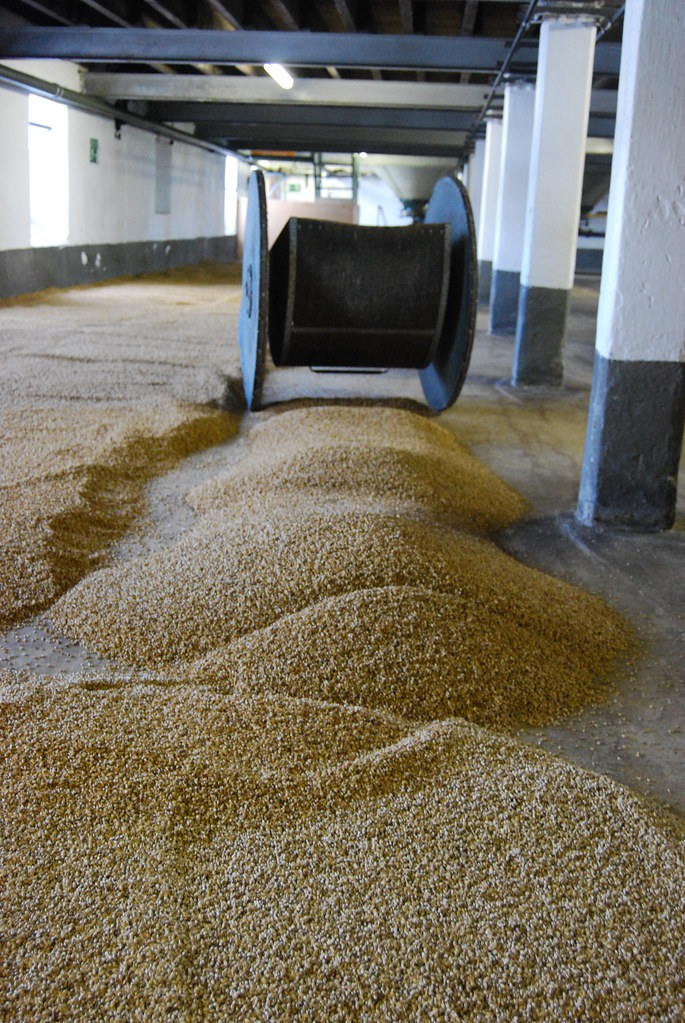
The steeped grain is transferred to the malting, or germination, floor. This is where it begins to grow visibly. Conditions have to be right. It's too hot in the summer months for floor malting, however, with the modern GKV systems it's now possible to make malt every day of the year. At an industrial floor maltings there are large amounts of grain to be carefully transferred from one place to another. We were introduced to the malt chariot.

steeped grain goes into the chariot
source here
from steep tank to malting floor
source here

According to Distillery Manager Marie Stanton, a malt chariot is a tricky thing to learn how to drive. The maltsters are experts at it, of course. An industrial floor maltings has to deal with large amounts of malt which is couched, then spread out on the floor. The chariot at Highland Park was in use regularly for this purpose. Ambient temperature and weather conditions dictate the depth of the grain bed.

There were several wooden malt shovels, or shiels, leaning up against the wall. They are used to turn the malt. It's a long job and in an industrial maltings like this, team work is crucial. It takes hard work and skill to turn tons of malt on the floor using one of these. On the tour we were told that some maltsters at the Highland Park were ambidextrous, able to turn malt to the right and to the left with ease. Others preferred to just work one way, which seems to be how the owner of this well worn malt shovel worked.
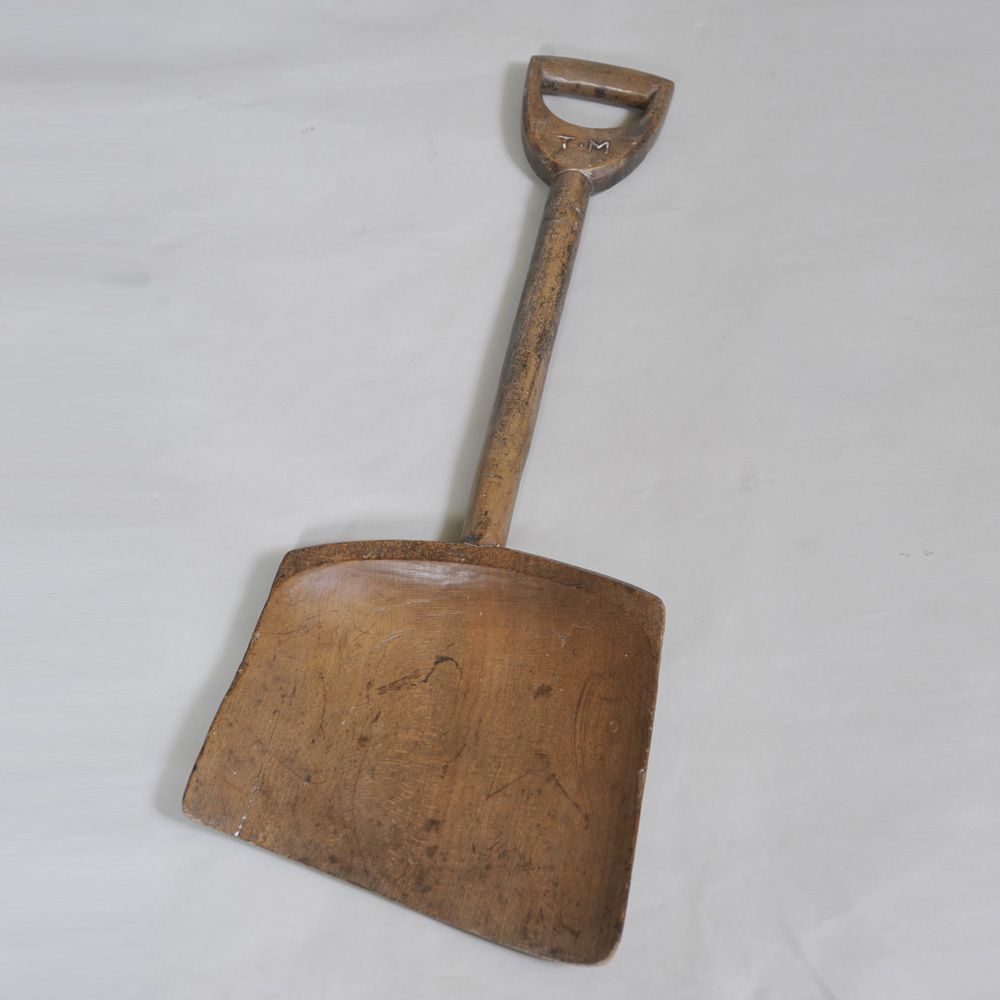
A 19th Century malt shovel, well worn from use
source here

As well as wooden malt shovels, fish tail rakes are used. These make the job so much easier, follow the link below the photo to find out why. Raking the malt is not just a skill, it's an art.

A medieval style custom made malt rake, with fish tails, used by Riverbend Malt House
How did neolithic and bronze age maltsters turn their malt? What did they use? They had no metal rakes. Wooden tools rarely survive in the archaeological record. I've sometimes thought that an animal's shoulder blade might have been a suitable tool. A scapula is a sturdy thing, it has the shape of a shovel and could be used for many tasks that the "first farmers" needed to do. It would do the job of turning the malt nicely. Has anything been found that might support this idea? There's only one discovery that I know of. During road works in 1987 at Achavanich in Scotland, a female cist burial dated to the Bronze Age was discovered. It had contained the crouched burial of a young woman, however only the skull and a few bones remained.

The grave goods that accompanied this young woman were these: a beaker or food vessel, a thumb nail scraper, two flint flakes and, unusually, the shoulder blade of an ox. The beaker or food vessel had organic residues within it. This is another rare find. According to the official site records (HER)

"The contents of the beaker were analysed by Dr Brian Moffat of SHARP who, from a preliminary examination, suggested that it contained: prepared cereal grain, honey, added flowers and fruit (including meadowsweet, bramble & wood sage), and the sap of birch and alder trees."
 
Similar residues have been found in other bronze age pots and have been identified as the remains of ale. These two things combined, the pot with cereal based residues and an ox shoulder blade, suggest to me that the woman may have been a maker of malt and ale. She had been buried with the necessary equipment. I mentioned this to a couple of people on the tour and they agreed it could be a possibility. The young woman who was buried 3700 years ago is now the subject of a new investigation by archaeologist Dr Maya Hoole. The details are here if you are interested.

ox shoulder blade from the Achavanich burial, was it used to turn the malt?
source here (this is a screen grab from the Facebook page)
The next part of the tour took us to a small room, the laboratory, where the viability of grain for germination was assessed. Why does it need to be tested before it is steeped and turned out on the malting floor? Because barley has a latent dormancy after harvest. It must be stored, in a dry place, for a few weeks or months before it will germinate. The reasons for this and the biochemistry behind it are not yet fully understood. The length of dormancy can vary between crops and barley variety. Traditionally, grain has always been left for a while after harvest. People have known about latent dormancy for a long time.

Grain that will not germinate is useless to a maltster. Upon delivery, samples are taken from every batch of grain. Individual grains are selected at random and tested for viability. This can be done by steeping them in a solution of hydrogen peroxide at 0.75% at 18-21 degrees Centigrade. Germinated corns (seeds) are counted after three days. For a working maltings, this takes too long.

A quicker method of checking viability is to cut a grain longitudinally and use tetrazolium chloride which stains the embryo pink. The maltster can get a result in half an hour. There was a very nice little grain cutting machine in the laboratory at Highland Park, used to cut grains in half for testing from every batch of barley. Shame I forgot my camera, but here's a picture of a stained living barley grain from the MAGB website. Pink toed barley, that's what the maltsters call it, if the barley has a pink toe then it's good for making malt.
white endosperm, pink embryo, it's alive!
source here


The final part of the tour was to climb the old narrow wooden staircase, it was more like a boxed in ladder, to look at the kilning floors in the loft. We were treading in the footsteps of maltsters past, it was a strange feeling. The steps were worn, malt has been dried here, in the same way, for two hundred years. We looked through the window to see the green malt, steaming as it began to dry. It looked very much like the photo below. Drying malt on this scale takes three or four days. The maltsters turn it at regular intervals so that it dries evenly. Hot air and peat smoke from the fire downstairs passes along the flue and through the bed of wet malt, imparting flavour, drying it gently so that the malt is not killed.

green malt at Highland Park, steaming on the kiln floor as it slowly dries
source: a blog by the whiskyspeller's here
We left the kilning floors by a small door which led us onto a metal walkway on the roof, right beside the distinctive pagodas. Whenever the malt is being dried there is steam coming from the pagodas. We had great view over Kirkwall and a new perspective of the Distillery, a place that we often drive past. 

the twin pagodas of the Highland Park Distillery
source here
Finally, we went down the metal staircase on the outside of the building to see the kiln fire downstairs. The maltsters start the fire with coke to warm the kiln, after this, peat from Hobbister is used. The peaty smoke flavours the wet malt. Coke is used at the end to thoroughly dry the malt. Each fire needs to be run slightly differently, depending upon the batch of malt. It's just another of those maltster's skills that can only be learned by experience and practice.

the kiln fire, it's a long way from the malt and there's a metal flue
This kiln has a fierce fire but is situated a long way from the malt. In a pot kiln, you need great heat to fire the pots. The principle with a grain or malt drying kiln is completely different. Hot air and smoke pass along the flue and through the bed of green malt. There are sturdy metal linings to contain the sparks and make it safe. I don't want to go into any more whisky making details. My interest is in making malt for brewing ale and beer. 

Today there are many different kinds of malt being made by maltsters for brewers. It can be confusing for a non brewer. The most crucial is the base malt, the one that is made and dried like this, carefully and slowly to keep the starch converting enzymes alive. These enzymes are needed in the mash tun. Base malt provides all the necessary sugars for fermentation. Other malts, such as crystal malt or chocolate malt have only been made since the mid 18th Century. Just to confuse the issue even further, there is also roasted barley, which is not malted at all and which gives dark beers like Guinness and porter their distinctive black colour and flavour. Hops add bitterness and other flavours, they are also antimicrobial. Unroasted barley alone cannot be used to make beer, it is added to the base malt. Unroasted barley has no enzymes.

Specialist malts provide colour and flavour to the finished ale or beer. They are a modern thing; making roasted malt is not a prehistoric technology. Specialist malts are roasted at high temperatures that kill all the enzymes, therefore it is not possible to make beer using only this kind of malt. I shall have to write something later about this, it's a huge subject. 

Malt is a mysterious thing to most people. In the world of archaeological and anthropological literature I find few references to malt. There is very little meaningful discussion of it.  Assumptions have been made that malt is "toasted roasted barley sprouts". Another belief is that the archaeologist has to actually find "sprouted barley" with roots and shoot still intact for there to have been malting and brewing at their site. I have been told this many times by archaeobotanists. The reality is that the malt loses its' roots and shoots in the kiln. An archaeologist will not find them. There are many other indications that grain has been malted.

When you read the academic archaeological and anthropological literature about "alcohol production in prehistory", there is a belief, an assumption, that all you have to do is mush up a few sweet things, like berries, honey, some sort of sweet plant, maybe a bit of barley and some birch sap. Leave it in a bucket or a pot and, magically, you will have "some sort of alcohol". Making ale and beer is not like that at all. Malt is the essential ingredient. It provides both flavour and, more importantly, the necessary fermentable sugars without which there will be no ale. No beer. 

That's more than enough for now. I shall continue working on my post about alcohol production and some of the myths that surround it in the archaeological and anthropological literature. I look forward to comments and discussion with about malt in the future. Malt matters.

~~~~~~~~~~~~~~~~~~~~~~~~~~~~~~~~

Here's a bit more that I've written about malt, malting, the history and the archaeology. I shall get around to tagging the blogs soon so they are easier to navigate.

Brewer & Distiller International February 2016
The craft of the maltster  
Food & Drink in Archaeology 4 eds Howard, Bedigan, Jervis & Sykes
grain dryers, malt kilns and malting ovens


Saturday, 26 April 2014

Beakers were for Beer! part three: alewives and barmaids

In the early years of my research, I visited a few microbreweries. I wanted to talk to professional brewers who made ale in the traditional way using crushed malt, not malt extract, and who worked on a small scale. This approach to brewing beer in small batches, supplying local pubs, hotels and restaurants, began to take off in the 1980s and 1990s. The interest in real ale in Britain began with CAMRA in 1971. Peter Brown does a good job in telling the story of the rise of craft beer UK style. Worth reading. Anyway, to get back to my story, one of the microbreweries I visited was a tiny establishment, equipped with one mash tun, one boiler and two fermenters. He used crushed malted barley, hops, water and yeast and made a wide variety of beers from these basic ingredients. As any good brewer does.

He was interested in the story of the Bronze Age woman buried in a stone cist at North Mains, Strathallan. She had been buried with a Food Vessel. The residue from a cereal based alcoholic brew, flavoured with meadowsweet, was discovered within it (see part one). We chatted about it in detail, and with some excitement, because I had only just found out about the residue analysis in the Strathallan pot myself. That evening, he went down to the pub and related the story to his mates. And why not? It's a good story. One of his mates was a journalist for the local paper. A couple of days later there was a headline "Bronze Age Barmaid" or "Prehistoric Barmaid discovered" or something along those lines. And my name was attached to it, almost as if I had discovered it. Many of the details were wrong. It was only a small piece in a local newspaper, but it seemed like sensational stuff at the time. Some folk at the University were not very pleased about it.

I had just had my first encounter with The Press, and with some of the silliness that seems to surround any news story about ancient alcoholic brews - beer, wine or mead. 

alewives and cup bearers 
Maybe that journalist was thinking along the right lines, although 'barmaid' is not quite the right word to use in a prehistoric context. There is a well established tradition of women as cup bearers, providing the drink at feasts.

Eva Koch, writing in 1986, gives several archaeological and historical examples of the woman as hostess, who would have held a high status position within society. In her article the woman with the drink she describes the grave at Juellinge of a woman, in her 30s, who was buried wearing her silver jewellery and hair ornaments. In the grave with her was some meat, either a whole sheep or pieces of pork and beef - archaeological sources vary. The bronze bucket had contained a drink brewed with barley and cranberries or crowberries and bog myrtle. There were drinking horns and glasses for her guests. The grave was excavated in 1909. 

A recent detailed analysis of these residues has led to the novel idea that the Juellinge vessel had contained 'nordic grog'. The media loved this story. There are variations of it all over the internet, but journalists don't always get all the details right. I don't agree with the concept of a 'nordic grog'. I think it is far more likely that the bucket contained an ale, or perhaps you could call it a barley wine, made from wort and flavoured with a few berries, flowers, herbs and maybe some honey. All the sugars that you need for fermentation can be obtained from the mash tun, as I explained in earlier posts.

There are many similarities between the Juellinge grave and the burial of the young woman, described by some as a dancing woman or priestess, at Egtved.
Egtved Girl tomb from bronze age- Denmark
reconstruction of the oak log coffin of the Egtved Girl. Bronze Age. 1370BC

She was buried wearing bronze jewellery and the bucket at her feet contained the remains of an ale or beer, flavoured with berries and perhaps honey. The bucket was made of birch bark and is too big for a drinking vessel. It is more suitable for serving or perhaps it was one of the vessels used in making the ale. One interpretation is that she was buried with ale for the journey into the afterlife, which is certainly possible. I can't help wondering whether she was buried with the tools of her trade - her brewing bucket.

And so we move on to Bronze Age Scotland and the cist grave excavated in 1979 - the one that the brewer was so interested in. The Bronze Age barmaid herself, buried with her Food Vessel. Could she have been a cup bearer, at feasts and ceremonies, perhaps? Maybe she was an alewife. Some might see her as a priestess or as one of the elite, a high status and important member of society. There are several possible interpretations of who this Bronze Age woman was and what her role in society could have been.

http://i.rcahms.gov.uk/canmore/l/SC00845100.jpg
female cist burial excavated in 1979 at Strathallan, North Mains, SC845100. (copyright Historic Scotland)
The specialist secrets, skills and knowledge of how to transform harvested grain into ale by malting, mashing, lautering, sparging and fermentation were as important then as they are now. Without them, there would be no ale or beer for the feast.

I'm sure that the tradition of the alewife, or brewster, goes right back to prehistoric times, to the earliest grain cultivators and processors, the neolithic folk. There are many different herbs and plants that have been used to flavour, preserve or enhance ale. Known today as gruit, some herbs have medicinal or hallucinogenic properties. Henbane pollen was identified in cereal based residues on sherds from large bucket shaped neolithic pottery known as Grooved Ware at a site called Balfarg in Scotland. More on this in the next post. This discovery extends the potential role of the alewife to that of a healer, maybe even more than that. Here's a link to a blog about the 'brewster as witch' by Jane Peyton, a sommelier and beer expert. Her article is a bit of an advert for a Ninkasi style women's brewing competition that took place in 2011. So, sadly, too late for me to make a brew for that. But she makes some interesting points.

I shall return to the 'magic of brewing' in a later post. It's a huge topic.

beakers, food vessels and tripartite urns - some brief notes
Welcome to the wonderful world of prehistoric pottery! It can be quite bewildering. Confusing to non archaeologists, at the very least. I have discovered this after many years of explaining (or trying to explain) prehistoric pottery classifications to tourists.

In a British Bronze Age context, there are beakers, collared urns, tripartite food vessels and funerary urns. Simply explained - beakers were drinking vessels. Food Vessels, otherwise known as tripartite food vessels, appear to have had no specific function, other than for 'food preparation'. This is how they are described in the archaeological literature.

Sometimes they are found in stone cists and they contained the cremated bone. Collared urns are larger vessels, also often found with cremated bone in burials. This is a blog. It is not an academic thesis. So I must apologise to all archaeological pottery specialists for the simplicity of these descriptions.

a few recent rather exciting discoveries of tripartite food vessels
In March 2012, the land owner of a disused quarry on the island of Arran, off the west coast of Scotland, noticed something interesting in the cliff face. It turned out to be not one, but two Bronze Age stone burial cists. One cist was empty and the other contained the remains of an adult human cremation in a tripartite food vessel and a flint knife.

A photo of a circular, sand-coloured Bronze Age pot against a black background
the food vessel
A photo of a large yellow digger on wheels carrying out work on a steep cliff face
an unusual excavation technique at Sannox Cliff, Arran


A radiocarbon date of 2154 - 2026 BC was obtained. The flint knife, when analysed, had traces of silica, indicating that it had been used to cut grasses or cereals. This is intriguing. Was this the cist grave of someone, probably a woman, whose work involved the gathering and the processing of wheat or barley? I think so. It's not the sort of thing that is found every day. Excavation techniques involved the use of a cherry picker. A news report with some great photos, is here. The excavation was undertaken by GUARD Archaeology, Glasgow and is available here.

In September 2011, in Spinningdale, by the Dornoch Firth in Sutherland, northern Scotland, the accidental discovery of a very well preserved Bronze Age female cist burial, with food vessel, occurred when someone was digging the hole for their new septic tank. Once again, it was excavated by the team at GUARD. Radiocarbon dates from the bone were 2051 -1911 BC and from the charcoal within the grave, dates of 2151-2018 BC were obtained. Inside the cist was female skeleton with a tripartite food vessel at her head.
She was between 35 and 50 years old and had been laid upon a sheepskin, or maybe she wore woollen clothing. It is not quite clear, but unusually, fragments of the wool had survived in the well sealed cist. The excavators thought she may have been an important woman, having been buried with such great care and attention. More details here.

The cist grave of another high status, important and wealthy Bronze Age woman was recently excavated near Windsor, England. Excavations at the Kingsmead Quarry, undertaken by Wessex Archaeology, were presented to the public in 2013. They have put a lot of their information online. It is a large, complex site that includes mesolithic, neolithic, bronze age, iron age, Romano British and medieval elements. The excavations were generously funded by CEMEX. The archaeologists have been digging up lots of really exciting stuff at Horton and you can read all about it on their web site.

Of particular interest is the female burial, dated to between 2500 and 2200 BC. She was at least 35 years old, according to bone evidence. She was buried wearing her necklace of gold, amber and black lignite beads. She may also have had a bracelet, since there were black lignite beads near her wrist. Some perforated amber beads or buttons indicate that she may have worn woolen clothing, with these valuable fasteners. By her side was a large drinking vessel, beaker style. Was this a serving vessel, rather than her personal beaker? It must be considered a possibility. It would be fantastic if a residue analysis could be done of the vessel fabric. I'm not sure, but I don't think this has yet been done.

We cannot be completely sure of her full role within society, whether she was a princess, queen, alewife or cup bearer. It is clear that she was a woman of some importance. More details about her here.

In the words of the site director, Gareth Chaffey, who has been excavating the site for seven years, " It is interesting to think who this woman was within her community. She was probably an important person in her society, perhaps holding some standing which gave her access to prestigious, rare and exotic items. She could have been a leader, a person with power and authority or possibly part of an elite family - perhaps a princess or a queen."


I shall leave the mysterious high status women of the Bronze Age, for now. I'm sure you will come to your own conclusions about them.


Site Director Gareth Chaffey, of Wessex Archaeology, who has been excavating the site for the last seven years, said: “It is interesting to think who this woman was within her community. She was probably an important person in her society, perhaps holding some standing which gave her access to prestigious, rare and exotic items. She could have been a leader, a person with power and authority, or possibly part of an elite family - perhaps a princess or queen.” - See more at: http://www.wessexarch.co.uk/blogs/news/2013/04/19/beaker-burial#sthash.uX7GzXBU.dpuf

Sunday, 13 April 2014

Beakers were for Beer! part two: a birch bark bucket with residues

The image below might not, at first, seem to have anything to do with prehistoric ale. Or beer even. This is the oak log coffin of the young Bronze Age woman known as the Egtved Girl. She died about 3300 years ago. Her oak coffin was found by a farmer, Peter Platz, within a large grassy burial mound in southern Jutland, Denmark. He called in the archaeologists from the local museum who excavated it in 1921. Recent dendrochronological dating of the oak log coffin reveals that the tree was felled in 1370 BC. The North European Bronze Age is a fascinating place to go and visit online to understand some of the background to the Egtved Girl's world. There is a lot of information out there - for example, this atmospheric short film. And lots of pictures of the things that they made and wore and used - the bronze figurines, the sun chariot, the drinking vessels, the well preserved clothing and even a wooden folding seat.

 Egtved Girl tomb from bronze age- Denmark

What the archaeologists discovered within the Egtved Girl's oak coffin was quite astonishing ... there was no skeleton, just a few fingernails and some of her teeth, brains and hair remained. Her bones had been destroyed by the acidic conditions. But the clothes and the grave goods of the young woman had survived the millennia virtually intact. She had been buried wearing a woven woolen tunic top, a corded wool skirt and a woven belt with a bronze spiked disc. Bronze bracelets adorned her arms. Most people agree that she was a dancer, maybe even a priestess, and that she was buried in her dancing clothes. A small bronze figurine, doing a back flip and wearing a skirt like that of the Egtved Girl, was found at Grevensvaenge, Zealand, Denmark. It was part of a small Bronze Age hoard that was first reported in 1779. Over the years, several of the figurines have been lost but the little bronze acrobatic dancer is now in the National Museum of Denmark.
a reconstruction of the Egtved Girl's clothes: details here
Now the oak coffin, the clothes and grave goods have been reconstructed and there is a wonderful display in the National Museum of Denmark. She is visited by thousands of people. There is so much on the internet about the Egtved Girl that it is easy to find out about her. She even has a few Facebook friends ...

I first came across reports of the Egtved Girl through reading the bibliography of Eva Koch's article Prehistoric Plant Food of Denmark, published in 1999. Archaeology can be a bit like a detective story. In the days before the internet was everywhere, the bibliography at the end of an academic paper was probably the only lead you had to find the next piece of information. What interested me about this young woman's grave was the discovery and subsequent analysis of cereal based organic residues in a birch bark bucket that had been placed in the log coffin.

residues in a birch bark bucket
The reconstruction at the National Museum shows how she was laid upon a cow skin. A bundle of cloth, at her feet, contains the burnt bones of a small child, aged 5 or 6 years old. Also at her feet was a bucket made of birch bark. Someone noticed that there was a thick, dark brown residue at the bottom of the bucket. It was analysed in 1929 by Bille Gram. For all you fellow bibliography hunters, this is the reference for the original archaeobotanical report ... over the years I have tried, and failed, to get hold of a copy. In either Danish or English. Maybe you can find it. If you do, please let me know!  
Th. Thomsen (1929): Egekistefundet fra Egtved. Nordiske Fortidsminder Andet Bind. København. (In this book, her drink is mentioned by Bille Gram on page 184 note 2, apparently)
http://media-cache-ec0.pinimg.com/736x/07/0f/29/070f293b5ec3a4e638f9cbacfd535151.jpg
the birch bark bucket 


I don't know how the analysis of the residue was undertaken. I would imagine that it involved a microscope and not a lot else, given that it was done in 1929. The bucket had contained an alcoholic drink - it was probably ale - made from wheat, cowberries or possibly cranberries, bog myrtle, some other plants and perhaps with added honey.

Descriptions of the residue analysis vary in the archaeological literature, which is why I would like to read the original archaeobotanical report. Some archaeologists mention the presence of clover pollen, others mention lime flower pollen. Mixed pollens often indicate the addition of honey. It has been suggested in some academic papers that the "beer" was made from the berries, but any all grain brewer knows that this is simply not possible. The primary source of fermentable sugars had to come from the grain - or rather, from grain that had been malted. It could have been either malted wheat or malted barley or a mixture of both.

Residue analysis provides you with a list of probable ingredients. It does not provide you with a recipe. Nor will it tell you the ratio of ingredients to each other, nor the quantities that are required. To make a similar brew from the list of ingredients you need a recipe. In other words, you need to know and understand the brewing process, the techniques and the methodology of how to make malt and ale.

making malt and ale
There seems to be some confusion amongst archaeologists and anthropologists about what malt is, how it is made and how the brewer uses it. Malt is sometimes described as 'toasted barley sprouts' or even as 'sprouted barley' - something like beansprouts. Neither of these is an accurate description. Malt is grain that has been steeped and aerated in water, then spread out on a smooth, level floor within a dark but well ventilated building to begin to germinate. When the acrospire (the root and shoot) is no more than one third the length of the grain, it is dried gently in a kiln. This is traditional floor malting and this process makes pale malt. Specialist malts are made by roasting at higher temperatures.

I have read descriptions of brewing in academic papers, explaining that malt is 'boiled with water' to make a 'malt solution'  but this would not work at all. The brewer mixes crushed pale malt with hot (not boiling) water to make a sweet wort. This process is called the 'mash' or 'saccharification'. If you boil the malt, then the enzymes that convert starch into sugars are destroyed and you will never make anything fermentable. Specialist dark malts, such as crystal or chocolate malt, are used for colour and flavour and do not provide any sugars in the mash tun.

I began to discuss these issues in an an earlier post and I will certainly go back to these fundamental aspects of making malt and ale in future posts. My last academic paper The Craft of the Maltster is about to be published as I write this blog post. I was given permission to put it online. The book of the conference will be out soon. Floor malting techniques have not changed over millennia.


the ingredients, according to residue analysis of the Egtved bucket
  • wheat - this was probably identified, under the microscope, by the presence of a part of a grain husk. Could it have been a bit of barley husk? This is possible. During the brewing process, specifically in the mash tun, the malted grain is mixed with hot water and the grains become broken up. As mentioned above, whether it was wheat, barley or a mixture of both, the grain had to have been malted. Malt provides the primary fermentable sugars for ale and beer.
  • cowberries - not the main source of fermentable sugars. These are very tart, sharp tasting berries. Probably used as an adjunct. Cowberries, also known as lingonberries were probably identified in the Egtved bucket residue analysis by the presence of seeds. It can be tricky to identify the specific berry type from the seed alone. 
  • bog myrtle - also known as myrica gale, this leafy shrub has been used for millennia as a 'brewer's herb'. It both preserves and flavours the ale and it was used before the introduction of hops in medieval times. Many other plants and herbs can be used in brewing ale. We have used meadowsweet and juniper berries in our ancient ales. Yarrow is another commonly used plant as an alternative to hops. These are known as gruit and these days you can buy a wide variety of these ancient and traditional ales in the shops, made by several different brewing companies. 
  • lime pollen, clover pollen - the presence of these in the bucket residue might indicate the addition of some honey to the ale. Again, it is an adjunct and not a primary source of sugars for fermentation. Alternatively, the pollen might indicate the addition of lime flowers and clover to the wort, for flavour and/or preservation.  

how we would make an 'Egtved Ale'- the basic techniques and recipe
We have been making ancient style ales for fifteen years now. Small batches, a few gallons at a time, in our home brewery. To recreate the ale that was in the Egtved bucket we would, first of all, get some malted grain. If possible, we would try to obtain some malted bere - an ancient strain of barley. The grain is skinny, much thinner than modern barley. We have used bere malt successfully to make an ale flavoured and preserved with a few dried meadowsweet flowers instead of hops.

our mash tun 


We would mash the crushed malt with hot water in the mash tun for about one hour. Grist is the brewer's term for crushed malt. Brewers refer to the water used for brewing as 'liquor'. It is not alcoholic. Then we would lauter, that is, collect the first runnings of sweet wort from the mash tun,  and then sparge. This involves running several gallons of hot water through the mash and collecting more wort. As far as quantities and ratios are concerned, we would use about 15 pounds of malted grain to make roughly 8 or 9 gallons of wort.

Cowberries could be added to the mash tun, or they could be added to the wort during the boil. It is difficult to know exactly how many to add, but when we made our Juniper Ale with berries, we used just a few ounces to twelve pounds of crushed malt. Having obtained the wort we would boil it, together with some sprigs of bog myrtle and/or lime flowers and clover flowers. Yeast would be added, most likely in the form of barm from a previous brew. Leave the ale to ferment for a few days, then rack it off into a fresh container and see what it tastes like.

strange brews
Over the last few years, there have been some rather strange re-creations of the alcoholic drink hinted at by the residues in the birch bark bucket found at Egtved. Not all of them are convincing. I watched a TV programme recently that showed the archaeologist Neil Oliver drinking an 'ancient style brew'. I think, but am not entirely sure, that it was supposed to be based upon the Egtved residues but, sadly, some of the basic ingredients had been altered. Apple juice was used instead of wort. The herbs, honey and berries were included. I don't think that apple juice would have been an option for those Bronze Age brewers 3300 years ago. Crabapples were the only available 'apple' and these are very sour. Even today, when people make a crabapple wine, they have to add a large quantity of sugar because the crabapples are not sweet enough to ferment by themselves. Crabapples also require a modern press to extract the juice. I cannot work out how the juice could have been pressed from crabapples in Bronze Age Denmark.

Another strange brew is Kvasir, made recently by the Dogfish Head Brewery in collaboration with Professor Pat McGovern, who is sometimes referred to as the Beer Archaeologist. For some reason, concentrated birch syrup was included in the Egtved inspired brew. I have no idea why, since this ingredient was not identified in the analysis of the residue from the birch bark bucket. Concentrated birch syrup is made using modern processing techniques. I think the word to remember here is 'inspired'. I don't think they were aiming to actually recreate an accurate copy of the 3300 year old ale, rather, they are making a modern Craft Beer, USA style, that pays homage to the Egtved Girl. I have found no mention of malt, mash tun or wort in the media coverage of this brew.

It is odd that she is referred to as a 'leather clad priestess' when she was actually wearing a tunic made from woven wool and a corded skirt. This is a very well known detail of the Egtved Girl's clothing. When she was first discovered, in 1921, some  archaeologists thought that there must have been a linen undergarment because the 'string skirt' was so revealing.

There are plans to make a commercial beer to a similar recipe in Sweden - Arketyp. This brew appears to have crushed pale malt as an ingredient, but it also includes concentrated birch syrup. Again, I don't understand the reason for this addition to the ale unless it is to make a kind of 'Nordic Grog'. Professor McGovern has proposed, in a recent academic paper, that this is what people made and drank throughout Europe in prehistory - some kind of mixed alcoholic drink made up of different components, such as birch syrup, wine and herbs. Although the biochemical analysis of four residues is incredibly detailed, there is nothing in the paper about malting, mashing, malt sugars or the brewing process.

For some of these strange and exotic brews, it seems as if the archaeologists who try to recreate them are struggling to find fermentable sugars, while neglecting the malt and the wort. Barley, and wheat, are an excellent source of sugars for fermentation  if processed in the right way. Maybe you have to be a brewer to understand these processes.

Egtvedpigens Bryg - made with malt, water, herbs and honey
I am very pleased to say that the National Museum of Denmark, working together with the Skands Brewery, have made an authentic ale based upon the ingredients identified in the bucket residue analysis. It should be available in the Museum Shop. If you are lucky enough to go and visit the Egtved Girl in Denmark, maybe you could try some. The details of this ale are, as yet, sparse on the internet. The launch party was on the 22nd of March 2014, so this really is the most recent and, for me, the most exciting development in the long story of the Egtved Girl and her bucket of ale.

I have found some Press Releases online, in Danish and translated into English. I expect that we will be hearing a lot more about it in the future.

The Egtved Girl's beer, made from a 3.300 year old recipe. In her coffin, a bark bucket was found. At the bottom lay a thick brown deposit. When the contents of the bucket were analysed it became clear that it had contained a fermented drink - probably beer sweetened with honey.  The newly reproduced beer is made from the same ingredients as was found in the coffin. Bronze age, beer, recipe, drinks, history, Denmark, prehistory.
launched recently, a modern commercial version of the Egtved Ale


Saturday, 29 March 2014

Beakers were for Beer! part one: ale, mead & residues

Beakers were for beer. I was told this back in 1995, in my final year as an archaeology undergraduate. There was absolutely no doubt about this, or so it seemed at the time. I made a note to look further into the idea. This was when my interest in ancient brewing techniques began. I had never thought about it before, but, being married to a home brewer of fine ales, made from all grain, I was intrigued. He would carry a 25 kilogram sack of crushed malt from the Brewing Supplies shop into the house, and then after about a week, he would have made us some excellent beer. A 25 kilo sack of malt would make 4 brews of 8 or 9 gallons each. Yes, I'm mixing Imperial and Metric but I am not bothered about that. The point is that you can make plenty of beer from 25 kilos of malt.

How did those Bronze Age folk, living in Britain around 4000 years ago, make their beer? I asked several people in the Archaeology Department but nobody seemed to know. They all thought I was crazy, looking for the archaeological evidence of beer brewing. You won't find anything, they said.

A paper was cited by the lecturer: Burgess and Shennan: The Beaker Phenomenon: some suggestions. It had been presented at a conference "Settlement and economy in the third and second millennia BC" and the proceedings were published in 1976 as a British Archaeological Report (BAR 33). It is cited in dozens, if not hundreds of academic bibliographies about the Bronze Age of the British Isles. It has become a classic paper, but it is not easy to find unless you have access to a University Library. That is to say that I have not managed to find access to a copy online.

One of the arguments of the paper was that Beakers were made specially for the drinking of beer. They proposed that a warrior cult existed in Bronze Age Britain, with some people buried with grave goods that reflected their prestige, high status and lifestyle. Grave goods often included a drinking vessel - a finely made and decorated pottery 'beaker' from which they drank their beer. No archaeological evidence, such as residue analysis, was presented in the paper.

The Amesbury Archer, referred to by the media as the 'King' of Stonehenge was considered to have been an important person and someone of high status, since he was buried with lots of grave goods, including five fine beakers, gold jewellery, the equipment for making metal and a slate wrist guard that hints at his prowess with a bow and arrows.

http://www.britishmuseum.org/collectionimages/AN00160/AN00160012_001_l.jpg
beaker from Hemp Knoll, Avebury

If beakers were for beer, then what is the archaeological evidence? Did it taste like the beer that we drink today? Who made it? Were the brewers men or women? What's the story?

Strictly speaking, when referring to prehistoric brewing from cereals, it should be called ale, not beer. What's the difference? Ale and beer are both made from malted grain - barley, wheat, oats or rye. Ale is preserved and flavoured with a variety of herbs, such as bog myrtle, heather, yarrow, juniper or meadowsweet. Beer is flavoured with hops which were introduced to the brewing process only recently, in medieval times. Spices can also be used. Today, we tend to use the terms 'ale' and 'beer' fairly indiscriminately.

For anyone interested in ancient ale, the discovery of cereal based residues on old pots has to be one of the most exciting things. Research was very different in those days. In the late 1990s the internet was in its' infancy. Internet search engines were a rare and wonderful thing, to be accessed by a few lucky academics. Charles Mount has written about how University research has changed over the last 20 years here. He is writing about University College Dublin, but the story is the same throughout UK Universities.

So, for me, my first research involved going to the John Rylands Library, looking through the card index systems, finding archaeology journals and reading lots of excavation reports. I spent many hours doing this. I started with the Proceedings of the Society of Antiquaries of Scotland, fondly known as the PSAS (now available online). It is an excellent resource. I soon stumbled on excavation reports that had some intriguing descriptions of cereal based residues on pottery, together with a detailed pollen analysis. Just what I was looking for.

cereal based residues on pottery
A couple of years after the Burgess and Shennan paper was published, a discovery was made in Fife, Scotland, that supported their thesis that beakers were for beer drinking in the Bronze Age. 

In 1978, excavations by a team led by Gordon Barclay at the site of a timber circle, bank and ditch (c2330 ± 60BC) at North Mains, Strathallan, Scotland, revealed several cist burials  In one of these, a female cist burial, there was a fine, complete Food Vessel with a deposit of organic material still adhering to the inner surface of the pot, after thousands of years. It was described as a 'black greasy material on the internal surfaces'. Such discoveries are extremely  rare.

The cist was situated in the centre of the timber circle. Fortunately, it had remained partially sealed, hence the unusual survival of the organic material. Analysis of the residues revealed high percentages of cereal pollen and meadowsweet pollen. It was interpreted as being the probable remains of a cereal based fermented drink. The radiocarbon date was 1540 ± 65BC. The analysis (below) is on pages 178 to 180 of the excavation report in PSAS Volume 113. The details are important and of interest to any all grain brewer. The 'human interference' that has introduced charcoal to and that is referred to might be the drying of malted grain, rather than parching harvested grain.

There is a Table on page 179 which gives the details and percentages of the pollen finds. Of course, I recommend reading the whole report, which can be downloaded from the PSAS website. That is because I really like to read the original excavation reports rather than secondhand interpretations. It is almost like being there! The descriptions of the pottery finds (between pages 155 and 163) are also informative.

When I showed this pollen analysis to my husband he said 'I can make that. I just need to replace the hops with some meadowsweet flowers.' And so our research into recreating ancient ales began.

POLLEN ANALYSIS OF DEPOSITS IN A FOOD VESSEL FROM THE HENGE MONUMENT, NORTH MAINS                         S Bohncke
INTRODUCTION
Burial B was accompanied by a food vessel (SF17), discovered lying on its side by the skull. Within the pot a small deposit of black greasy material was found. As the analysis of material within vessels has proved valuable (Dickson 1978) samples of this deposit and scrapings from the pot wall were subjected to pollen analysis. 


MATERIAL AND METHODS

Part of the black greasy material was used for the preparation of two pollen samples and another sample was scraped from the inner fabric of the pot. All samples were treated with hydrogen fluoride to remove the silaceous component and were subsequently subjected to Erdtman's acetolysis. Microscope slides were then prepared using glycerol jel as an embedding medium.
 

RESULT AND DISCUSSION 
High percentages of Filipendula (meadowsweet) pollen (74-1 %, 77-8%, 84% (scraping)) and relatively high percentages of cerealia pollen were noted. There was also a large proportion of charcoal fragments. Within the Filipendula grains there was a wide range of variation in the states of preservation. The well preserved type is the tricolpate micro echinate pollen in which the pores are clearly pouting. The very corroded type lacks the characteristic pores but the wall structure is not affected. Immature pollen was also present. Relatively high proportions of Filipendula can be attributed in part to selective corrosion as Filipendula has a relatively thick wall but this could not explain the 74-1-84% found in these samples.

Cereals are self pollinating, the result being that little pollen is dispersed into the air. The anthers remain within the spikelets so that on the fully grown cereal pollen grains could still be present, though most would be lost during the winnowing process. Compared with the other species the cereals are over represented in both samples. This is probably the result of human interference. The charcoal in the samples might have originated in the processing of the grain (eg roasting to remove chaff), however the cereal pollen were not burnt and this therefore seems unlikely. The charcoal may also have found its way into the pot during the burial ritual or have been in the pot already, perhaps as the result of firing a new vessel for the burial. The remaining pollen almost certainly came accidentally into the food vessel and represented a part of the contemporary pollen rain. The presence of pollen of plants flowering at different times of the year (eg Corylus March-April, Polypodium August-September) might be explained by the addition of pollen-bearing water to whatever was contained in the vessel or its incorporation in the manufacture of the contents.


Dickson (1978) in his analysis of the Ashgrove beaker scrapings discovered very high proportions of Tilia and Filipendula and concluded that the vessel had contained lime honey or mead flavoured with meadowsweet. The North Mains food vessel contained neither lime pollen nor sufficient pollen from other honey-producing plants. The 2-4-3-7% of Compositae pollen were not sufficient for a honey based on Compositae alone. The high proportion of cereal pollen grains might suggest either a porridge of cereals (eg frumenty) or a fermented ale, flavoured with meadowsweet flowers or extract. The name 'meadow-sweet' originates from mead-sweet as it was used to flavour mead and other drinks. It is distinctly possible therefore that the North Mains food vessel contained a fermented drink.

the Ashgrove beaker
Mention is made of the Ashgrove Beaker. This was found in an excavation of a Bronze Age cist burial by Audrey Henshall and was published in Antiquity in 1963. As well as the skeleton and a beaker, there was also a fine dagger. It seemed that the pot had fallen over, spilling its' contents on the floor of the cist. James Dickson analysed the residues in the 1970s and he also published his results in Antiquity.

Pollen analysis revealed large amounts of immature lime pollen and meadowsweet pollen, which was interpreted as the remains of mead but sadly, it was not radiocarbon-dated. Nor did they look for cereal residues. Ian Hornsey discusses the implications of this discovery in his book, The History of Beer.

my first article

These discoveries, and others, led me to write my first article about the archaeology of ancient ale, towards the end of 1996. Descriptions of residues on Grooved Ware pottery from the neolithic site of Balfarg are very similar to those found on Beaker pottery. It was beginning to look as if making ale from the grain was a Neolithic, not a Bronze Age phenomenon.

I was very pleased and proud to be the cover girl for BA19 and I have Simon Denison, the then editor of British Archaeology, to thank for that. He was interested in my work and very supportive.

The picture shows the Strathallan or North Mains food vessel, with meadowsweet flowers surrounding it. These flowers would have been the flavouring and preservative for the ale, the base of which would have been a wort made from crushed malted cereal - barley and/or wheat.


http://www.archaeologyuk.org/ba/ba19/ba19b.gif
Finding Magic in Stone Age Ale - my first article - you can read it here.

That's all for this blog - more than enough for you to be getting on with. I find it odd that in 2014, particularly in the UK, there seems to be a taboo surrounding any discussion by archaeologists of malt and ale in prehistory.

The evidence is there, if you know and understand what the brewing process is and what you have to look for in the archaeological record.

 *******************************************
... my next blog will be about the Egtved Girl's Brew, the residues of which were found in a birch bark bucket in her oak log coffin in Denmark ... there are some details here.

Please get in touch with me if you have made a beer based upon these residues, if you know of someone who has or if you have been lucky enough to taste one of these brews.

I know about the 'Nordic Grog' made by Dogfish Head Brewery, under the guidance of Professor Pat McGovern. It was recently marketed as Kvasir, named after a Nordic Princess. 

I want to hear about any real home brewers who have had a go at recreating it.


Thankyou! 
 ********************************************

further reading
Burgess, C. & Shennan, S. 1976. The Beaker Phenomenon: some suggestions. In Burgess, C Miket, R. (eds.)  Settlement and economy in the third and second millennia BC : papers delivered at a conference organised by the Department of Adult Education, University of Newcastle upon Tyne, B.A.R 33, Oxford, 309-331.

Barclay, G. (1984a) 'Sites of the third millenium BC to the first millenium AD at North Mains, Strathallan, Perthshire', Proceedings of the Society of Antiquaries of Scotland. Vol.113


Dickson, J. 1978 'Bronze age mead', Antiquity, 52 (1978), 108-13.