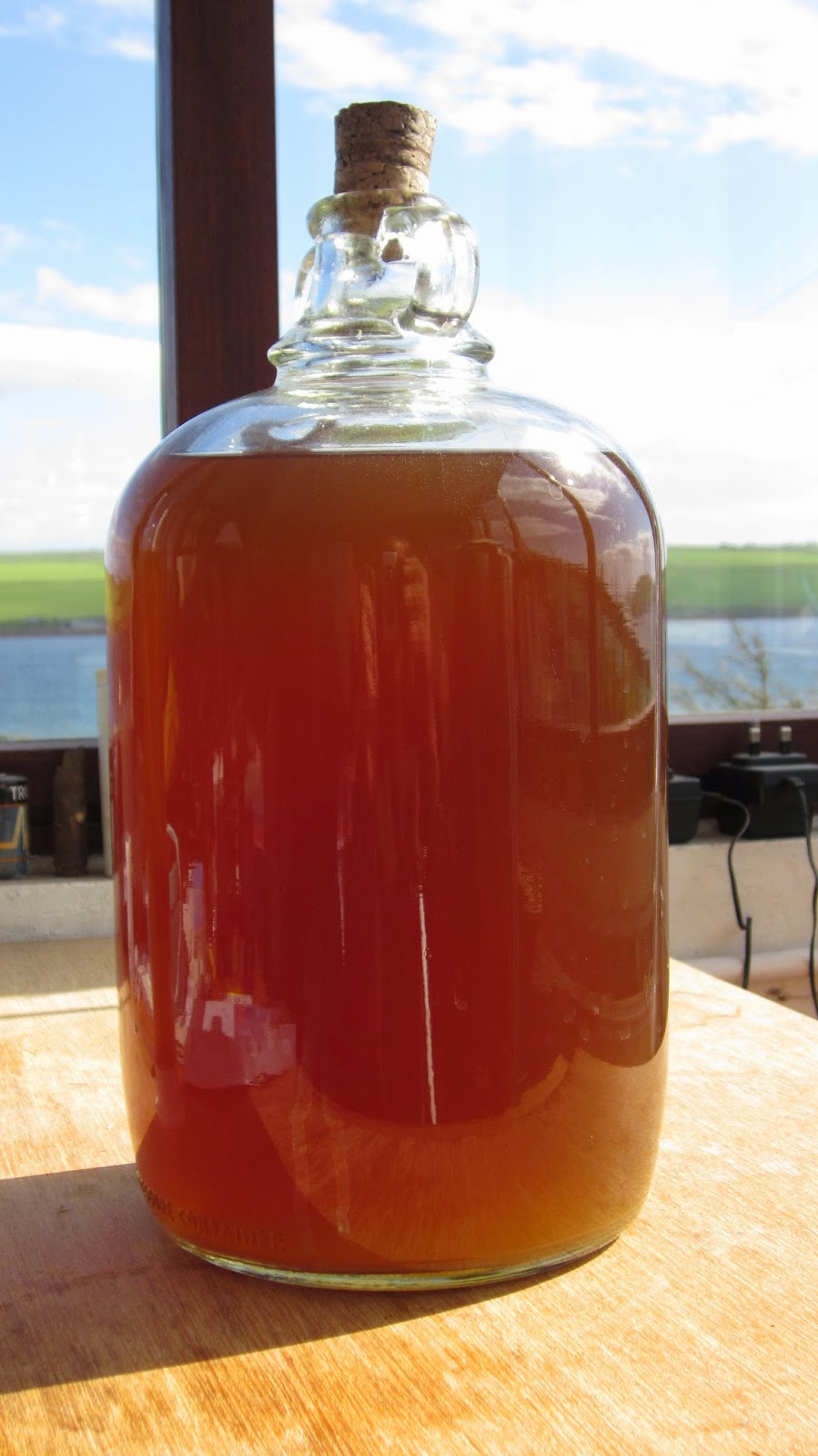
Showing posts with label beer. Show all posts

Saturday, 10 September 2016

a morning with maltsters, part one


The Orkney Science Festival is held annually. It's always a great week of varied and interesting events, talks, demonstrations and fun. This year there was a Malt and Malting seminar with a special tour of the Maltings at the Highland Park Distillery, Kirkwall. There were only a dozen places available and we were lucky to get tickets. We spent a fascinating morning with malting, brewing and distilling experts. It was all about the malt.

Making the malt for brewing and distilling is exactly the same process. The difference in processing techniques happens after the mash tun. A brewer takes the sweet liquid from the mash tun, calls it "wort" and adds hops or herbs, then ferments it into beer or ale. The distiller takes the sweet liquid, calls it "the wash" ferments it into alcohol and then distils it. The wort and the wash are two names for the same thing, the sweet liquid that is obtained from the mash tun. Every brewer who makes ale or beer from the grain knows what wort is because they work with it. People who have never made an ale or beer from the grain are perhaps a bit confused about what it is.
wort or wash?
Depends if you are a brewer or distiller.
source here
Dr Tim Dolan gave the first talk of the morning, explaining the fundamental aspects of what malt is, the biochemistry of malt, how it is made and a little of the history and development of the industry. His career in the malting and distilling industry goes back 40 years and he now teaches the subject. The other speakers were Marie Stanton, Distillery Manager of the Highland Park. She shared her knowledge of floor malting, then led us on a wonderful tour around the Maltings. The third speaker was Eric Walker, recently retired, a man with a distinguished background in all aspects of the malting, brewing and distilling industries. He talked to us about the prehistory and history of making malt and explained some technical details. They were quite a team and between them they had a huge amount of knowledge and experience of making malt.

"Malting is a process utilised by the Ancients to produce palatable alcoholic beverages: ale and beer"  (Eric Walker)

In previous years there have been talks about brewing and distillation, usually organised by the Institute of Brewing and Distilling. Tim told us that he thought it was about time there was a Science Festival event about malt, the Cinderella subject, because malt is the crucial ingredient for ale, beer and whisky. What is malt? It is grain that has been germinated under controlled conditions, then dried carefully in a kiln. Making malt has been a skill, an art and a craft for a very long time. Over the years I have given a few talks at the Science Festival. I was pleased that Tim remembered me and had been to my presentations on malting in prehistory, neolithic ale, grain barns and my most recent "Where were the Viking Brew Houses?" a couple of years ago.

The advent of the combine harvester in the 1940s transformed the grain harvest. The ancient and traditional way of harvesting grain by hand was extremely hard work, it was a time when the whole community worked together to bring the harvest home. On Orkney, where I live, grain was harvested by hand and stacked in stooks in the field until as recently as the 1950s. In case you don't know what a stook is, I looked online and found this painting by British artist Heywood Hardy (1843-1933). Painted in 1872, it depicts a typical scene of the time. I like the detail of the stook and you can see how they were made. The effort and hard work involved in making them can only be imagined.

 Corn Stooks by Bray Church by Heywood Hardy (1872) see here

This oil painting was done just a few years before Henry Stopes published his book about Malt and Malting, an Historical Scientific and Practical Treatise in 1885. It is now available to read online. Oxford University took the trouble to scan it in, many thanks to them for that. I first read it when I borrowed a copy from a brewing scientist when I began my research. It's such an important book and it is an excellent snapshot of the malting industry in the late 19th Century. Henry Stopes mentions the work of Louis Pasteur, who had recently published his work on Germ Theory which was to make such a huge impact on the brewing industry.

But I digress. Let's get back to the talk about malting.

Tim explained the biochemical processes of germination, with the embryo being the living part of the grain and the endosperm being the starchy food store. Malt, he said, is a living thing. It must be handled and processed carefully and correctly by the maltster. This was a point that was made several times throughout the morning. First, the harvested grain is steeped in water. It's crucial to allow air rests. The steep tank is drained of water at regular intervals. If the grain is left in water without air rests it will drown and this means that it will not begin to germinate.

Thanks to scientific research into grain germination physiology and biochemistry which began in the 1960s, we now know that when grain is  sufficiently wet and aerated, gibberellic acid is released from the embryo and the aleurone cells. This stimulates enzymes which convert the grain starch into sugars, the food source for the plant.

All grains can be malted. Barley is considered to be the best grain for malting but wheat, rye and oats can also be malted. Here's a useful diagram of the internal structure of a barley grain in the early stages of germination.

ancient malt and ale : malting and mashing

The craft and skill of the maltster lies in getting the grain to start growing, but not too much. This is known as modification and there is some excellent and detailed information about what malt is and how malt is made on the Maltster's Association of Great Britain web site.

The Highland Park has three traditional malting floors where the grain is spread out after steeping. Raking and turning the malt is a crucial part of the process. We were told that this helps to maintain an even temperature and it also prevents rootlets from tangling. On the malting floor the barleya malted barley grain more details here begins to germinate. When the maltster sees the root and shoot being about four fifths the length of the grain, it is sufficiently modified and ready to be carefully and gently dried in the kiln.  a malted barley grain more details here

Modern techniques of making malt involve the use of Saladin boxes and drums. There are also huge germinating kilning vessels which can make three to five hundred tons of malt at a time. All year round. The quality of the malt can be controlled because it is easy to maintain precise temperatures and levels of moisture. The third speaker of the day, Eric Walker, gave an interesting talk about the industrialisation of malting and I'll write that up later. In the meantime, here's something I wrote about where the malting floors have gone.

Barley is self pollinating. Dr Tim Dolan emphasised this several times, but I wondered why was he making this point so many times? It was because it's so significant in understanding barley breeding. There were not so many varieties of barley in the past as there are today. The science and practice of cross breeding barley began at Warminster Maltings in 1904. This was news to me. Rather than tell you the story myself, here is the account from the Wiltshire Community History web page:

"The most famous name in local malting was that of Dr. Ernest Sloper Beaven, and his reputation is international. He was born in 1857 to a Heytesbury farming family, who moved to Boreham Farm at Warminster in 1868. Beaven said that he began to observe barley closely from 1878 and he became associated with Frank Morgan, Warminster’s leading Maltster. Beaven’s first experiments had been with onions and potatoes but from 1900 he was growing, selecting and crossing barley from seven initial different ‘races’. In 1904 he acquired fields on the Boreham Road for a nursery and in 1914 he launched ‘Beaven’s Plumage Archer’ strain of barley and continued with seed trials for the next 27 years. Beaven could claim that 85% of the total U.K. acreage of barley was grown from the progeny of just four plants, three of which had been selected in the nursery at Warminster between 1900 and 1904."

In the last one hundred years or so, much has been learned about barley and the biochemistry of germination, however, there is still much to be learned. Although some of the mystery and magic of malting has been studied and explained by scientists, some things about barley are little understood.

One of these is latent dormancy. Someone in the group asked about this and the answer was that it is still a bit of a mystery. There is a practical tradition of leaving the grain for a while between harvest and steep, because it will not germinate. This could be about variety, or it could be seasonal. The best thing I can suggest, if you are interested in finding out more about latent dormancy, is to search for the academic and scholarly papers on it. There are quite a few of them out there.

The next talk was about the skills, techniques and practicalities of floor malting and the turn of Marie Stanton, Distillery Manager, an experienced maltster at a number of distilleries. And then there was the tour of the Maltings.

There is only so much detail that one blog post can take, so I shall leave you with a picture of the malting floor at the Highland Park Distillery, Kirkwall, Orkney. It is taken from Wikimedia Commons. I forgot to take my camera to the seminar, but I did take plenty of notes, so I hope this will suffice while I get down to writing part two, while it is fresh in my memory.

File:Highland park malting floor.jpg

https://commons.wikimedia.org/wiki/File:Highland_park_malting_floor.jpg


Sunday, 28 December 2014

What is Wort - a brewer's perspective

Hope you had a grand Yule and that you enjoyed the midwinter celebrations. We wish you all the best and A Happy New Year for 2015. There has been a bit of a lull on ancient ale blogging in the last couple of months, however we aim to correct this in the New Year and get back to writing again.

This one is about the Wort. Graham wrote it several months ago. It would make a good response to a short article "Beverage with heritage" that we read over the holidays. It was published in the Christmas and New Year Edition of New Scientist magazine, the 'one minute interview' with Patrick McGovern, director of the Biomolecular Archaeology Project for Cuisine, Fermented Beverages and Health at the University of Pennsylvania Museum. The question is asked: how does ancient booze compare with the modern stuff? The answer includes that "they wanted to be sure they had enough sugar to get the fermentation going, so they took whatever they had that contained sugar and mixed them together."
.
This idea of 'mushing loads of random sweet stuff together to make alcohol in prehistory' seems to be a commonly held view amongst non brewers. Merryn wrote a blog about desperately seeking sugars a few months ago, which tried to address the issue and dispel this myth.

Here is Graham's perspective, a beer brewer's explanation of what wort is:


Wort (pronounced wirt, not wart ) is the Juice of the Barley, well not quite, but almost very nearly so. It is a thin, runny, very sweet but very sticky liquid, straw coloured through to brown. It is effectively a thin synthetic honey substitute. Ale made from wort without preservatives or flavouring actually tastes a lot like mead made from honey.

Wort is the liquid sugars extracted from malt, that is to say, partially germinated cereal grains - barley, wheat of all varieties, oats and even millet, but not rice or maize. It is the primary source of fermentable sugars in making ale or beer and always has been. It is relatively easy to make a sugar solution of at least 10% from malt, and then to wash further sugars from the grain down to a realistic level of 1-2%,  "small beer" level and, of course, anywhere in-between. This compares very favourably with other natural sources of sugar like birch sap, which is between 0.5 and 2% sugar, which would only make a small beer. So adding birch sap to a brew would only dilute it, not strengthen it as some scholars claim.

Wort is made by "hijacking" some of the natural processes of the grain's life cycle.

As part of the growing process the germinating grain must convert it's energy store, starch, into sugars so that these can then be built into cellulose, the structural skeleton of the roots and shoots. This requires the liberation of the two amylitic enzymes, alpha and beta, which are little like ptyalase, the enzyme in saliva that converts starches into sugars.

If this growing (germination) process is halted when the most enzymes are present and little of the growing structure has started, it will be good malt.

So, to make wort you lightly crush the malt and mix it with hot water at about 65 degrees Centigrade. Keep it at this temperature for anywhere between half hour to about 2 hours, depending on your style. This is called mashing. Then you drain the clear liquid sugars from this mash by lautering, which is yet another story. This gives you a strong wort. Then you can wash further sugars from this mash, sparging, to get a weaker wort.

Brewers measure the potential sugar and therefore alcohol of a wort using "specific gravity". Water is 1000. David Line in his book "The Big Book of Brewing" explains this in great detail in chapter 18.

This was my "Bible" when when I first began brewing beer 32 years ago. David Line was a pioneer in his time, explaining what the processes were, how they were done and why. He also explains different methods of mashing using simple equipment and this has been very valuable to me in re-creating the ancient and traditional crafts of brewing ale.

So to recap: wort is a golden brown, very sweet, very sticky, runny liquid that contains most of the potential sugars from the malt. It can be made to a variety of strengths e.g. Arctic Ale.

To illustrate this I will give you the results of one of my recent brews.

The recipe is loosely based on David Line's "Brewing Beers Like Those You Buy" page 88, Gales HSB. One of my favourite beers, sadly no longer made. I found his book to be an excellent collection of recipes for good Ales and Beers that could be bought in the late 1970s and 80s. Large brewery's methods have changed since then and sadly many of the modern renditions taste nothing like they used to.

15lb 8oz of crushed pale malt, Munton's Perl Blend, were mashed with 5 gallons of water, inside a grain bag, in a Peco Electrim mash-tun. The strike temperature was 70 degrees Centigrade and as the grain was added slowly, the temperature fell to about 60 degrees Centigrade, and was then raised back to 65 degrees Centigrade.

The mash tun was unplugged and covered with a sleeping bag to maintain the mash temperature. It was left like this for 2 hours.

From this I lautered 3.5 gals of wort which was nearly 1080OG.

wort: the first running
measuring the first running


This was followed by sparging. The first gallon of wort was 1062OG, the second 1048OG, and these, together with the 3.5 gallons, were boiled in an Buffalo 40 litre boiler with 1lb of dark soft brown sugar, and 4oz of molasses (these are the in the recipe and I think the molasses adds a certain something to the flavour) for one and a half hours. This produced 5 gallons of 1084OG. This was fermented in two fermenters.


A further 5 gallons of wort were sparged of 1036OG, 1020OG, 1012OG, 1006OG (this was very pale and weak) and finally 1014OG left to drain overnight. This was again boiled on the old hops, because there is an awful lot of sugars left on the hops. This gave 5 gallons of 1024OG, which was added to the two fermenters. At the end of primary fermentation this gave 10 gallons of 1008 final gravity.

The average of 1084 and 1024 gives an OG of 1054 for the 10 gallons. According to David Line's graph (on page 147 Big Book of Brewing) gives a strength of 7.5-1.1= 6.4% alcohol.

This was quite a surprise to me, for I haven't been measuring the gravities for some time, and I never expected to get this much beer from 15.5lbs of malt.

A recent comparison with a commercial beer, Scapa Special 4.6%, suggests that my beer was no stronger, so maybe there is something wrong with my figures.

But it did make me think that I may be over-sparging my wort and that this could be contributing to the haze, and tannin like bitterness. So I have increased the malt to 17lb 8oz, and now I am getting a much nicer beer.

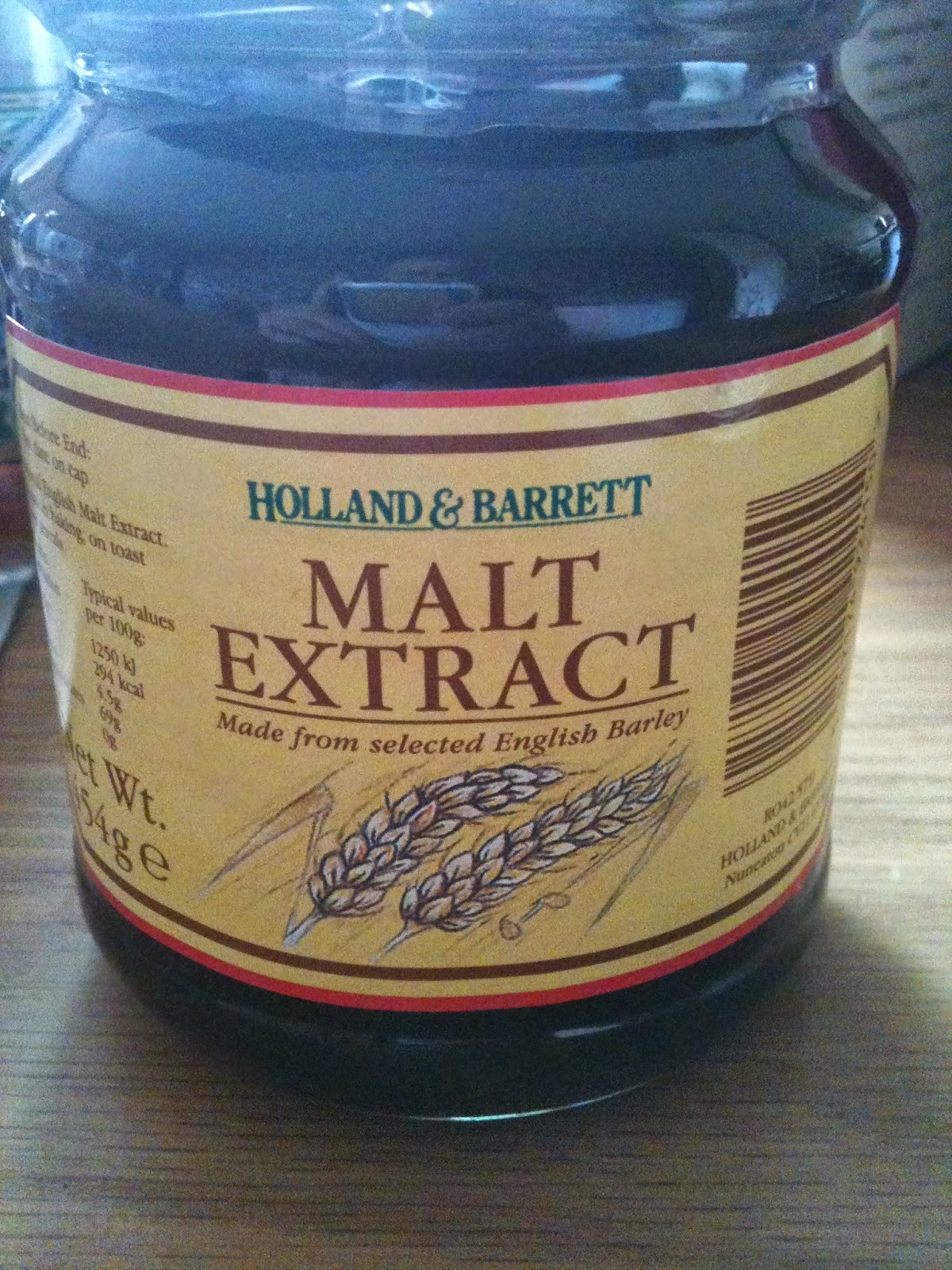
For those of you who will never meet malt, or a mash tun there is an alternative. Go to a whole food shop and buy one of these.


As best as I can estimate, this jar contains 11 fl oz of malt extract weighing 16oz, so this makes a density, specific gravity, or OG of 1450 or so. Dilute this with 4 imperial pints of water and you will have a re-hydrated wort of about OG1054.

Wort is a brown, runny, very sweet liquid that is extremely sticky when it dries. It could be described as a kind of dilute synthetic honey, that is very ancient in origin and is possibly the first process that was ever made with cereals. It could be that cereals were first cultivated, not for their staple qualities e.g. flour, gruel or bread, but instead for their status potential, sugars.

Many of the early settlements in the Fertile Crescent had special buildings with smooth floors, made of beaten earth, clay or lime plaster which are ideal as malting floors. All that is then required are containers within which to heat the crushed malt and water (the mash) to make a sweet wort. Merryn's M. Phil, entitled Barley Malt & Ale in the Neolithic (1999), looks at this, and the archaeological evidence for it, in some detail. One particular site, Beidha, was excavated in the late 1950s by Diana Kirkbride, a member of Robert Braidwood's team. She describes a smooth plaster floor with 'thousands of grain impressions'. This is probably a malting floor. The site is dated to the 8th millennium BC.

There is a Biblical expression: "The land flowing with milk and honey". Some Biblical scholars have made tortuous explanations to explain this phrase - they write about how wild bees' nests in cracks in the rocks would ooze honey in the hot sun. More informed scholars explain that this phrase refers not to bee honey, but rather to some kind of artificial sweetness, perhaps made from figs or dates, or maybe even made from grapes.

This must be because these scholars do not recognise nor do they understand that cereals can be a source of sweetness, if processed correctly.

I think that this phrase 'land of milk and honey' refers to milk and wort. It is a metaphor, or a description of a land that is good for both cows and for growing grain.

It seems that Biblical scholars have overlooked the fact that wort (liquid sugars made from the grain) was once commonplace in Egypt and Sumeria, otherwise they would not have been able to make beer. This was probably common throughout the whole Fertile Crescent and the Biblical Israel.

With the rise of Islam in this area, alcohol has been proscribed. There is no further use for malt or wort, so the practices and knowledge of malting and mashing have died out completely there. Archaeobotanists and archaeologists who have done field work on cereals in Turkey and the Ancient Near East seem to be unaware of the malting, the mashing and the wort. It is outside their experience and so it is understandable that wort has been overlooked in archaeological interpretation.

Today Bouza is made, it can be described as a type of beer, however it is a wheat based beverage made by lactic fermention. It is no longer alcoholic.

So, why do I bother to go to all the trouble of mashing, lautering, sparging, boiling and all that washing of brewing equipment? After all, it takes a whole day, a huge amount of effort. The answer is that all of the Beer Kits that I have ever used produce a beer with a kind of metallic flavour. The Kit contains a large can of Malt Extract. No amount of boiling with extra hops, or anything else will make it taste any better.

I make my beer with the simple, basic ingredients. I use traditional techniques to make the wort because I think it makes a better tasting beer. At least, when everything goes to plan, it tastes good. Even when it's bad it is often not much worse than some of the bad commercial beer available in supermarkets.

Beer is changing, with the way it is made. Some commercial beers, in cans, bottles and on draught have this unpleasant metallic flavour. They have been made from malt extract.

I was disturbed recently by looking carefully at the contents lists of commercial beers. Some like Scapa Special say that they are made from "maris otter pale ale malt", or others "a blend of pale and roasted malts". I know these are made "from the grain" and not with malt extract.

Some lagers and stouts are labeled as containing barley, wheat and oats, with no mention at all of the malt.  I can't help but wonder if they have been made from syrups, much like the high fructose corn syrup so popular in the processed food industry. This could explain the uniform blandness of some of these cheaper beers.


Monday, 19 May 2014

desperately seeking sugars

A few years ago, we were standing beside the trench of an excavation on Orkney. Lots of serious digging was going on. One of the diggers looked up, recognised us and said something like...

oh hello! Are you those brewing people?

Yes, that's us. 

Can you tell me how to make Heather Ale?

Of course, we replied. No problem.

Because we've got loads of heather growing around our house and we want to make some beer with it! 

But you can't make beer from flowers, we replied. Flowers provide the flavouring, the preservative ... you have to add sugar. That's what ferments into alcohol. 

beer made from flowers?
We began to think that, maybe, when some archaeologists had come across our work on prehistoric brewing and heard about our ancient style meadowsweet ale, they thought that we had made it from meadowsweet flowers. We had not considered that before. Later that month, our suspicions were confirmed when we did a prehistoric brewing demonstration at a neolithic feast, organised by the Orkney Archaeology Society. I think it was in 2008. Over an open fire, with just the hot ashes, we heated some water in an earthenware bowl. It was our mini mash tun.

When the water was clear enough for us to see our reflection, we knew it was the right temperature.We added the crushed malt. This is known as 'the strike'. The local hens came running when we got the malt sack out of the van. Soon, there was the sweet aroma of the saccharification, this is when the enzymes re-activate in the mash tun and turn grain starch into malt sugar. It smells delicious. Folk began to wander over to find out what was going on. Some of them tasted the mash.

We were asked how much sugar we had added. None, said Graham. All the sugars come from the malted barley in the mash tun. No, go on, there must be some added sugar in there! No, we assured them, there was no added sugar. Later a couple of ladies asked how many flowers we had used to make our ancient brew. The answer was about an ounce and a half for five gallons of ale. They walked away, shaking their heads in disbelief. I am quite sure that they had confused what we were doing with making a flower wine.

Check out the recipes for "country wines" online - they all have a couple of pounds of sugar per gallon in the list of ingredients.

Quite simply, it is not possible to make ale or beer from flowers.

beer made from birch sap? 
Birch sap contains very few sugars, less than one per cent. It is more like a sweet water. You could collect a lot of it, then boil it to make a syrup but it is hardly a practical way of obtaining sugars for fermentation. John Wright, writing in the Guardian, explains how to make birch sap wine. The ingredients include 1.8 kilos of sugar and grape juice concentrate.

beer made from bread?
Some archaeological and anthropological sources suggest that beer and ale were made from bread in ancient times. There is a common myth that beer was discovered when a loaf of bread fell into a bucket of water and fermented overnight.

If it was really possible to make beer from bread in ancient times, then why aren't we doing it now? Surely people would be queuing up to buy loaves of bread so that they could throw them into a bucket of water to ferment for a few days. Home brewed Egyptian beer. It might taste horrible. It might be a bit weak and sour. But that's what it was like in the past. Wasn't it?

Sorry to disappoint you, but it is not possible to make beer from bread. The biochemistry does not allow it. There are no sugars in bread to ferment into alcohol. However, a quick search on the internet shows how the idea that bread can be somehow transformed into beer still prevails. There are lots of different methods suggested. Here is just one example:

" Barley was used to make beer. The barley was combined with yeast and made into a dough which was part-baked in a stone oven. It was then crumbled into a large vat, mixed with water and allowed to ferment before being flavoured with dates or honey. Recent evidence suggests that barley malt may also have been used in the process.www.historyonthenet.com

If you crush the barley into flour, then make a bread you have destroyed the fabric of the grain. There is no possibility of germination, no possibility of starches being turned into sugars. No beer or ale. Baking in a hot oven alone would be enough to destroy any enzymes. It would also destroy the yeast. This method would not work.

The recent evidence, referred to above, is that of Delwen Samuel. Analysis of residues on 3000 year old ancient Egyptian pottery showed erosion pits from the enzymatic action in the the individual starch granules. This proved that the grain had begun germination - it was malt.

Delwen Samuel's papers are available online. In 1997 she published 'Fermentation Technology 3000 years ago. The Archaeology of Ancient Egyptian beer'. The scanning electron microscope images of pitted starch granules can be seen there.

beer is made from malt
To make ale or beer, you need malt. This is grain - barley, wheat, oats or rye - that has begun to germinate. Germination stimulates the production of the starch converting enzymes. Making malt is a specialised craft in itself. There is far more to it than soaking grain in a bucket, then letting it sprout. The two crafts of maltster and brewer are separate today. The maltster supplies the brewer with malted grain.

mashing 
The brewer heats the crushed malt with hot water in the mash tun to make malt sugars. Sugars ferment into alcohol. It's a simple but very obvious thing. Over the years, we have given demonstrations of what happens in the mash tun, of how the crushed malted grain is heated up gently, to make malt sugars. This is known as the mash, or saccharification - the enzymes in the malt are active at about 65 to 67 degrees Centigrade, so this is the temperature to aim at in your mash tun. 

The mash tun can be an earthenware bowl, heated in the ashes of a fire. We have done this many times, the image below is from a demonstration at Eindhoven Museum. I went there in 2009, as part of a brewing forum organised by EXARC.

a mashing demonstration at Eindhoven,

Or the mash tun can be a wooden trough in the ground, heated by hot rocks. We have done this several times. The pioneers of the technique are the Moore Group archaeologists. The video of their hot rock mash in a wooden trough, first done in 2007, is now legendary.

Given that thermometers are a recent invention, brewers in the past learned how to judge this temperature by skill and experience. John Tyndall, giving a lecture on Fermentation at the Glasgow Science Lectures Association, October 19th, 1876 said

"Our prehistoric fathers may have been savages, but they were clever and observant ones ... the art and practice of the brewer are founded on empirical observation ... the brewer learnt from long experience the conditions not the reasons for success" 

In the scholarly literature and in many of the archaeological and anthropological academic papers about making beer in ancient times, a wide range of beer making ingredients have been suggested - barley, wheat, dates, figs, fruit, berries, birch sap or birch syrup, honey or flowers and leaves.

All that any brewer needs to make ale or beer is water, malt, herbs and/or hops and yeast.

Wort is the sweet liquid that comes from the mash tun after sparging. The exotic ingredients of the scholarly papers can enhance the ale in several ways, by preserving, flavouring or by providing medicinal or other properties. But they do not provide the primary fermentable sugars. This comes from the grain, which has been malted, mashed, lautered and sparged. Barley is a reliable source of sugars for fermentation. You just need to know how to make it.

There is no need to go desperately seeking sugars.

Just understand the malt, the mash and the saccharification that occurs in the mash tun.


further reading
The Big Book of Brewing by David Line
In our opinion, this is the best book to read on the processes of malting, mashing, lautering, sparging and fermentation.

------------------------------------------------------------

two years later 
I went to a talk recently, it was about the neolithic, grooved ware and the use of pottery. My impression, after talking to several archaeologists, is that it still seems to be a widely held belief among archaeologists that 'alcohol production' in prehistory was no more than guesswork. It involved mixing up random stuff to make 'something alcoholic that did not taste very nice'. No skill involved.


Saturday, 26 April 2014

Beakers were for Beer! part three: alewives and barmaids

In the early years of my research, I visited a few microbreweries. I wanted to talk to professional brewers who made ale in the traditional way using crushed malt, not malt extract, and who worked on a small scale. This approach to brewing beer in small batches, supplying local pubs, hotels and restaurants, began to take off in the 1980s and 1990s. The interest in real ale in Britain began with CAMRA in 1971. Peter Brown does a good job in telling the story of the rise of craft beer UK style. Worth reading. Anyway, to get back to my story, one of the microbreweries I visited was a tiny establishment, equipped with one mash tun, one boiler and two fermenters. He used crushed malted barley, hops, water and yeast and made a wide variety of beers from these basic ingredients. As any good brewer does.

He was interested in the story of the Bronze Age woman buried in a stone cist at North Mains, Strathallan. She had been buried with a Food Vessel. The residue from a cereal based alcoholic brew, flavoured with meadowsweet, was discovered within it (see part one). We chatted about it in detail, and with some excitement, because I had only just found out about the residue analysis in the Strathallan pot myself. That evening, he went down to the pub and related the story to his mates. And why not? It's a good story. One of his mates was a journalist for the local paper. A couple of days later there was a headline "Bronze Age Barmaid" or "Prehistoric Barmaid discovered" or something along those lines. And my name was attached to it, almost as if I had discovered it. Many of the details were wrong. It was only a small piece in a local newspaper, but it seemed like sensational stuff at the time. Some folk at the University were not very pleased about it.

I had just had my first encounter with The Press, and with some of the silliness that seems to surround any news story about ancient alcoholic brews - beer, wine or mead. 

alewives and cup bearers 
Maybe that journalist was thinking along the right lines, although 'barmaid' is not quite the right word to use in a prehistoric context. There is a well established tradition of women as cup bearers, providing the drink at feasts.

Eva Koch, writing in 1986, gives several archaeological and historical examples of the woman as hostess, who would have held a high status position within society. In her article the woman with the drink she describes the grave at Juellinge of a woman, in her 30s, who was buried wearing her silver jewellery and hair ornaments. In the grave with her was some meat, either a whole sheep or pieces of pork and beef - archaeological sources vary. The bronze bucket had contained a drink brewed with barley and cranberries or crowberries and bog myrtle. There were drinking horns and glasses for her guests. The grave was excavated in 1909. 

A recent detailed analysis of these residues has led to the novel idea that the Juellinge vessel had contained 'nordic grog'. The media loved this story. There are variations of it all over the internet, but journalists don't always get all the details right. I don't agree with the concept of a 'nordic grog'. I think it is far more likely that the bucket contained an ale, or perhaps you could call it a barley wine, made from wort and flavoured with a few berries, flowers, herbs and maybe some honey. All the sugars that you need for fermentation can be obtained from the mash tun, as I explained in earlier posts.

There are many similarities between the Juellinge grave and the burial of the young woman, described by some as a dancing woman or priestess, at Egtved.
Egtved Girl tomb from bronze age- Denmark
reconstruction of the oak log coffin of the Egtved Girl. Bronze Age. 1370BC

She was buried wearing bronze jewellery and the bucket at her feet contained the remains of an ale or beer, flavoured with berries and perhaps honey. The bucket was made of birch bark and is too big for a drinking vessel. It is more suitable for serving or perhaps it was one of the vessels used in making the ale. One interpretation is that she was buried with ale for the journey into the afterlife, which is certainly possible. I can't help wondering whether she was buried with the tools of her trade - her brewing bucket.

And so we move on to Bronze Age Scotland and the cist grave excavated in 1979 - the one that the brewer was so interested in. The Bronze Age barmaid herself, buried with her Food Vessel. Could she have been a cup bearer, at feasts and ceremonies, perhaps? Maybe she was an alewife. Some might see her as a priestess or as one of the elite, a high status and important member of society. There are several possible interpretations of who this Bronze Age woman was and what her role in society could have been.

http://i.rcahms.gov.uk/canmore/l/SC00845100.jpg
female cist burial excavated in 1979 at Strathallan, North Mains, SC845100. (copyright Historic Scotland)
The specialist secrets, skills and knowledge of how to transform harvested grain into ale by malting, mashing, lautering, sparging and fermentation were as important then as they are now. Without them, there would be no ale or beer for the feast.

I'm sure that the tradition of the alewife, or brewster, goes right back to prehistoric times, to the earliest grain cultivators and processors, the neolithic folk. There are many different herbs and plants that have been used to flavour, preserve or enhance ale. Known today as gruit, some herbs have medicinal or hallucinogenic properties. Henbane pollen was identified in cereal based residues on sherds from large bucket shaped neolithic pottery known as Grooved Ware at a site called Balfarg in Scotland. More on this in the next post. This discovery extends the potential role of the alewife to that of a healer, maybe even more than that. Here's a link to a blog about the 'brewster as witch' by Jane Peyton, a sommelier and beer expert. Her article is a bit of an advert for a Ninkasi style women's brewing competition that took place in 2011. So, sadly, too late for me to make a brew for that. But she makes some interesting points.

I shall return to the 'magic of brewing' in a later post. It's a huge topic.

beakers, food vessels and tripartite urns - some brief notes
Welcome to the wonderful world of prehistoric pottery! It can be quite bewildering. Confusing to non archaeologists, at the very least. I have discovered this after many years of explaining (or trying to explain) prehistoric pottery classifications to tourists.

In a British Bronze Age context, there are beakers, collared urns, tripartite food vessels and funerary urns. Simply explained - beakers were drinking vessels. Food Vessels, otherwise known as tripartite food vessels, appear to have had no specific function, other than for 'food preparation'. This is how they are described in the archaeological literature.

Sometimes they are found in stone cists and they contained the cremated bone. Collared urns are larger vessels, also often found with cremated bone in burials. This is a blog. It is not an academic thesis. So I must apologise to all archaeological pottery specialists for the simplicity of these descriptions.

a few recent rather exciting discoveries of tripartite food vessels
In March 2012, the land owner of a disused quarry on the island of Arran, off the west coast of Scotland, noticed something interesting in the cliff face. It turned out to be not one, but two Bronze Age stone burial cists. One cist was empty and the other contained the remains of an adult human cremation in a tripartite food vessel and a flint knife.

A photo of a circular, sand-coloured Bronze Age pot against a black background
the food vessel
A photo of a large yellow digger on wheels carrying out work on a steep cliff face
an unusual excavation technique at Sannox Cliff, Arran


A radiocarbon date of 2154 - 2026 BC was obtained. The flint knife, when analysed, had traces of silica, indicating that it had been used to cut grasses or cereals. This is intriguing. Was this the cist grave of someone, probably a woman, whose work involved the gathering and the processing of wheat or barley? I think so. It's not the sort of thing that is found every day. Excavation techniques involved the use of a cherry picker. A news report with some great photos, is here. The excavation was undertaken by GUARD Archaeology, Glasgow and is available here.

In September 2011, in Spinningdale, by the Dornoch Firth in Sutherland, northern Scotland, the accidental discovery of a very well preserved Bronze Age female cist burial, with food vessel, occurred when someone was digging the hole for their new septic tank. Once again, it was excavated by the team at GUARD. Radiocarbon dates from the bone were 2051 -1911 BC and from the charcoal within the grave, dates of 2151-2018 BC were obtained. Inside the cist was female skeleton with a tripartite food vessel at her head.
She was between 35 and 50 years old and had been laid upon a sheepskin, or maybe she wore woollen clothing. It is not quite clear, but unusually, fragments of the wool had survived in the well sealed cist. The excavators thought she may have been an important woman, having been buried with such great care and attention. More details here.

The cist grave of another high status, important and wealthy Bronze Age woman was recently excavated near Windsor, England. Excavations at the Kingsmead Quarry, undertaken by Wessex Archaeology, were presented to the public in 2013. They have put a lot of their information online. It is a large, complex site that includes mesolithic, neolithic, bronze age, iron age, Romano British and medieval elements. The excavations were generously funded by CEMEX. The archaeologists have been digging up lots of really exciting stuff at Horton and you can read all about it on their web site.

Of particular interest is the female burial, dated to between 2500 and 2200 BC. She was at least 35 years old, according to bone evidence. She was buried wearing her necklace of gold, amber and black lignite beads. She may also have had a bracelet, since there were black lignite beads near her wrist. Some perforated amber beads or buttons indicate that she may have worn woolen clothing, with these valuable fasteners. By her side was a large drinking vessel, beaker style. Was this a serving vessel, rather than her personal beaker? It must be considered a possibility. It would be fantastic if a residue analysis could be done of the vessel fabric. I'm not sure, but I don't think this has yet been done.

We cannot be completely sure of her full role within society, whether she was a princess, queen, alewife or cup bearer. It is clear that she was a woman of some importance. More details about her here.

In the words of the site director, Gareth Chaffey, who has been excavating the site for seven years, " It is interesting to think who this woman was within her community. She was probably an important person in her society, perhaps holding some standing which gave her access to prestigious, rare and exotic items. She could have been a leader, a person with power and authority or possibly part of an elite family - perhaps a princess or a queen."


I shall leave the mysterious high status women of the Bronze Age, for now. I'm sure you will come to your own conclusions about them.


Site Director Gareth Chaffey, of Wessex Archaeology, who has been excavating the site for the last seven years, said: “It is interesting to think who this woman was within her community. She was probably an important person in her society, perhaps holding some standing which gave her access to prestigious, rare and exotic items. She could have been a leader, a person with power and authority, or possibly part of an elite family - perhaps a princess or queen.” - See more at: http://www.wessexarch.co.uk/blogs/news/2013/04/19/beaker-burial#sthash.uX7GzXBU.dpuf

Sunday, 13 April 2014

Beakers were for Beer! part two: a birch bark bucket with residues

The image below might not, at first, seem to have anything to do with prehistoric ale. Or beer even. This is the oak log coffin of the young Bronze Age woman known as the Egtved Girl. She died about 3300 years ago. Her oak coffin was found by a farmer, Peter Platz, within a large grassy burial mound in southern Jutland, Denmark. He called in the archaeologists from the local museum who excavated it in 1921. Recent dendrochronological dating of the oak log coffin reveals that the tree was felled in 1370 BC. The North European Bronze Age is a fascinating place to go and visit online to understand some of the background to the Egtved Girl's world. There is a lot of information out there - for example, this atmospheric short film. And lots of pictures of the things that they made and wore and used - the bronze figurines, the sun chariot, the drinking vessels, the well preserved clothing and even a wooden folding seat.

 Egtved Girl tomb from bronze age- Denmark

What the archaeologists discovered within the Egtved Girl's oak coffin was quite astonishing ... there was no skeleton, just a few fingernails and some of her teeth, brains and hair remained. Her bones had been destroyed by the acidic conditions. But the clothes and the grave goods of the young woman had survived the millennia virtually intact. She had been buried wearing a woven woolen tunic top, a corded wool skirt and a woven belt with a bronze spiked disc. Bronze bracelets adorned her arms. Most people agree that she was a dancer, maybe even a priestess, and that she was buried in her dancing clothes. A small bronze figurine, doing a back flip and wearing a skirt like that of the Egtved Girl, was found at Grevensvaenge, Zealand, Denmark. It was part of a small Bronze Age hoard that was first reported in 1779. Over the years, several of the figurines have been lost but the little bronze acrobatic dancer is now in the National Museum of Denmark.
a reconstruction of the Egtved Girl's clothes: details here
Now the oak coffin, the clothes and grave goods have been reconstructed and there is a wonderful display in the National Museum of Denmark. She is visited by thousands of people. There is so much on the internet about the Egtved Girl that it is easy to find out about her. She even has a few Facebook friends ...

I first came across reports of the Egtved Girl through reading the bibliography of Eva Koch's article Prehistoric Plant Food of Denmark, published in 1999. Archaeology can be a bit like a detective story. In the days before the internet was everywhere, the bibliography at the end of an academic paper was probably the only lead you had to find the next piece of information. What interested me about this young woman's grave was the discovery and subsequent analysis of cereal based organic residues in a birch bark bucket that had been placed in the log coffin.

residues in a birch bark bucket
The reconstruction at the National Museum shows how she was laid upon a cow skin. A bundle of cloth, at her feet, contains the burnt bones of a small child, aged 5 or 6 years old. Also at her feet was a bucket made of birch bark. Someone noticed that there was a thick, dark brown residue at the bottom of the bucket. It was analysed in 1929 by Bille Gram. For all you fellow bibliography hunters, this is the reference for the original archaeobotanical report ... over the years I have tried, and failed, to get hold of a copy. In either Danish or English. Maybe you can find it. If you do, please let me know!  
Th. Thomsen (1929): Egekistefundet fra Egtved. Nordiske Fortidsminder Andet Bind. København. (In this book, her drink is mentioned by Bille Gram on page 184 note 2, apparently)
http://media-cache-ec0.pinimg.com/736x/07/0f/29/070f293b5ec3a4e638f9cbacfd535151.jpg
the birch bark bucket 


I don't know how the analysis of the residue was undertaken. I would imagine that it involved a microscope and not a lot else, given that it was done in 1929. The bucket had contained an alcoholic drink - it was probably ale - made from wheat, cowberries or possibly cranberries, bog myrtle, some other plants and perhaps with added honey.

Descriptions of the residue analysis vary in the archaeological literature, which is why I would like to read the original archaeobotanical report. Some archaeologists mention the presence of clover pollen, others mention lime flower pollen. Mixed pollens often indicate the addition of honey. It has been suggested in some academic papers that the "beer" was made from the berries, but any all grain brewer knows that this is simply not possible. The primary source of fermentable sugars had to come from the grain - or rather, from grain that had been malted. It could have been either malted wheat or malted barley or a mixture of both.

Residue analysis provides you with a list of probable ingredients. It does not provide you with a recipe. Nor will it tell you the ratio of ingredients to each other, nor the quantities that are required. To make a similar brew from the list of ingredients you need a recipe. In other words, you need to know and understand the brewing process, the techniques and the methodology of how to make malt and ale.

making malt and ale
There seems to be some confusion amongst archaeologists and anthropologists about what malt is, how it is made and how the brewer uses it. Malt is sometimes described as 'toasted barley sprouts' or even as 'sprouted barley' - something like beansprouts. Neither of these is an accurate description. Malt is grain that has been steeped and aerated in water, then spread out on a smooth, level floor within a dark but well ventilated building to begin to germinate. When the acrospire (the root and shoot) is no more than one third the length of the grain, it is dried gently in a kiln. This is traditional floor malting and this process makes pale malt. Specialist malts are made by roasting at higher temperatures.

I have read descriptions of brewing in academic papers, explaining that malt is 'boiled with water' to make a 'malt solution'  but this would not work at all. The brewer mixes crushed pale malt with hot (not boiling) water to make a sweet wort. This process is called the 'mash' or 'saccharification'. If you boil the malt, then the enzymes that convert starch into sugars are destroyed and you will never make anything fermentable. Specialist dark malts, such as crystal or chocolate malt, are used for colour and flavour and do not provide any sugars in the mash tun.

I began to discuss these issues in an an earlier post and I will certainly go back to these fundamental aspects of making malt and ale in future posts. My last academic paper The Craft of the Maltster is about to be published as I write this blog post. I was given permission to put it online. The book of the conference will be out soon. Floor malting techniques have not changed over millennia.


the ingredients, according to residue analysis of the Egtved bucket
  • wheat - this was probably identified, under the microscope, by the presence of a part of a grain husk. Could it have been a bit of barley husk? This is possible. During the brewing process, specifically in the mash tun, the malted grain is mixed with hot water and the grains become broken up. As mentioned above, whether it was wheat, barley or a mixture of both, the grain had to have been malted. Malt provides the primary fermentable sugars for ale and beer.
  • cowberries - not the main source of fermentable sugars. These are very tart, sharp tasting berries. Probably used as an adjunct. Cowberries, also known as lingonberries were probably identified in the Egtved bucket residue analysis by the presence of seeds. It can be tricky to identify the specific berry type from the seed alone. 
  • bog myrtle - also known as myrica gale, this leafy shrub has been used for millennia as a 'brewer's herb'. It both preserves and flavours the ale and it was used before the introduction of hops in medieval times. Many other plants and herbs can be used in brewing ale. We have used meadowsweet and juniper berries in our ancient ales. Yarrow is another commonly used plant as an alternative to hops. These are known as gruit and these days you can buy a wide variety of these ancient and traditional ales in the shops, made by several different brewing companies. 
  • lime pollen, clover pollen - the presence of these in the bucket residue might indicate the addition of some honey to the ale. Again, it is an adjunct and not a primary source of sugars for fermentation. Alternatively, the pollen might indicate the addition of lime flowers and clover to the wort, for flavour and/or preservation.  

how we would make an 'Egtved Ale'- the basic techniques and recipe
We have been making ancient style ales for fifteen years now. Small batches, a few gallons at a time, in our home brewery. To recreate the ale that was in the Egtved bucket we would, first of all, get some malted grain. If possible, we would try to obtain some malted bere - an ancient strain of barley. The grain is skinny, much thinner than modern barley. We have used bere malt successfully to make an ale flavoured and preserved with a few dried meadowsweet flowers instead of hops.

our mash tun 


We would mash the crushed malt with hot water in the mash tun for about one hour. Grist is the brewer's term for crushed malt. Brewers refer to the water used for brewing as 'liquor'. It is not alcoholic. Then we would lauter, that is, collect the first runnings of sweet wort from the mash tun,  and then sparge. This involves running several gallons of hot water through the mash and collecting more wort. As far as quantities and ratios are concerned, we would use about 15 pounds of malted grain to make roughly 8 or 9 gallons of wort.

Cowberries could be added to the mash tun, or they could be added to the wort during the boil. It is difficult to know exactly how many to add, but when we made our Juniper Ale with berries, we used just a few ounces to twelve pounds of crushed malt. Having obtained the wort we would boil it, together with some sprigs of bog myrtle and/or lime flowers and clover flowers. Yeast would be added, most likely in the form of barm from a previous brew. Leave the ale to ferment for a few days, then rack it off into a fresh container and see what it tastes like.

strange brews
Over the last few years, there have been some rather strange re-creations of the alcoholic drink hinted at by the residues in the birch bark bucket found at Egtved. Not all of them are convincing. I watched a TV programme recently that showed the archaeologist Neil Oliver drinking an 'ancient style brew'. I think, but am not entirely sure, that it was supposed to be based upon the Egtved residues but, sadly, some of the basic ingredients had been altered. Apple juice was used instead of wort. The herbs, honey and berries were included. I don't think that apple juice would have been an option for those Bronze Age brewers 3300 years ago. Crabapples were the only available 'apple' and these are very sour. Even today, when people make a crabapple wine, they have to add a large quantity of sugar because the crabapples are not sweet enough to ferment by themselves. Crabapples also require a modern press to extract the juice. I cannot work out how the juice could have been pressed from crabapples in Bronze Age Denmark.

Another strange brew is Kvasir, made recently by the Dogfish Head Brewery in collaboration with Professor Pat McGovern, who is sometimes referred to as the Beer Archaeologist. For some reason, concentrated birch syrup was included in the Egtved inspired brew. I have no idea why, since this ingredient was not identified in the analysis of the residue from the birch bark bucket. Concentrated birch syrup is made using modern processing techniques. I think the word to remember here is 'inspired'. I don't think they were aiming to actually recreate an accurate copy of the 3300 year old ale, rather, they are making a modern Craft Beer, USA style, that pays homage to the Egtved Girl. I have found no mention of malt, mash tun or wort in the media coverage of this brew.

It is odd that she is referred to as a 'leather clad priestess' when she was actually wearing a tunic made from woven wool and a corded skirt. This is a very well known detail of the Egtved Girl's clothing. When she was first discovered, in 1921, some  archaeologists thought that there must have been a linen undergarment because the 'string skirt' was so revealing.

There are plans to make a commercial beer to a similar recipe in Sweden - Arketyp. This brew appears to have crushed pale malt as an ingredient, but it also includes concentrated birch syrup. Again, I don't understand the reason for this addition to the ale unless it is to make a kind of 'Nordic Grog'. Professor McGovern has proposed, in a recent academic paper, that this is what people made and drank throughout Europe in prehistory - some kind of mixed alcoholic drink made up of different components, such as birch syrup, wine and herbs. Although the biochemical analysis of four residues is incredibly detailed, there is nothing in the paper about malting, mashing, malt sugars or the brewing process.

For some of these strange and exotic brews, it seems as if the archaeologists who try to recreate them are struggling to find fermentable sugars, while neglecting the malt and the wort. Barley, and wheat, are an excellent source of sugars for fermentation  if processed in the right way. Maybe you have to be a brewer to understand these processes.

Egtvedpigens Bryg - made with malt, water, herbs and honey
I am very pleased to say that the National Museum of Denmark, working together with the Skands Brewery, have made an authentic ale based upon the ingredients identified in the bucket residue analysis. It should be available in the Museum Shop. If you are lucky enough to go and visit the Egtved Girl in Denmark, maybe you could try some. The details of this ale are, as yet, sparse on the internet. The launch party was on the 22nd of March 2014, so this really is the most recent and, for me, the most exciting development in the long story of the Egtved Girl and her bucket of ale.

I have found some Press Releases online, in Danish and translated into English. I expect that we will be hearing a lot more about it in the future.

The Egtved Girl's beer, made from a 3.300 year old recipe. In her coffin, a bark bucket was found. At the bottom lay a thick brown deposit. When the contents of the bucket were analysed it became clear that it had contained a fermented drink - probably beer sweetened with honey.  The newly reproduced beer is made from the same ingredients as was found in the coffin. Bronze age, beer, recipe, drinks, history, Denmark, prehistory.
launched recently, a modern commercial version of the Egtved Ale


Saturday, 29 March 2014

Beakers were for Beer! part one: ale, mead & residues

Beakers were for beer. I was told this back in 1995, in my final year as an archaeology undergraduate. There was absolutely no doubt about this, or so it seemed at the time. I made a note to look further into the idea. This was when my interest in ancient brewing techniques began. I had never thought about it before, but, being married to a home brewer of fine ales, made from all grain, I was intrigued. He would carry a 25 kilogram sack of crushed malt from the Brewing Supplies shop into the house, and then after about a week, he would have made us some excellent beer. A 25 kilo sack of malt would make 4 brews of 8 or 9 gallons each. Yes, I'm mixing Imperial and Metric but I am not bothered about that. The point is that you can make plenty of beer from 25 kilos of malt.

How did those Bronze Age folk, living in Britain around 4000 years ago, make their beer? I asked several people in the Archaeology Department but nobody seemed to know. They all thought I was crazy, looking for the archaeological evidence of beer brewing. You won't find anything, they said.

A paper was cited by the lecturer: Burgess and Shennan: The Beaker Phenomenon: some suggestions. It had been presented at a conference "Settlement and economy in the third and second millennia BC" and the proceedings were published in 1976 as a British Archaeological Report (BAR 33). It is cited in dozens, if not hundreds of academic bibliographies about the Bronze Age of the British Isles. It has become a classic paper, but it is not easy to find unless you have access to a University Library. That is to say that I have not managed to find access to a copy online.

One of the arguments of the paper was that Beakers were made specially for the drinking of beer. They proposed that a warrior cult existed in Bronze Age Britain, with some people buried with grave goods that reflected their prestige, high status and lifestyle. Grave goods often included a drinking vessel - a finely made and decorated pottery 'beaker' from which they drank their beer. No archaeological evidence, such as residue analysis, was presented in the paper.

The Amesbury Archer, referred to by the media as the 'King' of Stonehenge was considered to have been an important person and someone of high status, since he was buried with lots of grave goods, including five fine beakers, gold jewellery, the equipment for making metal and a slate wrist guard that hints at his prowess with a bow and arrows.

http://www.britishmuseum.org/collectionimages/AN00160/AN00160012_001_l.jpg
beaker from Hemp Knoll, Avebury

If beakers were for beer, then what is the archaeological evidence? Did it taste like the beer that we drink today? Who made it? Were the brewers men or women? What's the story?

Strictly speaking, when referring to prehistoric brewing from cereals, it should be called ale, not beer. What's the difference? Ale and beer are both made from malted grain - barley, wheat, oats or rye. Ale is preserved and flavoured with a variety of herbs, such as bog myrtle, heather, yarrow, juniper or meadowsweet. Beer is flavoured with hops which were introduced to the brewing process only recently, in medieval times. Spices can also be used. Today, we tend to use the terms 'ale' and 'beer' fairly indiscriminately.

For anyone interested in ancient ale, the discovery of cereal based residues on old pots has to be one of the most exciting things. Research was very different in those days. In the late 1990s the internet was in its' infancy. Internet search engines were a rare and wonderful thing, to be accessed by a few lucky academics. Charles Mount has written about how University research has changed over the last 20 years here. He is writing about University College Dublin, but the story is the same throughout UK Universities.

So, for me, my first research involved going to the John Rylands Library, looking through the card index systems, finding archaeology journals and reading lots of excavation reports. I spent many hours doing this. I started with the Proceedings of the Society of Antiquaries of Scotland, fondly known as the PSAS (now available online). It is an excellent resource. I soon stumbled on excavation reports that had some intriguing descriptions of cereal based residues on pottery, together with a detailed pollen analysis. Just what I was looking for.

cereal based residues on pottery
A couple of years after the Burgess and Shennan paper was published, a discovery was made in Fife, Scotland, that supported their thesis that beakers were for beer drinking in the Bronze Age. 

In 1978, excavations by a team led by Gordon Barclay at the site of a timber circle, bank and ditch (c2330 ± 60BC) at North Mains, Strathallan, Scotland, revealed several cist burials  In one of these, a female cist burial, there was a fine, complete Food Vessel with a deposit of organic material still adhering to the inner surface of the pot, after thousands of years. It was described as a 'black greasy material on the internal surfaces'. Such discoveries are extremely  rare.

The cist was situated in the centre of the timber circle. Fortunately, it had remained partially sealed, hence the unusual survival of the organic material. Analysis of the residues revealed high percentages of cereal pollen and meadowsweet pollen. It was interpreted as being the probable remains of a cereal based fermented drink. The radiocarbon date was 1540 ± 65BC. The analysis (below) is on pages 178 to 180 of the excavation report in PSAS Volume 113. The details are important and of interest to any all grain brewer. The 'human interference' that has introduced charcoal to and that is referred to might be the drying of malted grain, rather than parching harvested grain.

There is a Table on page 179 which gives the details and percentages of the pollen finds. Of course, I recommend reading the whole report, which can be downloaded from the PSAS website. That is because I really like to read the original excavation reports rather than secondhand interpretations. It is almost like being there! The descriptions of the pottery finds (between pages 155 and 163) are also informative.

When I showed this pollen analysis to my husband he said 'I can make that. I just need to replace the hops with some meadowsweet flowers.' And so our research into recreating ancient ales began.

POLLEN ANALYSIS OF DEPOSITS IN A FOOD VESSEL FROM THE HENGE MONUMENT, NORTH MAINS                         S Bohncke
INTRODUCTION
Burial B was accompanied by a food vessel (SF17), discovered lying on its side by the skull. Within the pot a small deposit of black greasy material was found. As the analysis of material within vessels has proved valuable (Dickson 1978) samples of this deposit and scrapings from the pot wall were subjected to pollen analysis. 


MATERIAL AND METHODS

Part of the black greasy material was used for the preparation of two pollen samples and another sample was scraped from the inner fabric of the pot. All samples were treated with hydrogen fluoride to remove the silaceous component and were subsequently subjected to Erdtman's acetolysis. Microscope slides were then prepared using glycerol jel as an embedding medium.
 

RESULT AND DISCUSSION 
High percentages of Filipendula (meadowsweet) pollen (74-1 %, 77-8%, 84% (scraping)) and relatively high percentages of cerealia pollen were noted. There was also a large proportion of charcoal fragments. Within the Filipendula grains there was a wide range of variation in the states of preservation. The well preserved type is the tricolpate micro echinate pollen in which the pores are clearly pouting. The very corroded type lacks the characteristic pores but the wall structure is not affected. Immature pollen was also present. Relatively high proportions of Filipendula can be attributed in part to selective corrosion as Filipendula has a relatively thick wall but this could not explain the 74-1-84% found in these samples.

Cereals are self pollinating, the result being that little pollen is dispersed into the air. The anthers remain within the spikelets so that on the fully grown cereal pollen grains could still be present, though most would be lost during the winnowing process. Compared with the other species the cereals are over represented in both samples. This is probably the result of human interference. The charcoal in the samples might have originated in the processing of the grain (eg roasting to remove chaff), however the cereal pollen were not burnt and this therefore seems unlikely. The charcoal may also have found its way into the pot during the burial ritual or have been in the pot already, perhaps as the result of firing a new vessel for the burial. The remaining pollen almost certainly came accidentally into the food vessel and represented a part of the contemporary pollen rain. The presence of pollen of plants flowering at different times of the year (eg Corylus March-April, Polypodium August-September) might be explained by the addition of pollen-bearing water to whatever was contained in the vessel or its incorporation in the manufacture of the contents.


Dickson (1978) in his analysis of the Ashgrove beaker scrapings discovered very high proportions of Tilia and Filipendula and concluded that the vessel had contained lime honey or mead flavoured with meadowsweet. The North Mains food vessel contained neither lime pollen nor sufficient pollen from other honey-producing plants. The 2-4-3-7% of Compositae pollen were not sufficient for a honey based on Compositae alone. The high proportion of cereal pollen grains might suggest either a porridge of cereals (eg frumenty) or a fermented ale, flavoured with meadowsweet flowers or extract. The name 'meadow-sweet' originates from mead-sweet as it was used to flavour mead and other drinks. It is distinctly possible therefore that the North Mains food vessel contained a fermented drink.

the Ashgrove beaker
Mention is made of the Ashgrove Beaker. This was found in an excavation of a Bronze Age cist burial by Audrey Henshall and was published in Antiquity in 1963. As well as the skeleton and a beaker, there was also a fine dagger. It seemed that the pot had fallen over, spilling its' contents on the floor of the cist. James Dickson analysed the residues in the 1970s and he also published his results in Antiquity.

Pollen analysis revealed large amounts of immature lime pollen and meadowsweet pollen, which was interpreted as the remains of mead but sadly, it was not radiocarbon-dated. Nor did they look for cereal residues. Ian Hornsey discusses the implications of this discovery in his book, The History of Beer.

my first article

These discoveries, and others, led me to write my first article about the archaeology of ancient ale, towards the end of 1996. Descriptions of residues on Grooved Ware pottery from the neolithic site of Balfarg are very similar to those found on Beaker pottery. It was beginning to look as if making ale from the grain was a Neolithic, not a Bronze Age phenomenon.

I was very pleased and proud to be the cover girl for BA19 and I have Simon Denison, the then editor of British Archaeology, to thank for that. He was interested in my work and very supportive.

The picture shows the Strathallan or North Mains food vessel, with meadowsweet flowers surrounding it. These flowers would have been the flavouring and preservative for the ale, the base of which would have been a wort made from crushed malted cereal - barley and/or wheat.


http://www.archaeologyuk.org/ba/ba19/ba19b.gif
Finding Magic in Stone Age Ale - my first article - you can read it here.

That's all for this blog - more than enough for you to be getting on with. I find it odd that in 2014, particularly in the UK, there seems to be a taboo surrounding any discussion by archaeologists of malt and ale in prehistory.

The evidence is there, if you know and understand what the brewing process is and what you have to look for in the archaeological record.

 *******************************************
... my next blog will be about the Egtved Girl's Brew, the residues of which were found in a birch bark bucket in her oak log coffin in Denmark ... there are some details here.

Please get in touch with me if you have made a beer based upon these residues, if you know of someone who has or if you have been lucky enough to taste one of these brews.

I know about the 'Nordic Grog' made by Dogfish Head Brewery, under the guidance of Professor Pat McGovern. It was recently marketed as Kvasir, named after a Nordic Princess. 

I want to hear about any real home brewers who have had a go at recreating it.


Thankyou! 
 ********************************************

further reading
Burgess, C. & Shennan, S. 1976. The Beaker Phenomenon: some suggestions. In Burgess, C Miket, R. (eds.)  Settlement and economy in the third and second millennia BC : papers delivered at a conference organised by the Department of Adult Education, University of Newcastle upon Tyne, B.A.R 33, Oxford, 309-331.

Barclay, G. (1984a) 'Sites of the third millenium BC to the first millenium AD at North Mains, Strathallan, Perthshire', Proceedings of the Society of Antiquaries of Scotland. Vol.113


Dickson, J. 1978 'Bronze age mead', Antiquity, 52 (1978), 108-13.