Showing posts with label ritual. Show all posts

Sunday, 17 July 2016

big pots: fermentation and storage

Brewing ale in Neolithic Britain - it seems to be a controversial topic among some academic archaeologists. I'm not sure what the problem is with malting and brewing ale in the neolithic era. It could be that few people understand the processes involved in the transformation of grain into malt, wort and ale.

If you have come to this page via the BBC Earth website, or from the Stone Pages, please be aware that the comments attributed to me there are wrong. I have no idea where they came from, other than as a misunderstanding. I hope for a correction in the near future but so far I am not having much success.

Roasted malts, also known as specialty malts, are a feature of modern industrial malting. I'm working on a blog about that at the moment and will post a link to it when I have completed it, hopefully before the Yule celebrations of 2016!

The last few posts have been about explaining the saccharification in the mash tun, where the crushed malt, when mixed with water and gently heated, is converted by enzymes into malt sugars. I've also written a little about lautering, sparging and how to collect the wort.

We've been asked 'why not ferment in the trough. Why go to all the trouble of trying to collect a wort without bits in it?'

Firstly, alcoholic fermentation requires anaerobic conditions. A large vat (1000s of litres) within a building has a blanket of carbon dioxide over the fermenting beer, as in lambic brewing. A small trough (100s of litres) situated outside would have this blanket blown away. Secondly, during fermentation, the little bubbles of carbon dioxide produced by the yeast, stick to the smaller particles and lift them into the froth of the barm. You can see the towering barm in the picture below. It can turn into a really messy monster when it has a lot of little bits in it. After fermentation you would still have the problem of straining or filtering what brew has not been lost to the froth-over. That is a lot harder with little bubbles in it. A bed of husks will not form properly and filtering just doesn't work. 

Inoculating the wort: starting a fermentation
Once the brewer has obtained a quantity of wort by mashing, lautering and sparging, the next stage of the brewing process is the fermentation. Whether you mash in a large pot, a wooden tub with a spigot hole, in a trough in the ground or in a modern mash tun, the wort that you make must be dealt with promptly to prevent infection setting in. Wort does not keep well. Either you boil it, as is necessary with hops, and then cool and inoculate with yeast at the right temperature. Or you can inoculate a fresh wort when it has cooled, and then add the herbs. We found that meadowsweet flowers inhibited the yeast and are better added after the fermentation. To find out more about raw ale which, basically, is beer made from an unboiled wort, I suggest a look at this blog. Raw ale is a huge topic in itself.

fermentation in close up, this is the barm (foam) on a fermenting beer

There are a number of ways of adding the yeast to the wort to start the fermentation. Today, the brewer can add yeast directly, in dried form or as a yeast starter, when the wort temperature is just right. Many modern breweries keep their yeast starter in a fridge. They scoop some of the barm (foam) from the top of the fermenting beer and then store it in a cool place until required. The yeast culture can be kept and used for several months. 

Brewers in history and prehistory could also have used this simple and basic technique, keeping their barm/yeast culture in a cool place. In the 1980s, archaeologists found a medium sized grooved ware pot which had been sunk into the ground in the remains of one of the buildings at Barnhouse, Orkney. The pot, about a litre in volume, had been buried up to its' rim. Analysis revealed that it had contained some kind of 'cereal based mixture', but they were unsure about the pot's function. I think it may have been a barm pot. It was located in a large building, numbered eight by the excavation team and interpreted as a 'temple' or some other kind of ritual building. There were drains as well as many sherds of broken or smashed Grooved Ware pottery, representing pots of about one litre in volume. There was also evidence of feasting and what archaeologists refer to as 'ritual activity', although what that was is not made clear in the excavation report.

I would say that if an archaeologist is looking for a prehistoric ritual activity then the mysterious and magical transformation of grain into malt, wort and ale is well worth considering.

In Norway, Lithuania, Latvia and other places, the tradition of making farmhouse ale survives, with brewers passing on their skills, techniques and knowledge to their descendants. Old traditions of inoculating the wort are still practised in several areas of northern Europe. The picture below shows a wooden yeast ring or kveikering being used to inoculate a yeast starter.

wooden yeast ring or kveikering (photo from the beer blog of Lars Garshol)

Some sources say that the tradition of the kveikering dates back to the 18th century, although I wonder whether the concept might date even further back. It's difficult to be sure because, of course, a wooden object used to gather yeast and start a fermentation would not survive in the archaeological record. In the Viking era, apparently, a stick was used to stir the fermenting wort. This would put yeast onto the stick. Then, if it was kept dry, it could be used to start the next fermentation by stirring a fresh wort. In the Western Isles of Scotland there is a tradition of stirring the fermenting beer with a hazel stick (or wand) which is then hung up to dry and used to stir the next batch of wort, to begin the fermentation.

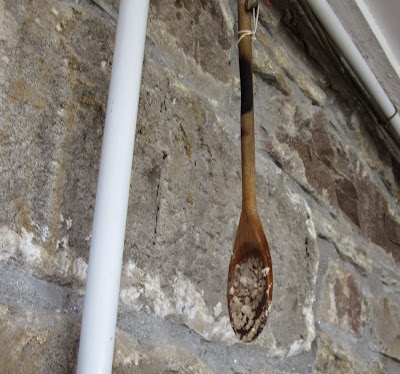
We did some experiments using a wooden spoon and found that this technique works perfectly.
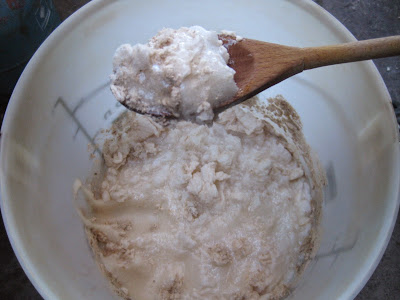
harvesting barm from the fermentation vessel
barm/yeast drying on the wooden spoon (more photos here)

Big pots as fermentation and storage vessels.
The neolithic era was the time of the 'first farmers'. The earliest grain agriculturalists of the British Isles (c4000BC onwards) were also the megalith builders. They created magnificent stone circles and henges as gathering places for the community. They built stone tombs for their dead and they began to settle down. Associated with the 'first farmers' is the integrated 'cultural package' of grain cultivation, the management of domesticated animals (cows, sheep, goats and pigs) and the manufacture of ceramics. This was the 'neolithic revolution', a different lifestyle to the mesolithic hunter gatherers who had roamed the land for thousands of years previously. At this time in prehistory, the technology for making large stave built wooden vessels (vats, tubs, barrels) did not exist.

How did these neolithic 'first farmers' process their grain? Were they grinding it into flour, to make bread? Were they boiling it, making some kind of gruel or porridge? Or were they making ale from it, by malting, mashing, sparging and fermentation? For some reason, the possibility that such a thing as ale in the neolithic is considered to be a controversial idea by many archaeologists. I'm not sure why. 

Some of the large neolithic Grooved Ware pots might have been used as fermentation vessels. They are perfect in both shape and size. One particularly large Grooved Ware pot found at the neolithic village of Skara Brae, Orkney, was around 30 gallons in volume. Most of the large Grooved Ware pots were around eight to ten gallons. They are found at many ritual and feasting sites of the neolithic, in domestic contexts, for example at Skara Brae, Orkney, and at stone circles and henge monuments throughout the British Isles.

What is Grooved Ware? It is neolithic pottery that archaeologists have defined by its' decorative pattern of grooves and shapes on the exterior. Not all grooved ware has grooves; some of it has fancy applied decoration, with blobs of clay and raised patterns. Most Grooved Ware pots are bucket shaped, with a flat bottom. They are found throughout the British Isles, from Clacton to Orkney and Shetland and also in Ireland. Indeed, this style of pottery was first called 'Rinyo-Clacton Ware'. Rinyo being the name of a site on one of the Orkney islands, Rousay. It was a neolithic village larger than Skara Brae. Grooved Ware was also found on the south coast, at Lion Point near Clacton.

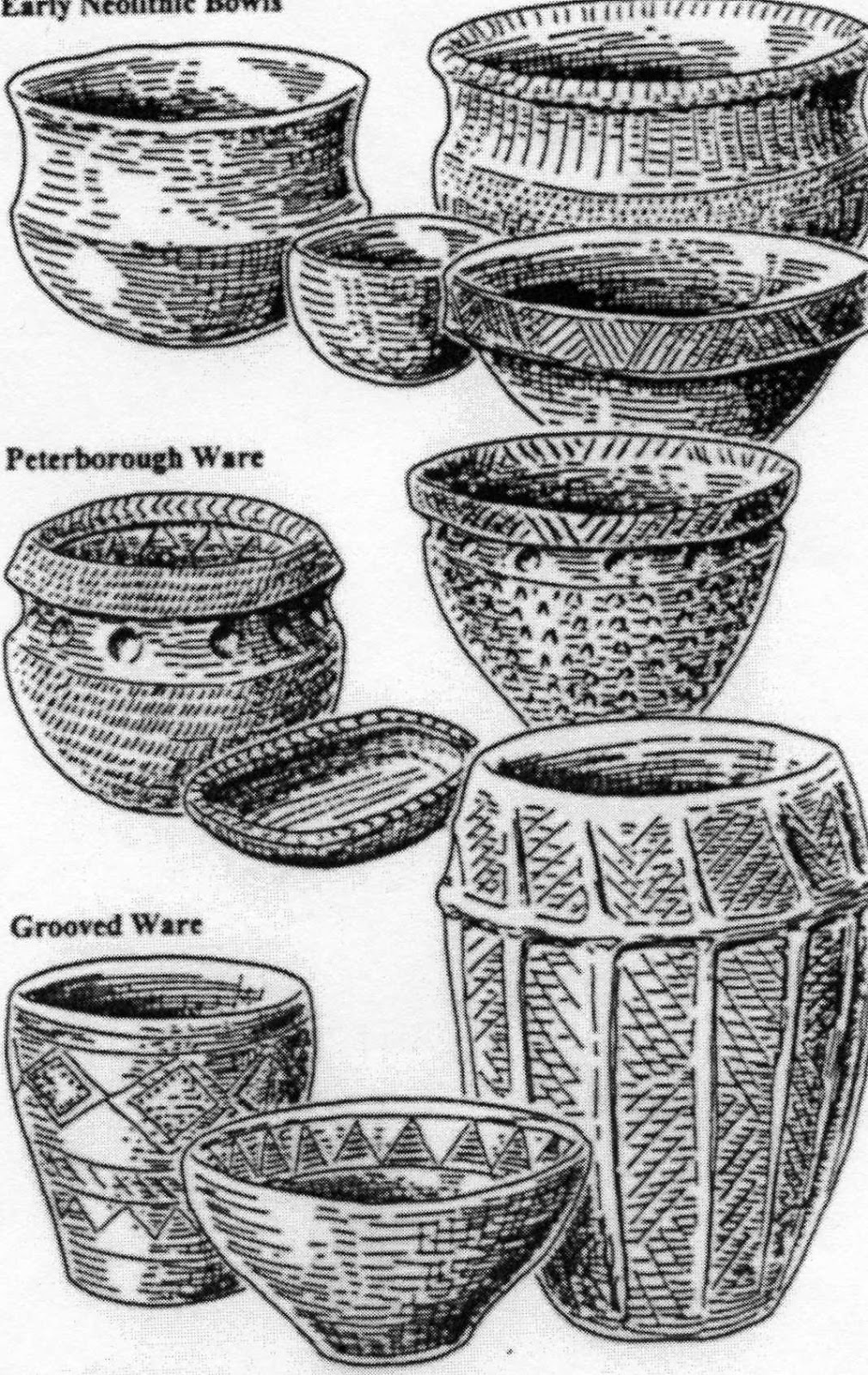
Here's one of Stuart Piggott's beautiful and classic drawings of British Neolithic pottery, showing what some of the Grooved Ware pots from the south coast probably looked like, based upon sherds found during excavations on the Essex coast, at Lion Point.


Pottery is frequently found during archaeological excavations. Archaeologists regard it as diagnostic. The discovery and identification of a sherd of pottery gives them a good clue about the date of the site. Neolithic and Bronze Age pottery was not glazed. It could have been waterproofed in several ways, by burnishing or by being sealed with fats, beeswax or milk.

a sherd of grooved ware
Pottery typologies are complex. It's an enormous area of archaeological study and I could not possibly go into every style and type of British Neolithic pottery in this blog. We would be here forever. There's Windmill Hill, Grimston-Lyles Hill Ware, Ronaldsway, Grooved Ware, Unstan Ware, Peterborough Ware, Ebbsfleet and so the list goes on. Most are round bottomed pots, with the exception of Grooved Ware. It took me many months to get to grips with these stylistic categorisations that have been imposed upon pottery of 5000 years ago.

Many bowl shaped pots are interpreted as 'cooking pots'. That seems fairly reasonable. What puzzles me is that whenever archaeologists find a very large pot, or the sherds of a large flat bottomed bucket shaped pot, it is almost always interpreted as a 'storage pot'. I have not yet come across a large pot from the British Neolithic that has been interpreted as a potential fermentation vessel, although some of them have a volume of several gallons and such large pots are often found at feasting sites, for example, at Durrington Walls, near Stonehenge.

If an earthenware pot is to be used to contain any liquid it must be waterproofed. We discovered, in our mashing and fermenting experiments, that beeswax worked very well as a sealant, as did butter and lard.

As a control experiment we tried fermenting mead in an untreated earthenware pot. The fermentation worked well, the room filled with the smell of mead, and the outside surface of the pot was covered in little beads of sticky sweetness. But the final product was disappointingly low in alcohol. It turns out that the alcohol diffuses through the porous pot much faster than the honey solution. This makes an untreated pot pretty useless for creating an alcoholic drink.

Here is a sample of some of the British Neolithic pottery types, as recorded by Stuart Piggott. You can see that there is a wide range of styles. Some have holes in the rim, to secure a covering or lid of, perhaps, leather. Some are deep, others are wide and shallow. I prefer to look at these pots with function in mind, rather than consider only their decoration and style.


Is there any archaeological evidence for the use of large pots for the fermentation or storage of barley wort? 
One of the very best indicators that a pot was used to ferment wort into ale, or for storing the ale, is the identification of beerstone on the internal surface. Beerstone precipitates out of a fermenting barley wort, it looks rather like eggshell. We have a lot of it accumulating on our plastic fermentation buckets and storage vessels.

It takes many hundreds of uses to accumulate a visible deposit of beerstone, but it is a certain proof of fermented wort. Brewers using plastic pipes in breweries often have to clean them of an accumulation of beerstone. It clogs the pipes.

Here is some beerstone from one of our fermentation vessels:


Beerstone has been identified on pots from a Bronze Age site in the Zagros mountains of modern day Iran. At excavations at Godin Tepe a great many pots and jars were discovered, they were stored in the University of Pennsylvania Museum. Subsequent analysis of a yellowish deposit on the internal surface of jars identified beerstone and it is generally accepted as unequivocal evidence for beer brewing. This pioneering paper by Badler, Michel and McGovern, published in 1993, tells the whole story and contains sufficient detail to be able to repeat the tests for beerstone on prehistoric pottery.

I wonder whether any archaeologists in the UK or Europe would consider looking for beerstone on big prehistoric pots? Maybe it is already being investigated. It would be great if this could happen, since this might end the apparent controversy about whether or not a big old pot was used for the fermentation of beer made from a barley wort.

-----------------------------------------------------

If you would like to make your own kveikering, here is some more information  and details of how to make one. Brewer Martin Warren of the Poppyland Brewery was so impressed by the idea that he made his own.

My conference paper from 1996 "Neolithic Ale: Barley as a source of sugars for fermentation" can be downloaded from my Academia page, here. 


Saturday, 26 April 2014

Beakers were for Beer! part three: alewives and barmaids

In the early years of my research, I visited a few microbreweries. I wanted to talk to professional brewers who made ale in the traditional way using crushed malt, not malt extract, and who worked on a small scale. This approach to brewing beer in small batches, supplying local pubs, hotels and restaurants, began to take off in the 1980s and 1990s. The interest in real ale in Britain began with CAMRA in 1971. Peter Brown does a good job in telling the story of the rise of craft beer UK style. Worth reading. Anyway, to get back to my story, one of the microbreweries I visited was a tiny establishment, equipped with one mash tun, one boiler and two fermenters. He used crushed malted barley, hops, water and yeast and made a wide variety of beers from these basic ingredients. As any good brewer does.

He was interested in the story of the Bronze Age woman buried in a stone cist at North Mains, Strathallan. She had been buried with a Food Vessel. The residue from a cereal based alcoholic brew, flavoured with meadowsweet, was discovered within it (see part one). We chatted about it in detail, and with some excitement, because I had only just found out about the residue analysis in the Strathallan pot myself. That evening, he went down to the pub and related the story to his mates. And why not? It's a good story. One of his mates was a journalist for the local paper. A couple of days later there was a headline "Bronze Age Barmaid" or "Prehistoric Barmaid discovered" or something along those lines. And my name was attached to it, almost as if I had discovered it. Many of the details were wrong. It was only a small piece in a local newspaper, but it seemed like sensational stuff at the time. Some folk at the University were not very pleased about it.

I had just had my first encounter with The Press, and with some of the silliness that seems to surround any news story about ancient alcoholic brews - beer, wine or mead. 

alewives and cup bearers 
Maybe that journalist was thinking along the right lines, although 'barmaid' is not quite the right word to use in a prehistoric context. There is a well established tradition of women as cup bearers, providing the drink at feasts.

Eva Koch, writing in 1986, gives several archaeological and historical examples of the woman as hostess, who would have held a high status position within society. In her article the woman with the drink she describes the grave at Juellinge of a woman, in her 30s, who was buried wearing her silver jewellery and hair ornaments. In the grave with her was some meat, either a whole sheep or pieces of pork and beef - archaeological sources vary. The bronze bucket had contained a drink brewed with barley and cranberries or crowberries and bog myrtle. There were drinking horns and glasses for her guests. The grave was excavated in 1909. 

A recent detailed analysis of these residues has led to the novel idea that the Juellinge vessel had contained 'nordic grog'. The media loved this story. There are variations of it all over the internet, but journalists don't always get all the details right. I don't agree with the concept of a 'nordic grog'. I think it is far more likely that the bucket contained an ale, or perhaps you could call it a barley wine, made from wort and flavoured with a few berries, flowers, herbs and maybe some honey. All the sugars that you need for fermentation can be obtained from the mash tun, as I explained in earlier posts.

There are many similarities between the Juellinge grave and the burial of the young woman, described by some as a dancing woman or priestess, at Egtved.
Egtved Girl tomb from bronze age- Denmark
reconstruction of the oak log coffin of the Egtved Girl. Bronze Age. 1370BC

She was buried wearing bronze jewellery and the bucket at her feet contained the remains of an ale or beer, flavoured with berries and perhaps honey. The bucket was made of birch bark and is too big for a drinking vessel. It is more suitable for serving or perhaps it was one of the vessels used in making the ale. One interpretation is that she was buried with ale for the journey into the afterlife, which is certainly possible. I can't help wondering whether she was buried with the tools of her trade - her brewing bucket.

And so we move on to Bronze Age Scotland and the cist grave excavated in 1979 - the one that the brewer was so interested in. The Bronze Age barmaid herself, buried with her Food Vessel. Could she have been a cup bearer, at feasts and ceremonies, perhaps? Maybe she was an alewife. Some might see her as a priestess or as one of the elite, a high status and important member of society. There are several possible interpretations of who this Bronze Age woman was and what her role in society could have been.

http://i.rcahms.gov.uk/canmore/l/SC00845100.jpg
female cist burial excavated in 1979 at Strathallan, North Mains, SC845100. (copyright Historic Scotland)
The specialist secrets, skills and knowledge of how to transform harvested grain into ale by malting, mashing, lautering, sparging and fermentation were as important then as they are now. Without them, there would be no ale or beer for the feast.

I'm sure that the tradition of the alewife, or brewster, goes right back to prehistoric times, to the earliest grain cultivators and processors, the neolithic folk. There are many different herbs and plants that have been used to flavour, preserve or enhance ale. Known today as gruit, some herbs have medicinal or hallucinogenic properties. Henbane pollen was identified in cereal based residues on sherds from large bucket shaped neolithic pottery known as Grooved Ware at a site called Balfarg in Scotland. More on this in the next post. This discovery extends the potential role of the alewife to that of a healer, maybe even more than that. Here's a link to a blog about the 'brewster as witch' by Jane Peyton, a sommelier and beer expert. Her article is a bit of an advert for a Ninkasi style women's brewing competition that took place in 2011. So, sadly, too late for me to make a brew for that. But she makes some interesting points.

I shall return to the 'magic of brewing' in a later post. It's a huge topic.

beakers, food vessels and tripartite urns - some brief notes
Welcome to the wonderful world of prehistoric pottery! It can be quite bewildering. Confusing to non archaeologists, at the very least. I have discovered this after many years of explaining (or trying to explain) prehistoric pottery classifications to tourists.

In a British Bronze Age context, there are beakers, collared urns, tripartite food vessels and funerary urns. Simply explained - beakers were drinking vessels. Food Vessels, otherwise known as tripartite food vessels, appear to have had no specific function, other than for 'food preparation'. This is how they are described in the archaeological literature.

Sometimes they are found in stone cists and they contained the cremated bone. Collared urns are larger vessels, also often found with cremated bone in burials. This is a blog. It is not an academic thesis. So I must apologise to all archaeological pottery specialists for the simplicity of these descriptions.

a few recent rather exciting discoveries of tripartite food vessels
In March 2012, the land owner of a disused quarry on the island of Arran, off the west coast of Scotland, noticed something interesting in the cliff face. It turned out to be not one, but two Bronze Age stone burial cists. One cist was empty and the other contained the remains of an adult human cremation in a tripartite food vessel and a flint knife.

A photo of a circular, sand-coloured Bronze Age pot against a black background
the food vessel
A photo of a large yellow digger on wheels carrying out work on a steep cliff face
an unusual excavation technique at Sannox Cliff, Arran


A radiocarbon date of 2154 - 2026 BC was obtained. The flint knife, when analysed, had traces of silica, indicating that it had been used to cut grasses or cereals. This is intriguing. Was this the cist grave of someone, probably a woman, whose work involved the gathering and the processing of wheat or barley? I think so. It's not the sort of thing that is found every day. Excavation techniques involved the use of a cherry picker. A news report with some great photos, is here. The excavation was undertaken by GUARD Archaeology, Glasgow and is available here.

In September 2011, in Spinningdale, by the Dornoch Firth in Sutherland, northern Scotland, the accidental discovery of a very well preserved Bronze Age female cist burial, with food vessel, occurred when someone was digging the hole for their new septic tank. Once again, it was excavated by the team at GUARD. Radiocarbon dates from the bone were 2051 -1911 BC and from the charcoal within the grave, dates of 2151-2018 BC were obtained. Inside the cist was female skeleton with a tripartite food vessel at her head.
She was between 35 and 50 years old and had been laid upon a sheepskin, or maybe she wore woollen clothing. It is not quite clear, but unusually, fragments of the wool had survived in the well sealed cist. The excavators thought she may have been an important woman, having been buried with such great care and attention. More details here.

The cist grave of another high status, important and wealthy Bronze Age woman was recently excavated near Windsor, England. Excavations at the Kingsmead Quarry, undertaken by Wessex Archaeology, were presented to the public in 2013. They have put a lot of their information online. It is a large, complex site that includes mesolithic, neolithic, bronze age, iron age, Romano British and medieval elements. The excavations were generously funded by CEMEX. The archaeologists have been digging up lots of really exciting stuff at Horton and you can read all about it on their web site.

Of particular interest is the female burial, dated to between 2500 and 2200 BC. She was at least 35 years old, according to bone evidence. She was buried wearing her necklace of gold, amber and black lignite beads. She may also have had a bracelet, since there were black lignite beads near her wrist. Some perforated amber beads or buttons indicate that she may have worn woolen clothing, with these valuable fasteners. By her side was a large drinking vessel, beaker style. Was this a serving vessel, rather than her personal beaker? It must be considered a possibility. It would be fantastic if a residue analysis could be done of the vessel fabric. I'm not sure, but I don't think this has yet been done.

We cannot be completely sure of her full role within society, whether she was a princess, queen, alewife or cup bearer. It is clear that she was a woman of some importance. More details about her here.

In the words of the site director, Gareth Chaffey, who has been excavating the site for seven years, " It is interesting to think who this woman was within her community. She was probably an important person in her society, perhaps holding some standing which gave her access to prestigious, rare and exotic items. She could have been a leader, a person with power and authority or possibly part of an elite family - perhaps a princess or a queen."


I shall leave the mysterious high status women of the Bronze Age, for now. I'm sure you will come to your own conclusions about them.


Site Director Gareth Chaffey, of Wessex Archaeology, who has been excavating the site for the last seven years, said: “It is interesting to think who this woman was within her community. She was probably an important person in her society, perhaps holding some standing which gave her access to prestigious, rare and exotic items. She could have been a leader, a person with power and authority, or possibly part of an elite family - perhaps a princess or queen.” - See more at: http://www.wessexarch.co.uk/blogs/news/2013/04/19/beaker-burial#sthash.uX7GzXBU.dpuf