Showing posts with label extract. Show all posts

Sunday, 28 December 2014

What is Wort - a brewer's perspective

Hope you had a grand Yule and that you enjoyed the midwinter celebrations. We wish you all the best and A Happy New Year for 2015. There has been a bit of a lull on ancient ale blogging in the last couple of months, however we aim to correct this in the New Year and get back to writing again.

This one is about the Wort. Graham wrote it several months ago. It would make a good response to a short article "Beverage with heritage" that we read over the holidays. It was published in the Christmas and New Year Edition of New Scientist magazine, the 'one minute interview' with Patrick McGovern, director of the Biomolecular Archaeology Project for Cuisine, Fermented Beverages and Health at the University of Pennsylvania Museum. The question is asked: how does ancient booze compare with the modern stuff? The answer includes that "they wanted to be sure they had enough sugar to get the fermentation going, so they took whatever they had that contained sugar and mixed them together."
.
This idea of 'mushing loads of random sweet stuff together to make alcohol in prehistory' seems to be a commonly held view amongst non brewers. Merryn wrote a blog about desperately seeking sugars a few months ago, which tried to address the issue and dispel this myth.

Here is Graham's perspective, a beer brewer's explanation of what wort is:


Wort (pronounced wirt, not wart ) is the Juice of the Barley, well not quite, but almost very nearly so. It is a thin, runny, very sweet but very sticky liquid, straw coloured through to brown. It is effectively a thin synthetic honey substitute. Ale made from wort without preservatives or flavouring actually tastes a lot like mead made from honey.

Wort is the liquid sugars extracted from malt, that is to say, partially germinated cereal grains - barley, wheat of all varieties, oats and even millet, but not rice or maize. It is the primary source of fermentable sugars in making ale or beer and always has been. It is relatively easy to make a sugar solution of at least 10% from malt, and then to wash further sugars from the grain down to a realistic level of 1-2%,  "small beer" level and, of course, anywhere in-between. This compares very favourably with other natural sources of sugar like birch sap, which is between 0.5 and 2% sugar, which would only make a small beer. So adding birch sap to a brew would only dilute it, not strengthen it as some scholars claim.

Wort is made by "hijacking" some of the natural processes of the grain's life cycle.

As part of the growing process the germinating grain must convert it's energy store, starch, into sugars so that these can then be built into cellulose, the structural skeleton of the roots and shoots. This requires the liberation of the two amylitic enzymes, alpha and beta, which are little like ptyalase, the enzyme in saliva that converts starches into sugars.

If this growing (germination) process is halted when the most enzymes are present and little of the growing structure has started, it will be good malt.

So, to make wort you lightly crush the malt and mix it with hot water at about 65 degrees Centigrade. Keep it at this temperature for anywhere between half hour to about 2 hours, depending on your style. This is called mashing. Then you drain the clear liquid sugars from this mash by lautering, which is yet another story. This gives you a strong wort. Then you can wash further sugars from this mash, sparging, to get a weaker wort.

Brewers measure the potential sugar and therefore alcohol of a wort using "specific gravity". Water is 1000. David Line in his book "The Big Book of Brewing" explains this in great detail in chapter 18.

This was my "Bible" when when I first began brewing beer 32 years ago. David Line was a pioneer in his time, explaining what the processes were, how they were done and why. He also explains different methods of mashing using simple equipment and this has been very valuable to me in re-creating the ancient and traditional crafts of brewing ale.

So to recap: wort is a golden brown, very sweet, very sticky, runny liquid that contains most of the potential sugars from the malt. It can be made to a variety of strengths e.g. Arctic Ale.

To illustrate this I will give you the results of one of my recent brews.

The recipe is loosely based on David Line's "Brewing Beers Like Those You Buy" page 88, Gales HSB. One of my favourite beers, sadly no longer made. I found his book to be an excellent collection of recipes for good Ales and Beers that could be bought in the late 1970s and 80s. Large brewery's methods have changed since then and sadly many of the modern renditions taste nothing like they used to.

15lb 8oz of crushed pale malt, Munton's Perl Blend, were mashed with 5 gallons of water, inside a grain bag, in a Peco Electrim mash-tun. The strike temperature was 70 degrees Centigrade and as the grain was added slowly, the temperature fell to about 60 degrees Centigrade, and was then raised back to 65 degrees Centigrade.

The mash tun was unplugged and covered with a sleeping bag to maintain the mash temperature. It was left like this for 2 hours.

From this I lautered 3.5 gals of wort which was nearly 1080OG.
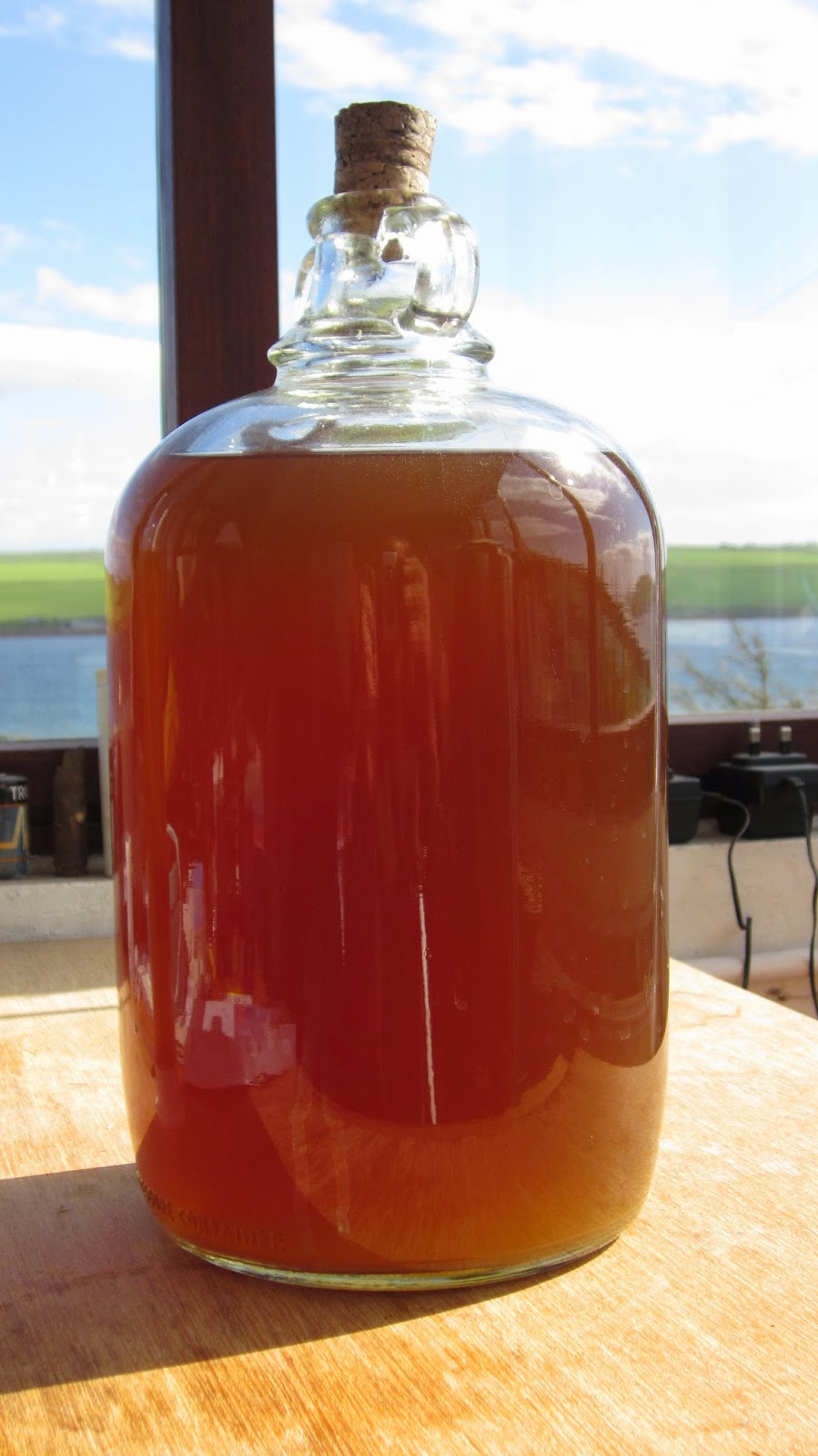
wort: the first running
measuring the first running


This was followed by sparging. The first gallon of wort was 1062OG, the second 1048OG, and these, together with the 3.5 gallons, were boiled in an Buffalo 40 litre boiler with 1lb of dark soft brown sugar, and 4oz of molasses (these are the in the recipe and I think the molasses adds a certain something to the flavour) for one and a half hours. This produced 5 gallons of 1084OG. This was fermented in two fermenters.


A further 5 gallons of wort were sparged of 1036OG, 1020OG, 1012OG, 1006OG (this was very pale and weak) and finally 1014OG left to drain overnight. This was again boiled on the old hops, because there is an awful lot of sugars left on the hops. This gave 5 gallons of 1024OG, which was added to the two fermenters. At the end of primary fermentation this gave 10 gallons of 1008 final gravity.

The average of 1084 and 1024 gives an OG of 1054 for the 10 gallons. According to David Line's graph (on page 147 Big Book of Brewing) gives a strength of 7.5-1.1= 6.4% alcohol.

This was quite a surprise to me, for I haven't been measuring the gravities for some time, and I never expected to get this much beer from 15.5lbs of malt.

A recent comparison with a commercial beer, Scapa Special 4.6%, suggests that my beer was no stronger, so maybe there is something wrong with my figures.

But it did make me think that I may be over-sparging my wort and that this could be contributing to the haze, and tannin like bitterness. So I have increased the malt to 17lb 8oz, and now I am getting a much nicer beer.

For those of you who will never meet malt, or a mash tun there is an alternative. Go to a whole food shop and buy one of these.
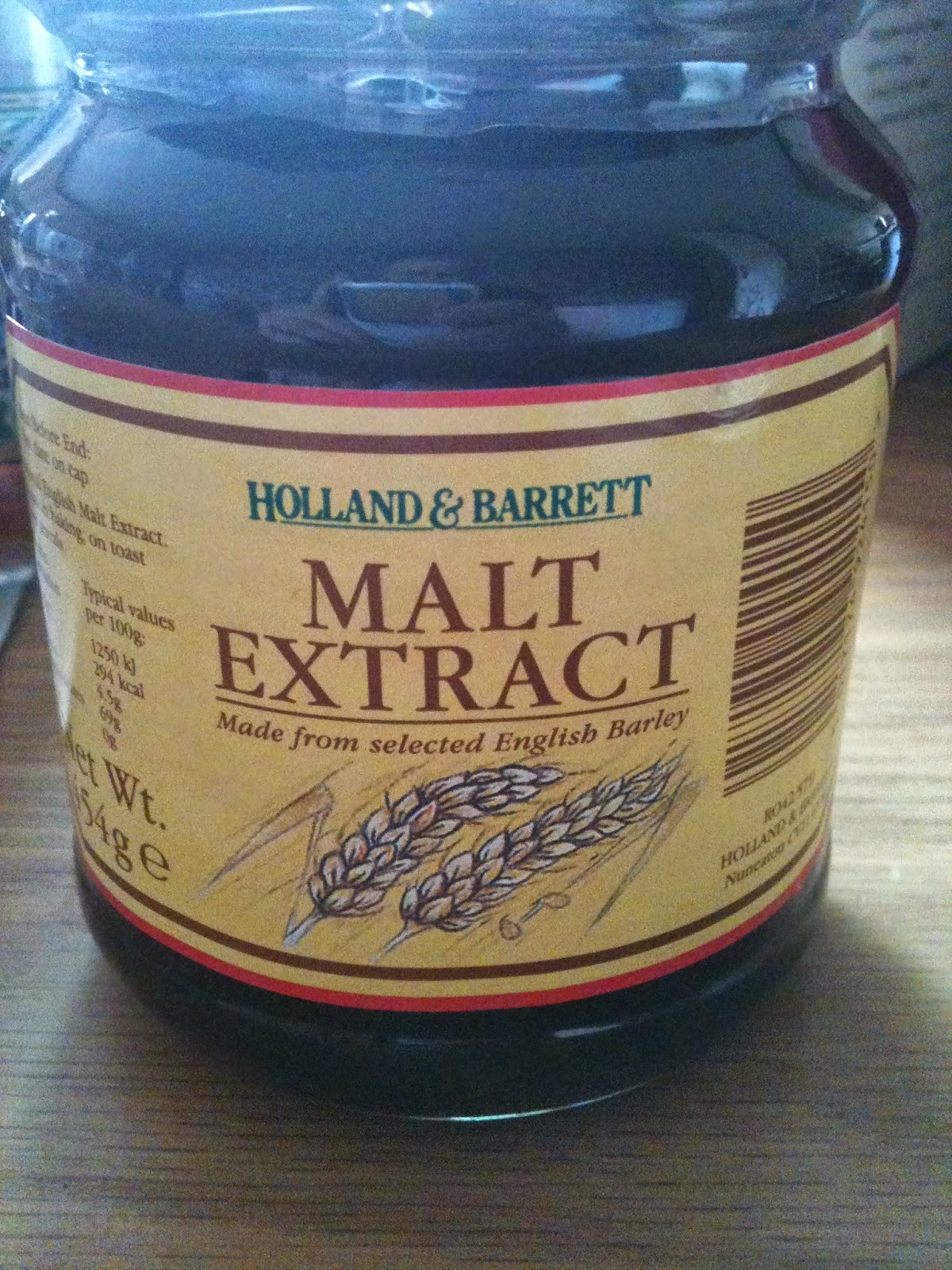

As best as I can estimate, this jar contains 11 fl oz of malt extract weighing 16oz, so this makes a density, specific gravity, or OG of 1450 or so. Dilute this with 4 imperial pints of water and you will have a re-hydrated wort of about OG1054.

Wort is a brown, runny, very sweet liquid that is extremely sticky when it dries. It could be described as a kind of dilute synthetic honey, that is very ancient in origin and is possibly the first process that was ever made with cereals. It could be that cereals were first cultivated, not for their staple qualities e.g. flour, gruel or bread, but instead for their status potential, sugars.

Many of the early settlements in the Fertile Crescent had special buildings with smooth floors, made of beaten earth, clay or lime plaster which are ideal as malting floors. All that is then required are containers within which to heat the crushed malt and water (the mash) to make a sweet wort. Merryn's M. Phil, entitled Barley Malt & Ale in the Neolithic (1999), looks at this, and the archaeological evidence for it, in some detail. One particular site, Beidha, was excavated in the late 1950s by Diana Kirkbride, a member of Robert Braidwood's team. She describes a smooth plaster floor with 'thousands of grain impressions'. This is probably a malting floor. The site is dated to the 8th millennium BC.

There is a Biblical expression: "The land flowing with milk and honey". Some Biblical scholars have made tortuous explanations to explain this phrase - they write about how wild bees' nests in cracks in the rocks would ooze honey in the hot sun. More informed scholars explain that this phrase refers not to bee honey, but rather to some kind of artificial sweetness, perhaps made from figs or dates, or maybe even made from grapes.

This must be because these scholars do not recognise nor do they understand that cereals can be a source of sweetness, if processed correctly.

I think that this phrase 'land of milk and honey' refers to milk and wort. It is a metaphor, or a description of a land that is good for both cows and for growing grain.

It seems that Biblical scholars have overlooked the fact that wort (liquid sugars made from the grain) was once commonplace in Egypt and Sumeria, otherwise they would not have been able to make beer. This was probably common throughout the whole Fertile Crescent and the Biblical Israel.

With the rise of Islam in this area, alcohol has been proscribed. There is no further use for malt or wort, so the practices and knowledge of malting and mashing have died out completely there. Archaeobotanists and archaeologists who have done field work on cereals in Turkey and the Ancient Near East seem to be unaware of the malting, the mashing and the wort. It is outside their experience and so it is understandable that wort has been overlooked in archaeological interpretation.

Today Bouza is made, it can be described as a type of beer, however it is a wheat based beverage made by lactic fermention. It is no longer alcoholic.

So, why do I bother to go to all the trouble of mashing, lautering, sparging, boiling and all that washing of brewing equipment? After all, it takes a whole day, a huge amount of effort. The answer is that all of the Beer Kits that I have ever used produce a beer with a kind of metallic flavour. The Kit contains a large can of Malt Extract. No amount of boiling with extra hops, or anything else will make it taste any better.

I make my beer with the simple, basic ingredients. I use traditional techniques to make the wort because I think it makes a better tasting beer. At least, when everything goes to plan, it tastes good. Even when it's bad it is often not much worse than some of the bad commercial beer available in supermarkets.

Beer is changing, with the way it is made. Some commercial beers, in cans, bottles and on draught have this unpleasant metallic flavour. They have been made from malt extract.

I was disturbed recently by looking carefully at the contents lists of commercial beers. Some like Scapa Special say that they are made from "maris otter pale ale malt", or others "a blend of pale and roasted malts". I know these are made "from the grain" and not with malt extract.

Some lagers and stouts are labeled as containing barley, wheat and oats, with no mention at all of the malt.  I can't help but wonder if they have been made from syrups, much like the high fructose corn syrup so popular in the processed food industry. This could explain the uniform blandness of some of these cheaper beers.

Wednesday, 4 June 2014

malt is a confusing thing

It seems that malt is a very confusing thing. The word 'malt' means different things to different people. Some people immediately think of malt whisky - a single malt or maybe blended malts. Others might think of a malted milky bedtime drink, like Horlicks. Other brands are, of course, available.

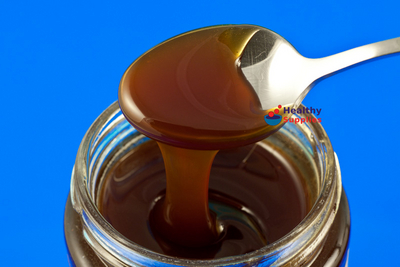
a sticky sweet spoonful of malt extract (photo: healthysupplies.co.uk)
a modern product
Or is it that sticky, viscous, sweet, dark brown syrup like stuff that you get in a tin in your beer kit? The stuff that you mix with water and boil? No, that is malt extract.

Malt extract is considered to be very good for you - it's an added ingredient in many breakfast cereals. When I do demonstrations, I always take a jar of malt extract for people to taste. They are reminded of their childhood, and of eating a spoonful every day, for the B Vitamins.

Malt extract is made by boiling wort in a vacuum and the technique was only discovered in the late 19th Century AD. Oh, and there is malt vinegar as well. And malt loaves. Many brewers use a liquid or a dry malt extract. Known as LME and DME, it's a main ingredient of beer kits in the 21st Century. Malt extract is also important to the modern food processing industry, particularly so in the USA it seems.

Prohibition forced maltsters to think of a different way to process and sell their malt, other than as alcoholic drinks, like beer and whisky. Prohibition was the death knell to many American breweries in the 1920s.

It's no wonder that so many people are confused about malt.

malt whisky. nice but not neolithic
I had a conversation about the archaeological evidence for malt with a fellow tour guide a few months ago. I thought we had a strange exchange of views, but it was only when they turned to go and mentioned that they were very surprised that the neolithic folk knew all about distillation. Did they use the pots for distilling? I realised that they thought I was talking about malt whisky manufacture in the neolithic. For this person, the word 'malt' meant whisky and nothing else.
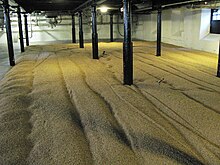
malt on a traditional malting floor

For me, 'malt' means partly germinated grain which has been carefully dried for further processing by brewers and/or distillers. It is traditionally made on the malting floor. The grain has been steeped and aerated, then it is spread out on the floor in a cool, dark, well ventilated building to begin to grow. Once the rootlet and shoot begin to show, it is gently dried in a kiln. We had been talking about two very different things. As part of writing this blog, I checked the  Encyclopedia Britannica for its' descriptions of what malt is, how it is made and what it is used for.

Much of the detail is correct, but there are a few salient details omitted. For example, there is no mention of the air rests that are an essential part of the steeping process. If you just leave the grain to soak or steep without air rests, then the grain will be killed. It will, effectively, drown. Ancient and traditional techniques include leaving the grain in a bag in a shallow stream. This provides the essential oxygen and water for the germination process to begin. Modern methods use huge steep tanks. 

Grain needs both water and oxygen to begin germination. If the steep is not aerated, then it will not take long for the water and grain to smell horrible and for the grain to be bad. It will not begin to germinate, you will not have any enzymes to convert starch into sugars and you will not be able to make ale. Or beer. Or whisky.

In the first stages of germination of any grain - wheat, barley, oats or rye - the enzymes necessary for the conversion of starch into sugars are liberated, and then the growth begins. If this continues, starches are used up, so it is important to stop the growth as soon as the shoot and root appear amongst most of the grains. This is usually when the acrospire (rootlet and shoot) are one third the length of the grain.

Often, descriptions in the archaeological and anthropological scholarly literature of how to make malt are not accurate. Some describe malt as 'toasted barley sprouts'. Anyone who says that malt is like toasted, sprouted barley, suggesting that it is something like dried bean sprouts, have obviously never handled proper malt.

It is very important to talk to a maltster to understand how to make malt, to ask the practitioners, the skilled people who make it. Craftsmanship not scholarship.

Graham brings a 25 kilo sack of crushed malt from the brewing suppliers into the house. Then he makes beer with it, using basic equipment - a mash tun, a boiler and fermenters. Lots of people have tried Graham's home brewed beer and it is considered to be top quality, good and tasty.

What is this crushed malt in the sack?

Where does it come from, who makes it and how?

As I was doing the mashing experiments in the garden, using beeswax sealed earthenware bowls as mini mash tuns, I became more and more interested in the malt and how it was made. I studied the science of grain germination physiology, learning about what happens inside the grain as it begins to grow. It is fascinating and complex, worthy of a blog post of its' own.


this post was co written by Graham and Merryn

Tuesday, 11 February 2014

crushed malt v malt extract

Making your own beer at home is becoming a popular hobby. On the internet there are thousands of videos, web pages and blogs about beer and how to make beer. They vary from the basic through to complex, jargon filled technical descriptions. There are some funny ones too. And quite a lot of strange stuff. If you are interested, just search for a few choice phrases around the basic question of 'how to make home brewed beer' and you will find plenty to choose from. I have put a couple of my favourite web sites and books at the end of this blog.

It can be confusing, with extract brewing, extract brewing (with grain) and all-grain brewing, not to mention the many different styles of beer and ale that can be made. Home brewers often tend to have their own, sometimes idiosyncratic ways of beer brewing. However, it is all based upon the same basic principle - that grain can be easily converted into ale by the processes of malting, mashing and fermentation. Maltsters and brewers have been doing this for thousands of years.

I aim to demystify the whole beer brewing process through this blog, and also to share some of our adventures with making ancient style ales.

Here is our Juniper Yule Ale, just as it is beginning to ferment. We had made 6 gallons of wort and the big plastic fermentation bucket was very full. When the ferment took off it was so vigorous that there was not enough headroom in the fermenter. So we siphoned a gallon of wort into this demijohn and put an airlock on when it settled down. No sugar was added to this wort - it all came from the crushed malt in the mash tun.

our ancient ale, bubbling away in the kitchen ... magic.

There are two main ways to make beer at home. Use a brewing kit with malt extract, or go for the all grain brew. We don't use malt extract, although it is possible to make really good beer with it. We just prefer the flavour of all grain ale, and think that it is well worth the extra effort of making your own wort, then fermenting it. Traditional ingredients and techniques provide authentic flavours for ancient ales.

Crushed malt is the traditional ingredient for ale and beer. Any grain can be malted - wheat, barley, oats, millet and rye. Today, a bewildering variety of malts are available to the brewer and for every brew there is a grain bill. Also known as the 'mash ingredients' or the 'mash bill' by some brewers, it is the particular and specific mixture of crushed malts in the mash tun that create the colour, flavour and body of the resulting ale. The grain bill depends what you are brewing - bitter, porter, pale ale or stout for example.

For our juniper ale, we mashed 15 pounds of pale crushed malt as the base malt, together with eight ounces of crystal malt and eight ounces of roasted barley for colour and flavour. From this, we got 6 gallons of wort that was boiled with a few hops and a couple of ounces of crushed juniper berries and then fermented into ale.


It is important to crush the malt before putting it into the mash tun because this mixes up the grain starch with the enzymes that were activated during the malting process. Those breweries who use malt tend to buy their malt as whole grains, because it stores better, then they crush it in a grain mill before mashing. Crushed malt is also known as 'grist' and the photo shows some of the pale crushed malt that we use. You can see the grain husks.

Malt extract is thick and sweet, like syrup. It is widely used in the food processing industry. You probably eat some most days, since it can be found in cereals, sweets, ice cream, cakes and many other processed foods.

sweet sticky malt extract


Today many home brewers and some of the big brewing companies use concentrated malt extract to make their ale and beer. There is no need for a mash tun. All you need are boilers and fermentation vessels. The mashing has been done for you, in the factory. Grain processing companies mash huge amounts of crushed malt, extract the wort and then concentrate it, by boiling it in a partial vacuum, to keep the temperature down.

It is a food processing technique that was patented in the 1860s and was first used to make condensed milk. It was not long before the vacuum extraction method was used to make wort concentrate and it is now a powerful industry, with factories all over the world. Over the past ten to fifteen years, the number of breweries using malt extract instead of malt has increased. Given that it is concentrated wort and that it has been made on an industrial scale using equipment, techniques and technologies that have only been available since the late 19th Century, it is debatable whether or not malt extract is a suitable ingredient if you want to re create an authentic ancient ale. In Brew Your Own magazine, May/June 2008, there is a detailed description of how to make malt extract. A shorter description can be found here

I was looking for a video that would show how extract brewing works. There are hundreds, if not thousands of them. I chose this one. In September 2012, the news story broke that President Obama wanted beer to be brewed in the White House. They chose the malt extract method. The recipe included a small amount of specialist malts for flavour, but the main ingredients were liquid malt extract and dried malt extract, with some special White House honey and pelleted hops. This seems to be the way that many people make beer at home. But not everyone.

There are a lot of home brewers who still use malted grain. There are even some who make the malt themselves and crush it before putting it into their mash tun. There are others who want to make ales using traditional gruit herbs instead of hops, which were introduced in medieval times ... but more of gruit ales and traditional floor malting later. That is another story. For now, I just wanted to write a little about the difference between extract brewing and all grain brewing. And I think I have done that.


*********************************************************************

If you are interested in reading more ...

... our favourite brewing book is The Big Book of Brewing by David Line.
First published in the 1970s, it is still in print. Excellent explanations of how to mash at home and it has very good, clear instructions and recipes. He wrote another book Brewing Beers Like Those You Buy. Also an excellent set of recipes for all grain brewing. I am not sure that all of the breweries that made those beers and ales still exist. The brewing industry has changed a lot since then.

... our favourite brewing history book is Beer: The Story of the Pint by Martyn Cornell.
This book covers the prehistory and the history of beer brewing. I think it is out of print but available secondhand, or from your local library. Another fascinating read by the same author is Amber Gold and Black, a history of beer styles. Available from here: zythophile

This is a very detailed site that explains everything you might want ever to know about making malt, ale and beer: http://www.howtobrew.com

Here is a site that discusses the 'extract or grain' debate:
http://www.maltproducts.com/news.malt.extract.html