Showing posts with label malting floor. Show all posts

Wednesday, 12 October 2016

a morning with maltsters, part four

Making Malt: in the final presentation we were taken from ancient times and traditional floor malting into the present day, where modern germinating kilning vessels can make up to 500 tons of malt at a time, in a continuous batching process.

Most of the malt made in Britain is used in the brewing and distilling industries, with roughly 500,000 tons of malt each year being used by commercial brewers and 800,000 tons going to the distilleries. There are around twenty million casks of whisky maturing in the 115 distilleries around the UK. Our third speaker, Eric Walker, was a man with lots of experience in every aspect of the malting, brewing and distilling industries. He began with a quick look at making malt in the distant past, pointing out that malt has been important for a very long time.

Its' origins are lost in the mists of time.

There's a story that ancient Egyptians, around 3000 years ago, may have made their malt by putting grain into baskets, then lowering the basket into a deep well. The basket could be raised and lowered, effectively steeping the grain. It would germinate in the basket and was shaken at regular intervals to prevent the rootlets from matting. Green malt was dried in the sun. The method is described in detail here on the Briess Malt web page. I'm not so sure this was an efficient way to make large amounts of malt for brewing. Perhaps enough could be made for small scale brewing.

It would be interesting to do some experimental and practical work, to assess the validity of the idea that malt can be made in a well, using a basket. I wondered how much malt could have been made in this way. There would not be enough to supply large vats like those at Hierakonopolis, a predynastic site in Egypt, which were probably used as mash tuns.

Beer was being made here in industrial quantities.

The vats, probably mash tuns, at Hierakonopolis, Egypt. Source here
The Egyptians must have used floors for germinating the barley. A malting floor is not an obvious thing to identify in the archaeological record. All that's required is a smooth level floor surface within a building. It's something that has been overlooked in the interpretation of archaeological sites. Archaeologists don't often interpret the remains of a building as having possibly been a grain barn or a floor surface as having been being suitable for making malt.

Eric talked about malting floors and the potential evidence for the manufacture of ale in prehistory. I was rather pleased that, on his next slide, he showed some of the evidence for the making of malt and ale in Neolithic Britain. That's my research.

There is good evidence for the manufacture of malt and ale at some of the Orcadian neolithic sites, such as Skara Brae and Barnhouse, six thousand years ago. At Skara Brae there were sherds from a large 30 gallon pot found beside the central hearth. Excavated by Vere Gordon Childe in the 1930s, no residue analysis was done on these pot sherds. Its' location would be an ideal spot for a fermenting barley wort. At the site of Barnhouse, another neolithic village, there was a possible malting floor as well as many drains which are essential for a brewer. Analysis of pot sherds using the technique of Gas Chromatography/Mass Spectrometry revealed "unidentified sugars and barley lipids" in the fabric of the pottery. It's a possible indication of sparging. If they were sparging to obtain a wort then they must have been making malt and ale. 

If you want to read more about neolithic and bronze age evidence, I suggest you have a look here at an article we wrote for Orkneyjar a few years ago. It's about the prehistoric transformation of grain into ale. You'll also find links to my published academic papers and to my thesis. I know of no other archaeologists who are working on the archaeological evidence for the manufacture of barley malt and ale in the neolithic. It seems to be considered a controversial topic by some academics, or so I am told. That's why I was pleased to see my work referred to at this malting seminar. Clearly the professional maltsters, brewers and distillers have no problem with the idea.

Eric described how floor malting is labour intensive, requiring skilled and dedicated people. It was the only way of making malt until the mid 19th century. The malt must be turned and raked on the floor, as well as being moved around the maltings from steep tank to germination floor, and from there to the kiln floor. It takes many workers to make the malt.

Modern pneumatic maltings changed all of this.

Two Belgian malting engineers, Galland and Saladin, are considered to be the fathers of modern pneumatic malting. In 1873 Galland designed a system of aerated rectangular boxes. A few years later, in 1880, Saladin introduced a mechanised turning system. The new integrated system of aeration and mechanical turning of the malt by Archimedes screws was called
a saladin box.

A few Saladin boxes are in use today, this one is at Tamdu Distillery
, source here

The workers who turned the malt cannot have been happy about this. For many, it meant the loss of their job. It was, in so many ways, a revolution in the malting industry, although it took several decades, until the 1960s, before Saladin boxes became commonplace in a maltings.

The technology of making malt developed rapidly. By the early 1970s, Saladin drums were being made and used. These are far larger and capable of producing thirty to fifty tonnes of malt at a time, in a continuous batching process. They can be operated all year round, in contrast to a traditional floor maltings that were subject to weather and temperature (see previous post). Much less manpower is needed, there is a lower cost of production. They consistently produce good quality malt in the quantity that is required today in the modern brewing and distilling business.

Germinating Kilning Vessel at Crisp's Maltings, source here

Germinating Kilning Vessels, can make up to 500 tons of malt at a time. I've not yet seen a large industrial maltings and have never looked inside one of these Germinating Kilning Vessels, but here's a man who has. Jeff Evans, on his blog inside beer, describes the experience:

"I climbed the stairs of one of these enormous, modern cylindrical towers to discover vast stainless-steel steeping tanks, malting floors and kilns. Having seen the simple, homely methods of the floor maltings, the scale and functionality came as a shock. Each of the tanks handles more than ten times the amount the entire floor malting facility can process in one go. 

At the push of a few buttons, the process gets underway – steeping, germination, kilning. Such are the efficiencies that germination is a day shorter here, and kilning only takes two days. The equipment is also much easier to clean, so you can see why new technology has its supporters in the industry. 

Once malted, the grains are quickly shipped out to breweries or malt merchants. Crisp’s job is done. The brewer will ultimately claim the credit for his wonderful beer, but, as the old saying puts it, you can’t make a silk purse out of a sow’s ear. There’s a lot of skill and care that goes into that drink even before the brewer starts his work. 

The next time you are entranced by a hoppy aroma as you raise a pint to your lips, stop, wait and think. Look beyond the green, tangy, zesty glory boys that steal the limelight and remember the malt and the maltster, the forgotten heroes of brewing."

In his final remarks about malt and malting techniques, Eric Walker reminded us of some of the fundamental principles.

Malt is a living thing. If it is not correctly steeped it can either drown or asphyxiate. It needs careful handling. The maltsters who make malt in these large vessels take as much care of it as the traditional floor maltster, there's a whole new set of skills and knowledge involved in the craft of making huge batches of good quality malt. The maltster's rub, whereby the maltster judges when it is ready for kilning, still applies. Ancient skills and knowledge are combined with modern technology.

Malting, he said

"is a process utilised by the ancients to produce palatable alcoholic beverages: ale and beer."

I couldn't agree more.

===============================
PS In one of my earlier blogs I've asked:  where have all the malting floors gone?

Tuesday, 20 January 2015

thousands of grain impressions in a burnt plaster floor

Sometimes, a single sentence in an excavation report can be the beginning of research that sparks your curiosity and makes you ask questions. For me, it was a few words and a brief, enigmatic description that I read in an excavation report several years ago, in the late 1990s, when I began my research into ancient grain processing techniques and the neolithic revolution.

The site was Beidha, a small neolithic village in the Jordan Valley. Here, in the 7th Millennium BC, people began to settle down, grow grain and keep domestic animals - cows, pigs, sheep and goats. Although they were still hunting and gathering, they were beginning to process the crops they grew, which included cereals and lentils. The earliest agriculturalists. Today, when you search for the neolithic village of Beidha on the internet you will find lots of information about it. This is, to some extent, thanks to a project established in 2010, to protect and promote the site. Beidha is an ancient place, now open to the public. It is not far from Petra, in Jordan, and is part of the World Heritage Site. Definitely on my list of places to go.

The village appeared to have burned down, nobody knows how or why. Diana Kirkbride excavated the site in the 1950s and 1960s as part of a larger project to investigate the early agriculturalists of the Ancient Near East, organised by Robert Braidwood of the Oriental Institute of Chicago. In her report, she described the remains and the contents of one of the rectangular mud brick buildings in the village of Beidha. As well as a lime plaster floor, facilities and equipment suitable for grain agriculture and processing were found, specifically, hoes, sickles and quern stones. There were also large stone bowls and the remains of baskets that appear to have been waterproofed. The baskets had been lined with either bitumen or lime plaster.

She thought that the building may have burnt down, somehow leaving behind the evidence of the presence of grain on the floor, which she described as

 “... tens of thousands of grain impressions in the burnt plaster floor ...”
Kirkbride, D. 1968 ‘Beidha: early neolithic village life south of the Dead Sea’ Antiquity XLII, 263

This is an intriguing description.

At the time that I was studying the Beidha excavation report, Graham and I had recently returned from Orkney where, at the Corrigall Farm Museum, we had our first lesson in the techniques and traditions of floor malting. The curator, Mr Harry Flett, had explained to us how the grain must be steeped in water, then turned out onto a smooth floor in a barn to begin germination. Malt is partially germinated grain. When growth is obvious, that is, when the root and shoot begin to show, the malt is carefully dried. Then it can be used for making wort and brewing ale.

I had been reading excavation reports from neolithic sites in the British Isles and northern Europe, where floor surfaces of buildings are rarely preserved. The floors of the long houses and other buildings of the Linearbandkeramik Culture were destroyed by modern deep ploughing. In the British Isles, I had only come across one description of a deliberately made beaten earth floor in a neolithic building. This was in one of the rectangular timber buildings at Lough Gur, in Ireland, a site excavated in the early 1950s by Sean O'Riordain and published in the Proceedings of the Royal Irish Academy.

It was great news to me that some floor surfaces of buildings from early neolithic cultures in the ancient Near East had been so well preserved. I began to read more excavation reports, to see what else had been discovered. Although I have yet to find another description of grain impressions in association with an early neolithic lime plaster floor from that part of the world, I did find plenty of detailed descriptions of floors made of beaten earth, stamped clay and lime plaster. Some of them were painted, and there was very little discussion of their function or purpose.

The function of floors is a subject not often discussed in excavation reports. Floors are important. They are a crucial facility for making malt. And, as many people know, it's the malting that interests me most. When was it discovered? How? Who were the first maltsters? How has malting technology changed and developed over the millennia? What is the archaeological evidence for malt? What role did malting play in the development of grain agriculture and the neolithic revolution? 

the neolithic revolution in the Fertile Crescent

The practice of grain cultivation, agriculture and grain processing as well as animal husbandry and the domestication of cattle, sheep, goats and pigs are defining features of the neolithic way of life.

Archaeologists agree on this definition, although there is much disagreement among the academics about why people "became farmers". It is one of the biggest questions in academic archaeology - why did people begin to cultivate and process wild grains in the Ancient Near East and Levant? What were they making with the grain? These were some of the questions that Braidwood's team of archaeologists, anthropologists and archaeobotanists and had set out to answer in the 1950s. Was it bread or beer?

The debate was reawakened in the 1980s by Solomon Katz and Mary Voigt, when they published their paper "Bread or Beer: the early use of cereals in the human diet". They suggested that making malt was an important part of the story. Hunting and gathering were, of course, still important ways of food acquisition. Wheat and barley grew as wild plants in this region. People began to gather and process them long before they started to cultivate them deliberately and settle down in villages to tend their crops and look after their sheep, goats, pigs and cattle.

Grain cultivation and processing began in the Near East and Levant around ten to twelve thousand years ago. This new way of life spread across Europe and reached the British Isles around six thousand years ago.

mud, clay & lime plaster floors in the neolithic of the Fertile Crescent

A common feature of many early neolithic sites in the Fertile Crescent are the deliberately made, smooth, level floors made of mud, clay or lime plaster. Mud or clay floors may have been relatively easy to make. The lime plaster floors, some of them apparently polished, would have involved a particularly complex technology in their manufacture, as well as considerable human effort and co-operation in their construction. The Natufians, these first agriculturalists of the Fertile Crescent, were using lime plaster for a wide range of uses - to make walls, floors, statues, as well as so called 'white ware' vessels, the precursor to pottery made from clay. The use of lime plaster in the early neolithic of the Fertile Crescent is a huge area for research and investigation.

To make lime plaster, large quantities of chalk had to be collected, then burnt at 850 degrees Centigrade to make the quicklime. Water would have been added to make the slaked lime which can then be used to make the floor. They must be laid and levelled very quickly and would have been similar in appearance to a modern concrete floor.

Polished lime plaster floors were found in a rectangular building at Gobekli Tepe, in the layers of this enigmatic settlement or temple dated to the seventh and eighth millennia BC, the era of the pre pottery neolithic. Gobekli Tepe was excavated by Professor Klaus Schmidt of the German Archaeological Institute over many seasons. The earliest levels have been dated to the epi-palaeolithic, around the tenth millennium BC. The team excavating this site interpreted it as having been a place of feasting and cult activity.

Another interesting and large rectangular building of the seventh millennium BC was excavated at the early neolithic village of Yiftahel, lower Galilee. Inside one of the buildings there was a lime plaster floor measuring 110 square metres and 3-6 cm thick. It would have required some seven tons of lime plaster. At the time of excavation, it was the largest rectangular mud brick building of the period in the Levant. Details of the lime plaster, what it was and how it was made can be found here in a paper published in the Journal Palaeorient in 1991.

File:Yiftahel structure with plastered floor1.jpg
remains of a lime plaster floor at Yiftahel: the production of lime plaster was on an industrial scale. see here


bins, pestles, mortars & earth floors at Ain Mallaha see here
At Ain Mallaha there are the remains of an early neolithic settlement. It is situated by Lake Huleh in the upper Jordan valley and was inhabited between 10,000 and 8200 BC. The floors within the buildings apparently gave the impression of having been deliberately made by accumulation and they appear to have been cleaned and repaired on a regular basis.

Stamped mud floors, some  surfaced with a smooth layer of clean clay, together with domed ovens and brick-lined roasting pits were features discovered during excavations at Ali Kosh, a neolithic settlement dated to c7200 BC and located on the southern plains of Khuzistan.

At Tell Ramad, a neolithic village in Syria, c7000–6000 BC, the remains of lime kilns were excavated and some of the floors were made of lime plaster. Again, lime plaster was being made on an almost industrial scale. During excavations, it was noted that some of the floors had upturned edges. What purpose was this innovation for? We may never know, but perhaps this refinement had the function of containing the malt. It would work to keep the germinating grain on the specially made lime plaster floor surface.

Floors of compacted clay were found in the buildings of the earliest and lowest occupation levels at Mureybit a settlement dated to between c8500 and c6900 BC and located beside the Euphrates river in northern Syria. Excavations also revealed a variety of grain agriculture and processing equipment including sickles, pestles, mortars, quern stones, fire pits and hearths.

A floor at the site of Ain Ghazal, an early neolithic settlement near Amman in Jordan, showed evidence of at least five different layers. It had been repeatedly repaired and well maintained. Re plastering and regular maintenance of these lime plaster floors was undertaken at a number of these early neolithic sites.

This is a feature of more recent malting floors. It is desirable to have a smooth and level surface for the efficient raking and turning of the grain as it germinates. Access to a reliable water source is another necessity for the malting and mashing of grain and at all of these sites that I have mentioned, there were nearby springs, streams or rivers.

Robert Braidwood of the Oriental Institute of Chicago initiated the "Bread or Beer" debate in 1953. Anthropologists and archaeologists discussed the roles of bread and beer in the Origin of Grain Agriculture debate. Only Hans Helbaek considered the role of malt, without which there would be no fermentable sugars and no beer.

The archaeological evidence, some of which is outlined above, indicates that it was neither bread nor beer, rather it seems that those first agriculturalists may have been making malt.

-------------------------------------------------------------

further reading:

I have a peer reviewed paper "The Craft of the Maltster" which is hopefully, due to be published soon. It was presented to the Food in Archaeology Conference in April 2010 at Exeter University. The book of the conference is, I am assured, on its' way into print. I have been given permission by the publishers to put the paper on my academia page. It can be downloaded here.


Monday, 18 August 2014

what's the archaeological evidence for malt?

This is something that I became more and more interested in, once I had completed and submitted my thesis. How does an archaeologist or an archaeobotanist recognise whether or not a grain is malted? What happens inside the grain on the malting floor? I had access to the University Library for a few years after my degree - by teaching archaeology classes in the Continuing Education Department. I explored sections of the Library that, perhaps, no archaeologist had visited before. I studied grain germination physiology, biochemistry and discovered that Bewley and Black's classic study of seed germination was the best.

Malting is an important craft and technology. The main reason for making malt is to brew with it, or more specifically, to make an ale or beer from the wort. Malt is also the main ingredient for whiskey, of course, but I am most interested in malt and ale in prehistory and its' role in the origin of grain agriculture. Apart from grain barns and malting floors, it seems that the best archaeological evidence for malt lies within the grain itself. There are clear physiological indications, depending upon whether the grain is desiccated (dried) or carbonised (charred).

Carbonised or charred grains are frequently found in archaeological excavations from the neolithic, when people first began to cultivate and process grain, right through to the medieval era and beyond. Carbonised grains are found all over northern Europe.

What do they signify?

Is it evidence of a grain store or granary that has been destroyed by fire? This was suggested in interpretations of excavations of an huge rectangular timber building at Balbridie, Fife, Scotland where thousands of carbonised grains were found?

Perhaps the grain dryer in a barn caught fire, while they were drying the harvested grain or oats. Or was it a kilning of the malt, which has gone disastrously wrong?

Lots of grain barns have burned down over the years, as well as traditional malthouses. It's not an unusual event. Even in recent times, as late as the 1960s, malthouses have been known to catch fire.

Carbonised grains were found at Eberdingen-Hochdorf, where there were the remains of Iron Age malting and brewing. This Iron Age site was excavated by Professor Hans Peter Stika between 1989 and 1993. According to the excavation report, it was a high status site, probably the rural residence of a prince. The carbonised grains, a huge number of them, were found in a sort of U shaped ditch, together with bits of charred wood. The interpretation was that as the malt was being dried, the fire had got out of control and set fire to both the wooden platform upon which the malt had been laid, as well as carbonising all the malt. The charred grains were mostly barley. Many of them had missing embryos and the grain was in poor condition.

They were identified as having been deliberately malted using these criteria:
... groove like channels on the dorsal sides
... the dorsal side becomes concave
... the coleoptile and coleorhizae become more prominent
... germination roots develop
... separated or fragmented embryos
... germination was even, meaning that it was deliberate and intentional

A recent excavation at another Iron Age site has also identified the activities of making malt and brewing by examining the charred grain. Another accidental fire had preserved the malt as it was being dried in the 5th Century BC at Roquepertuse in south eastern France. The sample of grain was taken from the floor of a building, close to a hearth and an oven. The excavators describe it like this:

"In spite of favourable conditions for the preservation of seeds in the sediment, which was rich in ash, charcoal and generally carbonised plant material, the grains are corroded and highly fragmented. This fairly poor preservation seems rather specific to the barley grains from this sample. Conditions are therefore not suitable for a satisfactory observation of all the morphological features of most of the grains. However, the best preserved specimens allow the assessment that slightly more than 90% of the grains were sprouted when carbonised. This is easily visible from the groove like channel on the dorsal side of the grains. As far as we can see, the sprout length is not perfectly uniform, but it generally reaches about two thirds the length of the grain. 

The poor preservation of barley grains is probably caused by germination, which tended to render them brittle. Fragmentation occurred mostly after carbonisation and is therefore not due to Iron Age human practices." Bouby et al, 2011, Never mind the bottle. Archaeobotanical evidence for beer brewing in Mediterranean France and the consumption of alcoholic beverages during the 5th Century BC

It's beginning to get a little bit technical here and, perhaps, a good time to explain some of the grain germination jargon. There is a lot of it, so I shall stick to the basics. The fundamental biochemical processes and the physiological changes of grain germination occurred in ancient grains just as they do today, in modern grains. It doesn't matter whether you make malt 10,000 years ago or 5000 years ago or 10 minutes ago, the biochemistry of grain germination remains the same.

Grains are a lot plumper than they used to be, because of selection and development by farmers over the millennia. The aleurone layer, a special layer of cells just beneath the husk, is three or four cells in depth in modern grains, rather than the one or two cells in ancient grains. The structure of ancient cereal grains was studied by Professor Geoffrey Palmer, who looked at 3000 year old grain from Amarna, Egypt. Using a scanning electron microscope to investigate ancient desiccated grains, he found that the internal structure remained intact. Individual starch granules within the endosperm could be seen with little holes or pits, where the enzymes had begun to convert grain starch into sugars. There are lots of wonderful scanning electron microscope images in his paper.

Carbonised, or charred grain is found on many archaeological sites in Northern Europe and the British Isles. The matrix of charred or carbonised grain has been destroyed by heat of the fire, so it is not possible to look at individual starch granules. Although carbonised grain is often used just to provide a radiocarbon date for the site, there might be other clues for the archaeologist and archaeobotanist that reveal what kind of grain processing techniques were taking place. Such as separated embryos, fragmentation and friability.

what happens on the malting floor?
Barley, wheat, oats, sorghum and rye can all be malted. I hope these diagrams of grain and malt will help to explain how the grain germinates. This is how it works at a basic level.

When the grain has been sufficiently steeped and aerated in water, growth hormones (gibberellin) are activated in the scutellum and embryo. These growth hormones stimulate the production of enzymes in the aleurone layer, which is a thin layer of special cells, just beneath the husk.


The maltster knows, through skill and experience, when the grain is sufficiently steeped. The wet grain is transferred to the malting floor, where it is piled up, then gradually raked out into a bed, a few inches deep. Here it begins to germinate. When rootlet and shoot are about one third the length of the grain, it is called green malt, and the next stage is to carefully dry it. 

Biochemical changes occur within the grain as it germinates on the floor. The enzymes that were activated within the aleurone layer begin to convert grain starch into sugars, the initial food source for the growing grain. These are the same enzymes that re activate in the mash tun and make a sweet mash. Other enzymes break down the husk, making the grain friable and, therefore, easier to crush than unmalted grain.

Malt, therefore, is made up of mostly starch, with a few sugars and, most importantly, those dormant starch converting enzymes that re activate in the mash tun at the right temperature.

Grain germination has a complex biochemistry. Scientists still don't fully understand how the aleurone layer works. If you want to know more detail, have a look here. If you want to read even more detail, have a look here, at chapter 14 of 'Barley: production, improvement and uses' by Steven Ullrich. Or get hold of a copy of Bewley and Black.

The products of brewing are ephemeral. Malt goes into the mash tun. Wort is fermented into ale which people drink and spent grain is fed to animals and waste liquid is washed down the drains. For the maltster and the brewer, it is a tragedy if the grain barn is destroyed by fire while the malt is being dried. For the archaeologist and archaeobotanist, it is a wonderful thing because the grain is carbonised and it is therefore preserved for analysis.

drying the green malt
Straight off the malting floor, it is called green malt. The maltster stops the growing process by gently drying the malt in a kiln. Gentle heat does not destroy the enzymes. Warm air passes through the malt, usually over several days. Traditional grain drying kilns do not have a solid floor. The malt is put upon a permeable floor to dry, so that warm air passes through the grain bed. Making good malt is a skilful task.

Today, maltsters produce a variety of types of malt by kilning at different temperatures. Base malts are kilned at lower temperatures. The enzymes are not destroyed and will remain active in the mash tun. Specialty malts are kilned at higher temperatures, destroying the enzymes. These provide only colour and flavour to the beer, making up no more than 10% of the grain bill in the mash tun. Specialty malts have been developed over the last two hundred years, making a wide range of beers possible from pale ale to dark stout.

SEMs of carbonised grain from Balbridie 'timber hall', Fife, Scotland
I spent a few years making funding applications, hoping to continue my research into the archaeological evidence for malt. That never happened but, working with the Satake Centre for Grain Process Engineering at UMIST, Manchester, I was able to get some scanning electron images of ancient carbonised grain from a neolithic site in Scotland.

The SEM images below were taken to accompany our funding applications and they were not originally intended for publication, but I think enough time has passed for me to now put them up on my blog and share them. The SEM work was done by a brewing research student. I am sorry to say I don't know her name and I did not get to meet her.

I was given six tiny carbonised grains from the thousands that had littered the floor of a 6000 year old, early neolithic rectangular timber building in Scotland. The building was destroyed by fire. Professor Ian Ralston, one of the original excavators, was kind enough to send me them. Three of the grains had missing embryos, visible with the naked aye and very clear under a normal microscope. One of the grains was examined using a scanning electron microscope and it shows the missing embryo, on the right, indicating that it has begun to germinate.

More of the grains from the site would need to be examined, to identify how many had begun to germinate. If it turns out to be a high percentage, and if the grains are friable and poorly preserved, then this is a deliberate malting for the production of ale in neolithic Scotland. Several SEM images of the same grain were made. The image below shows that the endosperm of the grain has been badly damaged by the fire. But it is possible to just about see the aleurone layer, beneath the husk.

Moving in closer to see the detail of the husk, we were very surprised indeed to see that the aleurone layer, that special layer of cells that kick starts the germination process, is visible, intact and well preserved. The husk has begun to be broken down by other enzymes, as can be seen in the bottom left of the image, and the grain was friable and fragile. All these are good indications of being malted.

This final image of that little carbonised grain show how well the individual cells of the aleurone layer have been preserved. They look rather like sponges, and some appear to have been activated. The more you look at this image, the more detail you can see. It is possible to make out erosion pits, beneath the individual aleurone layer cells, that indicate that the enzymes have begun to hydrolyse starch into sugars.
This is my favourite SEM image of an ancient grain. I think it would be a very good research project for someone to look at ancient carbonised grain from as many sites as possible. Changes in the aleurone layer cells and degradation of the husk might prove to be important criteria for the identification of malt. 


********************************************


Wednesday, 4 June 2014

malt is a confusing thing

It seems that malt is a very confusing thing. The word 'malt' means different things to different people. Some people immediately think of malt whisky - a single malt or maybe blended malts. Others might think of a malted milky bedtime drink, like Horlicks. Other brands are, of course, available.

a sticky sweet spoonful of malt extract (photo: healthysupplies.co.uk)
a modern product
Or is it that sticky, viscous, sweet, dark brown syrup like stuff that you get in a tin in your beer kit? The stuff that you mix with water and boil? No, that is malt extract.

Malt extract is considered to be very good for you - it's an added ingredient in many breakfast cereals. When I do demonstrations, I always take a jar of malt extract for people to taste. They are reminded of their childhood, and of eating a spoonful every day, for the B Vitamins.

Malt extract is made by boiling wort in a vacuum and the technique was only discovered in the late 19th Century AD. Oh, and there is malt vinegar as well. And malt loaves. Many brewers use a liquid or a dry malt extract. Known as LME and DME, it's a main ingredient of beer kits in the 21st Century. Malt extract is also important to the modern food processing industry, particularly so in the USA it seems.

Prohibition forced maltsters to think of a different way to process and sell their malt, other than as alcoholic drinks, like beer and whisky. Prohibition was the death knell to many American breweries in the 1920s.

It's no wonder that so many people are confused about malt.

malt whisky. nice but not neolithic
I had a conversation about the archaeological evidence for malt with a fellow tour guide a few months ago. I thought we had a strange exchange of views, but it was only when they turned to go and mentioned that they were very surprised that the neolithic folk knew all about distillation. Did they use the pots for distilling? I realised that they thought I was talking about malt whisky manufacture in the neolithic. For this person, the word 'malt' meant whisky and nothing else.
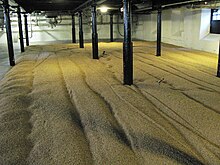
malt on a traditional malting floor

For me, 'malt' means partly germinated grain which has been carefully dried for further processing by brewers and/or distillers. It is traditionally made on the malting floor. The grain has been steeped and aerated, then it is spread out on the floor in a cool, dark, well ventilated building to begin to grow. Once the rootlet and shoot begin to show, it is gently dried in a kiln. We had been talking about two very different things. As part of writing this blog, I checked the  Encyclopedia Britannica for its' descriptions of what malt is, how it is made and what it is used for.

Much of the detail is correct, but there are a few salient details omitted. For example, there is no mention of the air rests that are an essential part of the steeping process. If you just leave the grain to soak or steep without air rests, then the grain will be killed. It will, effectively, drown. Ancient and traditional techniques include leaving the grain in a bag in a shallow stream. This provides the essential oxygen and water for the germination process to begin. Modern methods use huge steep tanks. 

Grain needs both water and oxygen to begin germination. If the steep is not aerated, then it will not take long for the water and grain to smell horrible and for the grain to be bad. It will not begin to germinate, you will not have any enzymes to convert starch into sugars and you will not be able to make ale. Or beer. Or whisky.

In the first stages of germination of any grain - wheat, barley, oats or rye - the enzymes necessary for the conversion of starch into sugars are liberated, and then the growth begins. If this continues, starches are used up, so it is important to stop the growth as soon as the shoot and root appear amongst most of the grains. This is usually when the acrospire (rootlet and shoot) are one third the length of the grain.

Often, descriptions in the archaeological and anthropological scholarly literature of how to make malt are not accurate. Some describe malt as 'toasted barley sprouts'. Anyone who says that malt is like toasted, sprouted barley, suggesting that it is something like dried bean sprouts, have obviously never handled proper malt.

It is very important to talk to a maltster to understand how to make malt, to ask the practitioners, the skilled people who make it. Craftsmanship not scholarship.

Graham brings a 25 kilo sack of crushed malt from the brewing suppliers into the house. Then he makes beer with it, using basic equipment - a mash tun, a boiler and fermenters. Lots of people have tried Graham's home brewed beer and it is considered to be top quality, good and tasty.

What is this crushed malt in the sack?

Where does it come from, who makes it and how?

As I was doing the mashing experiments in the garden, using beeswax sealed earthenware bowls as mini mash tuns, I became more and more interested in the malt and how it was made. I studied the science of grain germination physiology, learning about what happens inside the grain as it begins to grow. It is fascinating and complex, worthy of a blog post of its' own.


this post was co written by Graham and Merryn