Showing posts with label ale. Show all posts

Wednesday, 3 November 2021

Barm and the magic spoon. Godisgoode. ( part two )

This post is written by Graham Dineley, the brewer. The opinions, mistakes and misunderstandings are entirely my own, and I welcome corrections.

What is our research all about? Well the clue is in the Latin name for brewer's yeast "saccharomyces cerevisiae", a sugar fungus of beer. Only sugars can be fermented into alcohol, not starches. Cereals can be tricked into digesting themselves into malt sugars by malting and mashing. Malting is the careful and skilful controlled germination of the grains. Mashing is skilfully providing those malted grains with hot water so that their enzymes can complete the trick of saccharification, making sweet liquid wort. Anyone who talks about making ale or beer and does not mention those sugars is missing something crucial, the key ingredient. These malt sugars in themselves are very palatable and attractive and this is why the "first farmers" grew cereals. For the sugars. Once you have those malt sugars then alcoholic fermentation is an inevitable consequence and this also attractive.
https://merryn.dineley.com/2018/03/mashing-and-bit-on-fermentation.html
When this post was first started nearly five  years ago, I thought I knew a little bit about yeast. Then things happened that made me realise just how small that little really was. I picked it up again in March 2020, but never got around to publishing it yet again. Procrastination. So I must also update this prefix.

Brewing historian Lars Marius Garshol discovered kveik. Follow this link to read more about Norway's now famous farmhouse yeast, it's a great article by Claire Bullen on the Good Beer Hunting blog.

He also discovered the kveik yeast ring, which is the "magic spoon" on steroids.

These can now be bought from my favourite "goods" supplier The Malt Miller.

Back then I had looked forward to working with kveik. It seemed to have the qualities of my once favourite bakers yeast. 

I have now had the privilege of using two kveiks generously provided by Lars Marius: Espe #20 and Rivenes #2. I can confirm that Espe is a vigorous high temperature yeast that imbues the beer with a fruity plum like flavour. It was very tasty.

Also my favourite bakers yeast changed into a bread making yeast, and became unusable. It stubbornly refused to drop out, even after four weeks settling, the taste is still "muddy". It still does the same today and is no longer fit for my brewing purposes. I now use a commercial brewers packet yeast that has a wonderful coagulating and clumping action.

On the left is the baker's yeast, middle is bread makers yeast and right the commercial yeast. The bakers yeast changed before the packaging did. This confused me at the time.

I also looked into sourdough because so many people have said that it can be used for brewing. Mostly not, because it is a different fermentation mostly lactic, but some sour-doughs do contain Saccharomyces Cerevisiae. Sourdough is a whole other warren full of wonderful rabbit holes, if one has the time and curiosity to study it.

I am prompted to publish it now because of two recent experiments, where people have tried to recreate ancient brews and have relied upon the vagaries of "wild wind borne" yeasts. This "wind borne" yeast is an archaeological myth that will not die.

The first is the Dietrich's experiment to recreate a Gobekli Tepe brew. If you look closely you can see that their "beer" has a greenish tinge (page 17). Click on the link above to read their paper. It must have been made with sprouted grain. 

I wonder whether they managed to make any malt sugars to ferment. I'm not so sure that they did. This is another archaeological myth, that malt is sprouted grain with green shoots. For a discussion of this see my blog, where there is a picture of archaeological malt from the Plant Cult workshop on Ancient Beer. Merryn was invited to present a paper at this meeting in February 2019, however, due to illness she was unable to attend. Fortunately, she has just published an article based upon this presentation. It is called 'The Ancient Magic of Malt' and you can read it online in the EXARC Journal here.

The second experiment is a Czech scientist brewing a 3000 year old "beer", using millet and potato? starch. What no malt? So no sugars! It must be a lactic fermentation and not lambic. Wild yeasts are notoriously unreliable. The beer was sour, like lemons. Chemist Lukáš Kučera from the University of Olomouc brewed the "beer". He says of his recreated brew:

“What makes this beer specific is that it needs to be fermented with wild yeast. You cannot buy this type of yeast in a shop. That's why I purposely fermented the beer in the vicinity of apples.

“The beer has a characteristic acidic flavour that will remind you of cider or wine, rather than beer. It has the colour of beer, it smells like cider and tastes a bit like lemon.”


Both of these two experiments also rely upon the widespread misconception, or myth that it is easy to capture a wild yeast that will start an alcoholic fermentation.
I do not rely upon this myth. On the two occasions that we demonstrated mashing and have got back too late to deal with the mash that day, we have left a the mash overnight.
Both times we have found the next morning that the mash is sour and fizzy. They had become infected with a lactic fermentation. It is impossible to make a mash with primitive equipment  and keep it hygienic. To effect a decent fermentation it is necessary to inoculate the fresh wort with a vigorous yeast starter.

I am beginning to suspect that the root cause here is that there is widespread confusion and misunderstanding about fermentation. That there is only one kind, and this would lie behind the idea that one can ferment anything. There are many kinds of fermentation, but the two most commonly encountered are lactic fermentation, e.g. sauerkraut, and alcoholic fermentation, turning sugars into alcohol, e.g. wine and beer.

Professor Keith Steinkraus has written a definitive book about fermentation and here is a good paper.


So here are some random ramblings about yeast, slightly updated.
------------------------------------------------------------------------------------------------------------------------------------

Apparently Saccharomyces Cerevisiae is a "killer" yeast, that is, it secretes toxins that inhibit the growth of other yeasts and bacteria. This is how it can predominate given favourable conditions. How it does this is fascinating.

How it replicates is even more interesting. It has two forms, haploid and diploid. Both forms normally replicate by mitosis, they bud daughter yeast cells. Under stress, e.g. drying, the haploid form normally dies, but the diploid form sporulates, that is it produces spores. These spores can then mate to provide new yeast cells and this gives it the chance to hybridise with other yeasts. This doesn't happen very often, but it can lead to new strains and varieties with different properties.

From wikimedia.


The spores can be wind and air borne on dust and insects. This became obvious to me in our last house in Manchester. After about 12 years of brewing and washing equipment there, any sweet juice drinks left out overnight by the kids in the summer months would be slightly fizzy by the morning, as did any yoghurt.

It was obvious to me that the yeast had established itself in the microbiome of the house, along with 130 years worth of other micro-organisms. This sort of thing must happen in every brewery, no matter how much attention is devoted to hygiene and sterility.

Airborne yeast.

Recently I was listening to a radio interview about the archaeological discovery of the earliest physical evidence for beer in Britain, a fourth century BC site by the A14 near Oxford. Apparently examination of carbonised cereal residue found "micro structures of remains had changed through the fermentation process and air bubbles are typical of those formed in the boiling and mashing process of brewing". What!? This makes absolutely no sense to me, the processes are in the wrong order. Where did they get this from? Did it come from the academic literature, or did they just make it up, or perhaps both?

The beer writer said something like "It would have been a wild yeast. It would be wind borne, and so it would taste like this Belgian Lambic Beer".

I thought to myself, that is three naive assumptions in a row.

1) I would never trust the vagaries of the wind to get the right yeast. These people should know how to manage yeast if they were making beer regularly.
One thing learnt from our ancient brewing research is that if one uses "rustic" methods to make a wort, it is already heavily infected with all kinds of things, mostly various lactic bacteria. If one is making raw ale, that is unboiled ale, then one has to quickly overcome these infections with a vigorous ferment.

2) The Belgian Lambic beers are air inoculated, not wind inoculated, as is shown by the Cantillon brewery. When they refurbished their brewery with a new roof they found that the open wort would not ferment, like it used to. They had to put some of the old roof tiles back into the roof fabric to maintain the ferments, so the microbes are coming from the building and not the wind.

3) That particular Belgian flavour of beer is a local tradition and is not universal.

Windborne yeast.

In the late 80s I was following an American e-mail brewing discussion list digest. I was surprised and intrigued by one post. A brewer had visited a Founding Fathers re-enactment settlement, and he spotted a hop plant. When he asked what it was for, the lady replied that it was to make hop-tea to capture the right yeast for making bread. This means that there was a pre-existing Saccharomyces Cerevisiae in North America, suitable for both baking and brewing before brewing had been established there. I have heard that this was a common practise in North America, particularly on the West Coast, until the advent of dried yeast, and the rail-roads.
Perhaps this was a close relative of S.C. Californiensis that is found in some sourdoughs.

It is an experiment I have often thought about, could I capture the right yeast here on Orkney with a hop tea.

Hybrids.

In 1980 I was still living in shared accommodation and for convenience I was making beer from kits. At work we had a retirement celebration for some colleagues and one of the refreshments was a polypin of Pollard's Ale. Beer writers and bloggers Boak and Bailey have written a blog about Pollards.

Pollard's beer had a very distinctive, dry almost musty flavour, that was very popular. At the end of the celebration there were a few pints left with the lees ( sludge at the bottom). So I took it home and added it to a 5 gallon kit brew that had just finished primary fermentation. I expected it to settle out, but instead it took off with a very vigorous fermentation and a strong sulphurous aroma that lasted just over a day. The Pollard's was obviously metabolising something that the kit yeast had not. The resulting beer had that distinct Pollard flavour too. I have often wondered if that was a hybrid yeast. Pollard's ales did not last that long, despite being very popular. The story that I heard at the time of it's demise was that they had lost that unique yeast, and with no back up brewery to restore it, that was the end of Pollard's. 

Saccharomyces Carlsburgensis has been said to be a hybrid of an Ale yeast and a Patagonian forest yeast, or even two forest yeasts. Another story I have heard is that it is a hybrid with a Mongolian desert yeast. I don't know, but here is a link to an early use of Saccharomyces Eubayanus:

https://www.atlasobscura.com/articles/found-the-earliest-evidence-of-lager-yeast-being-used-to-make-alcohol

SPECULATION

One thing that intrigues me still is the Bronze Age practise of burying cremations in large ceramic "food vessels", because they are always found upside down. If these pots were used for fermentation, then it would make good sense to store them upside down when not in use. This would dry the yeast residues and protect them from dust, so that when reused these pots would spontaneously start a ferment. They would then be considered special, maybe even life giving, and this would make sense for a burial, a kind of sympathetic magic.


Saturday, 10 September 2016

a morning with maltsters, part one


The Orkney Science Festival is held annually. It's always a great week of varied and interesting events, talks, demonstrations and fun. This year there was a Malt and Malting seminar with a special tour of the Maltings at the Highland Park Distillery, Kirkwall. There were only a dozen places available and we were lucky to get tickets. We spent a fascinating morning with malting, brewing and distilling experts. It was all about the malt.

Making the malt for brewing and distilling is exactly the same process. The difference in processing techniques happens after the mash tun. A brewer takes the sweet liquid from the mash tun, calls it "wort" and adds hops or herbs, then ferments it into beer or ale. The distiller takes the sweet liquid, calls it "the wash" ferments it into alcohol and then distils it. The wort and the wash are two names for the same thing, the sweet liquid that is obtained from the mash tun. Every brewer who makes ale or beer from the grain knows what wort is because they work with it. People who have never made an ale or beer from the grain are perhaps a bit confused about what it is.
wort or wash?
Depends if you are a brewer or distiller.
source here
Dr Tim Dolan gave the first talk of the morning, explaining the fundamental aspects of what malt is, the biochemistry of malt, how it is made and a little of the history and development of the industry. His career in the malting and distilling industry goes back 40 years and he now teaches the subject. The other speakers were Marie Stanton, Distillery Manager of the Highland Park. She shared her knowledge of floor malting, then led us on a wonderful tour around the Maltings. The third speaker was Eric Walker, recently retired, a man with a distinguished background in all aspects of the malting, brewing and distilling industries. He talked to us about the prehistory and history of making malt and explained some technical details. They were quite a team and between them they had a huge amount of knowledge and experience of making malt.

"Malting is a process utilised by the Ancients to produce palatable alcoholic beverages: ale and beer"  (Eric Walker)

In previous years there have been talks about brewing and distillation, usually organised by the Institute of Brewing and Distilling. Tim told us that he thought it was about time there was a Science Festival event about malt, the Cinderella subject, because malt is the crucial ingredient for ale, beer and whisky. What is malt? It is grain that has been germinated under controlled conditions, then dried carefully in a kiln. Making malt has been a skill, an art and a craft for a very long time. Over the years I have given a few talks at the Science Festival. I was pleased that Tim remembered me and had been to my presentations on malting in prehistory, neolithic ale, grain barns and my most recent "Where were the Viking Brew Houses?" a couple of years ago.

The advent of the combine harvester in the 1940s transformed the grain harvest. The ancient and traditional way of harvesting grain by hand was extremely hard work, it was a time when the whole community worked together to bring the harvest home. On Orkney, where I live, grain was harvested by hand and stacked in stooks in the field until as recently as the 1950s. In case you don't know what a stook is, I looked online and found this painting by British artist Heywood Hardy (1843-1933). Painted in 1872, it depicts a typical scene of the time. I like the detail of the stook and you can see how they were made. The effort and hard work involved in making them can only be imagined.

 Corn Stooks by Bray Church by Heywood Hardy (1872) see here

This oil painting was done just a few years before Henry Stopes published his book about Malt and Malting, an Historical Scientific and Practical Treatise in 1885. It is now available to read online. Oxford University took the trouble to scan it in, many thanks to them for that. I first read it when I borrowed a copy from a brewing scientist when I began my research. It's such an important book and it is an excellent snapshot of the malting industry in the late 19th Century. Henry Stopes mentions the work of Louis Pasteur, who had recently published his work on Germ Theory which was to make such a huge impact on the brewing industry.

But I digress. Let's get back to the talk about malting.

Tim explained the biochemical processes of germination, with the embryo being the living part of the grain and the endosperm being the starchy food store. Malt, he said, is a living thing. It must be handled and processed carefully and correctly by the maltster. This was a point that was made several times throughout the morning. First, the harvested grain is steeped in water. It's crucial to allow air rests. The steep tank is drained of water at regular intervals. If the grain is left in water without air rests it will drown and this means that it will not begin to germinate.

Thanks to scientific research into grain germination physiology and biochemistry which began in the 1960s, we now know that when grain is  sufficiently wet and aerated, gibberellic acid is released from the embryo and the aleurone cells. This stimulates enzymes which convert the grain starch into sugars, the food source for the plant.

All grains can be malted. Barley is considered to be the best grain for malting but wheat, rye and oats can also be malted. Here's a useful diagram of the internal structure of a barley grain in the early stages of germination.

ancient malt and ale : malting and mashing

The craft and skill of the maltster lies in getting the grain to start growing, but not too much. This is known as modification and there is some excellent and detailed information about what malt is and how malt is made on the Maltster's Association of Great Britain web site.

The Highland Park has three traditional malting floors where the grain is spread out after steeping. Raking and turning the malt is a crucial part of the process. We were told that this helps to maintain an even temperature and it also prevents rootlets from tangling. On the malting floor the barleya malted barley grain more details here begins to germinate. When the maltster sees the root and shoot being about four fifths the length of the grain, it is sufficiently modified and ready to be carefully and gently dried in the kiln.  a malted barley grain more details here

Modern techniques of making malt involve the use of Saladin boxes and drums. There are also huge germinating kilning vessels which can make three to five hundred tons of malt at a time. All year round. The quality of the malt can be controlled because it is easy to maintain precise temperatures and levels of moisture. The third speaker of the day, Eric Walker, gave an interesting talk about the industrialisation of malting and I'll write that up later. In the meantime, here's something I wrote about where the malting floors have gone.

Barley is self pollinating. Dr Tim Dolan emphasised this several times, but I wondered why was he making this point so many times? It was because it's so significant in understanding barley breeding. There were not so many varieties of barley in the past as there are today. The science and practice of cross breeding barley began at Warminster Maltings in 1904. This was news to me. Rather than tell you the story myself, here is the account from the Wiltshire Community History web page:

"The most famous name in local malting was that of Dr. Ernest Sloper Beaven, and his reputation is international. He was born in 1857 to a Heytesbury farming family, who moved to Boreham Farm at Warminster in 1868. Beaven said that he began to observe barley closely from 1878 and he became associated with Frank Morgan, Warminster’s leading Maltster. Beaven’s first experiments had been with onions and potatoes but from 1900 he was growing, selecting and crossing barley from seven initial different ‘races’. In 1904 he acquired fields on the Boreham Road for a nursery and in 1914 he launched ‘Beaven’s Plumage Archer’ strain of barley and continued with seed trials for the next 27 years. Beaven could claim that 85% of the total U.K. acreage of barley was grown from the progeny of just four plants, three of which had been selected in the nursery at Warminster between 1900 and 1904."

In the last one hundred years or so, much has been learned about barley and the biochemistry of germination, however, there is still much to be learned. Although some of the mystery and magic of malting has been studied and explained by scientists, some things about barley are little understood.

One of these is latent dormancy. Someone in the group asked about this and the answer was that it is still a bit of a mystery. There is a practical tradition of leaving the grain for a while between harvest and steep, because it will not germinate. This could be about variety, or it could be seasonal. The best thing I can suggest, if you are interested in finding out more about latent dormancy, is to search for the academic and scholarly papers on it. There are quite a few of them out there.

The next talk was about the skills, techniques and practicalities of floor malting and the turn of Marie Stanton, Distillery Manager, an experienced maltster at a number of distilleries. And then there was the tour of the Maltings.

There is only so much detail that one blog post can take, so I shall leave you with a picture of the malting floor at the Highland Park Distillery, Kirkwall, Orkney. It is taken from Wikimedia Commons. I forgot to take my camera to the seminar, but I did take plenty of notes, so I hope this will suffice while I get down to writing part two, while it is fresh in my memory.

File:Highland park malting floor.jpg

https://commons.wikimedia.org/wiki/File:Highland_park_malting_floor.jpg


Sunday, 17 July 2016

big pots: fermentation and storage

Brewing ale in Neolithic Britain - it seems to be a controversial topic among some academic archaeologists. I'm not sure what the problem is with malting and brewing ale in the neolithic era. It could be that few people understand the processes involved in the transformation of grain into malt, wort and ale.

If you have come to this page via the BBC Earth website, or from the Stone Pages, please be aware that the comments attributed to me there are wrong. I have no idea where they came from, other than as a misunderstanding. I hope for a correction in the near future but so far I am not having much success.

Roasted malts, also known as specialty malts, are a feature of modern industrial malting. I'm working on a blog about that at the moment and will post a link to it when I have completed it, hopefully before the Yule celebrations of 2016!

The last few posts have been about explaining the saccharification in the mash tun, where the crushed malt, when mixed with water and gently heated, is converted by enzymes into malt sugars. I've also written a little about lautering, sparging and how to collect the wort.

We've been asked 'why not ferment in the trough. Why go to all the trouble of trying to collect a wort without bits in it?'

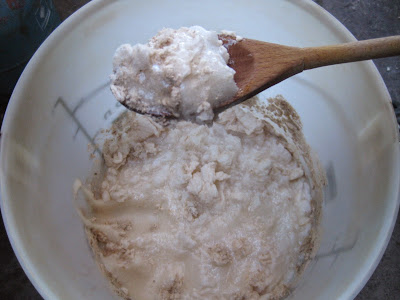
Firstly, alcoholic fermentation requires anaerobic conditions. A large vat (1000s of litres) within a building has a blanket of carbon dioxide over the fermenting beer, as in lambic brewing. A small trough (100s of litres) situated outside would have this blanket blown away. Secondly, during fermentation, the little bubbles of carbon dioxide produced by the yeast, stick to the smaller particles and lift them into the froth of the barm. You can see the towering barm in the picture below. It can turn into a really messy monster when it has a lot of little bits in it. After fermentation you would still have the problem of straining or filtering what brew has not been lost to the froth-over. That is a lot harder with little bubbles in it. A bed of husks will not form properly and filtering just doesn't work. 

Inoculating the wort: starting a fermentation
Once the brewer has obtained a quantity of wort by mashing, lautering and sparging, the next stage of the brewing process is the fermentation. Whether you mash in a large pot, a wooden tub with a spigot hole, in a trough in the ground or in a modern mash tun, the wort that you make must be dealt with promptly to prevent infection setting in. Wort does not keep well. Either you boil it, as is necessary with hops, and then cool and inoculate with yeast at the right temperature. Or you can inoculate a fresh wort when it has cooled, and then add the herbs. We found that meadowsweet flowers inhibited the yeast and are better added after the fermentation. To find out more about raw ale which, basically, is beer made from an unboiled wort, I suggest a look at this blog. Raw ale is a huge topic in itself.

fermentation in close up, this is the barm (foam) on a fermenting beer

There are a number of ways of adding the yeast to the wort to start the fermentation. Today, the brewer can add yeast directly, in dried form or as a yeast starter, when the wort temperature is just right. Many modern breweries keep their yeast starter in a fridge. They scoop some of the barm (foam) from the top of the fermenting beer and then store it in a cool place until required. The yeast culture can be kept and used for several months. 

Brewers in history and prehistory could also have used this simple and basic technique, keeping their barm/yeast culture in a cool place. In the 1980s, archaeologists found a medium sized grooved ware pot which had been sunk into the ground in the remains of one of the buildings at Barnhouse, Orkney. The pot, about a litre in volume, had been buried up to its' rim. Analysis revealed that it had contained some kind of 'cereal based mixture', but they were unsure about the pot's function. I think it may have been a barm pot. It was located in a large building, numbered eight by the excavation team and interpreted as a 'temple' or some other kind of ritual building. There were drains as well as many sherds of broken or smashed Grooved Ware pottery, representing pots of about one litre in volume. There was also evidence of feasting and what archaeologists refer to as 'ritual activity', although what that was is not made clear in the excavation report.

I would say that if an archaeologist is looking for a prehistoric ritual activity then the mysterious and magical transformation of grain into malt, wort and ale is well worth considering.

In Norway, Lithuania, Latvia and other places, the tradition of making farmhouse ale survives, with brewers passing on their skills, techniques and knowledge to their descendants. Old traditions of inoculating the wort are still practised in several areas of northern Europe. The picture below shows a wooden yeast ring or kveikering being used to inoculate a yeast starter.

wooden yeast ring or kveikering (photo from the beer blog of Lars Garshol)

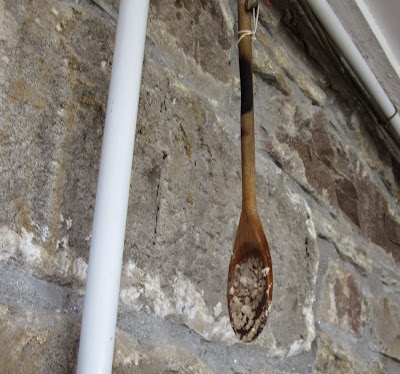
Some sources say that the tradition of the kveikering dates back to the 18th century, although I wonder whether the concept might date even further back. It's difficult to be sure because, of course, a wooden object used to gather yeast and start a fermentation would not survive in the archaeological record. In the Viking era, apparently, a stick was used to stir the fermenting wort. This would put yeast onto the stick. Then, if it was kept dry, it could be used to start the next fermentation by stirring a fresh wort. In the Western Isles of Scotland there is a tradition of stirring the fermenting beer with a hazel stick (or wand) which is then hung up to dry and used to stir the next batch of wort, to begin the fermentation.

We did some experiments using a wooden spoon and found that this technique works perfectly.

harvesting barm from the fermentation vessel
barm/yeast drying on the wooden spoon (more photos here)

Big pots as fermentation and storage vessels.
The neolithic era was the time of the 'first farmers'. The earliest grain agriculturalists of the British Isles (c4000BC onwards) were also the megalith builders. They created magnificent stone circles and henges as gathering places for the community. They built stone tombs for their dead and they began to settle down. Associated with the 'first farmers' is the integrated 'cultural package' of grain cultivation, the management of domesticated animals (cows, sheep, goats and pigs) and the manufacture of ceramics. This was the 'neolithic revolution', a different lifestyle to the mesolithic hunter gatherers who had roamed the land for thousands of years previously. At this time in prehistory, the technology for making large stave built wooden vessels (vats, tubs, barrels) did not exist.

How did these neolithic 'first farmers' process their grain? Were they grinding it into flour, to make bread? Were they boiling it, making some kind of gruel or porridge? Or were they making ale from it, by malting, mashing, sparging and fermentation? For some reason, the possibility that such a thing as ale in the neolithic is considered to be a controversial idea by many archaeologists. I'm not sure why. 

Some of the large neolithic Grooved Ware pots might have been used as fermentation vessels. They are perfect in both shape and size. One particularly large Grooved Ware pot found at the neolithic village of Skara Brae, Orkney, was around 30 gallons in volume. Most of the large Grooved Ware pots were around eight to ten gallons. They are found at many ritual and feasting sites of the neolithic, in domestic contexts, for example at Skara Brae, Orkney, and at stone circles and henge monuments throughout the British Isles.

What is Grooved Ware? It is neolithic pottery that archaeologists have defined by its' decorative pattern of grooves and shapes on the exterior. Not all grooved ware has grooves; some of it has fancy applied decoration, with blobs of clay and raised patterns. Most Grooved Ware pots are bucket shaped, with a flat bottom. They are found throughout the British Isles, from Clacton to Orkney and Shetland and also in Ireland. Indeed, this style of pottery was first called 'Rinyo-Clacton Ware'. Rinyo being the name of a site on one of the Orkney islands, Rousay. It was a neolithic village larger than Skara Brae. Grooved Ware was also found on the south coast, at Lion Point near Clacton.

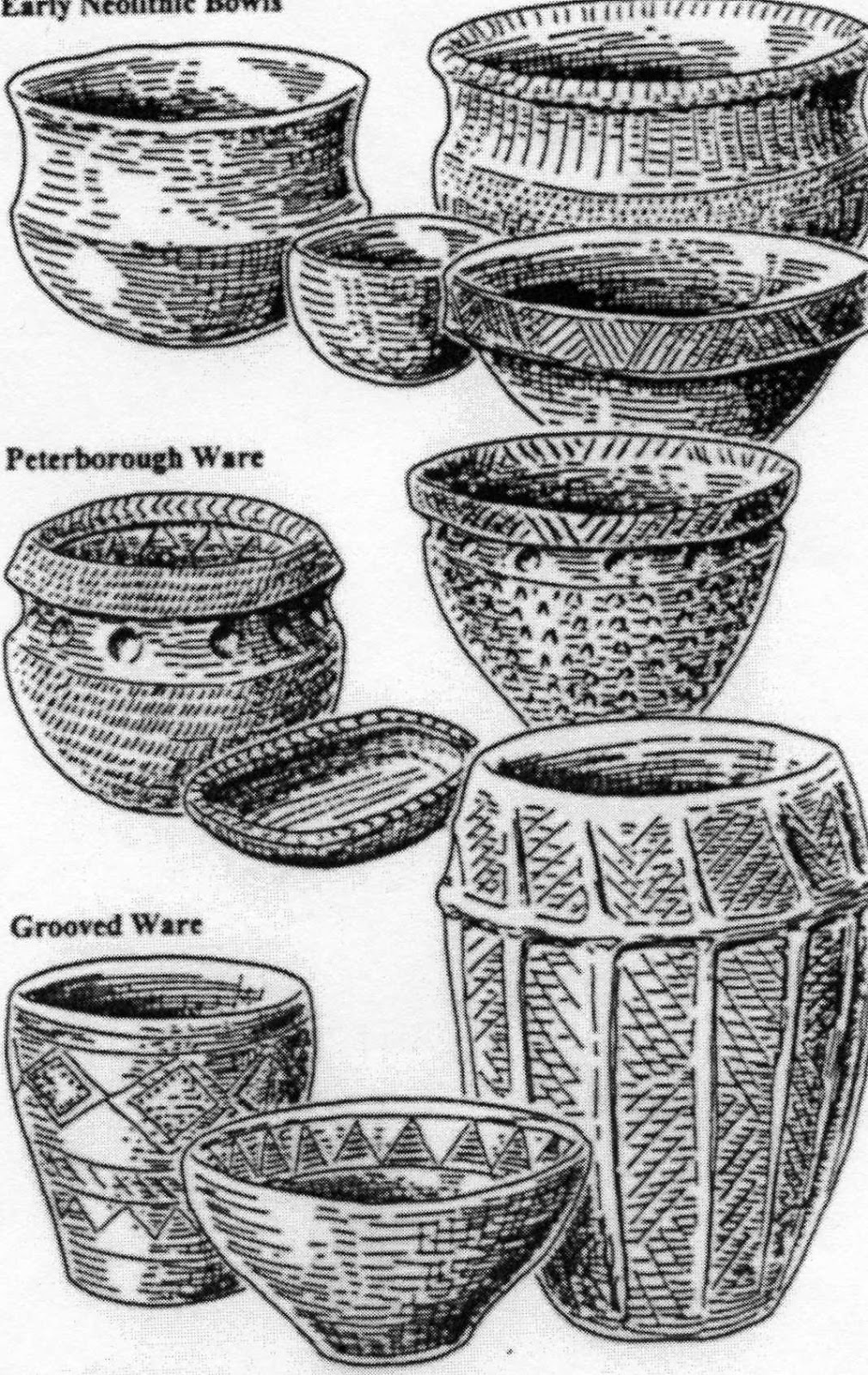
Here's one of Stuart Piggott's beautiful and classic drawings of British Neolithic pottery, showing what some of the Grooved Ware pots from the south coast probably looked like, based upon sherds found during excavations on the Essex coast, at Lion Point.


Pottery is frequently found during archaeological excavations. Archaeologists regard it as diagnostic. The discovery and identification of a sherd of pottery gives them a good clue about the date of the site. Neolithic and Bronze Age pottery was not glazed. It could have been waterproofed in several ways, by burnishing or by being sealed with fats, beeswax or milk.

a sherd of grooved ware
Pottery typologies are complex. It's an enormous area of archaeological study and I could not possibly go into every style and type of British Neolithic pottery in this blog. We would be here forever. There's Windmill Hill, Grimston-Lyles Hill Ware, Ronaldsway, Grooved Ware, Unstan Ware, Peterborough Ware, Ebbsfleet and so the list goes on. Most are round bottomed pots, with the exception of Grooved Ware. It took me many months to get to grips with these stylistic categorisations that have been imposed upon pottery of 5000 years ago.

Many bowl shaped pots are interpreted as 'cooking pots'. That seems fairly reasonable. What puzzles me is that whenever archaeologists find a very large pot, or the sherds of a large flat bottomed bucket shaped pot, it is almost always interpreted as a 'storage pot'. I have not yet come across a large pot from the British Neolithic that has been interpreted as a potential fermentation vessel, although some of them have a volume of several gallons and such large pots are often found at feasting sites, for example, at Durrington Walls, near Stonehenge.

If an earthenware pot is to be used to contain any liquid it must be waterproofed. We discovered, in our mashing and fermenting experiments, that beeswax worked very well as a sealant, as did butter and lard.

As a control experiment we tried fermenting mead in an untreated earthenware pot. The fermentation worked well, the room filled with the smell of mead, and the outside surface of the pot was covered in little beads of sticky sweetness. But the final product was disappointingly low in alcohol. It turns out that the alcohol diffuses through the porous pot much faster than the honey solution. This makes an untreated pot pretty useless for creating an alcoholic drink.

Here is a sample of some of the British Neolithic pottery types, as recorded by Stuart Piggott. You can see that there is a wide range of styles. Some have holes in the rim, to secure a covering or lid of, perhaps, leather. Some are deep, others are wide and shallow. I prefer to look at these pots with function in mind, rather than consider only their decoration and style.


Is there any archaeological evidence for the use of large pots for the fermentation or storage of barley wort? 
One of the very best indicators that a pot was used to ferment wort into ale, or for storing the ale, is the identification of beerstone on the internal surface. Beerstone precipitates out of a fermenting barley wort, it looks rather like eggshell. We have a lot of it accumulating on our plastic fermentation buckets and storage vessels.

It takes many hundreds of uses to accumulate a visible deposit of beerstone, but it is a certain proof of fermented wort. Brewers using plastic pipes in breweries often have to clean them of an accumulation of beerstone. It clogs the pipes.

Here is some beerstone from one of our fermentation vessels:


Beerstone has been identified on pots from a Bronze Age site in the Zagros mountains of modern day Iran. At excavations at Godin Tepe a great many pots and jars were discovered, they were stored in the University of Pennsylvania Museum. Subsequent analysis of a yellowish deposit on the internal surface of jars identified beerstone and it is generally accepted as unequivocal evidence for beer brewing. This pioneering paper by Badler, Michel and McGovern, published in 1993, tells the whole story and contains sufficient detail to be able to repeat the tests for beerstone on prehistoric pottery.

I wonder whether any archaeologists in the UK or Europe would consider looking for beerstone on big prehistoric pots? Maybe it is already being investigated. It would be great if this could happen, since this might end the apparent controversy about whether or not a big old pot was used for the fermentation of beer made from a barley wort.

-----------------------------------------------------

If you would like to make your own kveikering, here is some more information  and details of how to make one. Brewer Martin Warren of the Poppyland Brewery was so impressed by the idea that he made his own.

My conference paper from 1996 "Neolithic Ale: Barley as a source of sugars for fermentation" can be downloaded from my Academia page, here. 


Sunday, 28 December 2014

What is Wort - a brewer's perspective

Hope you had a grand Yule and that you enjoyed the midwinter celebrations. We wish you all the best and A Happy New Year for 2015. There has been a bit of a lull on ancient ale blogging in the last couple of months, however we aim to correct this in the New Year and get back to writing again.

This one is about the Wort. Graham wrote it several months ago. It would make a good response to a short article "Beverage with heritage" that we read over the holidays. It was published in the Christmas and New Year Edition of New Scientist magazine, the 'one minute interview' with Patrick McGovern, director of the Biomolecular Archaeology Project for Cuisine, Fermented Beverages and Health at the University of Pennsylvania Museum. The question is asked: how does ancient booze compare with the modern stuff? The answer includes that "they wanted to be sure they had enough sugar to get the fermentation going, so they took whatever they had that contained sugar and mixed them together."
.
This idea of 'mushing loads of random sweet stuff together to make alcohol in prehistory' seems to be a commonly held view amongst non brewers. Merryn wrote a blog about desperately seeking sugars a few months ago, which tried to address the issue and dispel this myth.

Here is Graham's perspective, a beer brewer's explanation of what wort is:


Wort (pronounced wirt, not wart ) is the Juice of the Barley, well not quite, but almost very nearly so. It is a thin, runny, very sweet but very sticky liquid, straw coloured through to brown. It is effectively a thin synthetic honey substitute. Ale made from wort without preservatives or flavouring actually tastes a lot like mead made from honey.

Wort is the liquid sugars extracted from malt, that is to say, partially germinated cereal grains - barley, wheat of all varieties, oats and even millet, but not rice or maize. It is the primary source of fermentable sugars in making ale or beer and always has been. It is relatively easy to make a sugar solution of at least 10% from malt, and then to wash further sugars from the grain down to a realistic level of 1-2%,  "small beer" level and, of course, anywhere in-between. This compares very favourably with other natural sources of sugar like birch sap, which is between 0.5 and 2% sugar, which would only make a small beer. So adding birch sap to a brew would only dilute it, not strengthen it as some scholars claim.

Wort is made by "hijacking" some of the natural processes of the grain's life cycle.

As part of the growing process the germinating grain must convert it's energy store, starch, into sugars so that these can then be built into cellulose, the structural skeleton of the roots and shoots. This requires the liberation of the two amylitic enzymes, alpha and beta, which are little like ptyalase, the enzyme in saliva that converts starches into sugars.

If this growing (germination) process is halted when the most enzymes are present and little of the growing structure has started, it will be good malt.

So, to make wort you lightly crush the malt and mix it with hot water at about 65 degrees Centigrade. Keep it at this temperature for anywhere between half hour to about 2 hours, depending on your style. This is called mashing. Then you drain the clear liquid sugars from this mash by lautering, which is yet another story. This gives you a strong wort. Then you can wash further sugars from this mash, sparging, to get a weaker wort.

Brewers measure the potential sugar and therefore alcohol of a wort using "specific gravity". Water is 1000. David Line in his book "The Big Book of Brewing" explains this in great detail in chapter 18.

This was my "Bible" when when I first began brewing beer 32 years ago. David Line was a pioneer in his time, explaining what the processes were, how they were done and why. He also explains different methods of mashing using simple equipment and this has been very valuable to me in re-creating the ancient and traditional crafts of brewing ale.

So to recap: wort is a golden brown, very sweet, very sticky, runny liquid that contains most of the potential sugars from the malt. It can be made to a variety of strengths e.g. Arctic Ale.

To illustrate this I will give you the results of one of my recent brews.

The recipe is loosely based on David Line's "Brewing Beers Like Those You Buy" page 88, Gales HSB. One of my favourite beers, sadly no longer made. I found his book to be an excellent collection of recipes for good Ales and Beers that could be bought in the late 1970s and 80s. Large brewery's methods have changed since then and sadly many of the modern renditions taste nothing like they used to.

15lb 8oz of crushed pale malt, Munton's Perl Blend, were mashed with 5 gallons of water, inside a grain bag, in a Peco Electrim mash-tun. The strike temperature was 70 degrees Centigrade and as the grain was added slowly, the temperature fell to about 60 degrees Centigrade, and was then raised back to 65 degrees Centigrade.

The mash tun was unplugged and covered with a sleeping bag to maintain the mash temperature. It was left like this for 2 hours.

From this I lautered 3.5 gals of wort which was nearly 1080OG.

wort: the first running
measuring the first running


This was followed by sparging. The first gallon of wort was 1062OG, the second 1048OG, and these, together with the 3.5 gallons, were boiled in an Buffalo 40 litre boiler with 1lb of dark soft brown sugar, and 4oz of molasses (these are the in the recipe and I think the molasses adds a certain something to the flavour) for one and a half hours. This produced 5 gallons of 1084OG. This was fermented in two fermenters.


A further 5 gallons of wort were sparged of 1036OG, 1020OG, 1012OG, 1006OG (this was very pale and weak) and finally 1014OG left to drain overnight. This was again boiled on the old hops, because there is an awful lot of sugars left on the hops. This gave 5 gallons of 1024OG, which was added to the two fermenters. At the end of primary fermentation this gave 10 gallons of 1008 final gravity.

The average of 1084 and 1024 gives an OG of 1054 for the 10 gallons. According to David Line's graph (on page 147 Big Book of Brewing) gives a strength of 7.5-1.1= 6.4% alcohol.

This was quite a surprise to me, for I haven't been measuring the gravities for some time, and I never expected to get this much beer from 15.5lbs of malt.

A recent comparison with a commercial beer, Scapa Special 4.6%, suggests that my beer was no stronger, so maybe there is something wrong with my figures.

But it did make me think that I may be over-sparging my wort and that this could be contributing to the haze, and tannin like bitterness. So I have increased the malt to 17lb 8oz, and now I am getting a much nicer beer.

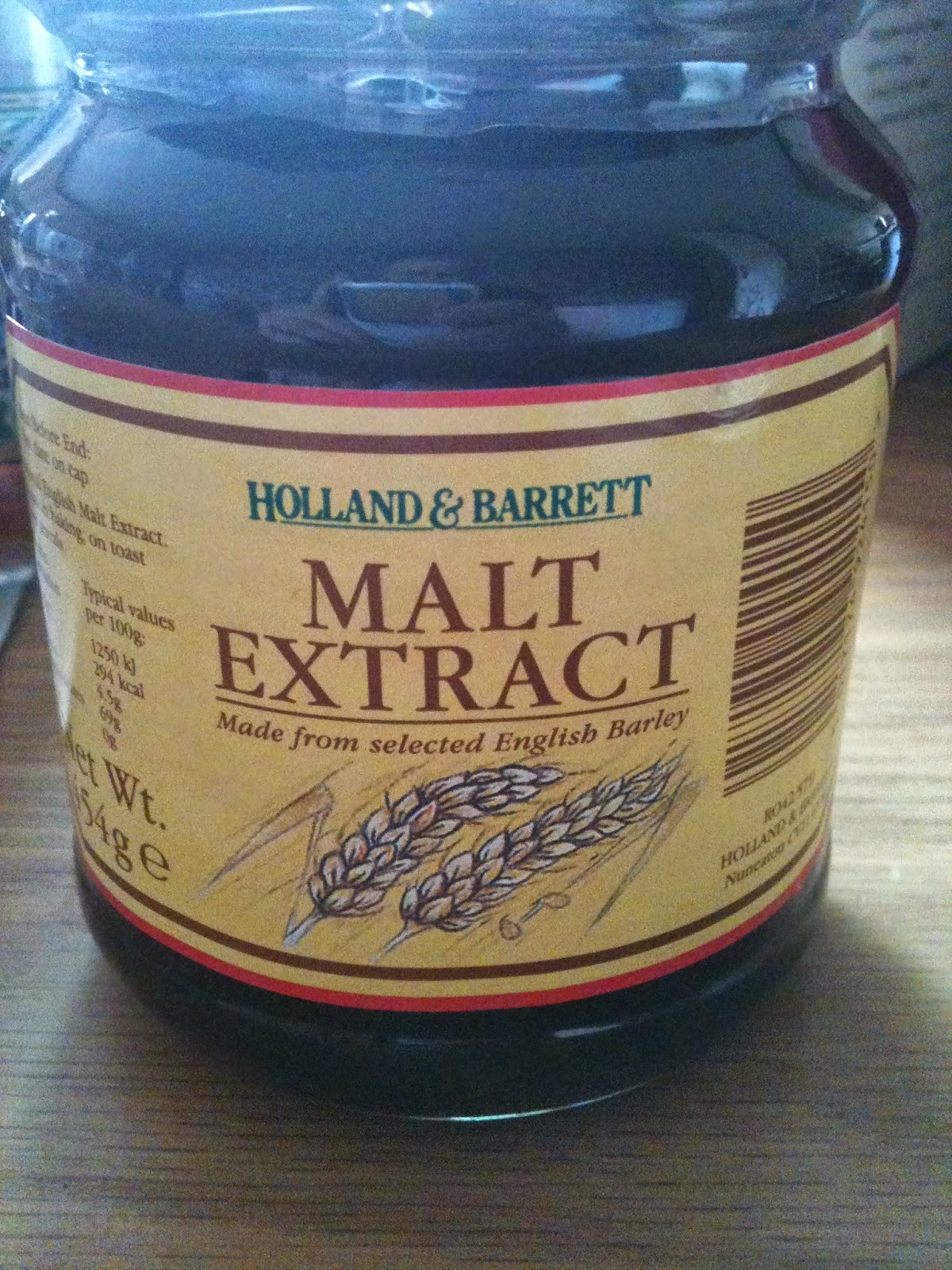
For those of you who will never meet malt, or a mash tun there is an alternative. Go to a whole food shop and buy one of these.


As best as I can estimate, this jar contains 11 fl oz of malt extract weighing 16oz, so this makes a density, specific gravity, or OG of 1450 or so. Dilute this with 4 imperial pints of water and you will have a re-hydrated wort of about OG1054.

Wort is a brown, runny, very sweet liquid that is extremely sticky when it dries. It could be described as a kind of dilute synthetic honey, that is very ancient in origin and is possibly the first process that was ever made with cereals. It could be that cereals were first cultivated, not for their staple qualities e.g. flour, gruel or bread, but instead for their status potential, sugars.

Many of the early settlements in the Fertile Crescent had special buildings with smooth floors, made of beaten earth, clay or lime plaster which are ideal as malting floors. All that is then required are containers within which to heat the crushed malt and water (the mash) to make a sweet wort. Merryn's M. Phil, entitled Barley Malt & Ale in the Neolithic (1999), looks at this, and the archaeological evidence for it, in some detail. One particular site, Beidha, was excavated in the late 1950s by Diana Kirkbride, a member of Robert Braidwood's team. She describes a smooth plaster floor with 'thousands of grain impressions'. This is probably a malting floor. The site is dated to the 8th millennium BC.

There is a Biblical expression: "The land flowing with milk and honey". Some Biblical scholars have made tortuous explanations to explain this phrase - they write about how wild bees' nests in cracks in the rocks would ooze honey in the hot sun. More informed scholars explain that this phrase refers not to bee honey, but rather to some kind of artificial sweetness, perhaps made from figs or dates, or maybe even made from grapes.

This must be because these scholars do not recognise nor do they understand that cereals can be a source of sweetness, if processed correctly.

I think that this phrase 'land of milk and honey' refers to milk and wort. It is a metaphor, or a description of a land that is good for both cows and for growing grain.

It seems that Biblical scholars have overlooked the fact that wort (liquid sugars made from the grain) was once commonplace in Egypt and Sumeria, otherwise they would not have been able to make beer. This was probably common throughout the whole Fertile Crescent and the Biblical Israel.

With the rise of Islam in this area, alcohol has been proscribed. There is no further use for malt or wort, so the practices and knowledge of malting and mashing have died out completely there. Archaeobotanists and archaeologists who have done field work on cereals in Turkey and the Ancient Near East seem to be unaware of the malting, the mashing and the wort. It is outside their experience and so it is understandable that wort has been overlooked in archaeological interpretation.

Today Bouza is made, it can be described as a type of beer, however it is a wheat based beverage made by lactic fermention. It is no longer alcoholic.

So, why do I bother to go to all the trouble of mashing, lautering, sparging, boiling and all that washing of brewing equipment? After all, it takes a whole day, a huge amount of effort. The answer is that all of the Beer Kits that I have ever used produce a beer with a kind of metallic flavour. The Kit contains a large can of Malt Extract. No amount of boiling with extra hops, or anything else will make it taste any better.

I make my beer with the simple, basic ingredients. I use traditional techniques to make the wort because I think it makes a better tasting beer. At least, when everything goes to plan, it tastes good. Even when it's bad it is often not much worse than some of the bad commercial beer available in supermarkets.

Beer is changing, with the way it is made. Some commercial beers, in cans, bottles and on draught have this unpleasant metallic flavour. They have been made from malt extract.

I was disturbed recently by looking carefully at the contents lists of commercial beers. Some like Scapa Special say that they are made from "maris otter pale ale malt", or others "a blend of pale and roasted malts". I know these are made "from the grain" and not with malt extract.

Some lagers and stouts are labeled as containing barley, wheat and oats, with no mention at all of the malt.  I can't help but wonder if they have been made from syrups, much like the high fructose corn syrup so popular in the processed food industry. This could explain the uniform blandness of some of these cheaper beers.


Monday, 9 June 2014

Ale or mead - a numerical and functional analysis

Mead is frequently mentioned in the early Germanic literature, more so than ale. This, together with the Saxon mead halls of the poetry, gives the impression that mead was widely available. Everyone drank mead because honey was widely available. However, a functional and numerical analysis does not support this.

Sugars ferment into alcohol. Mead is made from honey and ale is made from malt sugars. These malt sugars are made in the mash tun by heating crushed malt with hot water, 65C, for about an hour for the malt enzymes to convert the malt starches into sugars. In both cases the relative amounts are about the same:

2 to 3lbs of honey to make 1 gallon (Imperial) of Mead
2 to 3lbs of malt to make 1 gallon of Ale or Beer, or approximately 1kg to 3 litres.

Prior to 18th Century, bee keeping was unscientific and honey gathering was a destructive process. Thomas Wildman in 1768 describes these improvements. Traditionally bees were kept in voids of many sorts, skeps, hollow logs, and clay jars.

a traditional skep details here

The bees created their own combs inside, often cross attached. The only way to get the honey was to destroy the colony.

In 1860, L.L. Langstroth developed a design for hives with exchangeable combs and it was now possible to harvest honey without damage. Before then honey was a scarce and valuable commodity, and highly prized.

Langstroth hives - a Victorian invention details here
However malt is readily available. All that is needed is a crop of grain, preferably barley, and a malt barn to process it in.

Today honey is about 10 times the cost of malt, weight for weight. In mediaeval times it may well have been even dearer.

Bere barley is an early, primitive but very vigorous strain that was certainly grown by the early Viking farmers in Orkney and is still grown to this day. It is the only arable crop that will grow in the far North in places like Iceland. Gordon Childe noted that the impression of a grain of Bere was found on an Unstan Ware pot in Orkney, dating from the 4th Millennium BC.

Bere is a "skinny" grain. It does not contain as much starch as modern barley varieties. So to make ale from Bere malt the ratios will be more like 3-4 lb of crushed malt to make one gallon of ale

Svein Asleiferson was a renowned Viking warrior. He is mentioned in the Orkneyinga Saga. He was also known to be a fastidious farmer. He would spend the spring personally supervising the sowing of his crops, then spend the summer on raiding trips. When he returned in autumn he would again supervise the harvesting of his crops, and again go raiding until the start of winter, when he would return and spend the winter on Gairsay together with his 80 fighting men. They would probably not stay loyal and remain with him, unless he could provide some sort of hospitality for them.

I suggest that he was growing his grain to make malt and ale and not for bread, gruel or porridge.  I estimate that the warriors and retinue would drink the ale from about 4 tons of malt in this time, about 2,200 gallons or 30 barrels. This could easily be grown on 2 or 3 acres of good land, according to yield figures from Orkney Agronomy Institute. Finding 2 or 3 tons of honey on Orkney would not be easy.

It is interesting that the Viking poetry refers predominantly to mead, with very little mention of ale, whereas the Viking Sagas refer to ale far more than mead. I suggest that mead was quite scarce and highly prized, fit for the Kings and Gods. Ale was for the warriors and mortals.

this post was written by Graham


further reading

Eva Crane, The World History of Beekeeping and Honey Hunting
Eva Crane, The Archaeology of Beekeeping

The Bee Hive: a history of beekeeping

Friday, 23 May 2014

trough mashing, tridents, fire cracked stones and ale

introduction and update
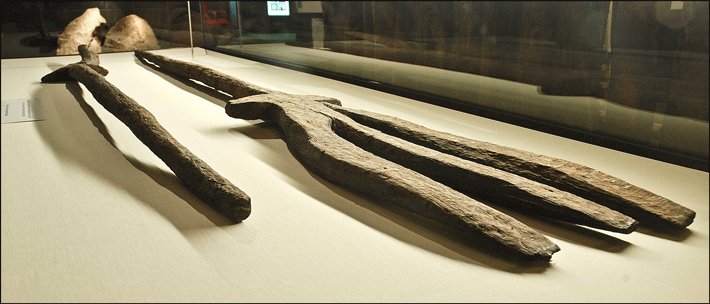
This blog discusses some of the practical and technical details of mashing in, Neolithic and Bronze Age style. It's about troughs and tridents, hot rocks and prehistoric burnt mounds. It was first published in the summer of 2014. I've edited it, added a few more details and brought it a bit more up to date. Why did I do this? Because it's now 17th February 2022 and the World of Stonehenge Exhibition has just opened at the British Museum in London. Among the 400 wonderful exhibits are two large wooden tridents, carved from solid oak and each measuring over two metres long. They were discovered near Stainton, Carslisle, in 2013. What were these mysterious objects used for? Archaeologists were puzzled. Suggestions at the time included eel spears or hay forks, neither being particularly convincing.

There was quite a lot of discussion on social media about the various possible and probable uses for these enigmatic objects made from solid oak. I'll try and find a link to it. It was a lively and, at times, argumentative discussion.

One suggestion that Graham and I made at the time was that these wooden tridents were ideal as mash forks, a traditional tool used for stirring the crushed malt into hot water in the 'mashing in' part of the ale and beer brewing process. Initially the idea was met with some negativity and suspicion. However, it now seems to be one of the accepted interpretations and, I am pleased to report, is included in the newly published book of the 'The World of Stonehenge' Exhibition:

"The tridents may have been used for fishing or eel trapping, or in agricultural activities as hay forks, and even as mashing forks in the process of beer brewing. It is likely that farmers were using some of their cereal harvests to make alcohol for social and religious gatherings rather than consuming only sober porridge and savoury foods." 

(Garrow, D. & Wilkin, N. The World of Stonehenge, published by The British Museum, 2022 page 50)

Neolithic-wooden-trident
(© Tullie House Museum and Art Gallery Trust)
This image is from a news item in Archaeology, Friday December 6th 2013. see:https://www.archaeology.org/news/1610-england-neolithic-wooden-tridents

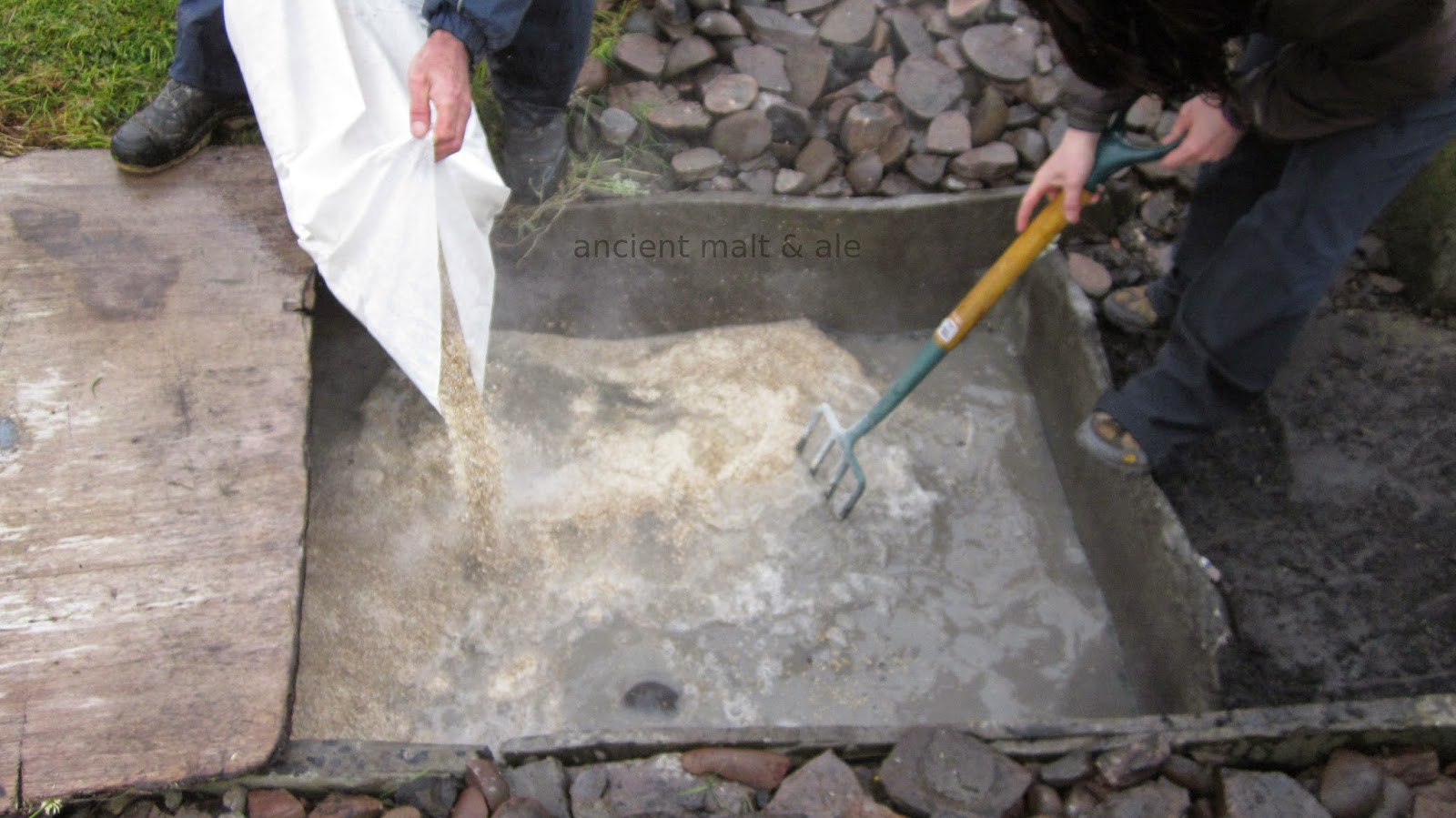
At the World Archaeology Conference (WAC 6) in Dublin, 2008, archaeologists from the Moore Group demonstrated how to mash in a wooden trough using fire heated stones. They used a garden fork to transfer the stones into the trough.  Inspired by their brewing experiments Graham and I mashed in a replica stone trough at Bressay, Shetland, the site of a Bronze Age burnt mound, in the summer of 2011. We used a garden fork to stir the mash and, at the time, we wished that the handle of the fork could have been longer. Something like these tridents would have been perfect for the job. See our blog trough, mash and wort for more details of these experiments and demonstrations.

These two wooden tridents were carved from single pieces of oak and would certainly have been sturdy enough for the task of stirring the mash in a trough in the ground. They would also have been suitable to remove hot stones from a fire, transferring them into the trough of water in order to heat it and maintain a good mash temperature. The tridents have been dated to c3650 BC and were found in a palaeochannel at Stainton, a site associated with burnt mounds and much more. See here for more details of the excavations. 

And now, after this updated introduction, let's go back to the blog that we wrote in the summer of 2014:

what is a burnt mound?  

In Ireland, over 5000 burnt mound sites are known. In Scotland, about 1900 have been excavated so far. They also found in England and Wales. The burnt mound itself is a pile of fire reddened and cracked stones, often in a semi-circular shape as they have been thrown onto the heap. The stones were put into a fire to be heated up, then dropped into a trough of water in order to heat it. There are many things that hot water can be used for.

Archaeologists agree that burnt mound sites are something to do with hot rock technology - using hot stones to heat lots of water - but to what purpose? That's what archaeologists can't agree on. There have been several suggestions:

- they were used to cook meat. The idea is that you wrap a big piece of meat in straw and leave it in the heated water trough for several hours. You probably have to keep putting more hot stones in, as the water cools. There are easier and more efficient ways of cooking meat.

- they were a sauna or sweat lodge. I don't understand this. In my experience, a sauna has a few hot stones upon which water is splashed to make steam. You don't need a large trough of water and lots of hot stones.

- you can wash sheep fleece or wool in them. This seems to be a practical idea. Fleece must be washed before it is spun into wool for clothing.

None of these suggestions are controversial. Most people reckon that the troughs would have been multi functional - a bit like the kitchen sink only much bigger. When it was suggested that these sites could have been used for making beer, some archaeologists became ever so slightly annoyed. Although the idea was first put forward in 2007, backed by successful experimental work and sound brewing theory, it is still considered by some to be controversial. I don't know why. 

Hot rocks are ideal for heating large amounts of water to the perfect temperature for mashing, which is between 65 and 67 degrees Centigrade. Getting the water much hotter than this is very difficult. We found it impossible to get the water to boil. 

troughs as mash tuns
The possibility that they were used in the making of ale or beer was first suggested by Declan Moore and Billy Quinn of Moore Archaeological and Environmental Services Ltd. I first met them at a Conference about beer and brewing in prehistory and antiquity, held in Barcelona, October 2004. I gave a paper about the importance of malt in the brewing process. Billy and Declan asked me whether it was possible to make beer in a hole in the ground. We agreed they should have a go.

The following year, they came to Orkney to meet Graham and to learn a bit more about how to make ale and beer from the grain. They tasted the wort and were surprised how sweet it is. They tried Graham's beer and liked it. Then they went back to Ireland to do their own research into hot rock mashing in a trough. It went extremely well, and led to their now famous video on You Tube. They wrote an article for Archaeology Ireland and there have been several more articles online since then. The details of their subsequent work are on their web page.

They gave a demonstration of the technique at the Sixth World Archaeology Conference in Dublin, 2008. I was lucky enough to be there and it was spectacular. The smoke, the steam, the hot stones and the aroma of the mash! All of these things added to the magic and drama of the demonstration. If an archaeologist is looking for an impressive show of ritual, power and transformation in prehistory, then a hot rock mash ticks all the boxes. 

One day in the summer of 2009, I got a phone call from Billy. He told me that a trough with grain in it had just been found in Wales. The well preserved trough, with wood lined water channels, was excavated by Dave Chapman of Ancient Arts who went on to do some mashing and brewing experiments of his own. He was successful, as reported in British Archaeology news.

We had to try this for ourselves. So far, we had been mashing small amounts of crushed malt in earthenware bowls. It was clear that the 'hot rocks in a trough' technique worked much better. Graham made a small wooden trough, about one third the size of the real ones, and we had some fun mashing with hot stones. It is best to use stones from the land. Rocks collected from the beach explode when being heated in the fire. This is very dangerous.

We had an opportunity to mash in the replica trough at Bressay, Shetland in the summer of 2011. The same trough that was used to experimentally wash fleeces. We cleaned it well and luted the corners with local clay, to prevent water leakage. This explains the grey colour of the water in the photo below. There was initially some concern that there might be a problem. It turned out to be the clearest, sparkliest ale we have ever made. Bentonite powder, a derivative of clay, is used today to clear wine and beer.

the strike: 50 kg of crushed malt is added to about 250 litres of hot water in the replica Cruester trough, Bressay, Shetland.
We used a garden fork to stir it about.
 
A successful mash. Adding a few hot stones kept the mash at an ideal temperature for the conversion of starch into sugar, which took about an hour. We put a piece of wood over the trough for heat retention. 

crushed malt & water transformed into 250 litres of wort in the trough, enough to make plenty of ale for a feast.
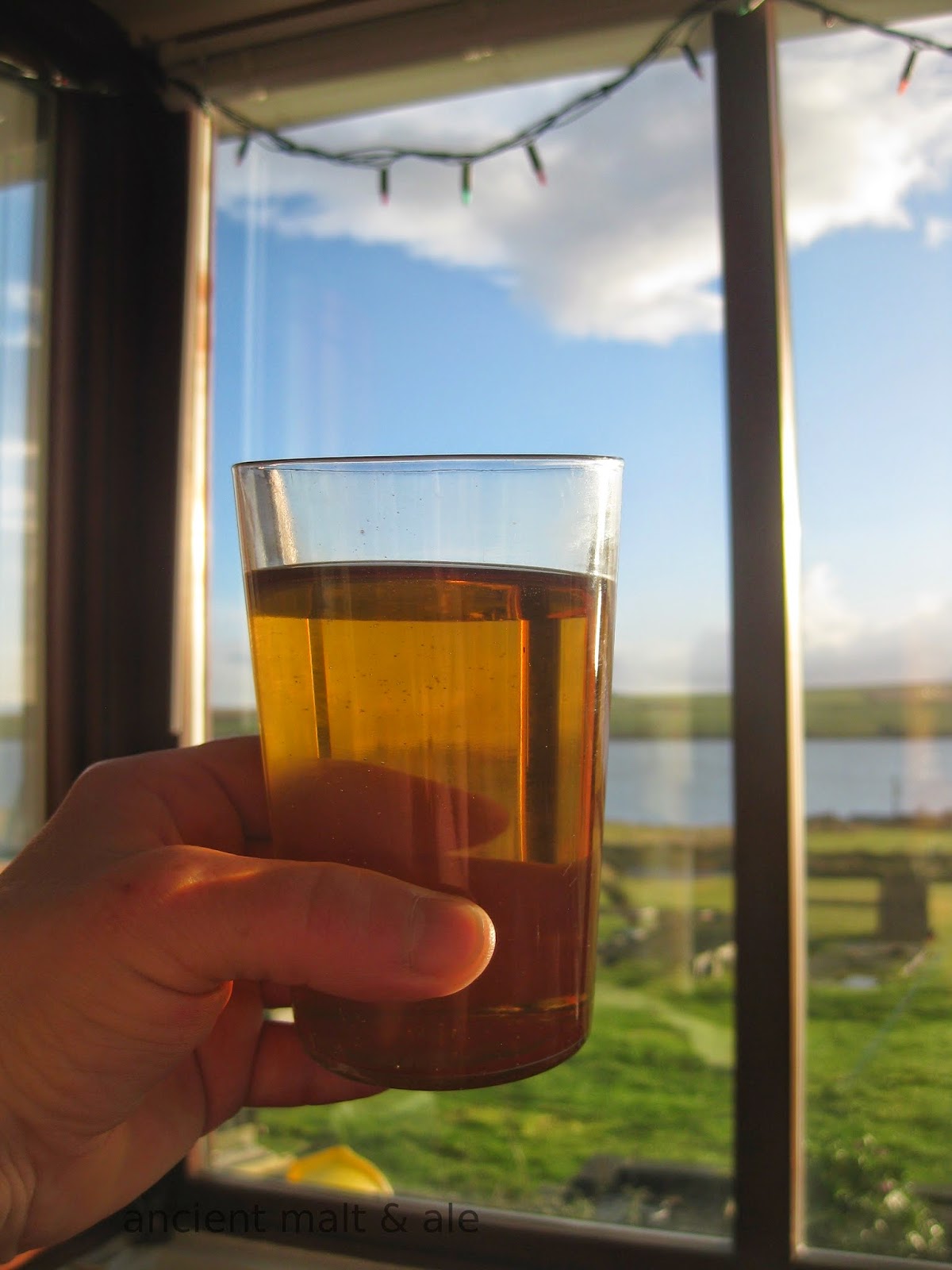
cheers! our clear and bright Bressay Ale.

After taking some of the wort from the trough using jugs, we added brewer's yeast and fermented it for several days. We only had one fermentation vessel, so we could not make use of more than 6 gallons of wort.

Next morning, when we went to empty and clean the trough, all the wort had drained away. Only the spent grain was left. Although we had clay luted it, the reconstructed trough is above the local water table. Meadowsweet flowers, about an ounce and a half, were added to the 6 gallons of wort when it had finished fermenting. Also, we had a ferry to catch and so our time was limited.

The result was a strong, clear ale. You can see all the pictures of our Bressay mashing and brewing adventure on my Facebook page. The ale kept really well.

We bottled it and sent some to the Past Horizons people to taste. It did take a while to open the parcel, but I think it was probably worth it.


neolithic burnt mounds, wooden tridents and fire cracked stones
There are excavations taking place in Northumberland, not far from Bamburgh Castle, organised by the Bamburgh Research Project. Several burnt mounds have been excavated and archaeomagnetromic dates that have so far been obtained indicate that these burnt mounds were in use during the Neolithic. Pottery finds support this interpretation. The dates obtained so far are 6,230 +/- 50 years BP at 95% confidence. There is a good summary of the excavations here.

St.Arnoldus.jpg
Bishop Arnold of Soissons
In December last year, there was much discussion and argument on social media about some neolithic wooden tridents that had been found at a multi period site in Cumbria, which included several burnt mounds. What were these long handled wooden 'forks' used for? Fish prongs? Or maybe they were used for catching eels? Interpretations varied amongst archaeologists.

We think they would be a useful implement for stirring the crushed malt into the hot water - the strike. The crushed malt, also known as grist, clumps together when it is being added to the hot water. It is important to stir it about. It is also necessary to stir the mash when you add more heated stones. You don't want to have hot spots, you want to maintain an even temperature throughout the mash. The fork can also be used to move the hot stones about in the trough, if necessary.

In the Bressay trough, we used a garden fork. The handle was far too short and a long handled wooden trident would have been ideal.

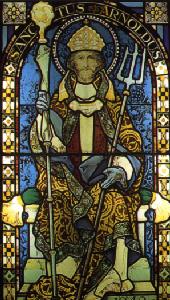
Bishop Arnold of Soissons (who lived from 1040 to 1087) was the patron saint of brewers in Belgium. He is depicted with Bishop's mitre and a mash rake, which looks very much like those neolithic wooden rakes excavated in Cumbria.

Several neolithic buildings have been excavated at Kingsmead Quarry, Berkshire, England, by Wessex Archaeology. They have been interpreted as houses. This site is another very complex, multi period discovery, with finds ranging from the mesolithic, neolithic and Bronze Age through to post medieval structures.

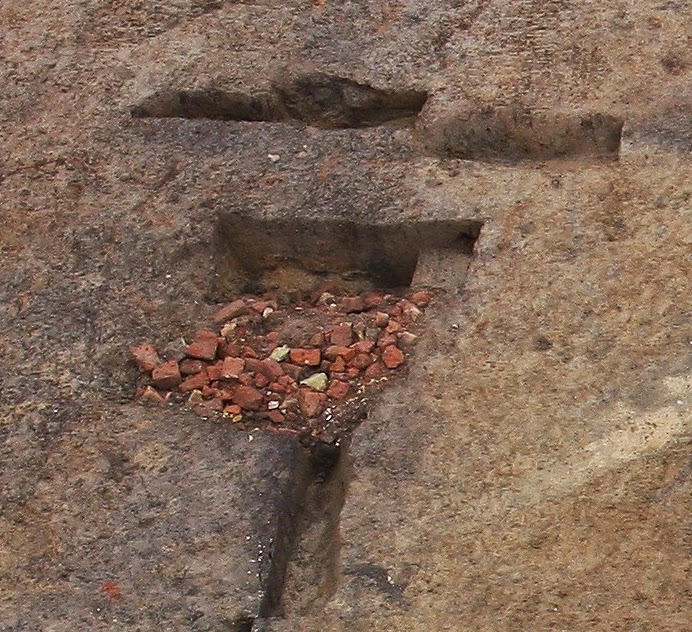
One of the four neolithic rectangular timber buildings, or 'houses' at Horton caught our attention when we were looking at the images online. There seem to be some fire reddened rocks close by the trenches that reveal the outline of the building in the photo below. What are they? They look rather like modern bricks, but the stratigraphy indicates that they are contemporary with the building. Are these stones an indication of hot rock technology at neolithic Horton? If so, exactly what were they doing in and around this wooden building, over 5000 years ago?

the footprint of a neolithic rectangular timber building at Horton, Kingsmead Quarry, with a big pile of fire cracked stones.
Details of the excavation here.


We looked through the reports online but could not find a reference to them. Quite a mystery! Graham managed to enlarge the section of the image with the rocks in and here it is. In close up they look even more mysterious. We look forward to reading the full excavation report to see what the interpretation of these rocks might be.

a close up of those mysterious fire reddened stones.

We would love to hear your ideas about burnt mounds, troughs, mash tuns and the possibilities of hot stone technology. This technique, of heating water and the mash with hot stones, is so successful that it has been done from the Neolithic to Viking times. Some burnt mounds provide dates that indicate this.

Monday, 19 May 2014

desperately seeking sugars

A few years ago, we were standing beside the trench of an excavation on Orkney. Lots of serious digging was going on. One of the diggers looked up, recognised us and said something like...

oh hello! Are you those brewing people?

Yes, that's us. 

Can you tell me how to make Heather Ale?

Of course, we replied. No problem.

Because we've got loads of heather growing around our house and we want to make some beer with it! 

But you can't make beer from flowers, we replied. Flowers provide the flavouring, the preservative ... you have to add sugar. That's what ferments into alcohol. 

beer made from flowers?
We began to think that, maybe, when some archaeologists had come across our work on prehistoric brewing and heard about our ancient style meadowsweet ale, they thought that we had made it from meadowsweet flowers. We had not considered that before. Later that month, our suspicions were confirmed when we did a prehistoric brewing demonstration at a neolithic feast, organised by the Orkney Archaeology Society. I think it was in 2008. Over an open fire, with just the hot ashes, we heated some water in an earthenware bowl. It was our mini mash tun.

When the water was clear enough for us to see our reflection, we knew it was the right temperature.We added the crushed malt. This is known as 'the strike'. The local hens came running when we got the malt sack out of the van. Soon, there was the sweet aroma of the saccharification, this is when the enzymes re-activate in the mash tun and turn grain starch into malt sugar. It smells delicious. Folk began to wander over to find out what was going on. Some of them tasted the mash.

We were asked how much sugar we had added. None, said Graham. All the sugars come from the malted barley in the mash tun. No, go on, there must be some added sugar in there! No, we assured them, there was no added sugar. Later a couple of ladies asked how many flowers we had used to make our ancient brew. The answer was about an ounce and a half for five gallons of ale. They walked away, shaking their heads in disbelief. I am quite sure that they had confused what we were doing with making a flower wine.

Check out the recipes for "country wines" online - they all have a couple of pounds of sugar per gallon in the list of ingredients.

Quite simply, it is not possible to make ale or beer from flowers.

beer made from birch sap? 
Birch sap contains very few sugars, less than one per cent. It is more like a sweet water. You could collect a lot of it, then boil it to make a syrup but it is hardly a practical way of obtaining sugars for fermentation. John Wright, writing in the Guardian, explains how to make birch sap wine. The ingredients include 1.8 kilos of sugar and grape juice concentrate.

beer made from bread?
Some archaeological and anthropological sources suggest that beer and ale were made from bread in ancient times. There is a common myth that beer was discovered when a loaf of bread fell into a bucket of water and fermented overnight.

If it was really possible to make beer from bread in ancient times, then why aren't we doing it now? Surely people would be queuing up to buy loaves of bread so that they could throw them into a bucket of water to ferment for a few days. Home brewed Egyptian beer. It might taste horrible. It might be a bit weak and sour. But that's what it was like in the past. Wasn't it?

Sorry to disappoint you, but it is not possible to make beer from bread. The biochemistry does not allow it. There are no sugars in bread to ferment into alcohol. However, a quick search on the internet shows how the idea that bread can be somehow transformed into beer still prevails. There are lots of different methods suggested. Here is just one example:

" Barley was used to make beer. The barley was combined with yeast and made into a dough which was part-baked in a stone oven. It was then crumbled into a large vat, mixed with water and allowed to ferment before being flavoured with dates or honey. Recent evidence suggests that barley malt may also have been used in the process.www.historyonthenet.com

If you crush the barley into flour, then make a bread you have destroyed the fabric of the grain. There is no possibility of germination, no possibility of starches being turned into sugars. No beer or ale. Baking in a hot oven alone would be enough to destroy any enzymes. It would also destroy the yeast. This method would not work.

The recent evidence, referred to above, is that of Delwen Samuel. Analysis of residues on 3000 year old ancient Egyptian pottery showed erosion pits from the enzymatic action in the the individual starch granules. This proved that the grain had begun germination - it was malt.

Delwen Samuel's papers are available online. In 1997 she published 'Fermentation Technology 3000 years ago. The Archaeology of Ancient Egyptian beer'. The scanning electron microscope images of pitted starch granules can be seen there.

beer is made from malt
To make ale or beer, you need malt. This is grain - barley, wheat, oats or rye - that has begun to germinate. Germination stimulates the production of the starch converting enzymes. Making malt is a specialised craft in itself. There is far more to it than soaking grain in a bucket, then letting it sprout. The two crafts of maltster and brewer are separate today. The maltster supplies the brewer with malted grain.

mashing 
The brewer heats the crushed malt with hot water in the mash tun to make malt sugars. Sugars ferment into alcohol. It's a simple but very obvious thing. Over the years, we have given demonstrations of what happens in the mash tun, of how the crushed malted grain is heated up gently, to make malt sugars. This is known as the mash, or saccharification - the enzymes in the malt are active at about 65 to 67 degrees Centigrade, so this is the temperature to aim at in your mash tun. 

The mash tun can be an earthenware bowl, heated in the ashes of a fire. We have done this many times, the image below is from a demonstration at Eindhoven Museum. I went there in 2009, as part of a brewing forum organised by EXARC.

a mashing demonstration at Eindhoven,

Or the mash tun can be a wooden trough in the ground, heated by hot rocks. We have done this several times. The pioneers of the technique are the Moore Group archaeologists. The video of their hot rock mash in a wooden trough, first done in 2007, is now legendary.

Given that thermometers are a recent invention, brewers in the past learned how to judge this temperature by skill and experience. John Tyndall, giving a lecture on Fermentation at the Glasgow Science Lectures Association, October 19th, 1876 said

"Our prehistoric fathers may have been savages, but they were clever and observant ones ... the art and practice of the brewer are founded on empirical observation ... the brewer learnt from long experience the conditions not the reasons for success" 

In the scholarly literature and in many of the archaeological and anthropological academic papers about making beer in ancient times, a wide range of beer making ingredients have been suggested - barley, wheat, dates, figs, fruit, berries, birch sap or birch syrup, honey or flowers and leaves.

All that any brewer needs to make ale or beer is water, malt, herbs and/or hops and yeast.

Wort is the sweet liquid that comes from the mash tun after sparging. The exotic ingredients of the scholarly papers can enhance the ale in several ways, by preserving, flavouring or by providing medicinal or other properties. But they do not provide the primary fermentable sugars. This comes from the grain, which has been malted, mashed, lautered and sparged. Barley is a reliable source of sugars for fermentation. You just need to know how to make it.

There is no need to go desperately seeking sugars.

Just understand the malt, the mash and the saccharification that occurs in the mash tun.


further reading
The Big Book of Brewing by David Line
In our opinion, this is the best book to read on the processes of malting, mashing, lautering, sparging and fermentation.

------------------------------------------------------------

two years later 
I went to a talk recently, it was about the neolithic, grooved ware and the use of pottery. My impression, after talking to several archaeologists, is that it still seems to be a widely held belief among archaeologists that 'alcohol production' in prehistory was no more than guesswork. It involved mixing up random stuff to make 'something alcoholic that did not taste very nice'. No skill involved.