Showing posts with label barm. Show all posts

Wednesday, 3 November 2021

Barm and the magic spoon. Godisgoode. ( part two )

This post is written by Graham Dineley, the brewer. The opinions, mistakes and misunderstandings are entirely my own, and I welcome corrections.

What is our research all about? Well the clue is in the Latin name for brewer's yeast "saccharomyces cerevisiae", a sugar fungus of beer. Only sugars can be fermented into alcohol, not starches. Cereals can be tricked into digesting themselves into malt sugars by malting and mashing. Malting is the careful and skilful controlled germination of the grains. Mashing is skilfully providing those malted grains with hot water so that their enzymes can complete the trick of saccharification, making sweet liquid wort. Anyone who talks about making ale or beer and does not mention those sugars is missing something crucial, the key ingredient. These malt sugars in themselves are very palatable and attractive and this is why the "first farmers" grew cereals. For the sugars. Once you have those malt sugars then alcoholic fermentation is an inevitable consequence and this also attractive.
https://merryn.dineley.com/2018/03/mashing-and-bit-on-fermentation.html
When this post was first started nearly five  years ago, I thought I knew a little bit about yeast. Then things happened that made me realise just how small that little really was. I picked it up again in March 2020, but never got around to publishing it yet again. Procrastination. So I must also update this prefix.

Brewing historian Lars Marius Garshol discovered kveik. Follow this link to read more about Norway's now famous farmhouse yeast, it's a great article by Claire Bullen on the Good Beer Hunting blog.

He also discovered the kveik yeast ring, which is the "magic spoon" on steroids.

These can now be bought from my favourite "goods" supplier The Malt Miller.

Back then I had looked forward to working with kveik. It seemed to have the qualities of my once favourite bakers yeast. 

I have now had the privilege of using two kveiks generously provided by Lars Marius: Espe #20 and Rivenes #2. I can confirm that Espe is a vigorous high temperature yeast that imbues the beer with a fruity plum like flavour. It was very tasty.

Also my favourite bakers yeast changed into a bread making yeast, and became unusable. It stubbornly refused to drop out, even after four weeks settling, the taste is still "muddy". It still does the same today and is no longer fit for my brewing purposes. I now use a commercial brewers packet yeast that has a wonderful coagulating and clumping action.

On the left is the baker's yeast, middle is bread makers yeast and right the commercial yeast. The bakers yeast changed before the packaging did. This confused me at the time.

I also looked into sourdough because so many people have said that it can be used for brewing. Mostly not, because it is a different fermentation mostly lactic, but some sour-doughs do contain Saccharomyces Cerevisiae. Sourdough is a whole other warren full of wonderful rabbit holes, if one has the time and curiosity to study it.

I am prompted to publish it now because of two recent experiments, where people have tried to recreate ancient brews and have relied upon the vagaries of "wild wind borne" yeasts. This "wind borne" yeast is an archaeological myth that will not die.

The first is the Dietrich's experiment to recreate a Gobekli Tepe brew. If you look closely you can see that their "beer" has a greenish tinge (page 17). Click on the link above to read their paper. It must have been made with sprouted grain. 

I wonder whether they managed to make any malt sugars to ferment. I'm not so sure that they did. This is another archaeological myth, that malt is sprouted grain with green shoots. For a discussion of this see my blog, where there is a picture of archaeological malt from the Plant Cult workshop on Ancient Beer. Merryn was invited to present a paper at this meeting in February 2019, however, due to illness she was unable to attend. Fortunately, she has just published an article based upon this presentation. It is called 'The Ancient Magic of Malt' and you can read it online in the EXARC Journal here.

The second experiment is a Czech scientist brewing a 3000 year old "beer", using millet and potato? starch. What no malt? So no sugars! It must be a lactic fermentation and not lambic. Wild yeasts are notoriously unreliable. The beer was sour, like lemons. Chemist Lukáš Kučera from the University of Olomouc brewed the "beer". He says of his recreated brew:

“What makes this beer specific is that it needs to be fermented with wild yeast. You cannot buy this type of yeast in a shop. That's why I purposely fermented the beer in the vicinity of apples.

“The beer has a characteristic acidic flavour that will remind you of cider or wine, rather than beer. It has the colour of beer, it smells like cider and tastes a bit like lemon.”


Both of these two experiments also rely upon the widespread misconception, or myth that it is easy to capture a wild yeast that will start an alcoholic fermentation.
I do not rely upon this myth. On the two occasions that we demonstrated mashing and have got back too late to deal with the mash that day, we have left a the mash overnight.
Both times we have found the next morning that the mash is sour and fizzy. They had become infected with a lactic fermentation. It is impossible to make a mash with primitive equipment  and keep it hygienic. To effect a decent fermentation it is necessary to inoculate the fresh wort with a vigorous yeast starter.

I am beginning to suspect that the root cause here is that there is widespread confusion and misunderstanding about fermentation. That there is only one kind, and this would lie behind the idea that one can ferment anything. There are many kinds of fermentation, but the two most commonly encountered are lactic fermentation, e.g. sauerkraut, and alcoholic fermentation, turning sugars into alcohol, e.g. wine and beer.

Professor Keith Steinkraus has written a definitive book about fermentation and here is a good paper.


So here are some random ramblings about yeast, slightly updated.
------------------------------------------------------------------------------------------------------------------------------------

Apparently Saccharomyces Cerevisiae is a "killer" yeast, that is, it secretes toxins that inhibit the growth of other yeasts and bacteria. This is how it can predominate given favourable conditions. How it does this is fascinating.

How it replicates is even more interesting. It has two forms, haploid and diploid. Both forms normally replicate by mitosis, they bud daughter yeast cells. Under stress, e.g. drying, the haploid form normally dies, but the diploid form sporulates, that is it produces spores. These spores can then mate to provide new yeast cells and this gives it the chance to hybridise with other yeasts. This doesn't happen very often, but it can lead to new strains and varieties with different properties.

From wikimedia.


The spores can be wind and air borne on dust and insects. This became obvious to me in our last house in Manchester. After about 12 years of brewing and washing equipment there, any sweet juice drinks left out overnight by the kids in the summer months would be slightly fizzy by the morning, as did any yoghurt.

It was obvious to me that the yeast had established itself in the microbiome of the house, along with 130 years worth of other micro-organisms. This sort of thing must happen in every brewery, no matter how much attention is devoted to hygiene and sterility.

Airborne yeast.

Recently I was listening to a radio interview about the archaeological discovery of the earliest physical evidence for beer in Britain, a fourth century BC site by the A14 near Oxford. Apparently examination of carbonised cereal residue found "micro structures of remains had changed through the fermentation process and air bubbles are typical of those formed in the boiling and mashing process of brewing". What!? This makes absolutely no sense to me, the processes are in the wrong order. Where did they get this from? Did it come from the academic literature, or did they just make it up, or perhaps both?

The beer writer said something like "It would have been a wild yeast. It would be wind borne, and so it would taste like this Belgian Lambic Beer".

I thought to myself, that is three naive assumptions in a row.

1) I would never trust the vagaries of the wind to get the right yeast. These people should know how to manage yeast if they were making beer regularly.
One thing learnt from our ancient brewing research is that if one uses "rustic" methods to make a wort, it is already heavily infected with all kinds of things, mostly various lactic bacteria. If one is making raw ale, that is unboiled ale, then one has to quickly overcome these infections with a vigorous ferment.

2) The Belgian Lambic beers are air inoculated, not wind inoculated, as is shown by the Cantillon brewery. When they refurbished their brewery with a new roof they found that the open wort would not ferment, like it used to. They had to put some of the old roof tiles back into the roof fabric to maintain the ferments, so the microbes are coming from the building and not the wind.

3) That particular Belgian flavour of beer is a local tradition and is not universal.

Windborne yeast.

In the late 80s I was following an American e-mail brewing discussion list digest. I was surprised and intrigued by one post. A brewer had visited a Founding Fathers re-enactment settlement, and he spotted a hop plant. When he asked what it was for, the lady replied that it was to make hop-tea to capture the right yeast for making bread. This means that there was a pre-existing Saccharomyces Cerevisiae in North America, suitable for both baking and brewing before brewing had been established there. I have heard that this was a common practise in North America, particularly on the West Coast, until the advent of dried yeast, and the rail-roads.
Perhaps this was a close relative of S.C. Californiensis that is found in some sourdoughs.

It is an experiment I have often thought about, could I capture the right yeast here on Orkney with a hop tea.

Hybrids.

In 1980 I was still living in shared accommodation and for convenience I was making beer from kits. At work we had a retirement celebration for some colleagues and one of the refreshments was a polypin of Pollard's Ale. Beer writers and bloggers Boak and Bailey have written a blog about Pollards.

Pollard's beer had a very distinctive, dry almost musty flavour, that was very popular. At the end of the celebration there were a few pints left with the lees ( sludge at the bottom). So I took it home and added it to a 5 gallon kit brew that had just finished primary fermentation. I expected it to settle out, but instead it took off with a very vigorous fermentation and a strong sulphurous aroma that lasted just over a day. The Pollard's was obviously metabolising something that the kit yeast had not. The resulting beer had that distinct Pollard flavour too. I have often wondered if that was a hybrid yeast. Pollard's ales did not last that long, despite being very popular. The story that I heard at the time of it's demise was that they had lost that unique yeast, and with no back up brewery to restore it, that was the end of Pollard's. 

Saccharomyces Carlsburgensis has been said to be a hybrid of an Ale yeast and a Patagonian forest yeast, or even two forest yeasts. Another story I have heard is that it is a hybrid with a Mongolian desert yeast. I don't know, but here is a link to an early use of Saccharomyces Eubayanus:

https://www.atlasobscura.com/articles/found-the-earliest-evidence-of-lager-yeast-being-used-to-make-alcohol

SPECULATION

One thing that intrigues me still is the Bronze Age practise of burying cremations in large ceramic "food vessels", because they are always found upside down. If these pots were used for fermentation, then it would make good sense to store them upside down when not in use. This would dry the yeast residues and protect them from dust, so that when reused these pots would spontaneously start a ferment. They would then be considered special, maybe even life giving, and this would make sense for a burial, a kind of sympathetic magic.


Sunday, 17 July 2016

big pots: fermentation and storage

Brewing ale in Neolithic Britain - it seems to be a controversial topic among some academic archaeologists. I'm not sure what the problem is with malting and brewing ale in the neolithic era. It could be that few people understand the processes involved in the transformation of grain into malt, wort and ale.

If you have come to this page via the BBC Earth website, or from the Stone Pages, please be aware that the comments attributed to me there are wrong. I have no idea where they came from, other than as a misunderstanding. I hope for a correction in the near future but so far I am not having much success.

Roasted malts, also known as specialty malts, are a feature of modern industrial malting. I'm working on a blog about that at the moment and will post a link to it when I have completed it, hopefully before the Yule celebrations of 2016!

The last few posts have been about explaining the saccharification in the mash tun, where the crushed malt, when mixed with water and gently heated, is converted by enzymes into malt sugars. I've also written a little about lautering, sparging and how to collect the wort.

We've been asked 'why not ferment in the trough. Why go to all the trouble of trying to collect a wort without bits in it?'

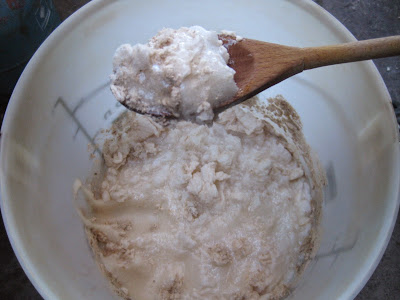
Firstly, alcoholic fermentation requires anaerobic conditions. A large vat (1000s of litres) within a building has a blanket of carbon dioxide over the fermenting beer, as in lambic brewing. A small trough (100s of litres) situated outside would have this blanket blown away. Secondly, during fermentation, the little bubbles of carbon dioxide produced by the yeast, stick to the smaller particles and lift them into the froth of the barm. You can see the towering barm in the picture below. It can turn into a really messy monster when it has a lot of little bits in it. After fermentation you would still have the problem of straining or filtering what brew has not been lost to the froth-over. That is a lot harder with little bubbles in it. A bed of husks will not form properly and filtering just doesn't work. 

Inoculating the wort: starting a fermentation
Once the brewer has obtained a quantity of wort by mashing, lautering and sparging, the next stage of the brewing process is the fermentation. Whether you mash in a large pot, a wooden tub with a spigot hole, in a trough in the ground or in a modern mash tun, the wort that you make must be dealt with promptly to prevent infection setting in. Wort does not keep well. Either you boil it, as is necessary with hops, and then cool and inoculate with yeast at the right temperature. Or you can inoculate a fresh wort when it has cooled, and then add the herbs. We found that meadowsweet flowers inhibited the yeast and are better added after the fermentation. To find out more about raw ale which, basically, is beer made from an unboiled wort, I suggest a look at this blog. Raw ale is a huge topic in itself.

fermentation in close up, this is the barm (foam) on a fermenting beer

There are a number of ways of adding the yeast to the wort to start the fermentation. Today, the brewer can add yeast directly, in dried form or as a yeast starter, when the wort temperature is just right. Many modern breweries keep their yeast starter in a fridge. They scoop some of the barm (foam) from the top of the fermenting beer and then store it in a cool place until required. The yeast culture can be kept and used for several months. 

Brewers in history and prehistory could also have used this simple and basic technique, keeping their barm/yeast culture in a cool place. In the 1980s, archaeologists found a medium sized grooved ware pot which had been sunk into the ground in the remains of one of the buildings at Barnhouse, Orkney. The pot, about a litre in volume, had been buried up to its' rim. Analysis revealed that it had contained some kind of 'cereal based mixture', but they were unsure about the pot's function. I think it may have been a barm pot. It was located in a large building, numbered eight by the excavation team and interpreted as a 'temple' or some other kind of ritual building. There were drains as well as many sherds of broken or smashed Grooved Ware pottery, representing pots of about one litre in volume. There was also evidence of feasting and what archaeologists refer to as 'ritual activity', although what that was is not made clear in the excavation report.

I would say that if an archaeologist is looking for a prehistoric ritual activity then the mysterious and magical transformation of grain into malt, wort and ale is well worth considering.

In Norway, Lithuania, Latvia and other places, the tradition of making farmhouse ale survives, with brewers passing on their skills, techniques and knowledge to their descendants. Old traditions of inoculating the wort are still practised in several areas of northern Europe. The picture below shows a wooden yeast ring or kveikering being used to inoculate a yeast starter.

wooden yeast ring or kveikering (photo from the beer blog of Lars Garshol)

Some sources say that the tradition of the kveikering dates back to the 18th century, although I wonder whether the concept might date even further back. It's difficult to be sure because, of course, a wooden object used to gather yeast and start a fermentation would not survive in the archaeological record. In the Viking era, apparently, a stick was used to stir the fermenting wort. This would put yeast onto the stick. Then, if it was kept dry, it could be used to start the next fermentation by stirring a fresh wort. In the Western Isles of Scotland there is a tradition of stirring the fermenting beer with a hazel stick (or wand) which is then hung up to dry and used to stir the next batch of wort, to begin the fermentation.

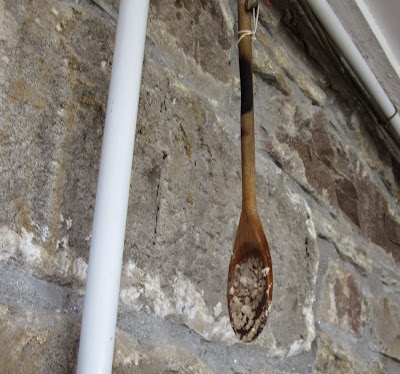
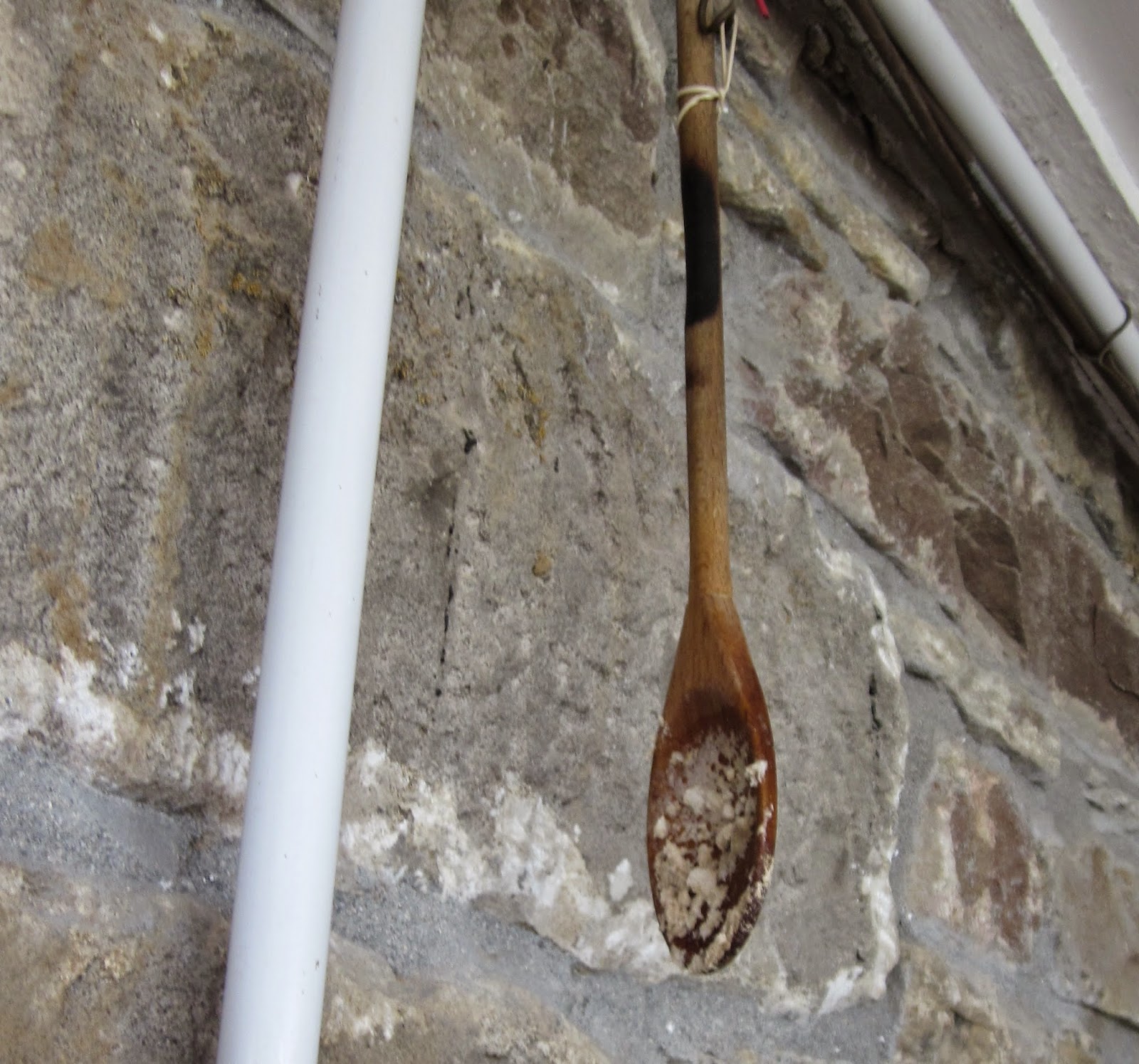
We did some experiments using a wooden spoon and found that this technique works perfectly.

harvesting barm from the fermentation vessel
barm/yeast drying on the wooden spoon (more photos here)

Big pots as fermentation and storage vessels.
The neolithic era was the time of the 'first farmers'. The earliest grain agriculturalists of the British Isles (c4000BC onwards) were also the megalith builders. They created magnificent stone circles and henges as gathering places for the community. They built stone tombs for their dead and they began to settle down. Associated with the 'first farmers' is the integrated 'cultural package' of grain cultivation, the management of domesticated animals (cows, sheep, goats and pigs) and the manufacture of ceramics. This was the 'neolithic revolution', a different lifestyle to the mesolithic hunter gatherers who had roamed the land for thousands of years previously. At this time in prehistory, the technology for making large stave built wooden vessels (vats, tubs, barrels) did not exist.

How did these neolithic 'first farmers' process their grain? Were they grinding it into flour, to make bread? Were they boiling it, making some kind of gruel or porridge? Or were they making ale from it, by malting, mashing, sparging and fermentation? For some reason, the possibility that such a thing as ale in the neolithic is considered to be a controversial idea by many archaeologists. I'm not sure why. 

Some of the large neolithic Grooved Ware pots might have been used as fermentation vessels. They are perfect in both shape and size. One particularly large Grooved Ware pot found at the neolithic village of Skara Brae, Orkney, was around 30 gallons in volume. Most of the large Grooved Ware pots were around eight to ten gallons. They are found at many ritual and feasting sites of the neolithic, in domestic contexts, for example at Skara Brae, Orkney, and at stone circles and henge monuments throughout the British Isles.

What is Grooved Ware? It is neolithic pottery that archaeologists have defined by its' decorative pattern of grooves and shapes on the exterior. Not all grooved ware has grooves; some of it has fancy applied decoration, with blobs of clay and raised patterns. Most Grooved Ware pots are bucket shaped, with a flat bottom. They are found throughout the British Isles, from Clacton to Orkney and Shetland and also in Ireland. Indeed, this style of pottery was first called 'Rinyo-Clacton Ware'. Rinyo being the name of a site on one of the Orkney islands, Rousay. It was a neolithic village larger than Skara Brae. Grooved Ware was also found on the south coast, at Lion Point near Clacton.

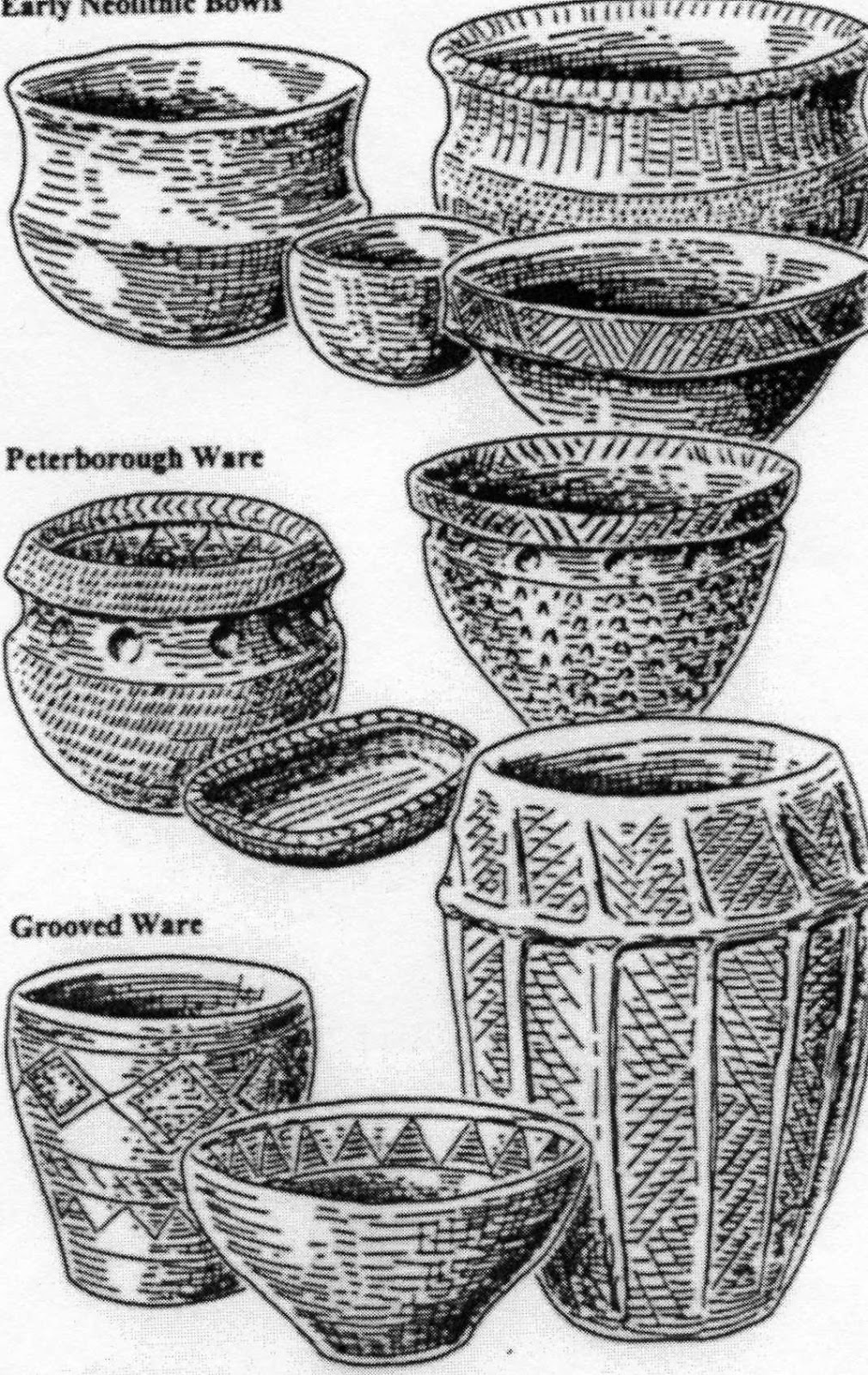
Here's one of Stuart Piggott's beautiful and classic drawings of British Neolithic pottery, showing what some of the Grooved Ware pots from the south coast probably looked like, based upon sherds found during excavations on the Essex coast, at Lion Point.


Pottery is frequently found during archaeological excavations. Archaeologists regard it as diagnostic. The discovery and identification of a sherd of pottery gives them a good clue about the date of the site. Neolithic and Bronze Age pottery was not glazed. It could have been waterproofed in several ways, by burnishing or by being sealed with fats, beeswax or milk.

a sherd of grooved ware
Pottery typologies are complex. It's an enormous area of archaeological study and I could not possibly go into every style and type of British Neolithic pottery in this blog. We would be here forever. There's Windmill Hill, Grimston-Lyles Hill Ware, Ronaldsway, Grooved Ware, Unstan Ware, Peterborough Ware, Ebbsfleet and so the list goes on. Most are round bottomed pots, with the exception of Grooved Ware. It took me many months to get to grips with these stylistic categorisations that have been imposed upon pottery of 5000 years ago.

Many bowl shaped pots are interpreted as 'cooking pots'. That seems fairly reasonable. What puzzles me is that whenever archaeologists find a very large pot, or the sherds of a large flat bottomed bucket shaped pot, it is almost always interpreted as a 'storage pot'. I have not yet come across a large pot from the British Neolithic that has been interpreted as a potential fermentation vessel, although some of them have a volume of several gallons and such large pots are often found at feasting sites, for example, at Durrington Walls, near Stonehenge.

If an earthenware pot is to be used to contain any liquid it must be waterproofed. We discovered, in our mashing and fermenting experiments, that beeswax worked very well as a sealant, as did butter and lard.

As a control experiment we tried fermenting mead in an untreated earthenware pot. The fermentation worked well, the room filled with the smell of mead, and the outside surface of the pot was covered in little beads of sticky sweetness. But the final product was disappointingly low in alcohol. It turns out that the alcohol diffuses through the porous pot much faster than the honey solution. This makes an untreated pot pretty useless for creating an alcoholic drink.

Here is a sample of some of the British Neolithic pottery types, as recorded by Stuart Piggott. You can see that there is a wide range of styles. Some have holes in the rim, to secure a covering or lid of, perhaps, leather. Some are deep, others are wide and shallow. I prefer to look at these pots with function in mind, rather than consider only their decoration and style.


Is there any archaeological evidence for the use of large pots for the fermentation or storage of barley wort? 
One of the very best indicators that a pot was used to ferment wort into ale, or for storing the ale, is the identification of beerstone on the internal surface. Beerstone precipitates out of a fermenting barley wort, it looks rather like eggshell. We have a lot of it accumulating on our plastic fermentation buckets and storage vessels.

It takes many hundreds of uses to accumulate a visible deposit of beerstone, but it is a certain proof of fermented wort. Brewers using plastic pipes in breweries often have to clean them of an accumulation of beerstone. It clogs the pipes.

Here is some beerstone from one of our fermentation vessels:


Beerstone has been identified on pots from a Bronze Age site in the Zagros mountains of modern day Iran. At excavations at Godin Tepe a great many pots and jars were discovered, they were stored in the University of Pennsylvania Museum. Subsequent analysis of a yellowish deposit on the internal surface of jars identified beerstone and it is generally accepted as unequivocal evidence for beer brewing. This pioneering paper by Badler, Michel and McGovern, published in 1993, tells the whole story and contains sufficient detail to be able to repeat the tests for beerstone on prehistoric pottery.

I wonder whether any archaeologists in the UK or Europe would consider looking for beerstone on big prehistoric pots? Maybe it is already being investigated. It would be great if this could happen, since this might end the apparent controversy about whether or not a big old pot was used for the fermentation of beer made from a barley wort.

-----------------------------------------------------

If you would like to make your own kveikering, here is some more information  and details of how to make one. Brewer Martin Warren of the Poppyland Brewery was so impressed by the idea that he made his own.

My conference paper from 1996 "Neolithic Ale: Barley as a source of sugars for fermentation" can be downloaded from my Academia page, here. 


Wednesday, 25 February 2015

Barm and the magic spoon. Godisgoode. (part one)

"Our prehistoric fathers may have been savages, but they were clever and observant ones ... the art and practice of the brewer are founded on empirical observation ... the brewer learnt from long experience the conditions not the reasons for success" 
John Tyndall FRS, extract from his speech on Fermentation, Glasgow Science Lectures Association, October 19th 1876.

Before Louis Pasteur's investigation into fermentation the whole process was a complete mystery. It was considered to be part of the "Spontaneous Generation of Life", a supernatural, magical, mystical or even divine creation. This is why one mediaeval name for it was "Godisgoode", a demonstration of God's bounty and munificence.

John Tyndall continued Pasteur's work into fermentation and helped to demolish the myth of spontaneous generation by demonstrating that micro-organisms can be carried by air-borne dust, and cause all kinds of fermentations and cultures.

We now know that beer yeast is the microorganism, saccharomyces cerevisiae, a one celled fungus that feeds on simple sugars.

http://www.microbiologyonline.org.uk/about-microbiology/introducing-microbes/fungi

In the presence of oxygen yeast can replicate rapidly through budding, turning the sugars into water and carbon dioxide, through respiration. It can double in 2 hours at 30 degrees Centigrade.

In the absence of oxygen it cannot replicate, but it can metabolise the sugars into alcohol and carbon dioxide. It isn't really happy with high alcohol concentrations and this limits production to about 10-12% alcohol.

Brewer's top fermenting yeast seems to work best, both aerobic and anaerobic, at between 15C to 25C, but it doesn't like varying temperatures and will lose condition quickly if subject to heating cycles. It generates quite a lot of heat whilst working.

I can sustain a good ferment of 10 gallons at ambient temperatures as low as 5C by insulating it with a couple of sleeping bags.

Under stress such as drying it can sporulate, and the spores can become wind-born by dust and insects.

Barm is the word used to describe brewing yeast in it's active replicating state.
The cells stick to the CO2 bubbles in the ferment and rise to the surface (top fermenting brewers yeasts) and form a foam. This is the Barm. Bread makers use this to leaven their doughs. Nowadays brewing yeasts and bread making yeasts differ, though in the past they were the same.

Barm in the brewing buckets.
This foam of yeast cells, Barm, can grow into impressive towers of rafts, and a vigorous ferment will need significant head space, or spillage will occur.

Close view of Barm.

This is how a beer brew looks after a day or two. It is at this point that the Barm can be harvested, by skimming the foam off and storing the liquid in a container. Harvested barm can remain viable for up to two weeks if it is kept cool and free from dust. Before the invention of refrigeration, a well could be used to store the barm in a warm climate. 

Brewers are paranoid about infection by a wild yeast strain or other micro-organisms, so they prefer to start a brew by inoculating the warm wort with a proven viable yeast culture, the starter. 

The starter is made by adding stored barm, or a dried yeast to a small amount of warm wort. Nowadays dried yeast can be bought, but there are traditional methods.

A good starter for pitching on the wort.

A Nordic and Hebridean tradition is to stir the barmy brew with a stick or wand, and to leave this to dry, hanging in a dry place. I've tried this and it works well. Could this be the origin of the magic witches wand?

Harvesting Barm on a spoon.

Drying spoon.


Dried yeast - barm - on the spoon

Inoculation of wort
After 32 hours at 20C.


After 48 hours at 20C.
After 48 hours from the side.
After 24 hours from the inoculation I was disappointed. Nothing seemed to be happening at all, but by 48 hours a healthy culture was established, fit for pitching.
After 96 hours.
After 96 hours.
After four days, primary fermentation is complete. It is this rapid initial doubling under favourable conditions that can make even a small amount of the right yeast into a viable starter for a pitching a good ferment.

From the moment I first started grain beer brewing I used commercial packets of dried brewers yeast. I was often disappointed by the slow or even non-existent activation for the starter. Maybe I should have been more patient, like with the spoon, but then I would have to make the starter a day or two before the wort.

Eventually I found brewing supplier who packed their own yeast which set off vigorously in the starter, giving a viable pitch in half to one hour. I quite liked the fruity and sometimes even buttery flavours.

When we moved from Manchester to Orkney I had the same problem with packet yeasts, so I had the supplier post yeast up to me. One day when I was struggling to learn how to make bread with a machine, I realised that the yeast I had become so fond of looked indistinguishable from the bakers yeast.

I now use baker's bread making yeast.

"Real Ale" brewer's yeast from a packet, left, and Baker's yeast from a tin, right.

Many breweries are very particular about their own yeasts and indeed a lot of the flavour of the beer does indeed come from the yeasts action. Some traditional recipes actually call for bakers yeast to be used. There is a very interesting article on Sahti here, and in it there is a link to a comparison of brewers and bakers yeasts.

I am beginning to suspect that the distinction between brewer's and baker's yeast only came about with the industrialisation of brewing in the Georgian era. I am certain brewing came before the leavening of bread, if not even before the invention of bread itself.

I have much more to say about yeast, microbes and infections but this post is already getting long, so there will be a part 2 to follow.