Thursday, 7 July 2016

trough, mash and wort

How do you collect the wort when you have mashed in a trough in the ground?

The main problem, obviously, is that you can't lauter and sparge in the same way that you would if you had used a wooden tub as a mash tun with a spigot, or if you had a bespoke lautering and sparging vessel. When the trough is in the ground, it's a different story.

There are thousands of sites throughout the British Isles that archaeologists know as Burnt Mounds. All that remains is a large pile of fire cracked stones and the remains of a trough lined with either stone or wood. If you have never heard of burnt mounds before, I suggest you have a look at an earlier blog which explains what they are and some of the interpretations. Archaeologists agree that they were used to make water hot. This was achieved by heating rocks in a fire then putting them into the trough of water. What you do with that hot water is up to you. There are many possibilities. Some interpretations include bathing, others suggest cooking meat and some archaeologists think that they were used as a sauna. Another function is as a mash tun. With the discovery of chaff and grain in an oak trough excavated in Wales in 2008, a mash tun is a strong possibility.

Trough mashing at Bressay, Shetland

Replica trough at Bressay, Shetland, surrounded by fire cracked stones.


A few years ago, we mashed in a full sized replica stone trough, based on the one from the Bronze Age burnt mound site on the island of Bressay, Shetland.

The original trough and buildings were moved stone by stone, since it was in danger from coastal erosion.

A replica trough and hearth was built beside the Bressay Heritage Centre, for experimental archaeological work. It's been used to dye wool, it has been used as a bath and also as a mash tun by archaeologist Dr Lauren Doughton in her experimental work.

We were there in the summer of 2011 to mash some malt with her when she was working on her PhD about burnt mounds and troughs. 

The weather was rough, even though it was mid July. Buffeted by the wind and rain, we managed to run a mash and collect some of the wort. Our time was strictly limited because we had to catch the last ferry off the island and get back to our tent. A full set of pictures of the day's mashing, collection of wort and the final brew can be seen here on my Facebook page.

Brewers usually want to obtain as much wort as they can from the mash. There is potential for lots of waste from a trough mash unless you can find a way of maximising the wort extraction. The most obvious technique might be to let the grain settle to the bottom of the trough, then scoop the wort out using a jug or a bucket or something like that. It's tricky, as we discovered. Nevertheless, it works. Inevitably there will be bits of husk in the wort. This is not a problem. They will sink to the bottom again and it is easily possible to obtain a clear wort for fermentation from a trough mash.

Locally sourced clay was used to seal the corners of the replica trough before we began the mash.

Water was put into the trough. It became slightly murky, a grey colour from the clay luting that we had used to seal the trough. We were a bit worried, however, we did not need to be concerned because the resulting ale from this experiment was delicious, sparklingly clear and bright, perhaps the result of our accidental addition of clay to the water.

The hot rock rolling team, from the fire into the water.

The technique of rolling hot stones from the fire into the trough of water had been perfected by Lauren and her team in previous runs. Using garden forks and spades, the hot rocks were expertly rolled down the slope and into the water.

When the water reached strike temperature, 50 kilos of crushed pale malt was added to the 200 litres of water and stirred with a garden fork. You know when the water is the correct temperature for the strike, around 74 degrees Centigrade or thereabouts, because this is when you can clearly see your reflection in the water, no ripples, no steam. We double checked with a thermometer.

The strike:adding the crushed malt to hot water.

The saccharification takes about an hour and it's crucial to keep the mash temperature right for that time, adding hot rocks and stirring as necessary. We put a wooden board over the trough, to help keep the steam and the heat in. It was a good conversion of starches into sugars, a successful mash. The finished mash, when settled, was a deep dark brown and it tasted very sweet.

The finished and settled mash - the next job is to collect the wort and ferment it.
For non brewers, I should emphasise that wort is not alcoholic. Sugar ferments into alcohol, starch does not. The saccharification that happens during the mash is a crucial part of the beer brewing process. Fresh wort is very sweet and prone to all kinds of bacterial and fungal infections. On the three occasions when we have been too tired to process the mash after a demonstration, the next morning the mash was fizzy and sour. Wild yeasts and lactic bacteria infections had ruined it. It was useless. Wort must be collected as soon as it is cool enough to take the yeast. The yeast ferments sugars into alcohol. Herbs or hops preserve and flavour the ale or beer.

We were short of time and collected as much wort as was possible. The brewer used jugs, buckets and plastic containers to scoop from the trough. We had, of course, taken the stones out first, when they were cool enough to handle. The process of collecting the wort was hard work and we only managed to get about 6 gallons out of the trough before we had to pack up, load the van and catch the last ferry back to the Shetland mainland.

The brewer collects wort from the trough. The stones have been removed and are on the heap.

The wort was put into a fermentation vessel, yeast was added and the fermentation vessel was kept warm using sleeping bags as insulation. After about four or five days it had fermented into a fine, clear and strong ale. We used a handful of dried meadowsweet flowers as a preservative.

This is how we should have collected the wort
On the ferry back to mainland Shetland we realised that we had made a mistake. We should have piled the stones up in the trough to make a sort of dam, then we could have put the mash to one side and the wort would have been so much easier to collect. This is how the Moore Group archaeologists collected the wort at their trough mash demonstration at the Sixth World Archaeology Conference in Dublin, 2008.

They made a wooden trough and painted the bottom part with bitumen to ensure that it did not leak. They correctly assumed that the University authorities would not allow them to dig a big hole and set their trough in the ground.

Moore Group archaeologists filling the trough with water at WAC 6, Dublin
They heated the stones on a fire, dropped them into the water and added the crushed malt when the strike temperature was right. It was this hot rock mashing demonstration that inspired us to stop mashing in pottery vessels and start using troughs, wooden tubs and hot stones.

Here are some of my photos of the Moore Group's event:

1 heating the rocks
2 heating the water
3 saccharification: the mash


4 the stone dam, mash and wort separated

5 settled wort and mash

6 collecting the wort, it's cloudy because it has been stirred up.


Hot rock mashing is a spectacular process, the stones sizzle as they hit the water, the mash saccharification happens right before your eyes and the aroma from the mash smells delicious. This is a mysterious, magical transformation from grain starchiness into fermentable sweetness. Surely this would have been an event that would have amazed and impressed people in prehistory, just as much as it does in modern times.

Collecting the wort like this, by creating a dam of stones, is an extremely efficient way of doing it, perhaps even allowing for sparging. Once the first runnings have been collected from the trough, more hot water can be poured gently through the mash, thus releasing more wort for the brewer. There would be very little waste and a good quantity of wort could be collected.


Is there any archaeological evidence for the collection of wort like this?

It is rare that prehistoric troughs are excavated with the stones still within them. If you have excavated one like this, I would love to hear about it. Excavations in 2013 by Wessex Archaeology at Kingsmead Quarry, Horton, in Berkshire, England revealed the remains of four neolithic buildings. They were interpreted as having been 'houses', which is often the case with these discoveries. I do wonder how many of these neolithic 'houses' might have been used as barns or as buildings where the grain was stored and processed. But that's a story for another blog.

One of these four neolithic rectangular timber buildings at Horton caught our attention when we were looking at the pictures online. There appear to be some fire reddened rocks close by one of the buildings, in a heap. The buildings are, as always, interpreted as "houses". But were they dwellings? Or some other kind of building, like a barn or grain processing building? See Wessex Archaeology's page about them here. 


The red rocks look rather like modern bricks. There seems to be no mention or discussion of them on the web page. Maybe I missed it. However the stratigraphy indicates that they are contemporary with the building. So, are these stones an indication of hot rock water heating technology at neolithic Horton? Were they piled up in a wooden trough that has long rotted away? What were the people doing in and around this rectangular wooden building, over 5000 years ago?

I cannot answer these questions. I am nevertheless intrigued by this discovery. And so I finish this blog with a close up (thanks to Graham) of those mysterious fire reddened stones and welcome interpretations, comments and discussion.
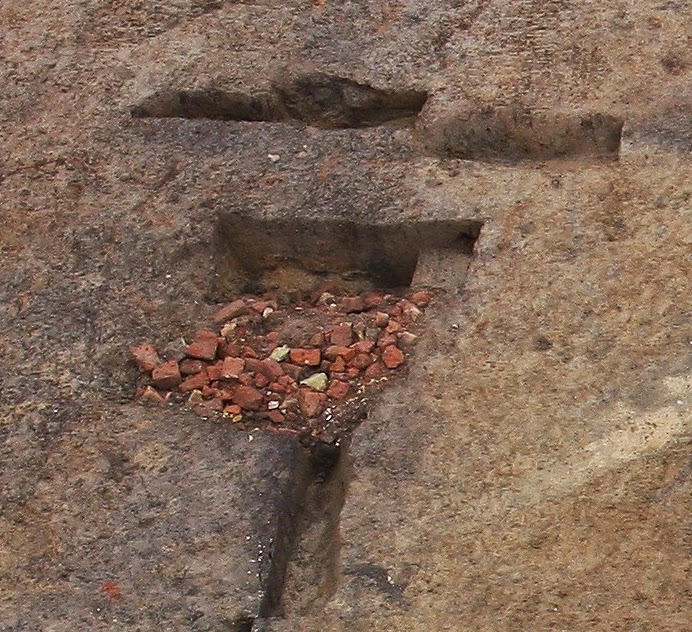
a close up of those mysterious fire reddened stones beside the neolithic building at Horton

 ------------------------------------------------------------------------------------

If you want to know what our Bronze Age Trough Ale, with meadowsweet, tasted like, we sent some to David Connolly of BAJR (British Archaeological Jobs & Resources). Although he struggled to open the parcel, he gave his opinion on the ale's flavour and strength.

It is sometimes said that prehistoric ale was weak, cloudy and sour and that it tasted disgusting. We disagree.

Here is the link: https://www.youtube.com/watch?v=wpvPi25TTOI

Quinn, B., & Moore, D. 2009 ‘Fulacht fiadh’ and the beer experiment’ in Stanley et al (eds) Dining & Dwelling. NRA Monograph Series No. 6, 43-53, NRA, Dublin.

Thursday, 16 June 2016

lauter and sparge

When the brewer has mashed in, he or she needs to separate the sweet wort from the grain husks. This is achieved by lautering and sparging.

It's a crucial part of the beer making process.

The previous blog was about the ancient magic of the mash tun, where the brewer transforms grain starch into sweetness. The saccharification, a process that is driven by the starch converting enzymes in the partially germinated grain, the malt.

At the end of the mash the contents of a mash tun are sweet, with the grain husks mixed up with the liquid. Although the brewer calls it the mash, it has not been physically mashed up, as you would mash potatoes for example. It's more like an infusion, when you put the leaf tea into the pot with hot water, then allow it to mash for several minutes.

In the brewer's mash tun you could be fooled into thinking that the grains are still whole - they look as if they are. But the starchy endosperm is gone, what looks like a whole grain is just the husk with very little left inside.

the contents of our mash tun: pale malt, roasted barley & wort

Lauter and sparge are wonderful words that mean nothing if you have never done it. They are a crucial part of the transformation of grain into ale. Many beer recipes don't use these words. You are just told to 'collect six gallons of wort'. The writer of the recipe assumes that you know how to do this.

Lautering is when you collect some of the wort and then, gently and carefully pour it, or trickle it, through the mash. Keep repeating until the wort runs clear, then collect the clear, strong first runnings. After that, you can begin to sparge. This involves running hot water through the mash to obtain several further gallons of weaker wort. How much wort you collect depends upon how much mash there is in the mash tun and what strength you want the resulting ale or beer to be.

For further details, see the brewer's post about wort which gives specific gravities and more information about wort.

There is a detailed explanation of some of the aspects of lautering and sparging by the brewer and writer John Palmer, from his excellent online book 'How to Brew'. It is,of course, the modern home brewer's perspective and one of the most comprehensive descriptions of how to lauter and sparge that I know of. His next chapter, about the importance of crushing the malt is also well worth reading.

The malt that goes into the mash tun should be lightly bruised, as they say in Orkney. Just enough to break the husk but not enough so that it has the consistency of flour. Too floury and you will have a stuck mash. This means that the hot water will not trickle through the mash and it's almost impossible to obtain the wort. No brewer wants that.

The interesting thing, for me, is how lautering and sparging was done in the past.

Today, a modern all grain home brewer can buy a mashing and sparging bag which sits neatly inside the mash tun. This is how we and many other home brewers mash, lauter and sparge.

First, the mash bag is put securely into the mash tun which has a tap near the bottom. Tie the string nice and tight. Add the required quantity of crushed malt and hot water, leave it for about an hour to mash, maintaining the temperature at around 67 degrees Centigrade. When the mash is done, all you need to do is collect some of the wort in a jug and pour it carefully through the mash. Keep doing this until the wort runs clear. This is lautering. Inside the mash tun, the bed of grain has settled and consolidated, creating a natural filter of grain husks that is held in place by the mesh at the bottom of the mashing and sparging bag.

Then you run off and collect the first runnings; this is very strong wort, very sweet. You can collect further wort by sparging. The more wort you collect the weaker it becomes. Hot water is trickled through the mash and several gallons of wort can be collected in this way. It's not absolutely essential to lauter. It's possible to go straight to sparging. The wort will be cloudy with lots of particles of grain in suspension. Leave it for a while, they will settle at the bottom of the container.


Lautering: we use a jug to collect the wort


Sparging: first runnings, the clear wort is collected

In the days before mashing and sparging bags, how did people collect the wort?

There would be a small hole in the mash tun, either at the bottom of the tub or at the side, very close to the bottom. They used a bed of straw, juniper branches or other fibrous material at the bottom of the mash tun, this would give the grain husks a place to settle and help the grain husks to form the natural filter. The fibrous material would be held down with stones, so that it does not float about in the mash. This traditional method of mashing (they call it masking) and drawing off the wort is described in the malt making and brewing chapter of Mary Scott's book (1967) Island Saga: the story of North Ronaldsay. It was written by her brother William, presumably because he was one of the island's brewers:

" The vat had been prepared beforehand by taking a good handful out from an oat sheaf and spreading it across the tap at the bottom of the vat, and then covering the straw with a stone shaped somewhat like a half moon - the straight side resting on the bottom of the vat and the rounded part fitting snugly to the round of it. The stone would be tilted to an angle of approximately 45 degrees. The stone was to keep the straw in place. 

Masking is then proceeded with using alternative pailfuls of water from the boiler and the first potful that had cooled off somewhat. If boiling water were put on the malt it was liable to stick - that is, it might all set in a gloggy mass, and no liquid could be drawn off. In the breweries I suppose they will put the water on at a certain temperature; there was no thermometer used here, just guess work."

After the mash, or masking, the wort must be drawn off. This is how it was done:

"The vat was allowed to stand for two hours. The boiler was by this time going full swing again ... when the two hours were up it was time to set about drawing off the wort. 

You put a pail under the tap, pulled out the plug, and, if everything was right, the liquid would run off in a beautiful amber stream. It was a great relief when you saw it was running off clear. The first pailful to be drawn off  might have some settlings or groot in it - that is some of the dust or fine stuff out of the malt - so you would tip that pailful back into the vat, for the groot would take a long time to seep to the bottom of the vat again."

I first came across this description of traditional mashing, lautering and sparging techniques when I was doing research in the Orkney Library over ten years ago. At the time I didn't imagine that there might be corroboration or that there are brewers still using these techniques today. Not in Orkney, but in Norway, Lithuania and Latvia. The tradition of making farmhouse ale continues in these, and other, countries and it's possible to meet the brewers and see how they make malt and ale, thanks to this blog by Lars Marius Garshol. He has been visiting them, talking to them and writing about them. It is wonderful research.

Straw, juniper branches and even raspberry canes can be used to help create the filter bed in the mash tun. In this blog, Brewing in Morgedal, Lars tells the story of how he found farmhouse brewing alive and thriving in eastern Norway. The brewers, Halvor Bjåland and Terje Haugen and their apprentice, Bjørn, make ale in the way of their ancestors. I am sure that these methods and traditions go back to medieval times, to the Viking era even. In this blog you can see photographs of the brewing process, including the stones at the bottom of the mash tun holding down the juniper branches and you can see the wort being collected by sparging.

In another of Lars' blogs he writes about farmhouse brewing in Denmark. Here the tradition has almost died out, but not quite. There are some great descriptions and images of lautering and sparging, using hot water and large wooden tubs as mash tuns. I recommend reading through his blogs. It might take you a while, there is a tremendous amount of detail. It's valuable information and an important record of local traditional malting and brewing.

Archaeologists and anthropologists, as well as maltsters and brewers, would benefit from reading, at the very least, some of these blogs. It tells a story that relates to the history and prehistory of making malt and ale in Northern Europe.

Excavations at Must Farm in the Fens of England are drawing to a close. Here, archaeologists from the Cambridge University Archaeological Unit are slowly uncovering a very well preserved Bronze Age village. It seems that there was a fire, the houses and contents burned and have been preserved in wet anaerobic conditions. Archaeologists are finding the remains of wooden buckets, pots with food contents intact and worked wood.

One of the most intriguing and exciting discoveries, for me, was the pot that contained both carbonised grain and some fibrous material. I wanted to include a link to the photograph here, however it's on their Facebook page and it does not seem possible to do that ... a few days later and now it seems to work see here

Why should a fairly large Bronze Age pot contain these two organic substances?

Could it be that the pot was being used in part of the ale making process? Not being involved in these excavations myself, all I can do is speculate. At this moment, I can't think of another reason why the pot contained fibrous material and grain, but there may well be another explanation. Please let me know what you think this might be.

That's all for now, in the next post I shall be looking at how to sparge when you are mashing in a large trough in the ground.

Saturday, 21 May 2016

saccharification or what happens in the mash tun

I'm picking up the blog again, after taking quite a long time off. To my surprise, folk have been reading our past posts, so thank you very much indeed for that.

One of the reasons that I started this blog was to try and deal with some peculiar misunderstandings about how beer and ale are made. In the archaeological and anthropological literature you can read all sorts of odd things about brewing beer in prehistory and how it was invented. Malt is rarely mentioned.

I have read that "... beer was invented when some barley got wet in a bucket and then it fermented" or, and I read this very recently, that "... beer is one of the most important of human inventions, as it is likely to be one of the key reasons that farming was started, in order to grow hops for brewing ..."

You need malt, not hops, to provide the fermentable sugars to make beer and ale. This blog is about what happens to the malt in the mash tun - the transformation from grain starch into sugars.

Most people don't have the opportunity to see or to experience this magical process. We are fortunate, we have our own mash tun in the garage and we regularly make some very tasty ale and beer, using crushed malt that we buy directly from the maltster. We can go online and buy the malt. It's delivered to the door. We buy 25 kg at a time and it's always very fresh and good malt.

Our mash tun can take about sixteen or seventeen pounds of malt and we usually make about ten or eleven gallons of beer. That lasts us a while, so we don't have to make it too often.

We can choose how strong or weak we want the beer to be. We do this by deciding how much malt to use and how much water to sparge with. We can add hops or herbs, whatever we decide to do. In the past we've made some very good ancient ales in our mash tun - meadowsweet is the usual herb of choice because we live on Orkney and it grows profusely here. So we can go and pick it in July/August, dry it, store it and use it whenever we want to. We'd like to try other herbs. I'm just starting to grow a brewers herb garden, so far I have yarrow, heather, meadowsweet and angelica. Mostly we use hops.

What happens in the mash tun? Saccharification. The creation of sweetness that can be fermented. Grain starch is converted into malt sugar in the mash tun by enzymes in the malt.

Where do the enzymes come from? Basically, when any grain begins to germinate, starch converting enzymes are activated in the aleurone layer of cells, just beneath the grain husk. These enzymes convert the starch of the endosperm into sugars, the food source for the growing plant. The maltster's job is to begin germination, then stop it and dry it, very gently, at just the right moment. The craft of the maltster goes back to the dawn of grain agriculture. The first alchemy. 

Saccharification is an essential part of the brewing process. The brewer takes the lightly crushed malted grain and adds it to hot, but not boiling, water in the mash tun. Enzymes in the partially germinated grain re-activate in the mash tun and convert the grain starch into malt sugar. The process takes about an hour.

Here's our mash tun:
The strike: the moment when crushed malt is added to hot water
The aroma of a mash is distinctive - it's a strong, sweet, delicious smell. Recently we went to a meeting about recreating old beer styles at Fuller's Brewery in Chiswick, London. As we approached the brewery, even though we could not see it, we knew we were going in the right direction because we could smell the first mash of the day. Exactly the same smell that we get from our little mash tun in the garage.

The process is the same, no matter what the size or the shape of the mash tun.

A few years ago, I went to the Eindhoven Open Air Archaeology Museum and used an earthenware bowl to demonstrate the saccharification - how to gently heat crushed malt and water over the hot ashes of a fire and make sugars. In the photograph below, you can see the white crushed malt in the bowls by the hearth. For me, that's a little over crushed, but it still worked just fine for the saccharification. In little over one hour, the starchy crushed malt had become a mash of delicious malt sugars, as you can see in the large earthenware bowl in the hearth.

Saccharification in a hearth at Eindhoven Open Air Museum.
The beautiful bowl was made by Flor Buchuk Gill, she was the potter at the Open Air Museum at the time.
The equipment is very simple. The technique is not complicated. There is no need to understand the complex biochemistry that goes on in the mash tun. All you have to do is get the details right and you will get a result. Heat some crushed malt with abundant water at temperatures not exceeding 67 degrees Centigrade and the enzymes will re-activate. If the temperature is too high, then the enzymes are destroyed. 

The next stage is to separate the sweet liquid (the wort) from the mash. This is done by sparging, washing hot water through the mash and collecting the wort. I shall save that for the next blog.

Some people think that the beer brewer's mash tun is something like the wine maker's tub. They are not at all the same thing. They are completely different processes. Perhaps the word 'mash' is confusing.

Making wine, as most people know, involves treading or mashing grapes into a pulp, then syphoning off the juice and fermenting it. When making ale or beer, you have to make the sugars first, and this happens in the mash tun.

Some people make 'country wines'. Among the most popular are dandelion, parsnip, nettle and elderflower. Each wine making event involves gathering the ingredients and then buying a few kilos of sugar. Dandelion flowers, for example, are mixed with hot water and a kilo or two of sugar. Here's a typical country wine recipe. There are loads of recipes for these so called country wines. They are all pretty much the same. They all involve several bags of sugar.

As has been explained in an earlier blog, flowers, nettles or parsnips do not provide any fermentable sugars, just flavour.

I can understand why some people might be confused if they have never seen inside a mash tun or if they have not made an ale or a beer using malted grain. For most people today, seeing what happens inside a mash tun is not part of their everyday life and experience.

However, a few hundred years ago, making the malt and brewing ale and beer at home was a common activity. It happened on farms and in large households. It was a household task. In the past, when making the malt and the ale was a regular event, it would have been something that people were familiar with.

Today it seems to be a mystery to many.

Wednesday, 25 February 2015

Barm and the magic spoon. Godisgoode. (part one)

"Our prehistoric fathers may have been savages, but they were clever and observant ones ... the art and practice of the brewer are founded on empirical observation ... the brewer learnt from long experience the conditions not the reasons for success" 
John Tyndall FRS, extract from his speech on Fermentation, Glasgow Science Lectures Association, October 19th 1876.

Before Louis Pasteur's investigation into fermentation the whole process was a complete mystery. It was considered to be part of the "Spontaneous Generation of Life", a supernatural, magical, mystical or even divine creation. This is why one mediaeval name for it was "Godisgoode", a demonstration of God's bounty and munificence.

John Tyndall continued Pasteur's work into fermentation and helped to demolish the myth of spontaneous generation by demonstrating that micro-organisms can be carried by air-borne dust, and cause all kinds of fermentations and cultures.

We now know that beer yeast is the microorganism, saccharomyces cerevisiae, a one celled fungus that feeds on simple sugars.

http://www.microbiologyonline.org.uk/about-microbiology/introducing-microbes/fungi

In the presence of oxygen yeast can replicate rapidly through budding, turning the sugars into water and carbon dioxide, through respiration. It can double in 2 hours at 30 degrees Centigrade.

In the absence of oxygen it cannot replicate, but it can metabolise the sugars into alcohol and carbon dioxide. It isn't really happy with high alcohol concentrations and this limits production to about 10-12% alcohol.

Brewer's top fermenting yeast seems to work best, both aerobic and anaerobic, at between 15C to 25C, but it doesn't like varying temperatures and will lose condition quickly if subject to heating cycles. It generates quite a lot of heat whilst working.

I can sustain a good ferment of 10 gallons at ambient temperatures as low as 5C by insulating it with a couple of sleeping bags.

Under stress such as drying it can sporulate, and the spores can become wind-born by dust and insects.

Barm is the word used to describe brewing yeast in it's active replicating state.
The cells stick to the CO2 bubbles in the ferment and rise to the surface (top fermenting brewers yeasts) and form a foam. This is the Barm. Bread makers use this to leaven their doughs. Nowadays brewing yeasts and bread making yeasts differ, though in the past they were the same.

Barm in the brewing buckets.
This foam of yeast cells, Barm, can grow into impressive towers of rafts, and a vigorous ferment will need significant head space, or spillage will occur.

Close view of Barm.

This is how a beer brew looks after a day or two. It is at this point that the Barm can be harvested, by skimming the foam off and storing the liquid in a container. Harvested barm can remain viable for up to two weeks if it is kept cool and free from dust. Before the invention of refrigeration, a well could be used to store the barm in a warm climate. 

Brewers are paranoid about infection by a wild yeast strain or other micro-organisms, so they prefer to start a brew by inoculating the warm wort with a proven viable yeast culture, the starter. 

The starter is made by adding stored barm, or a dried yeast to a small amount of warm wort. Nowadays dried yeast can be bought, but there are traditional methods.

A good starter for pitching on the wort.

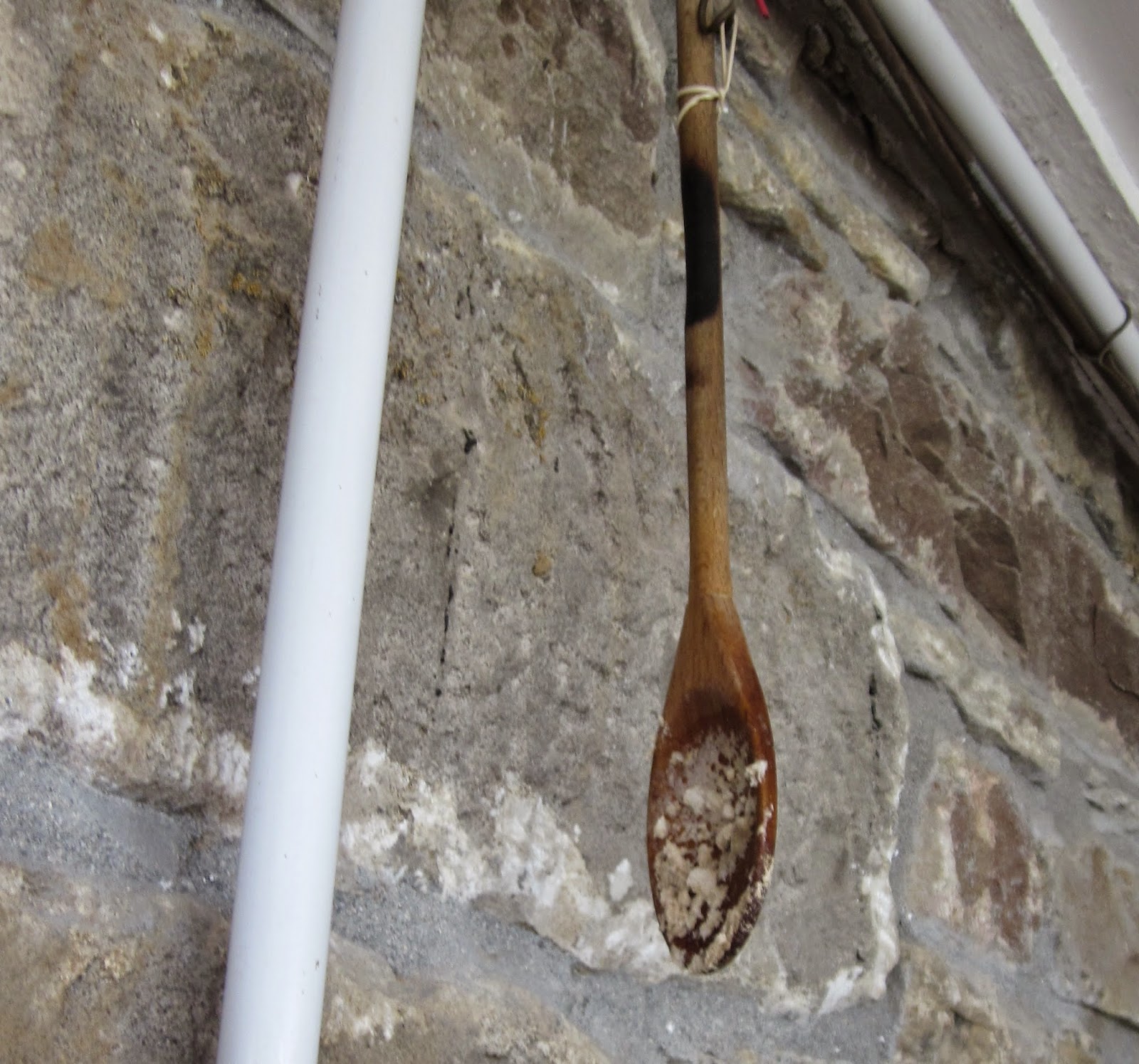
A Nordic and Hebridean tradition is to stir the barmy brew with a stick or wand, and to leave this to dry, hanging in a dry place. I've tried this and it works well. Could this be the origin of the magic witches wand?

Harvesting Barm on a spoon.

Drying spoon.


Dried yeast - barm - on the spoon

Inoculation of wort
After 32 hours at 20C.


After 48 hours at 20C.
After 48 hours from the side.
After 24 hours from the inoculation I was disappointed. Nothing seemed to be happening at all, but by 48 hours a healthy culture was established, fit for pitching.
After 96 hours.
After 96 hours.
After four days, primary fermentation is complete. It is this rapid initial doubling under favourable conditions that can make even a small amount of the right yeast into a viable starter for a pitching a good ferment.

From the moment I first started grain beer brewing I used commercial packets of dried brewers yeast. I was often disappointed by the slow or even non-existent activation for the starter. Maybe I should have been more patient, like with the spoon, but then I would have to make the starter a day or two before the wort.

Eventually I found brewing supplier who packed their own yeast which set off vigorously in the starter, giving a viable pitch in half to one hour. I quite liked the fruity and sometimes even buttery flavours.

When we moved from Manchester to Orkney I had the same problem with packet yeasts, so I had the supplier post yeast up to me. One day when I was struggling to learn how to make bread with a machine, I realised that the yeast I had become so fond of looked indistinguishable from the bakers yeast.

I now use baker's bread making yeast.

"Real Ale" brewer's yeast from a packet, left, and Baker's yeast from a tin, right.

Many breweries are very particular about their own yeasts and indeed a lot of the flavour of the beer does indeed come from the yeasts action. Some traditional recipes actually call for bakers yeast to be used. There is a very interesting article on Sahti here, and in it there is a link to a comparison of brewers and bakers yeasts.

I am beginning to suspect that the distinction between brewer's and baker's yeast only came about with the industrialisation of brewing in the Georgian era. I am certain brewing came before the leavening of bread, if not even before the invention of bread itself.

I have much more to say about yeast, microbes and infections but this post is already getting long, so there will be a part 2 to follow.


Wednesday, 4 February 2015

first farmers, first maltsters?

Could the first farmers in the fertile crescent have been the first people to make malt? Who were the first maltsters? After I had completed my M. Phil in 1999, I used to go round archaeology conferences and meetings (as an independent researcher, not affiliated to any University or College) and I gave papers and presentations that aimed to promote some discussion of these questions among archaeologists and anthropologists.

This is the first of a number of blogs based on these talks, presentations and papers from between 2000 and 2010.

I'm presenting here a few thoughts based upon a simple question - what were those first farmers doing with grain that they were so keen to grow? Of course, grain can be ground into flour to make bread, or perhaps, in the neolithic, some kind of gruel or porridge was made. But there is something else that can be done with grain, which not everyone is familiar with. It can also be malted.

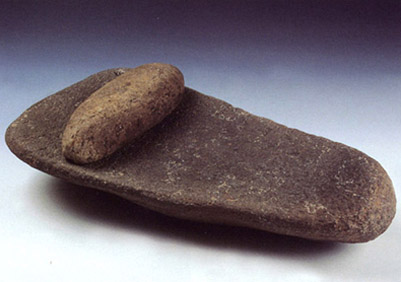
quern, suitable for crushing grain and malt here
Malting is the process of deliberate and careful partial germination transforms the properties of the grain. Within the grain, at the beginning of germination, enzymes are activated that can convert starches into sugars. Malted grain is friable, easier to crush and is very different to unmalted grain.

It seems probable that grain, because of its' special qualities when malted, was a status crop rather than a staple crop in the neolithic.  

Every all-grain beer brewer knows the importance of malt. It's the fundamental ingredient. When malt is crushed a little, mixed with water and heated in a mash tun to the correct temperature, it becomes sweet. The brewer then separates the liquid from the grain by lautering and sparging, and collects the liquid run off which is known today as wort. This is boiled with herbs or hops, then fermented into ale or beer.

the first farmers
The transition from fishing, hunting and gathering to a settled life of farming began around ten to twelve thousand years ago in the Near East and Levant. Wild grain grew abundantly, in natural fields, in the area now known as the Fertile Crescent (Harlan, 1967). Grain, lentils and chickpeas were gathered and processed by the nomadic population. As time went on, people began to plant and cultivate these crops deliberately. They processed them in different ways. Villages became established, such as Beidha, and plant domestication began as well as the domestication of goats. Hunter-gatherers became farmers. This was the neolithic revolution, or so it was named by Vere Gordon Childe in the 1930s.

The Spread of Agriculture in the Middle East
fertile crescent, image copyright:Oriental Institute of the University of Chicago

The new lifestyle spread rapidly across Europe, reaching the British Isles around five or six thousand years ago. This ‘wave of agriculture’ and the debate surrounding it have been discussed at great length in the literature (eg Maisels 1993, Harris 1996, Smith 1998, Zohary & Hopf 2001, Bellwood 2005). A great deal has been written and it is a complex issue. In 1952 Gordon Childe proposed that climate change was a major factor. Other explanations for the origins of agriculture include population pressure (Binford 1968, Flannery 1973), changes in socio-economic complexity, inequalities and drought. Theories abound, too many to discuss here. In 1990 Brian Hayden noted that

“few topics have engendered as much discussion and resulted in so few satisfying answers as the attempt to explain why hunter-gatherers began to cultivate plants and raise animals.” (Hayden 1990, 31) 

Archaeobotanical analysis of pollen, seeds, flora and fauna within the archaeological record seems to reveal that, ten to twelve thousand years ago, there were oak woods, pistachio trees and there was an abundance of wild life and game (Maisels 1993). Streams and rivers would have provided good fishing. It seems unlikely that the Natufian cultures of the epi-palaeolithic gathered wild grains to tide them over food shortages. They collected and processed them, and later domesticated them, because they wanted to make something. But what did they want to make?

the bread or beer debate
In 1953, Robert Braidwood from Oriental Institute of the University of Chicago initiated the ‘bread or beer’ debate, by organising a symposium "Did man once live by beer alone?". He was curious about the reason for the neolithic revolution, having been excavating at Jarmo, an early Neolithic village in the foothills of the Zagros Mountains of Iran, since the 1940s. He had organised a specialised multi disciplinary team with natural scientists, archaeobotanists, anthropologists and archaeologists (Braidwood et al, 1983). The excavation report Prehistoric Archaeology along the Zagros Flanks is a classic, if you like to read excavation reports, that is.

The symposium was published in the Journal of American Anthropology, number 55, in 1953 and it is now available to read online if you follow the next link. The specific question proposed by Professor Jonathan Sauer in Braidwood's Symposium was this:

“… could the discovery that a mash of fermented grain yielded a palatable and nutritious beverage have acted as a greater stimulant toward the experimental selection and breeding of the cereals than the discovery of flour and bread making? One would assume that the utilisation of wild cereals (along with edible roots and berries) as a source of collected food would have been in existence for millennia before their domestication took place. Was the subsequent impetus to this domestication bread or beer?” (Braidwood 1953, 515)

Hans Helbaek considered that malting could perhaps have been the key to understanding early agriculture, even though he was aware that it was "a sore point in archaeological interpretation." It seems that it still is today. He discusses several aspects of malting on pages 517 & 518, for example, that a large vat may have been useful for part of the process. Germination may have been deliberate or accidental, he says, and context would be vital if germinated grain was to be found. Later on, he points out that germinated grain would have not survived in the ground. Carbonised grain might perhaps indicate a failed malting. It is clear from his argument that in the 1950s, there was some scientific understanding of the malting process. There were established techniques and processes that scientists had begun to understand.

Paul Manglesdorf pointed out that barley is “virtually useless” for bread making. He found it difficult to believe that “the foundations of Western Civilisation were laid by an ill fed people living in a perpetual state of partial intoxication” (page 520). He did not recognise germinated grain among the samples that he analysed from Jarmo, concluding that the earliest cereals were not used for brewing or baking but that they were used as ‘popped’ or ‘parched’ grains.

Linton noted the difficulty of making finely ground flour suitable for bread using a pestle and mortar or rubbing stones (page 524) and Oppenheim (page 525) suggested that gruel made from coarsely ground grits was the most likely product being made by the first farmers.

There was no consensus of opinion. After this auspicious start, the question of ‘bread or beer’ rested, debate appears to have died down and there was little further discussion. Presumably, it remained a controversial idea. The debate was resurrected in the late 1980s. In 1986, Solomon Katz and Mary Voigt published a paper in Expedition, volume 25/2 "Bread and Beer: the early use of cereals in the human diet" in which they presented a new paradigm: the biocultural development of cuisine. Their hypothesis included the idea that epi-palaeolithic hunter-gatherers had discovered that slightly sprouted grain tasted sweeter. I'd agree with their hypothesis. It would not be too difficult to discover this. The debate is not just about beer or bread, flour, porridge or gruel. It is also about making malt, malt sugars, the wort. I wrote my thesis, "Barley Malt and Ale in the Neolithic" about this, but I am not the first person to suggest the idea of maltsters in the epi-palaeolithic. Without malt there would be no wort and no ale or beer.

Grain processing was not necessarily a backbreaking, dreary chore of grinding the grain into a rough kind of flour to make unleavened bread.

The processes of malting and mashing magically transform inedible grain starch into delicious, sweet malt sugars. It could even be considered the first alchemy. The biblical phrase ‘land of milk and honey’ might refer to domesticated animals and the milk that they produced, as well as the production of liquid sugars from cereals, what brewers today call wort.

Malt and sweet barley mash are likely candidates for the things that the first farmers were interested in making. The accidental discovery of fermentation, whereby sugars are transformed into alcohol, followed closely behind. The spent grain that is left after sparging makes excellent animal fodder (Dineley, 2006). Spent grain is not alcoholic, it's just the slightly sweet barley husks and mash that is left after the malt sugars have been washed through.

Maltsters have known, for millennia, what they need to do with harvested grain in order to make sugars. Malting is an ancient skill, based upon techniques that, even today, have an element of magic, ritual and mystery. Making malt and malt sugars from the grain was one of the new technologies of the epi-palaeolithic. These grain processing techniques were discovered in the fertile crescent, these new skills crossed Europe, eventually arriving in the British Isles around five or six thousand years ago.  

neolithic farmers of the British Isles
What were the early neolithic farmers of the British Isles making with the grain that they grew? The transformation of grain into ale can be accurately described as both a ritual and a domestic activity and it seems to have been an important aspect of the neolithic cultural package. In the British Isles, harvested grain was being made into ale, an intoxicating beverage to be consumed, perhaps, at ceremonial sites. The making of the ale was as much of a ritual as its' consumption. 

further reading
My paper on the craft of the maltster was finally published, I put it on my Academia.edu page here

I wrote an article, based on the paper, for Brewer and Distiller International about the archaeological evidence for floor malting. It was published in the February issue, 2016: Who were the first maltsters? 

references

Bellwood P. 2005 First Farmers: The Origins of Agricultural Societies. Blackwell.

Binford L. 1968 Post Pleistocene Adaptations. In S. Binford and L. Binford (eds) New perspectives in Archaeology. Chicago.

Braidwood R. (1953) Did Man once live by bread alone? American Anthropologist 55, 515-526.

Braidwood R., Braidwood L., Howe B., Reed C. & Watson P. eds 1983 Prehistoric Archaeology across the Zagros Flanks. University of Chicago Oriental Institute Publications Vol 105, Chicago. here

Dineley M & Dineley G 2000 Neolithic ale: Barley as a source of malt sugars for fermentation. In Fairbairn A (ed) Plants in Neolithic Britain and beyond. Neolithic Studies Group Seminar Papers 5, 137-155, Oxbow Books. Paper presented at the Spring Meeting of the Neolithic Studies Group, Royal Academy, London, March, 1998.

Dineley M. 2006 The Use of Spent Grain as Cattle Feed in the Neolithic. In D. Serjeantson and D. Field (eds) Animals in the Neolithic of Britain and Europe, Neolithic Studies Group Seminar papers 7, Oxbow Books. Paper presented to the Spring Meeting of the Neolithic Studies Group, British Museum, 2004


Flannery K. 1974 The Origins of Agriculture. Annual Review of Anthropology, 2, 271-310.

Harlan J. R. 1967 A Wild Wheat Harvest in Turkey. Archaeology 20, 197-201.

Hayden B. 1990 Nimrods, Piscators, Pluckers and Planters: the emergence of food production. Journal of Anthropological Archaeology Vol 9, No 1, 31-69.

Harris D. R. 1996 The Origins and Spread of Agriculture and Pastoralism in Eurasia Routledge.

Katz S. & Voigt M. 1986 Bread and Beer: the early use of cereals in the human diet. Expedition Vol 25/2, 23-34 here

Maisels C. 1993 The Emergence of Civilisation. Routledge.


Smith B. 1998 The Emergence of Agriculture Scientific American Library, New York.

Zohary D. and Hopf M. 2001 Domestication of Plants in the Old World: the origin and spread of cultivated plants in West Asia, Europe and the Nile Valley. Clarendon Press, Oxford Science Publications.