Friday, 23 May 2014

trough mashing, tridents, fire cracked stones and ale

introduction and update
This blog discusses some of the practical and technical details of mashing in, Neolithic and Bronze Age style. It's about troughs and tridents, hot rocks and prehistoric burnt mounds. It was first published in the summer of 2014. I've edited it, added a few more details and brought it a bit more up to date. Why did I do this? Because it's now 17th February 2022 and the World of Stonehenge Exhibition has just opened at the British Museum in London. Among the 400 wonderful exhibits are two large wooden tridents, carved from solid oak and each measuring over two metres long. They were discovered near Stainton, Carslisle, in 2013. What were these mysterious objects used for? Archaeologists were puzzled. Suggestions at the time included eel spears or hay forks, neither being particularly convincing.

There was quite a lot of discussion on social media about the various possible and probable uses for these enigmatic objects made from solid oak. I'll try and find a link to it. It was a lively and, at times, argumentative discussion.

One suggestion that Graham and I made at the time was that these wooden tridents were ideal as mash forks, a traditional tool used for stirring the crushed malt into hot water in the 'mashing in' part of the ale and beer brewing process. Initially the idea was met with some negativity and suspicion. However, it now seems to be one of the accepted interpretations and, I am pleased to report, is included in the newly published book of the 'The World of Stonehenge' Exhibition:

"The tridents may have been used for fishing or eel trapping, or in agricultural activities as hay forks, and even as mashing forks in the process of beer brewing. It is likely that farmers were using some of their cereal harvests to make alcohol for social and religious gatherings rather than consuming only sober porridge and savoury foods." 

(Garrow, D. & Wilkin, N. The World of Stonehenge, published by The British Museum, 2022 page 50)
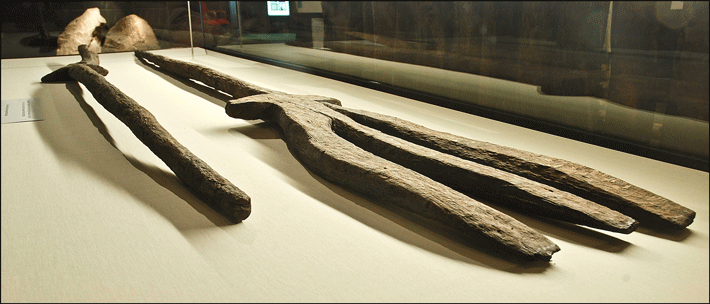
Neolithic-wooden-trident
(© Tullie House Museum and Art Gallery Trust)
This image is from a news item in Archaeology, Friday December 6th 2013. see:https://www.archaeology.org/news/1610-england-neolithic-wooden-tridents

At the World Archaeology Conference (WAC 6) in Dublin, 2008, archaeologists from the Moore Group demonstrated how to mash in a wooden trough using fire heated stones. They used a garden fork to transfer the stones into the trough.  Inspired by their brewing experiments Graham and I mashed in a replica stone trough at Bressay, Shetland, the site of a Bronze Age burnt mound, in the summer of 2011. We used a garden fork to stir the mash and, at the time, we wished that the handle of the fork could have been longer. Something like these tridents would have been perfect for the job. See our blog trough, mash and wort for more details of these experiments and demonstrations.

These two wooden tridents were carved from single pieces of oak and would certainly have been sturdy enough for the task of stirring the mash in a trough in the ground. They would also have been suitable to remove hot stones from a fire, transferring them into the trough of water in order to heat it and maintain a good mash temperature. The tridents have been dated to c3650 BC and were found in a palaeochannel at Stainton, a site associated with burnt mounds and much more. See here for more details of the excavations. 

And now, after this updated introduction, let's go back to the blog that we wrote in the summer of 2014:

what is a burnt mound?  

In Ireland, over 5000 burnt mound sites are known. In Scotland, about 1900 have been excavated so far. They also found in England and Wales. The burnt mound itself is a pile of fire reddened and cracked stones, often in a semi-circular shape as they have been thrown onto the heap. The stones were put into a fire to be heated up, then dropped into a trough of water in order to heat it. There are many things that hot water can be used for.

Archaeologists agree that burnt mound sites are something to do with hot rock technology - using hot stones to heat lots of water - but to what purpose? That's what archaeologists can't agree on. There have been several suggestions:

- they were used to cook meat. The idea is that you wrap a big piece of meat in straw and leave it in the heated water trough for several hours. You probably have to keep putting more hot stones in, as the water cools. There are easier and more efficient ways of cooking meat.

- they were a sauna or sweat lodge. I don't understand this. In my experience, a sauna has a few hot stones upon which water is splashed to make steam. You don't need a large trough of water and lots of hot stones.

- you can wash sheep fleece or wool in them. This seems to be a practical idea. Fleece must be washed before it is spun into wool for clothing.

None of these suggestions are controversial. Most people reckon that the troughs would have been multi functional - a bit like the kitchen sink only much bigger. When it was suggested that these sites could have been used for making beer, some archaeologists became ever so slightly annoyed. Although the idea was first put forward in 2007, backed by successful experimental work and sound brewing theory, it is still considered by some to be controversial. I don't know why. 

Hot rocks are ideal for heating large amounts of water to the perfect temperature for mashing, which is between 65 and 67 degrees Centigrade. Getting the water much hotter than this is very difficult. We found it impossible to get the water to boil. 

troughs as mash tuns
The possibility that they were used in the making of ale or beer was first suggested by Declan Moore and Billy Quinn of Moore Archaeological and Environmental Services Ltd. I first met them at a Conference about beer and brewing in prehistory and antiquity, held in Barcelona, October 2004. I gave a paper about the importance of malt in the brewing process. Billy and Declan asked me whether it was possible to make beer in a hole in the ground. We agreed they should have a go.

The following year, they came to Orkney to meet Graham and to learn a bit more about how to make ale and beer from the grain. They tasted the wort and were surprised how sweet it is. They tried Graham's beer and liked it. Then they went back to Ireland to do their own research into hot rock mashing in a trough. It went extremely well, and led to their now famous video on You Tube. They wrote an article for Archaeology Ireland and there have been several more articles online since then. The details of their subsequent work are on their web page.

They gave a demonstration of the technique at the Sixth World Archaeology Conference in Dublin, 2008. I was lucky enough to be there and it was spectacular. The smoke, the steam, the hot stones and the aroma of the mash! All of these things added to the magic and drama of the demonstration. If an archaeologist is looking for an impressive show of ritual, power and transformation in prehistory, then a hot rock mash ticks all the boxes. 

One day in the summer of 2009, I got a phone call from Billy. He told me that a trough with grain in it had just been found in Wales. The well preserved trough, with wood lined water channels, was excavated by Dave Chapman of Ancient Arts who went on to do some mashing and brewing experiments of his own. He was successful, as reported in British Archaeology news.

We had to try this for ourselves. So far, we had been mashing small amounts of crushed malt in earthenware bowls. It was clear that the 'hot rocks in a trough' technique worked much better. Graham made a small wooden trough, about one third the size of the real ones, and we had some fun mashing with hot stones. It is best to use stones from the land. Rocks collected from the beach explode when being heated in the fire. This is very dangerous.

We had an opportunity to mash in the replica trough at Bressay, Shetland in the summer of 2011. The same trough that was used to experimentally wash fleeces. We cleaned it well and luted the corners with local clay, to prevent water leakage. This explains the grey colour of the water in the photo below. There was initially some concern that there might be a problem. It turned out to be the clearest, sparkliest ale we have ever made. Bentonite powder, a derivative of clay, is used today to clear wine and beer.
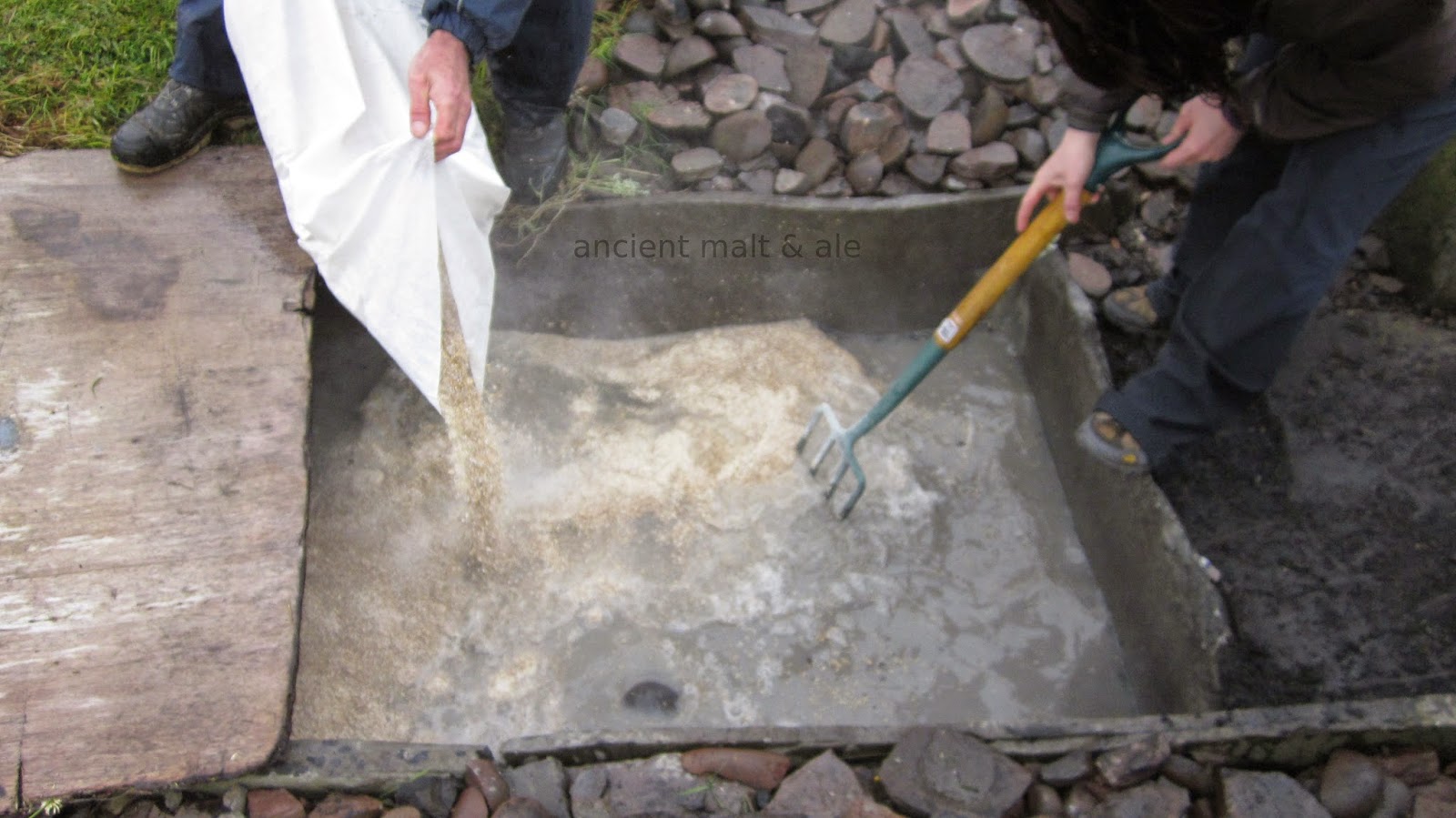
the strike: 50 kg of crushed malt is added to about 250 litres of hot water in the replica Cruester trough, Bressay, Shetland.
We used a garden fork to stir it about.
 
A successful mash. Adding a few hot stones kept the mash at an ideal temperature for the conversion of starch into sugar, which took about an hour. We put a piece of wood over the trough for heat retention. 

crushed malt & water transformed into 250 litres of wort in the trough, enough to make plenty of ale for a feast.
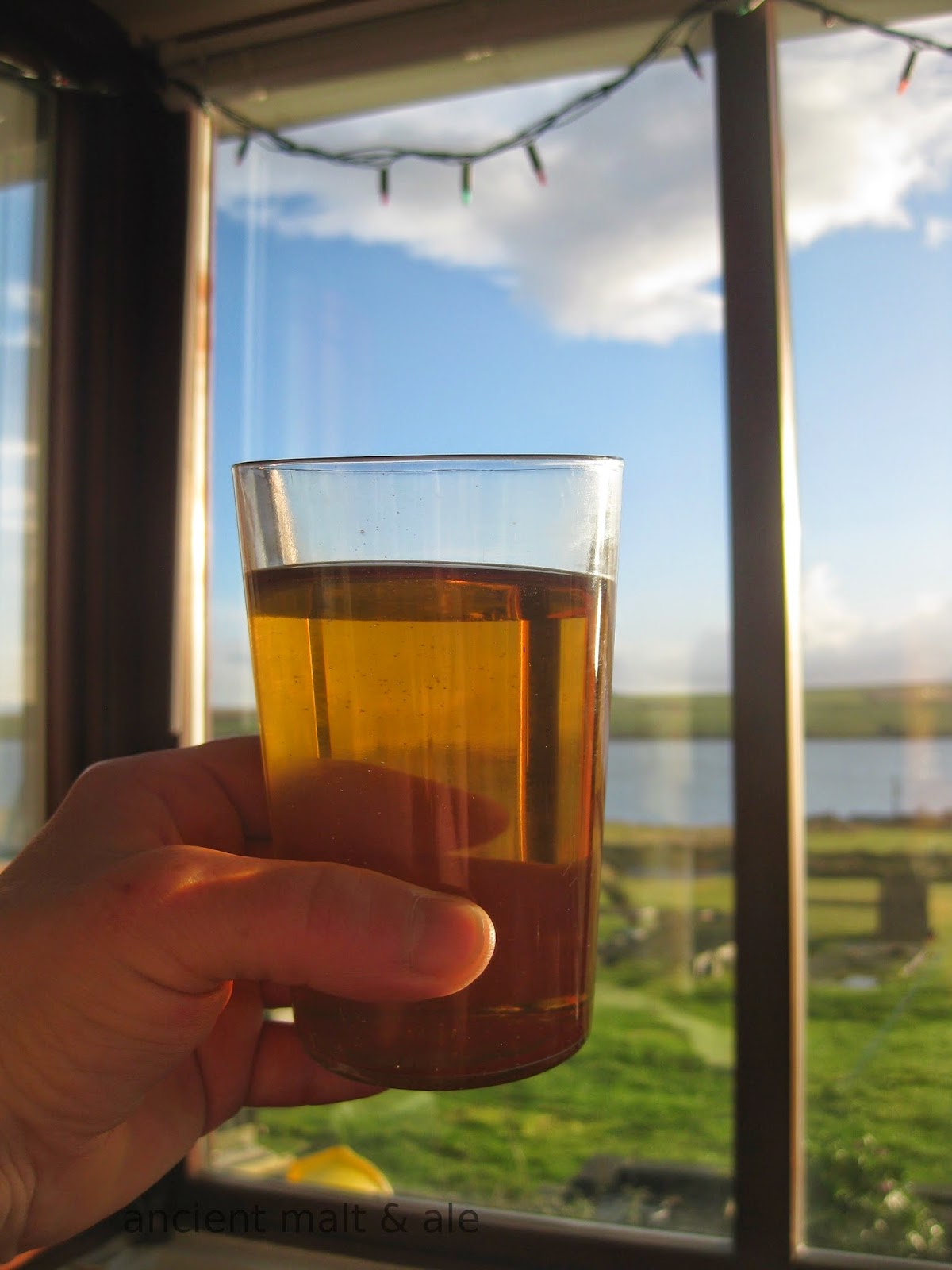
cheers! our clear and bright Bressay Ale.

After taking some of the wort from the trough using jugs, we added brewer's yeast and fermented it for several days. We only had one fermentation vessel, so we could not make use of more than 6 gallons of wort.

Next morning, when we went to empty and clean the trough, all the wort had drained away. Only the spent grain was left. Although we had clay luted it, the reconstructed trough is above the local water table. Meadowsweet flowers, about an ounce and a half, were added to the 6 gallons of wort when it had finished fermenting. Also, we had a ferry to catch and so our time was limited.

The result was a strong, clear ale. You can see all the pictures of our Bressay mashing and brewing adventure on my Facebook page. The ale kept really well.

We bottled it and sent some to the Past Horizons people to taste. It did take a while to open the parcel, but I think it was probably worth it.


neolithic burnt mounds, wooden tridents and fire cracked stones
There are excavations taking place in Northumberland, not far from Bamburgh Castle, organised by the Bamburgh Research Project. Several burnt mounds have been excavated and archaeomagnetromic dates that have so far been obtained indicate that these burnt mounds were in use during the Neolithic. Pottery finds support this interpretation. The dates obtained so far are 6,230 +/- 50 years BP at 95% confidence. There is a good summary of the excavations here.
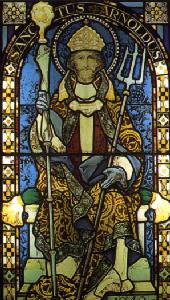
St.Arnoldus.jpg
Bishop Arnold of Soissons
In December last year, there was much discussion and argument on social media about some neolithic wooden tridents that had been found at a multi period site in Cumbria, which included several burnt mounds. What were these long handled wooden 'forks' used for? Fish prongs? Or maybe they were used for catching eels? Interpretations varied amongst archaeologists.

We think they would be a useful implement for stirring the crushed malt into the hot water - the strike. The crushed malt, also known as grist, clumps together when it is being added to the hot water. It is important to stir it about. It is also necessary to stir the mash when you add more heated stones. You don't want to have hot spots, you want to maintain an even temperature throughout the mash. The fork can also be used to move the hot stones about in the trough, if necessary.

In the Bressay trough, we used a garden fork. The handle was far too short and a long handled wooden trident would have been ideal.

Bishop Arnold of Soissons (who lived from 1040 to 1087) was the patron saint of brewers in Belgium. He is depicted with Bishop's mitre and a mash rake, which looks very much like those neolithic wooden rakes excavated in Cumbria.

Several neolithic buildings have been excavated at Kingsmead Quarry, Berkshire, England, by Wessex Archaeology. They have been interpreted as houses. This site is another very complex, multi period discovery, with finds ranging from the mesolithic, neolithic and Bronze Age through to post medieval structures.

One of the four neolithic rectangular timber buildings, or 'houses' at Horton caught our attention when we were looking at the images online. There seem to be some fire reddened rocks close by the trenches that reveal the outline of the building in the photo below. What are they? They look rather like modern bricks, but the stratigraphy indicates that they are contemporary with the building. Are these stones an indication of hot rock technology at neolithic Horton? If so, exactly what were they doing in and around this wooden building, over 5000 years ago?

the footprint of a neolithic rectangular timber building at Horton, Kingsmead Quarry, with a big pile of fire cracked stones.
Details of the excavation here.


We looked through the reports online but could not find a reference to them. Quite a mystery! Graham managed to enlarge the section of the image with the rocks in and here it is. In close up they look even more mysterious. We look forward to reading the full excavation report to see what the interpretation of these rocks might be.
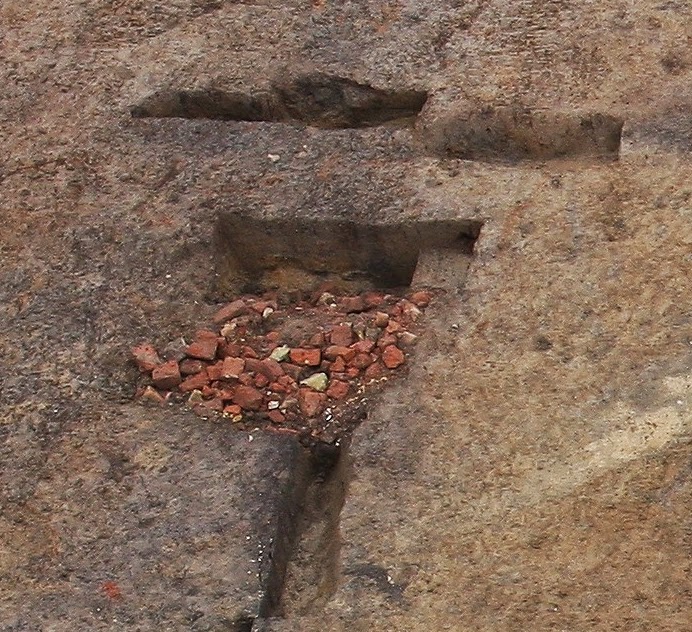
a close up of those mysterious fire reddened stones.

We would love to hear your ideas about burnt mounds, troughs, mash tuns and the possibilities of hot stone technology. This technique, of heating water and the mash with hot stones, is so successful that it has been done from the Neolithic to Viking times. Some burnt mounds provide dates that indicate this.

Monday, 19 May 2014

desperately seeking sugars

A few years ago, we were standing beside the trench of an excavation on Orkney. Lots of serious digging was going on. One of the diggers looked up, recognised us and said something like...

oh hello! Are you those brewing people?

Yes, that's us. 

Can you tell me how to make Heather Ale?

Of course, we replied. No problem.

Because we've got loads of heather growing around our house and we want to make some beer with it! 

But you can't make beer from flowers, we replied. Flowers provide the flavouring, the preservative ... you have to add sugar. That's what ferments into alcohol. 

beer made from flowers?
We began to think that, maybe, when some archaeologists had come across our work on prehistoric brewing and heard about our ancient style meadowsweet ale, they thought that we had made it from meadowsweet flowers. We had not considered that before. Later that month, our suspicions were confirmed when we did a prehistoric brewing demonstration at a neolithic feast, organised by the Orkney Archaeology Society. I think it was in 2008. Over an open fire, with just the hot ashes, we heated some water in an earthenware bowl. It was our mini mash tun.

When the water was clear enough for us to see our reflection, we knew it was the right temperature.We added the crushed malt. This is known as 'the strike'. The local hens came running when we got the malt sack out of the van. Soon, there was the sweet aroma of the saccharification, this is when the enzymes re-activate in the mash tun and turn grain starch into malt sugar. It smells delicious. Folk began to wander over to find out what was going on. Some of them tasted the mash.

We were asked how much sugar we had added. None, said Graham. All the sugars come from the malted barley in the mash tun. No, go on, there must be some added sugar in there! No, we assured them, there was no added sugar. Later a couple of ladies asked how many flowers we had used to make our ancient brew. The answer was about an ounce and a half for five gallons of ale. They walked away, shaking their heads in disbelief. I am quite sure that they had confused what we were doing with making a flower wine.

Check out the recipes for "country wines" online - they all have a couple of pounds of sugar per gallon in the list of ingredients.

Quite simply, it is not possible to make ale or beer from flowers.

beer made from birch sap? 
Birch sap contains very few sugars, less than one per cent. It is more like a sweet water. You could collect a lot of it, then boil it to make a syrup but it is hardly a practical way of obtaining sugars for fermentation. John Wright, writing in the Guardian, explains how to make birch sap wine. The ingredients include 1.8 kilos of sugar and grape juice concentrate.

beer made from bread?
Some archaeological and anthropological sources suggest that beer and ale were made from bread in ancient times. There is a common myth that beer was discovered when a loaf of bread fell into a bucket of water and fermented overnight.

If it was really possible to make beer from bread in ancient times, then why aren't we doing it now? Surely people would be queuing up to buy loaves of bread so that they could throw them into a bucket of water to ferment for a few days. Home brewed Egyptian beer. It might taste horrible. It might be a bit weak and sour. But that's what it was like in the past. Wasn't it?

Sorry to disappoint you, but it is not possible to make beer from bread. The biochemistry does not allow it. There are no sugars in bread to ferment into alcohol. However, a quick search on the internet shows how the idea that bread can be somehow transformed into beer still prevails. There are lots of different methods suggested. Here is just one example:

" Barley was used to make beer. The barley was combined with yeast and made into a dough which was part-baked in a stone oven. It was then crumbled into a large vat, mixed with water and allowed to ferment before being flavoured with dates or honey. Recent evidence suggests that barley malt may also have been used in the process."  www.historyonthenet.com

If you crush the barley into flour, then make a bread you have destroyed the fabric of the grain. There is no possibility of germination, no possibility of starches being turned into sugars. No beer or ale. Baking in a hot oven alone would be enough to destroy any enzymes. It would also destroy the yeast. This method would not work.

The recent evidence, referred to above, is that of Delwen Samuel. Analysis of residues on 3000 year old ancient Egyptian pottery showed erosion pits from the enzymatic action in the the individual starch granules. This proved that the grain had begun germination - it was malt.

Delwen Samuel's papers are available online. In 1997 she published 'Fermentation Technology 3000 years ago. The Archaeology of Ancient Egyptian beer'. The scanning electron microscope images of pitted starch granules can be seen there.

beer is made from malt
To make ale or beer, you need malt. This is grain - barley, wheat, oats or rye - that has begun to germinate. Germination stimulates the production of the starch converting enzymes. Making malt is a specialised craft in itself. There is far more to it than soaking grain in a bucket, then letting it sprout. The two crafts of maltster and brewer are separate today. The maltster supplies the brewer with malted grain.

mashing 
The brewer heats the crushed malt with hot water in the mash tun to make malt sugars. Sugars ferment into alcohol. It's a simple but very obvious thing. Over the years, we have given demonstrations of what happens in the mash tun, of how the crushed malted grain is heated up gently, to make malt sugars. This is known as the mash, or saccharification - the enzymes in the malt are active at about 65 to 67 degrees Centigrade, so this is the temperature to aim at in your mash tun. 

The mash tun can be an earthenware bowl, heated in the ashes of a fire. We have done this many times, the image below is from a demonstration at Eindhoven Museum. I went there in 2009, as part of a brewing forum organised by EXARC.

a mashing demonstration at Eindhoven,

Or the mash tun can be a wooden trough in the ground, heated by hot rocks. We have done this several times. The pioneers of the technique are the Moore Group archaeologists. The video of their hot rock mash in a wooden trough, first done in 2007, is now legendary.

Given that thermometers are a recent invention, brewers in the past learned how to judge this temperature by skill and experience. John Tyndall, giving a lecture on Fermentation at the Glasgow Science Lectures Association, October 19th, 1876 said

"Our prehistoric fathers may have been savages, but they were clever and observant ones ... the art and practice of the brewer are founded on empirical observation ... the brewer learnt from long experience the conditions not the reasons for success" 

In the scholarly literature and in many of the archaeological and anthropological academic papers about making beer in ancient times, a wide range of beer making ingredients have been suggested - barley, wheat, dates, figs, fruit, berries, birch sap or birch syrup, honey or flowers and leaves.

All that any brewer needs to make ale or beer is water, malt, herbs and/or hops and yeast.

Wort is the sweet liquid that comes from the mash tun after sparging. The exotic ingredients of the scholarly papers can enhance the ale in several ways, by preserving, flavouring or by providing medicinal or other properties. But they do not provide the primary fermentable sugars. This comes from the grain, which has been malted, mashed, lautered and sparged. Barley is a reliable source of sugars for fermentation. You just need to know how to make it.

There is no need to go desperately seeking sugars.

Just understand the malt, the mash and the saccharification that occurs in the mash tun.


further reading
The Big Book of Brewing by David Line
In our opinion, this is the best book to read on the processes of malting, mashing, lautering, sparging and fermentation.

------------------------------------------------------------

two years later 
I went to a talk recently, it was about the neolithic, grooved ware and the use of pottery. My impression, after talking to several archaeologists, is that it still seems to be a widely held belief among archaeologists that 'alcohol production' in prehistory was no more than guesswork. It involved mixing up random stuff to make 'something alcoholic that did not taste very nice'. No skill involved.


Tuesday, 13 May 2014

controversy in a grooved ware bucket

 The Larger Vertical Stone
Balfarg: an ancient site on a housing estate
The focus of my research changed suddenly, from the British Bronze Age to the Neolithic, one day in the summer of 1997. I was reading an excavation report about the prehistoric ceremonial site in Scotland, known as Balfarg. It was a large and complex place. As well as a neolithic henge and stone circle, which was preceded by a timber circle, there were the remains of mysterious rectangular timber built structures. There was also a ring cairn and a ring ditch. Lots of prehistoric pottery was found, ranging from neolithic bowls and large grooved ware bucket shaped pots to bronze age beakers, tripartite food vessels and bucket urns.

Pits contained what the excavators interpreted as "ritually charged" material. These so called "ritual pits" contained large quantities of broken and burnt pottery, mixed up with charcoal and burnt bone. Apparently, these things were deposited deliberately. In other pits there was no pottery, just charcoal, and the pit had been carefully sealed with closely packed stones.

Residues were noticed on a few sherds of neolithic grooved ware that had been buried in one of these pits. Analysis of these cereal based residues with meadowsweet pollen are similar to those found on Bronze Age pots, specifically, the Strathallan Food Vessel and the Ashgrove Beaker, which have both been interpreted as possibly being the remains of ale.

Were they making malt and ale in neolithic Britain? It seemed so to me. The Neolithic Revolution began in the British Isles around 4000 BC. Did it take people almost 2000 years, until the Bronze Age, before they realised or discovered that it was possible to make malt and ale with the barley and wheat that they were so keen to grow? Was the Neolithic really a time of growing grain to make flour, bread, porridge and gruel? Or were they making sandwiches for the feasts, as Professor Mike Parker Pearson seems to be suggesting. Or maybe he is just making a joke?

a few words about brewing residues
When making ale from crushed malted grain, two types of sludgy cereal based residues are generated during the brewing process. The first is a sludge, rich in barley chaff from the sparging process. Freshly sparged wort is cloudy at first. 

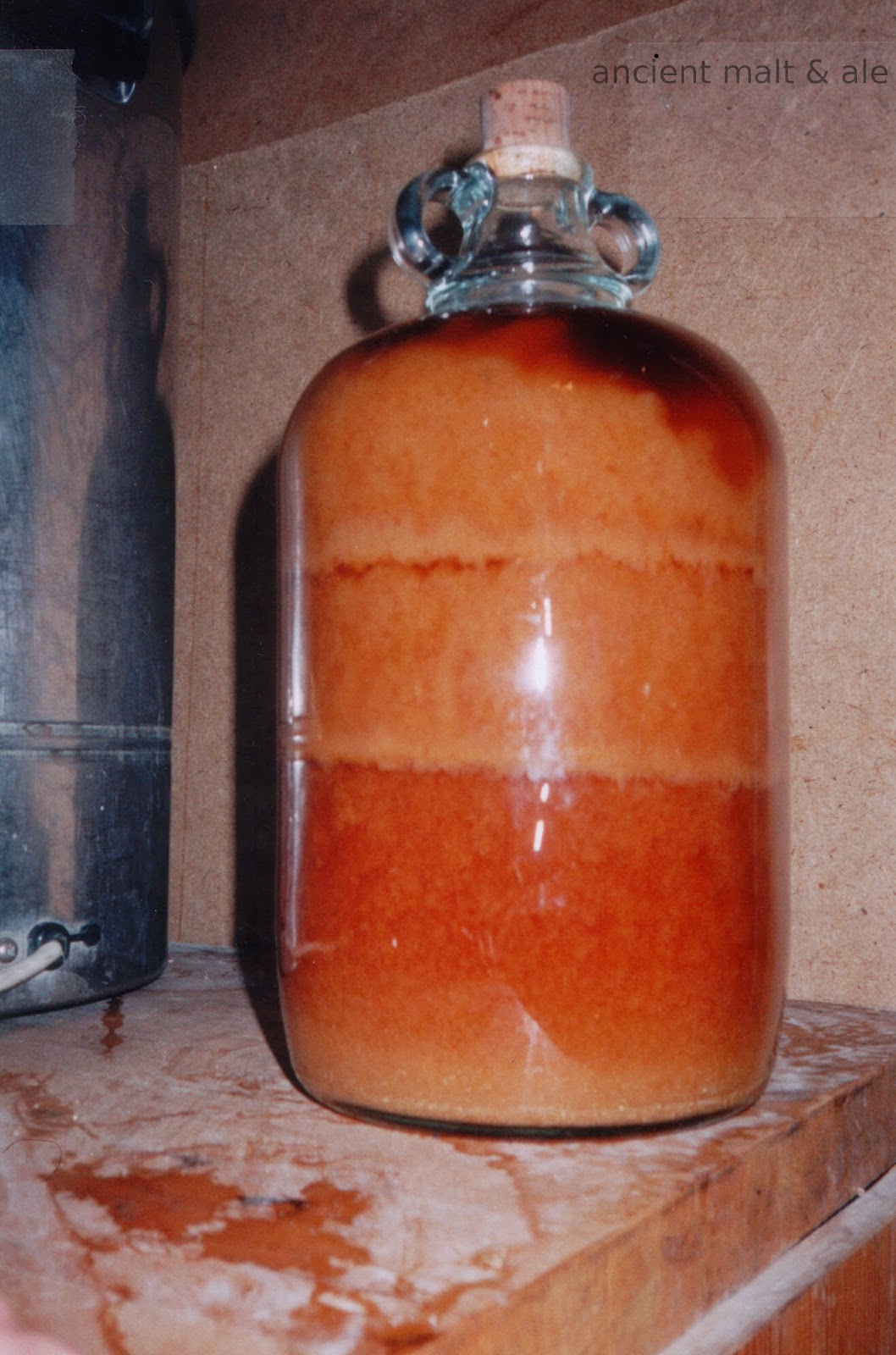
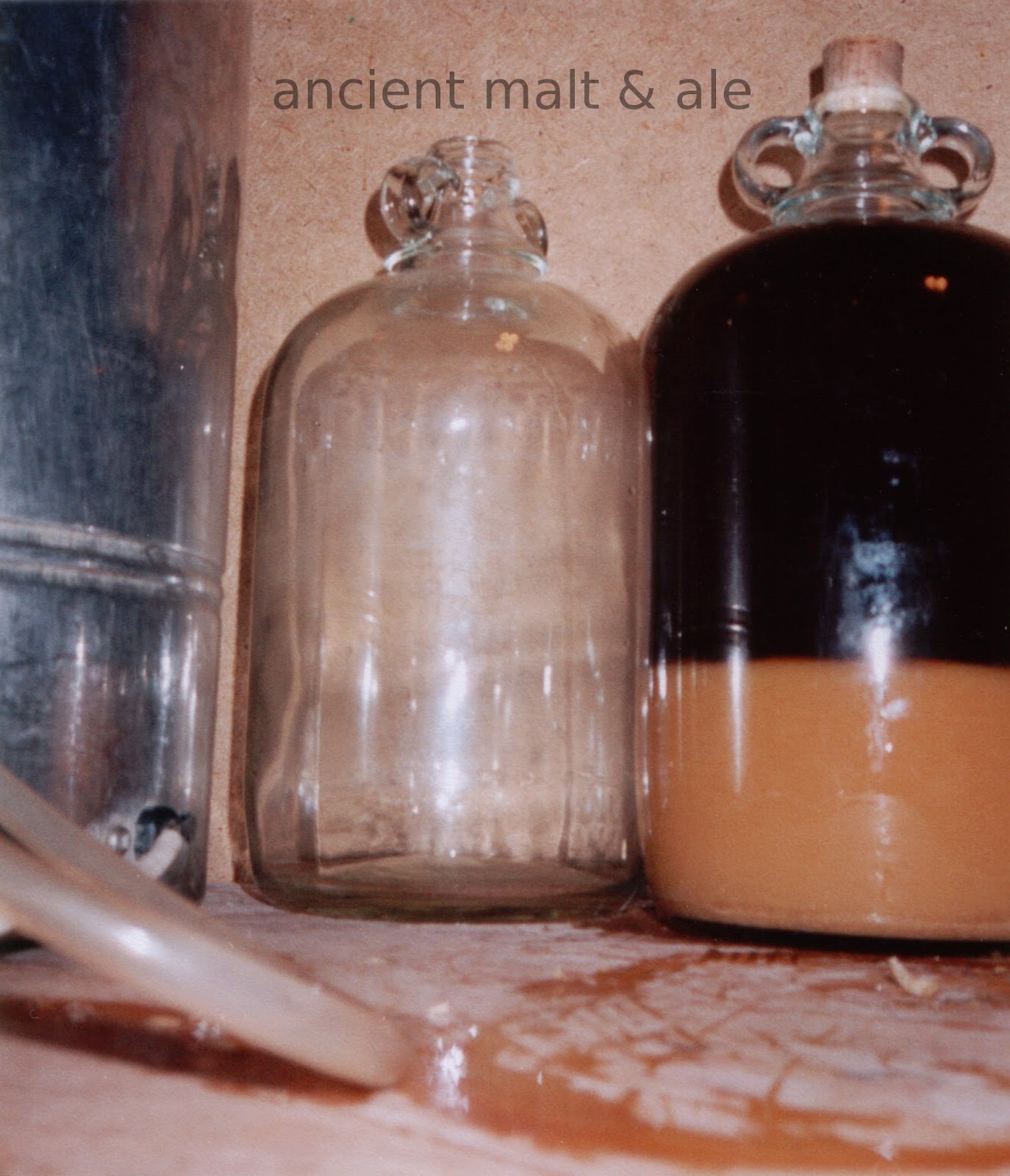
freshly sparged wort - settling out
the same wort, settled out with sludgy cereal residues accumulated
Once you have a clear wort, it is racked or syphoned off into a fresh clean vessel. Some chaff will inevitably get through. Boil the wort with selected herbs, flowers or hops and then ferment it. You can use the barm from previous brews to start a fermentation, it is ideal. A simple process, once you know how to do it.

The second type of brewing residue is cereal based, but with traces of yeast and herbs, hops, flower heads, leaves, twigs or pollen that settle out during the fermentation of the wort in the fermenting vessel. If you are lucky enough to drink a bottle of traditionally made real ale, the kind that must be poured in one go so as not to disturb the sediment, then you will know roughly what I mean. 

cereal based residues on grooved ware buckets
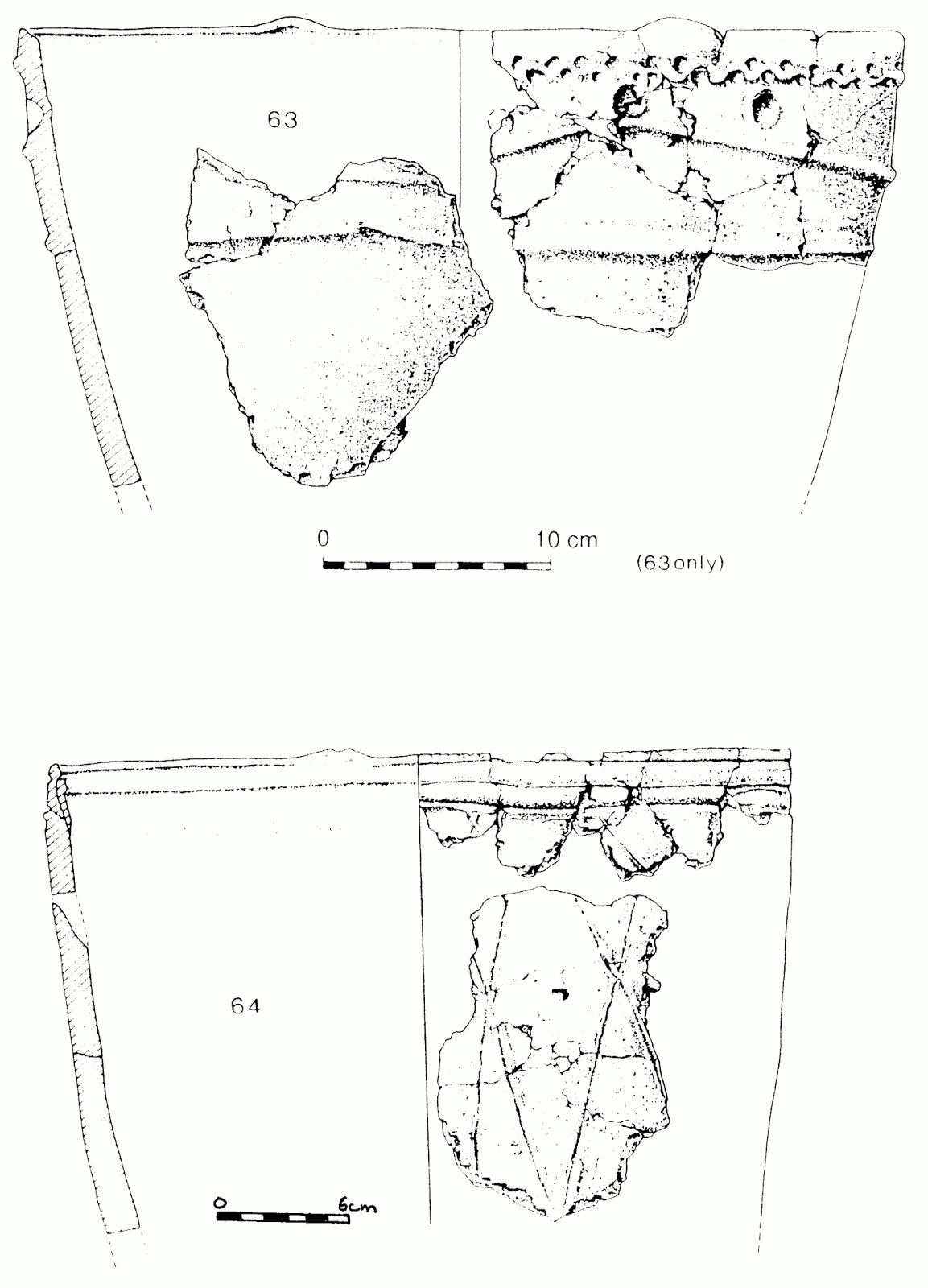
Let's go back to the Balfarg excavation report. The pots in question were numbers 63 and 64. Sherds from these two large grooved ware bucket shaped pots were found in a pit, close by one of the rectangular timber structures. Brian Moffat's descriptions of the cereal based residues make interesting reading for any all-grain brewer or archaeologist. I recognised immediately what these residues represented when I read them, way back on that summer's day in 1997. Not a sort of porridge with added herbs. Not a kind of gruel. These cereal based residues were probably the remains of brewing sediments from the fermentation bucket.

I was so excited by this! Ale in the Neolithic! I ran round to my best friend's house, just round the corner from where I lived, and told her all about it. She is a biochemist and was just as excited as I was. I told my supervisor the next day. He did not seem impressed at the prospect of malt and ale in neolithic Scotland. The previous year I had a short article published in British Archaeology, so I contacted the editor. He asked me to send him some details so that he could include it in the News section, September 1997. The Getafix and magic potions reference was not my idea! I do like it, though.

the original descriptions of the residues on pots 63 & 64

pots 63 & 64 from Balfarg (PSAS Vol 123)
Three broad, yet distinct types of burned cereal based residues were identified on the inside surface of sherds:
1. amorphous & burned
2. amorphous, granular & burned 
these two types were abundant in all samples.

3. burned cereal mash
both barley & oats, part grains, there was no entire carbonized grain since the grain had been thoroughly ground down, making taxonomic identification difficult.

"... a cereal based preparation ... with meadowsweet, indicated by both pollen & macroplant remains, clumps in one sample indicate a flowerhead was added ... fat hen ... cabbage/mustard? ... the single record of nightshade is puzzling ... pollen from hemlock ... the mix is coarse and crude ... like course porridge with potherbs and flavourings"

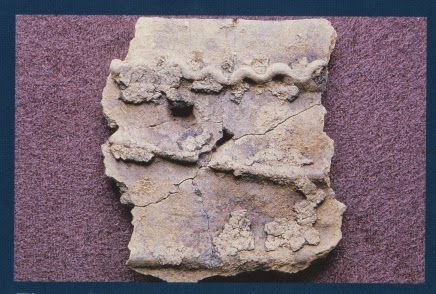
Another burned deposit was encrusted on the outer surface of one sherd of Pot P63. Both pollen and seeds of black henbane were identified.  
"... the seeds are robust and resilient and the breaks show mechanical rendering ... pollen and seed fragments were fairly well intermixed suggesting an incomplete process of homogenization ... the small cache of seeds is of black henbane alone."

Two separate organic residue deposits. One inside the pots, this one was cereal based with several different herbs added. The other residue was a burnt encrustation on the outside surface which, when first analysed, contained henbane pollen and several henbane seeds.
burnt encrustation on the outside of Pot 63 that contained henbane pollen and seeds

The above photo is from the booklet "Balfarg. The Prehistoric Ceremonial Complex" published by Fife Council, Glenrothes Development Corporation and Historic Scotland, 1993. I think it was intended as a guidebook for the site and is now out of print. There may be secondhand copies available. The original archaeobotanical report of the Balfarg residues is on pages 108-110 in Proceedings of the Society of Antiquaries of Scotland, Vol 123.

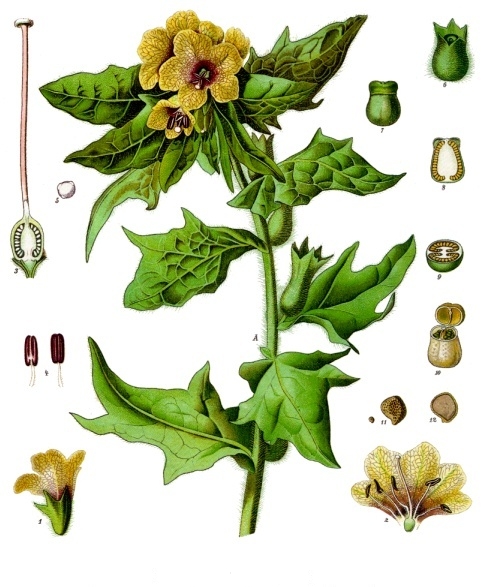
Henbane (hyoscyamus niger)
According to Culpepper, henbane should never be taken internally. More modern herbal reference books warn that it is a deadly poisonous plant. Do not use. This is very good advice. However, henbane does have its' place as a herbal remedy that was sometimes used in historical times, for example, to alleviate earache if applied externally, as a tincture. If consumed in small quantities, henbane induces intoxication, hallucinations, blurred vision, rapid heartbeat, euphoria and dizziness.

It is an effective painkiller, according to the herbal literature. All parts of the plant can be used and the seeds are about ten times more potent than the leaves or flowers. I am sure that, in the Neolithic, people knew about the medicinal and other properties of the henbane plant. It grows well in coastal regions and henbane seeds were identified at Skara Brae, a neolithic village in Orkney, Scotland. An intriguing aspect of the plant is that the active ingredients, the alkaloids, are more soluble in alcohol than in water.

henbane (hyoscyamus niger)

so what's the controversy?
This appeared to be not about the cereal based residues, but rather about the unusual identification of henbane seeds in the burnt encrustation on the outside surface of a neolithic pot sherd. It seems that, at first, there was not a problem. The excavation report, with its' rather interesting archaeobotanical report, sat quietly in the library journal section for a few years. It did not make any trouble. As more things were written about it, and as more archaeologists made reference to the possible "ritually charged" aspects of this rare residue discovery, it seemed that a re-analysis was required. This was commissioned by Historic Scotland. Two academic papers were rapidly produced.

The first was published in January 1999 in the Journal of Archaeological Science. This is a pay to view paper, with access available through University Libraries. Although the existence of henbane seeds within the residue was not confirmed, the residue was described as "a uniform and well processed substance, possibly something like a thick carbohydrate or protein based gruel". This description is consistent with the sludgy residues that accumulate at the bottom of an ale fermentation vessel - a well processed homogeneous mixture of cereal chaff, pollen, plant fragments and seeds.

The second paper was published in March, 2000 in Antiquity. This one, happily, is accessible online and is essentially a summary of the first paper. The focus is on disproving the "henbane ale" theory. The abstract makes this clear: "Were drugs in use in prehistory? Recent claims for the use of hallucinogenic substances have been made, and caused a stir. However, new work on a Scottish Neolithic ceremonial site suggests archaeologists (and the media) may have been jumping to the wrong conclusions!"

Whether or not henbane was added to the ale is clearly debatable. If such plants were being added to the brew, then it infers an understanding of their properties and some interesting ritual practices in prehistory. It might infer shamanistic practices, witchcraft, medicinal use of plants and more. A paper has been published recently in the Journal of Archaeological Method and Theory by Elisa Guerra-Doce of the Universidad de Valladolid in Spain. She argues that "far from being consumed for hedonistic purposes, drug plants and alcoholic drinks had a sacred role among prehistoric societies. It is not surprising that most of the evidence derives from both elite burials and restricted ceremonial sites, suggesting the possibility that the consumption of mind-altering products was socially controlled in prehistoric Europe."

My interest is in the cereal based residues on these ancient grooved ware pots and what they tell us about cereal processing techniques in the Neolithic. Flour, bread, porridge, gruel or was it malt and ale? What were they drinking at feasts? Was it sacred river water, or was it sacred ale? When searching for an image of grooved ware pottery online I found this comment on that well known online Encyclopedia - Wikipedia:

"Grooved ware comes in many sizes, some vessels are extremely large, about 30 gallons, and would be suitable for fermentation. The majority are smaller, ranging from jug to cup size, and could be used for serving and drinking. The theory that the first British farmers (c4000 BC) had the knowledge and ability to make ale from their crops with their pottery appears to be controversial and not yet widely discussed by the archaeological community."

There have been some amazing recent archaeological excavations and discoveries of ancient ceremonial and feasting sites, for example the Ness of Brodgar on Orkney and Durrington Walls, near Stonehenge in England, which was investigated by the Stonehenge Riverside Project. There is also evidence for beer brewing and feasting at Gobekli Tepe in Turkey, at the dawn of agriculture, some twelve thousand years ago.

It is surely time for the academic community to start talking seriously about how grain was being processed in prehistory. What were they were using it for? The options seem to be flour, bread, porridge, gruel or malt and ale, with added herbs.

----------------------------------------------------------------------------------------------------------------------

Balfarg Excavations
Balfarg was excavated before the construction of a housing estate. As a result, plans were altered to preserve the stones and build the houses around them. The excavation reports are online, thanks to the Archaeology Data Service, York University, so you can read it for yourself from the comfort of your own desk or armchair: Barclay, G J & Russell-White, C J (eds) 1993 'Excavations in the ceremonial complex at Balfarg/Balbirnie, Glenrothes, Fife' Proceedings of the Society of Antiquaries of Scotland Vol 123, 43-210.

Balfarg had been excavated earlier, in the 1970s. During those excavations a cist burial was found, containing the bones of an adult together with a dagger and a fine beaker with a handle - a rare find indeed. This excavation, by Roger Mercer, was published in 1981: The excavation of a late neolithic henge-type enclosure at Balfarg, Markinch, Fife, Scotland 1977-1978. Proceedings of the Society of the Antiquaries of Scotland Vol 111, 63-171.


Saturday, 26 April 2014

Beakers were for Beer! part three: alewives and barmaids

In the early years of my research, I visited a few microbreweries. I wanted to talk to professional brewers who made ale in the traditional way using crushed malt, not malt extract, and who worked on a small scale. This approach to brewing beer in small batches, supplying local pubs, hotels and restaurants, began to take off in the 1980s and 1990s. The interest in real ale in Britain began with CAMRA in 1971. Peter Brown does a good job in telling the story of the rise of craft beer UK style. Worth reading. Anyway, to get back to my story, one of the microbreweries I visited was a tiny establishment, equipped with one mash tun, one boiler and two fermenters. He used crushed malted barley, hops, water and yeast and made a wide variety of beers from these basic ingredients. As any good brewer does.

He was interested in the story of the Bronze Age woman buried in a stone cist at North Mains, Strathallan. She had been buried with a Food Vessel. The residue from a cereal based alcoholic brew, flavoured with meadowsweet, was discovered within it (see part one). We chatted about it in detail, and with some excitement, because I had only just found out about the residue analysis in the Strathallan pot myself. That evening, he went down to the pub and related the story to his mates. And why not? It's a good story. One of his mates was a journalist for the local paper. A couple of days later there was a headline "Bronze Age Barmaid" or "Prehistoric Barmaid discovered" or something along those lines. And my name was attached to it, almost as if I had discovered it. Many of the details were wrong. It was only a small piece in a local newspaper, but it seemed like sensational stuff at the time. Some folk at the University were not very pleased about it.

I had just had my first encounter with The Press, and with some of the silliness that seems to surround any news story about ancient alcoholic brews - beer, wine or mead. 

alewives and cup bearers 
Maybe that journalist was thinking along the right lines, although 'barmaid' is not quite the right word to use in a prehistoric context. There is a well established tradition of women as cup bearers, providing the drink at feasts.

Eva Koch, writing in 1986, gives several archaeological and historical examples of the woman as hostess, who would have held a high status position within society. In her article the woman with the drink she describes the grave at Juellinge of a woman, in her 30s, who was buried wearing her silver jewellery and hair ornaments. In the grave with her was some meat, either a whole sheep or pieces of pork and beef - archaeological sources vary. The bronze bucket had contained a drink brewed with barley and cranberries or crowberries and bog myrtle. There were drinking horns and glasses for her guests. The grave was excavated in 1909. 

A recent detailed analysis of these residues has led to the novel idea that the Juellinge vessel had contained 'nordic grog'. The media loved this story. There are variations of it all over the internet, but journalists don't always get all the details right. I don't agree with the concept of a 'nordic grog'. I think it is far more likely that the bucket contained an ale, or perhaps you could call it a barley wine, made from wort and flavoured with a few berries, flowers, herbs and maybe some honey. All the sugars that you need for fermentation can be obtained from the mash tun, as I explained in earlier posts.

There are many similarities between the Juellinge grave and the burial of the young woman, described by some as a dancing woman or priestess, at Egtved.
Egtved Girl tomb from bronze age- Denmark
reconstruction of the oak log coffin of the Egtved Girl. Bronze Age. 1370BC

She was buried wearing bronze jewellery and the bucket at her feet contained the remains of an ale or beer, flavoured with berries and perhaps honey. The bucket was made of birch bark and is too big for a drinking vessel. It is more suitable for serving or perhaps it was one of the vessels used in making the ale. One interpretation is that she was buried with ale for the journey into the afterlife, which is certainly possible. I can't help wondering whether she was buried with the tools of her trade - her brewing bucket.

And so we move on to Bronze Age Scotland and the cist grave excavated in 1979 - the one that the brewer was so interested in. The Bronze Age barmaid herself, buried with her Food Vessel. Could she have been a cup bearer, at feasts and ceremonies, perhaps? Maybe she was an alewife. Some might see her as a priestess or as one of the elite, a high status and important member of society. There are several possible interpretations of who this Bronze Age woman was and what her role in society could have been.

http://i.rcahms.gov.uk/canmore/l/SC00845100.jpg
female cist burial excavated in 1979 at Strathallan, North Mains, SC845100. (copyright Historic Scotland)
The specialist secrets, skills and knowledge of how to transform harvested grain into ale by malting, mashing, lautering, sparging and fermentation were as important then as they are now. Without them, there would be no ale or beer for the feast.

I'm sure that the tradition of the alewife, or brewster, goes right back to prehistoric times, to the earliest grain cultivators and processors, the neolithic folk. There are many different herbs and plants that have been used to flavour, preserve or enhance ale. Known today as gruit, some herbs have medicinal or hallucinogenic properties. Henbane pollen was identified in cereal based residues on sherds from large bucket shaped neolithic pottery known as Grooved Ware at a site called Balfarg in Scotland. More on this in the next post. This discovery extends the potential role of the alewife to that of a healer, maybe even more than that. Here's a link to a blog about the 'brewster as witch' by Jane Peyton, a sommelier and beer expert. Her article is a bit of an advert for a Ninkasi style women's brewing competition that took place in 2011. So, sadly, too late for me to make a brew for that. But she makes some interesting points.

I shall return to the 'magic of brewing' in a later post. It's a huge topic.

beakers, food vessels and tripartite urns - some brief notes
Welcome to the wonderful world of prehistoric pottery! It can be quite bewildering. Confusing to non archaeologists, at the very least. I have discovered this after many years of explaining (or trying to explain) prehistoric pottery classifications to tourists.

In a British Bronze Age context, there are beakers, collared urns, tripartite food vessels and funerary urns. Simply explained - beakers were drinking vessels. Food Vessels, otherwise known as tripartite food vessels, appear to have had no specific function, other than for 'food preparation'. This is how they are described in the archaeological literature.

Sometimes they are found in stone cists and they contained the cremated bone. Collared urns are larger vessels, also often found with cremated bone in burials. This is a blog. It is not an academic thesis. So I must apologise to all archaeological pottery specialists for the simplicity of these descriptions.

a few recent rather exciting discoveries of tripartite food vessels
In March 2012, the land owner of a disused quarry on the island of Arran, off the west coast of Scotland, noticed something interesting in the cliff face. It turned out to be not one, but two Bronze Age stone burial cists. One cist was empty and the other contained the remains of an adult human cremation in a tripartite food vessel and a flint knife.

A photo of a circular, sand-coloured Bronze Age pot against a black background
the food vessel
A photo of a large yellow digger on wheels carrying out work on a steep cliff face
an unusual excavation technique at Sannox Cliff, Arran


A radiocarbon date of 2154 - 2026 BC was obtained. The flint knife, when analysed, had traces of silica, indicating that it had been used to cut grasses or cereals. This is intriguing. Was this the cist grave of someone, probably a woman, whose work involved the gathering and the processing of wheat or barley? I think so. It's not the sort of thing that is found every day. Excavation techniques involved the use of a cherry picker. A news report with some great photos, is here. The excavation was undertaken by GUARD Archaeology, Glasgow and is available here.

In September 2011, in Spinningdale, by the Dornoch Firth in Sutherland, northern Scotland, the accidental discovery of a very well preserved Bronze Age female cist burial, with food vessel, occurred when someone was digging the hole for their new septic tank. Once again, it was excavated by the team at GUARD. Radiocarbon dates from the bone were 2051 -1911 BC and from the charcoal within the grave, dates of 2151-2018 BC were obtained. Inside the cist was female skeleton with a tripartite food vessel at her head.
She was between 35 and 50 years old and had been laid upon a sheepskin, or maybe she wore woollen clothing. It is not quite clear, but unusually, fragments of the wool had survived in the well sealed cist. The excavators thought she may have been an important woman, having been buried with such great care and attention. More details here.

The cist grave of another high status, important and wealthy Bronze Age woman was recently excavated near Windsor, England. Excavations at the Kingsmead Quarry, undertaken by Wessex Archaeology, were presented to the public in 2013. They have put a lot of their information online. It is a large, complex site that includes mesolithic, neolithic, bronze age, iron age, Romano British and medieval elements. The excavations were generously funded by CEMEX. The archaeologists have been digging up lots of really exciting stuff at Horton and you can read all about it on their web site.

Of particular interest is the female burial, dated to between 2500 and 2200 BC. She was at least 35 years old, according to bone evidence. She was buried wearing her necklace of gold, amber and black lignite beads. She may also have had a bracelet, since there were black lignite beads near her wrist. Some perforated amber beads or buttons indicate that she may have worn woolen clothing, with these valuable fasteners. By her side was a large drinking vessel, beaker style. Was this a serving vessel, rather than her personal beaker? It must be considered a possibility. It would be fantastic if a residue analysis could be done of the vessel fabric. I'm not sure, but I don't think this has yet been done.

We cannot be completely sure of her full role within society, whether she was a princess, queen, alewife or cup bearer. It is clear that she was a woman of some importance. More details about her here.

In the words of the site director, Gareth Chaffey, who has been excavating the site for seven years, " It is interesting to think who this woman was within her community. She was probably an important person in her society, perhaps holding some standing which gave her access to prestigious, rare and exotic items. She could have been a leader, a person with power and authority or possibly part of an elite family - perhaps a princess or a queen."


I shall leave the mysterious high status women of the Bronze Age, for now. I'm sure you will come to your own conclusions about them.


Site Director Gareth Chaffey, of Wessex Archaeology, who has been excavating the site for the last seven years, said: “It is interesting to think who this woman was within her community. She was probably an important person in her society, perhaps holding some standing which gave her access to prestigious, rare and exotic items. She could have been a leader, a person with power and authority, or possibly part of an elite family - perhaps a princess or queen.” - See more at: http://www.wessexarch.co.uk/blogs/news/2013/04/19/beaker-burial#sthash.uX7GzXBU.dpuf

Sunday, 13 April 2014

Beakers were for Beer! part two: a birch bark bucket with residues

The image below might not, at first, seem to have anything to do with prehistoric ale. Or beer even. This is the oak log coffin of the young Bronze Age woman known as the Egtved Girl. She died about 3300 years ago. Her oak coffin was found by a farmer, Peter Platz, within a large grassy burial mound in southern Jutland, Denmark. He called in the archaeologists from the local museum who excavated it in 1921. Recent dendrochronological dating of the oak log coffin reveals that the tree was felled in 1370 BC. The North European Bronze Age is a fascinating place to go and visit online to understand some of the background to the Egtved Girl's world. There is a lot of information out there - for example, this atmospheric short film. And lots of pictures of the things that they made and wore and used - the bronze figurines, the sun chariot, the drinking vessels, the well preserved clothing and even a wooden folding seat.

 Egtved Girl tomb from bronze age- Denmark

What the archaeologists discovered within the Egtved Girl's oak coffin was quite astonishing ... there was no skeleton, just a few fingernails and some of her teeth, brains and hair remained. Her bones had been destroyed by the acidic conditions. But the clothes and the grave goods of the young woman had survived the millennia virtually intact. She had been buried wearing a woven woolen tunic top, a corded wool skirt and a woven belt with a bronze spiked disc. Bronze bracelets adorned her arms. Most people agree that she was a dancer, maybe even a priestess, and that she was buried in her dancing clothes. A small bronze figurine, doing a back flip and wearing a skirt like that of the Egtved Girl, was found at Grevensvaenge, Zealand, Denmark. It was part of a small Bronze Age hoard that was first reported in 1779. Over the years, several of the figurines have been lost but the little bronze acrobatic dancer is now in the National Museum of Denmark.
a reconstruction of the Egtved Girl's clothes: details here
Now the oak coffin, the clothes and grave goods have been reconstructed and there is a wonderful display in the National Museum of Denmark. She is visited by thousands of people. There is so much on the internet about the Egtved Girl that it is easy to find out about her. She even has a few Facebook friends ...

I first came across reports of the Egtved Girl through reading the bibliography of Eva Koch's article Prehistoric Plant Food of Denmark, published in 1999. Archaeology can be a bit like a detective story. In the days before the internet was everywhere, the bibliography at the end of an academic paper was probably the only lead you had to find the next piece of information. What interested me about this young woman's grave was the discovery and subsequent analysis of cereal based organic residues in a birch bark bucket that had been placed in the log coffin.

residues in a birch bark bucket
The reconstruction at the National Museum shows how she was laid upon a cow skin. A bundle of cloth, at her feet, contains the burnt bones of a small child, aged 5 or 6 years old. Also at her feet was a bucket made of birch bark. Someone noticed that there was a thick, dark brown residue at the bottom of the bucket. It was analysed in 1929 by Bille Gram. For all you fellow bibliography hunters, this is the reference for the original archaeobotanical report ... over the years I have tried, and failed, to get hold of a copy. In either Danish or English. Maybe you can find it. If you do, please let me know!  
Th. Thomsen (1929): Egekistefundet fra Egtved. Nordiske Fortidsminder Andet Bind. København. (In this book, her drink is mentioned by Bille Gram on page 184 note 2, apparently)
http://media-cache-ec0.pinimg.com/736x/07/0f/29/070f293b5ec3a4e638f9cbacfd535151.jpg
the birch bark bucket 


I don't know how the analysis of the residue was undertaken. I would imagine that it involved a microscope and not a lot else, given that it was done in 1929. The bucket had contained an alcoholic drink - it was probably ale - made from wheat, cowberries or possibly cranberries, bog myrtle, some other plants and perhaps with added honey.

Descriptions of the residue analysis vary in the archaeological literature, which is why I would like to read the original archaeobotanical report. Some archaeologists mention the presence of clover pollen, others mention lime flower pollen. Mixed pollens often indicate the addition of honey. It has been suggested in some academic papers that the "beer" was made from the berries, but any all grain brewer knows that this is simply not possible. The primary source of fermentable sugars had to come from the grain - or rather, from grain that had been malted. It could have been either malted wheat or malted barley or a mixture of both.

Residue analysis provides you with a list of probable ingredients. It does not provide you with a recipe. Nor will it tell you the ratio of ingredients to each other, nor the quantities that are required. To make a similar brew from the list of ingredients you need a recipe. In other words, you need to know and understand the brewing process, the techniques and the methodology of how to make malt and ale.

making malt and ale
There seems to be some confusion amongst archaeologists and anthropologists about what malt is, how it is made and how the brewer uses it. Malt is sometimes described as 'toasted barley sprouts' or even as 'sprouted barley' - something like beansprouts. Neither of these is an accurate description. Malt is grain that has been steeped and aerated in water, then spread out on a smooth, level floor within a dark but well ventilated building to begin to germinate. When the acrospire (the root and shoot) is no more than one third the length of the grain, it is dried gently in a kiln. This is traditional floor malting and this process makes pale malt. Specialist malts are made by roasting at higher temperatures.

I have read descriptions of brewing in academic papers, explaining that malt is 'boiled with water' to make a 'malt solution'  but this would not work at all. The brewer mixes crushed pale malt with hot (not boiling) water to make a sweet wort. This process is called the 'mash' or 'saccharification'. If you boil the malt, then the enzymes that convert starch into sugars are destroyed and you will never make anything fermentable. Specialist dark malts, such as crystal or chocolate malt, are used for colour and flavour and do not provide any sugars in the mash tun.

I began to discuss these issues in an an earlier post and I will certainly go back to these fundamental aspects of making malt and ale in future posts. My last academic paper The Craft of the Maltster is about to be published as I write this blog post. I was given permission to put it online. The book of the conference will be out soon. Floor malting techniques have not changed over millennia.


the ingredients, according to residue analysis of the Egtved bucket
  • wheat - this was probably identified, under the microscope, by the presence of a part of a grain husk. Could it have been a bit of barley husk? This is possible. During the brewing process, specifically in the mash tun, the malted grain is mixed with hot water and the grains become broken up. As mentioned above, whether it was wheat, barley or a mixture of both, the grain had to have been malted. Malt provides the primary fermentable sugars for ale and beer.
  • cowberries - not the main source of fermentable sugars. These are very tart, sharp tasting berries. Probably used as an adjunct. Cowberries, also known as lingonberries were probably identified in the Egtved bucket residue analysis by the presence of seeds. It can be tricky to identify the specific berry type from the seed alone. 
  • bog myrtle - also known as myrica gale, this leafy shrub has been used for millennia as a 'brewer's herb'. It both preserves and flavours the ale and it was used before the introduction of hops in medieval times. Many other plants and herbs can be used in brewing ale. We have used meadowsweet and juniper berries in our ancient ales. Yarrow is another commonly used plant as an alternative to hops. These are known as gruit and these days you can buy a wide variety of these ancient and traditional ales in the shops, made by several different brewing companies. 
  • lime pollen, clover pollen - the presence of these in the bucket residue might indicate the addition of some honey to the ale. Again, it is an adjunct and not a primary source of sugars for fermentation. Alternatively, the pollen might indicate the addition of lime flowers and clover to the wort, for flavour and/or preservation.  

how we would make an 'Egtved Ale'- the basic techniques and recipe
We have been making ancient style ales for fifteen years now. Small batches, a few gallons at a time, in our home brewery. To recreate the ale that was in the Egtved bucket we would, first of all, get some malted grain. If possible, we would try to obtain some malted bere - an ancient strain of barley. The grain is skinny, much thinner than modern barley. We have used bere malt successfully to make an ale flavoured and preserved with a few dried meadowsweet flowers instead of hops.

our mash tun 


We would mash the crushed malt with hot water in the mash tun for about one hour. Grist is the brewer's term for crushed malt. Brewers refer to the water used for brewing as 'liquor'. It is not alcoholic. Then we would lauter, that is, collect the first runnings of sweet wort from the mash tun,  and then sparge. This involves running several gallons of hot water through the mash and collecting more wort. As far as quantities and ratios are concerned, we would use about 15 pounds of malted grain to make roughly 8 or 9 gallons of wort.

Cowberries could be added to the mash tun, or they could be added to the wort during the boil. It is difficult to know exactly how many to add, but when we made our Juniper Ale with berries, we used just a few ounces to twelve pounds of crushed malt. Having obtained the wort we would boil it, together with some sprigs of bog myrtle and/or lime flowers and clover flowers. Yeast would be added, most likely in the form of barm from a previous brew. Leave the ale to ferment for a few days, then rack it off into a fresh container and see what it tastes like.

strange brews
Over the last few years, there have been some rather strange re-creations of the alcoholic drink hinted at by the residues in the birch bark bucket found at Egtved. Not all of them are convincing. I watched a TV programme recently that showed the archaeologist Neil Oliver drinking an 'ancient style brew'. I think, but am not entirely sure, that it was supposed to be based upon the Egtved residues but, sadly, some of the basic ingredients had been altered. Apple juice was used instead of wort. The herbs, honey and berries were included. I don't think that apple juice would have been an option for those Bronze Age brewers 3300 years ago. Crabapples were the only available 'apple' and these are very sour. Even today, when people make a crabapple wine, they have to add a large quantity of sugar because the crabapples are not sweet enough to ferment by themselves. Crabapples also require a modern press to extract the juice. I cannot work out how the juice could have been pressed from crabapples in Bronze Age Denmark.

Another strange brew is Kvasir, made recently by the Dogfish Head Brewery in collaboration with Professor Pat McGovern, who is sometimes referred to as the Beer Archaeologist. For some reason, concentrated birch syrup was included in the Egtved inspired brew. I have no idea why, since this ingredient was not identified in the analysis of the residue from the birch bark bucket. Concentrated birch syrup is made using modern processing techniques. I think the word to remember here is 'inspired'. I don't think they were aiming to actually recreate an accurate copy of the 3300 year old ale, rather, they are making a modern Craft Beer, USA style, that pays homage to the Egtved Girl. I have found no mention of malt, mash tun or wort in the media coverage of this brew.

It is odd that she is referred to as a 'leather clad priestess' when she was actually wearing a tunic made from woven wool and a corded skirt. This is a very well known detail of the Egtved Girl's clothing. When she was first discovered, in 1921, some  archaeologists thought that there must have been a linen undergarment because the 'string skirt' was so revealing.

There are plans to make a commercial beer to a similar recipe in Sweden - Arketyp. This brew appears to have crushed pale malt as an ingredient, but it also includes concentrated birch syrup. Again, I don't understand the reason for this addition to the ale unless it is to make a kind of 'Nordic Grog'. Professor McGovern has proposed, in a recent academic paper, that this is what people made and drank throughout Europe in prehistory - some kind of mixed alcoholic drink made up of different components, such as birch syrup, wine and herbs. Although the biochemical analysis of four residues is incredibly detailed, there is nothing in the paper about malting, mashing, malt sugars or the brewing process.

For some of these strange and exotic brews, it seems as if the archaeologists who try to recreate them are struggling to find fermentable sugars, while neglecting the malt and the wort. Barley, and wheat, are an excellent source of sugars for fermentation  if processed in the right way. Maybe you have to be a brewer to understand these processes.

Egtvedpigens Bryg - made with malt, water, herbs and honey
I am very pleased to say that the National Museum of Denmark, working together with the Skands Brewery, have made an authentic ale based upon the ingredients identified in the bucket residue analysis. It should be available in the Museum Shop. If you are lucky enough to go and visit the Egtved Girl in Denmark, maybe you could try some. The details of this ale are, as yet, sparse on the internet. The launch party was on the 22nd of March 2014, so this really is the most recent and, for me, the most exciting development in the long story of the Egtved Girl and her bucket of ale.

I have found some Press Releases online, in Danish and translated into English. I expect that we will be hearing a lot more about it in the future.

The Egtved Girl's beer, made from a 3.300 year old recipe. In her coffin, a bark bucket was found. At the bottom lay a thick brown deposit. When the contents of the bucket were analysed it became clear that it had contained a fermented drink - probably beer sweetened with honey.  The newly reproduced beer is made from the same ingredients as was found in the coffin. Bronze age, beer, recipe, drinks, history, Denmark, prehistory.
launched recently, a modern commercial version of the Egtved Ale